


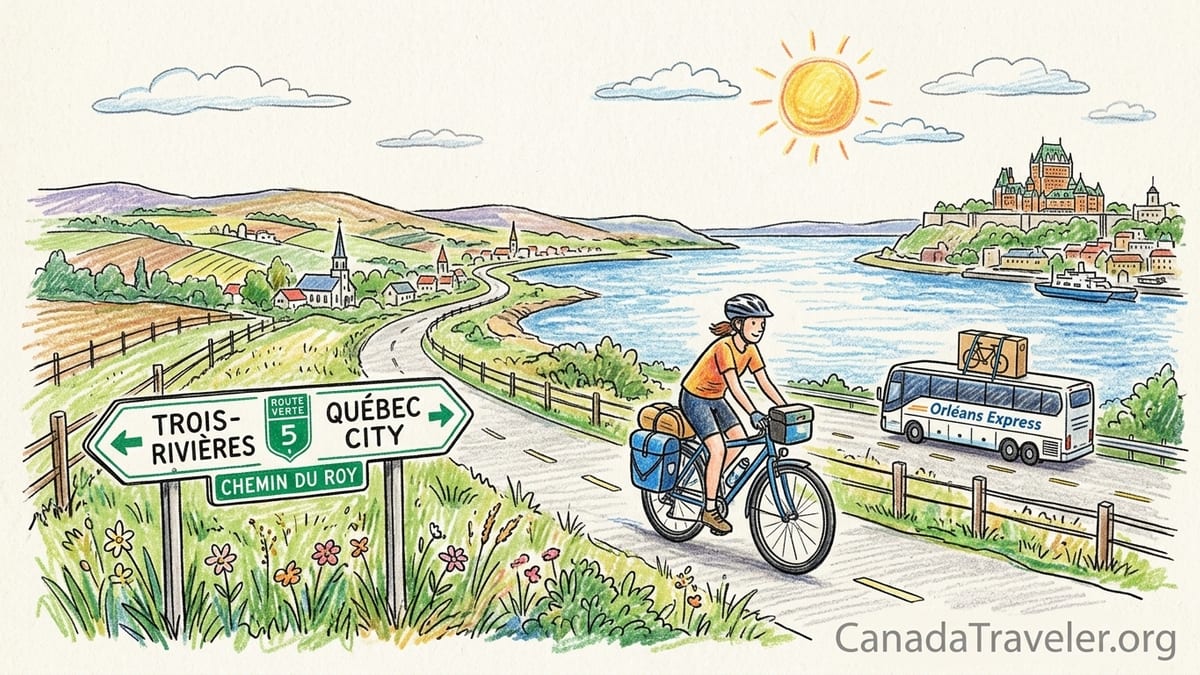
One July morning I rolled my loaded touring bike out of the bus station in Trois Rivières, clipped into my pedals, and pointed the front wheel toward Québec City. Four days and roughly 170 kilometers later, I coasted onto the promenade below the Château Frontenac with tired legs, chain‑greased calves, and a much clearer sense of what it actually feels like to ride a small piece of Québec’s 5,400‑kilometer Route Verte network. This is a story of that specific section only: Route Verte 5 between Trois Rivières and downtown Québec City, not a claim to know every kilometer of the province’s enormous cycling web.
The Exact Section I Rode and How I Got There
For this trip I chose a compact but varied stretch of Route Verte 5, also signed as Chemin du Roy along parts of the historic King’s Road. My route ran from central Trois Rivières to Old Québec, finishing near the ferry terminal below the walled upper town. My bike computer logged about 170 kilometers in total, spread over four riding days, with daily distances between 35 and 55 kilometers. That left time for café stops, detours into riverside villages, and a few necessary breaks when the headwind off the St. Lawrence River felt like pedaling into a hair dryer.
I reached Trois Rivières by bus, boarding an Orléans Express coach in Montréal with my bike boxed in a standard cardboard bike box. Orléans Express accepts bikes as checked baggage for an additional fee that was a little over 30 Canadian dollars once taxes were added, provided the bike is boxed or in a rigid case and space is available in the luggage hold. I removed the pedals, turned the handlebars, lowered the saddle, and padded the frame with my tent and sleeping mat before taping the box shut. On arrival in Trois Rivières, I reassembled the bike in a quiet corner of the station parking lot and rode less than ten minutes to pick up Route Verte 5 signs near the riverfront.
At the end of the ride, I exited Route Verte 5 on the Corridor du Littoral path, rolled into Québec City’s lower town, and spent a rest day in a Bienvenue cyclistes certified guesthouse in the old port district. To return to Montréal, I again used an Orléans Express bus, this time having a local bike shop pack my bike into a box they sourced from a recent sales delivery. The shop charged a modest service fee for the packing work, which felt like money well spent after four days of riding.
The bike itself was a steel touring bike with a triple crankset and 700c wheels, shod with 35 millimeter puncture resistant tires. I used a rear rack with two panniers and a small handlebar bag rather than bikepacking style soft bags. My total luggage, including camping gear I mostly did not need on this particular section, weighed in at roughly 15 kilograms. In hindsight that was more than necessary for a route with frequent services and plentiful accommodation, but it did mean I was self sufficient if plans changed.
Trail Surface, Shoulders, and How the Route Is Really Built
One of the big surprises on this section was how frequently the character of the riding changed. Route Verte marketing often shows smooth riverside paths, but between Trois Rivières and Québec City you experience a mix of bike path, quiet village streets, and provincial roads with variable shoulders. It is not technical riding, but it is more than a single long park path.
Leaving Trois Rivières, Route Verte 5 uses a combination of marked urban bike lanes and low speed residential streets to reach the outskirts. The pavement here was mostly in good condition, with separate bike lanes or shared streets where drivers are used to seeing cyclists. Once you hit the smaller communities east of the city, the route alternates between stretches of fully separated multi use path near the river and signed riding on local roads or on the shoulder of Route 138, the highway that parallels the St. Lawrence. On the shoulder sections, I typically had at least a half meter of space, sometimes more, with a painted white line separating me from traffic. The trade off is exposure to wind and road noise, but traffic volumes felt manageable, especially outside commuter peaks.
Surface quality ranged from fresh asphalt to older chip seal with cracks and patches. A few short connectors used compacted gravel or dusted stone, particularly approaching small viewpoints or river access points. My 35 millimeter tires were more than sufficient, and I would be comfortable on anything from 32 millimeter and up so long as you accept a bit of vibration on rougher patches. Riders on narrow race tires might find parts of the shoulder twitchy where pavement has heaved near the edge.
As you near Québec City, the route improves again, merging onto the Corridor du Littoral, a largely separated path system that brings you almost all the way into the city core. Here the surface is smooth asphalt, shared with joggers and families. The final kilometers feel almost ceremonial, with views of the old city walls appearing ahead as you follow the river.
Hills, Wind, Weather, and How the Riding Felt Day to Day
This part of Route Verte 5 is not mountainous, but it is also not entirely flat. The St. Lawrence valley rolls gently, and the route periodically leaves the immediate riverbank to climb toward inland farmland before dropping back down. Most climbs lasted five to ten minutes at a moderate gradient. My chosen gearing allowed me to stay seated and spin, which kept fatigue in check, but riders with a single chainring and heavy luggage might find a couple of the inland ramps slow going.
The greater factor for effort on this trip was wind. I rode eastward in July, broadly following the river current. Several days brought westerly tailwinds that made the morning kilometers slip by quickly, but my second day out delivered a steady headwind of around 20 to 30 kilometers per hour according to roadside weather displays and a local radio bulletin I overheard at lunch. On exposed stretches of Route 138, that meant riding in an easier gear than expected and watching my average speed drop to barely 15 kilometers per hour despite reasonable fitness.
Weather overall was classic Québec summer. Daytime highs sat in the mid twenties Celsius, with one warmer afternoon that pushed toward 30 degrees. I started most days in a light wind vest over a jersey and shorts, shedding layers by mid morning. A compact rain jacket lived in my handlebar bag, and I used it twice for brief showers that passed within an hour. If you plan similar timing, sun protection matters more than cold weather gear. There is long, unshaded exposure along the river, and reflected light off the water can surprise you even on cloudy days.
Insects were a small but noticeable part of the experience. Away from wooded areas they were not an issue, but when I stopped near marshy sections to take photos or filter water, mosquitoes and black flies arrived quickly. A small bottle of repellent and a long sleeved shirt for evenings at accommodations were enough to stay comfortable. I carried a head net out of habit from rougher trips but never needed it on this route.
Navigation, Signage, and Repair Options on the Route
Navigating Route Verte 5 between Trois Rivières and Québec City was refreshingly straightforward, although not quite set and forget. Green Route Verte logos with the route number appear on small roadside signs, often paired with Chemin du Roy branding. In towns these sometimes blend with other municipal signage, so you need to stay alert at intersections. I ran a basic offline map on my phone using a commercial navigation app that shows the official Route Verte line, which helped confirm that I had not missed a turn when signs were scarce.
Each morning I took a few minutes to review the day’s segment on the interactive Route Verte map before setting off. That allowed me to anticipate where the route would join busier roads or use gravel connectors, and where services were clustered. Mobile data coverage along this corridor was solid; I rarely lost signal long enough to matter. I kept my phone charged with a small power bank stored in the bar bag and topped both up each night.
On the mechanical front, this section is forgiving. I passed multiple bike shops in Trois Rivières itself and at least three more in smaller centers such as Deschambault Grondines and Donnacona, as well as shops on the outskirts of Québec City. Opening hours followed typical retail patterns, usually late morning to early evening, with limited Sunday hours. I suffered one puncture from a shard of glass on the outskirts of a village, which I fixed roadside using a spare tube and mini pump. If you are comfortable with basic roadside repairs, you are unlikely to be stranded. Still, I was glad I had two spare tubes, a patch kit, and a small multitool with chain breaker in case the rougher shoulder sections had produced a more serious issue.
Several municipalities along the route have installed public bike repair stations with a work stand, basic tools, and a floor pump. I used one near a riverside rest area to check my tire pressure and tweak my saddle height. They are a pleasant sign that local communities expect and welcome touring cyclists, and they add a bit of redundancy if you misplace your own pump.
Water, Food, and Actual Hours in the Saddle
Because this corridor follows long settled communities along the St. Lawrence, you are almost never far from food, water, and coffee. I carried two standard bidons and refilled them regularly at village parks, gas stations, and cafés. Many small towns maintain public washrooms and drinking fountains near churches or municipal buildings during the summer season. When in doubt, I simply asked at a corner store if I could top up from the sink while buying a snack, and never received a refusal.
Grocery options appeared roughly every 20 to 30 kilometers in the form of small supermarkets or well stocked dépanneurs. Breakfast most days came from a bakery in town, where I would pick up pastries and a yogurt to eat on a bench before rolling out. Lunch tended to be improvised picnics by the river using bread, cheese, fruit, and cold cuts. Evening meals alternated between restaurant dinners and simple stove free cooking if I felt tired. Prices were consistent with broader Québec norms: a café lunch with a sandwich and drink usually landed somewhere around 15 to 20 dollars before tip, while groceries for a day of riding rarely exceeded that.
In terms of time on the bike, I rode between three and five hours of actual pedaling each day, with my cycling computer showing average moving speeds around 18 to 20 kilometers per hour on easier days and closer to 15 on the hilly or windy ones. Factoring in café stops, photo breaks, and exploratory detours into churchyards and village main streets, my total day length from leaving one accommodation to arriving at the next often stretched to six or seven hours. This pacing felt relaxed but purposeful, well suited to a traveler who wants both kilometers and time to look around.
One interesting side effect of the easy access to services is that my emergency food never came out of the pannier. I had packed several dehydrated meals and multiple energy bars left over from a more remote bikepacking trip. On Route Verte 5, the most they did was add unnecessary grams to the rear rack. If I repeated the journey, I would rely on local groceries and only carry a couple of robust backup snacks.
Bienvenue Cyclistes Stays and What Actually Helped
On this section I used Bienvenue cyclistes certified accommodation on two of my three overnight stops. The first was a small family run inn in Deschambault Grondines, the second a guesthouse in Québec City itself. Both carried the official signage and had been vetted to meet cyclist specific standards. What I found most useful were not fancy add ons, but practical touches that smoothed the daily rhythm of touring.
Secure bike storage was the most immediate benefit. In Deschambault, the owners cleared a space in a locked garage where I could lean my bike, along with those of two other touring riders following the same route. In Québec City, the guesthouse offered an indoor storage room accessed through a side alley. In both cases I slept better knowing my bike and bags were not locked to a rail on the street.
Access to basic tools and washing facilities also mattered. The Deschambault inn had a hose in the backyard that I used to rinse accumulated road grime from my drivetrain after a rainy sprinkle, along with a small set of hex keys and a floor pump stored in the entrance hall. Both establishments provided laundry options: in one case a small fee to throw a load into the family machine, in the other a coin operated washer and dryer in the basement. Being able to wash jerseys and shorts midway through the trip meant I could have brought fewer clothing items.
Breakfast adapted subtly to cyclist needs. Rather than a leisurely 9 a.m. start, both hosts were happy to serve or set out food earlier so riders could take advantage of cooler morning temperatures and gentler winds. Tables held plenty of carb heavy options such as bread, cereal, fruit, and yogurt. Neither place pushed formal packed lunches, but both provided containers so guests could take a couple of muffins or pieces of fruit for the road. These may sound like small details, yet over several days they added up to smoother departures and less logistical fuss.
A Harder Day Than Expected and a Section I Would Happily Repeat
The second day from Trois Rivières turned out to be the hardest, even though on paper it was neither the longest nor the hilliest. The distance from my inn near Sainte Anne de la Pérade to Deschambault Grondines was modest, just under 50 kilometers if ridden directly. I figured it would be a gentle spin with time for sightseeing. Instead, a frontal system with gusty crosswinds swept up the river, turning exposed shoulder sections on Route 138 into a steady grind. At one point, leaning the bike into the wind to stay in a straight line, I laughed out loud at how quickly my schedule had evaporated.
I coped by shortening my mental horizon. Rather than thinking in terms of towns, I rode between visible landmarks: a church steeple across the fields, a clump of trees down the road, a rest area sign ahead. I accepted that my arrival time would be when it was, stopped for an unplanned hot chocolate in a small café to warm up after a shower passed through, and reminded myself that I had a reservation and bed waiting even if I arrived later than planned. That day left me more tired than the numbers suggested, and it underlined how strongly wind can shape the character of a ride on open routes like this.
By contrast, the section approaching Québec City on the Corridor du Littoral was pure delight and the part I would happily ride again. The path hugs the river, traffic noise fades, and the profile is largely flat or gently rolling. On my final morning I dawdled, stopping at interpretive panels about the river’s history and watching container ships slide by. Families on rental bikes and local commuters shared the path, yet it never felt congested. The visual reward of seeing the skyline of Old Québec grow larger with each kilometer gave the ride a sense of narrative closure that few bike routes manage.
That final stretch also demonstrated how a well integrated urban cycling network can make arrivals less stressful. I did not have to contend with unfamiliar multi lane roads or sudden disappearance of shoulders. Instead, painted wayfinding arrows and consistent signage carried me from path to city streets and directly to my guesthouse, all without a single honked horn.
Transporting a Bike by Bus and What Gear I Did Not Need
Using intercity buses to access this section of the Route Verte worked smoothly, with a few caveats that are worth noting. Orléans Express requires bikes to be boxed or in a rigid case for transport in the baggage hold and charges a separate bike fee on top of the passenger ticket. This fee has increased compared with older promotional material; at the time of my trip, packing and transport combined cost the equivalent of a modest restaurant meal, still far cheaper than renting a comparable touring bike for several days. Because bike space is limited, I booked tickets in advance and arrived at the station early to handle check in without rushing.
Cardboard bike boxes are not difficult to source in Québec. Larger bike shops in Montréal and Québec City often have boxes from new bike deliveries, and some will sell or even give them away if you ask politely and can pick up within a specific window. When leaving Trois Rivières, I brought my own box from Montréal, folded flat and strapped to the top of my rear rack using bungee cords, then re built it at the station at the start of the trip. The extra bulk on the first morning felt awkward, but it meant I was not scrambling to find packaging before boarding the bus.
The ride also clarified which pieces of gear I could have left at home. Besides the dehydrated meals I never used, my compact titanium stove and fuel canister stayed in the pannier the entire time. With frequent indoor accommodation and plentiful restaurant options, there was no realistic scenario where I needed to cook a full hot meal. A lighter backup plan, such as a small resistance to going to bed after eating only cold foods, would have been sufficient. I also packed more clothing than necessary: two extra pairs of socks and an additional jersey that never saw daylight. A two kit rotation, washed every other night at Bienvenue cyclistes or similar lodgings, would cover trips of a week or more on this corridor.
On the other hand, items that earned their place included a reflective vest for dull weather, front and rear lights for shaded sections and tunnels under roads, and a compact first aid kit that I fortunately did not need. While Route Verte 5 runs through populated areas, you are still sharing space with vehicles at times, and anything that increases your visibility is worthwhile.
The Takeaway
Riding Route Verte 5 between Trois Rivières and Québec City gave me a grounded appreciation for both the strengths and limits of Québec’s vaunted cycling network. It is a well signed, generally well surfaced route that threads together riverside scenery, living villages, and an impressive urban arrival into a coherent four day journey. It also reminds you that this network is stitched from real roads and communities, with all the associated variables of wind, pavement quality, and traffic.
Based on my experience, this section suits committed recreational riders and experienced touring cyclists more than absolute beginners. Daily distances can be kept modest, and there are no long alpine climbs, but you must be comfortable sharing space with cars and trucks on shoulder segments, riding in wind, and managing basic navigation. A rider who enjoys weekend club rides of 50 to 80 kilometers or has completed shorter overnight tours will likely find it well within reach and rewarding.
Beginners who are new to road riding might prefer to start with shorter out and back rides on the fully separated paths near Québec City or within other urban Route Verte sections before committing to the full Trois Rivières to Québec stretch. At the other end of the spectrum, seasoned tourers used to remote gravel passes and wild camping will find this a civilized, service rich interlude that showcases how bike infrastructure can integrate with daily life.
Above all, it is important to be clear about scope. I rode one carefully chosen slice of a network that officially spans thousands of kilometers across Québec. My impressions are rooted in the specific asphalt, headwinds, cafés, and guesthouses of Route Verte 5 between Trois Rivières and Québec City. The rest of the network will have its own moods and challenges. For me, this short journey was enough to prove that Québec’s claim to be a cycling province is more than marketing, and to leave me curious about the sections of green signed route that my wheels have not yet touched.
FAQ
Q1. How many days do I need to ride from Trois Rivières to Québec City on Route Verte 5?
Four days felt comfortable for roughly 170 kilometers, with daily distances between 35 and 55 kilometers and ample time for stops and sightseeing.
Q2. What type of bike is best for this section of the Route Verte?
A touring or gravel bike with relaxed geometry and 32 to 40 millimeter tires is ideal, as surfaces range from smooth bike path to older shoulder pavement and short gravel connectors.
Q3. Is the route mostly on separated bike paths or on roads with traffic?
It is a mix. You get pleasant separated paths near the cities, quiet village streets, and several stretches on the shoulder of Route 138 where you share space with motor traffic.
Q4. Can I ride this route with basic fitness but little touring experience?
Yes, if you are already comfortable riding 40 to 60 kilometers in a day and sharing roads with traffic. True beginners may find parts of the route stressful and should start with shorter path based rides.
Q5. How easy is it to find water, food, and accommodation along the way?
Very easy. Villages appear every 15 to 25 kilometers with dépanneurs, bakeries, and small supermarkets, and there is a good range of inns, guesthouses, and Bienvenue cyclistes lodging.
Q6. What is the best season to ride this section of Route Verte 5?
Late spring through early autumn works well. Summer offers long daylight and open services, while early autumn adds cooler temperatures and fall colors but shorter days.
Q7. Do I need to speak French to navigate and book services?
French is the primary language, but most tourism businesses and many locals along this corridor can manage basic English, and booking platforms often provide English interfaces.
Q8. How do I get my bike to the start and back from Québec City?
Intercity buses such as those serving Montréal, Trois Rivières, and Québec City accept boxed bikes for an additional fee, and local bike shops can help source or pack bike boxes.
Q9. Are punctures and mechanical problems common on this route?
I experienced one puncture over four days. Carry at least two spare tubes, a pump, and a multitool, but you are rarely far from a bike shop if something more serious occurs.
Q10. Is this section of the Route Verte suitable for children or family groups?
Segments on fully separated paths near Québec City can be very family friendly, but the shoulder riding and variable traffic between Trois Rivières and Québec make the full route better for older, confident riders.