


When I booked a long weekend in Mont-Tremblant, I imagined myself in deep Laurentian forest: quiet lakes, loons at dusk, maybe a modest auberge beside a gravel road. Instead, I rolled my suitcase past a Starbucks-style coffee line, a maple taffy stand on cobblestones, and a DJ hyping a bungee trampoline crowd beneath colorful condo facades. It took me a full day to realize that what most people casually call “Mont-Tremblant” is actually several different worlds, and the one I had landed in first was a highly choreographed resort village.
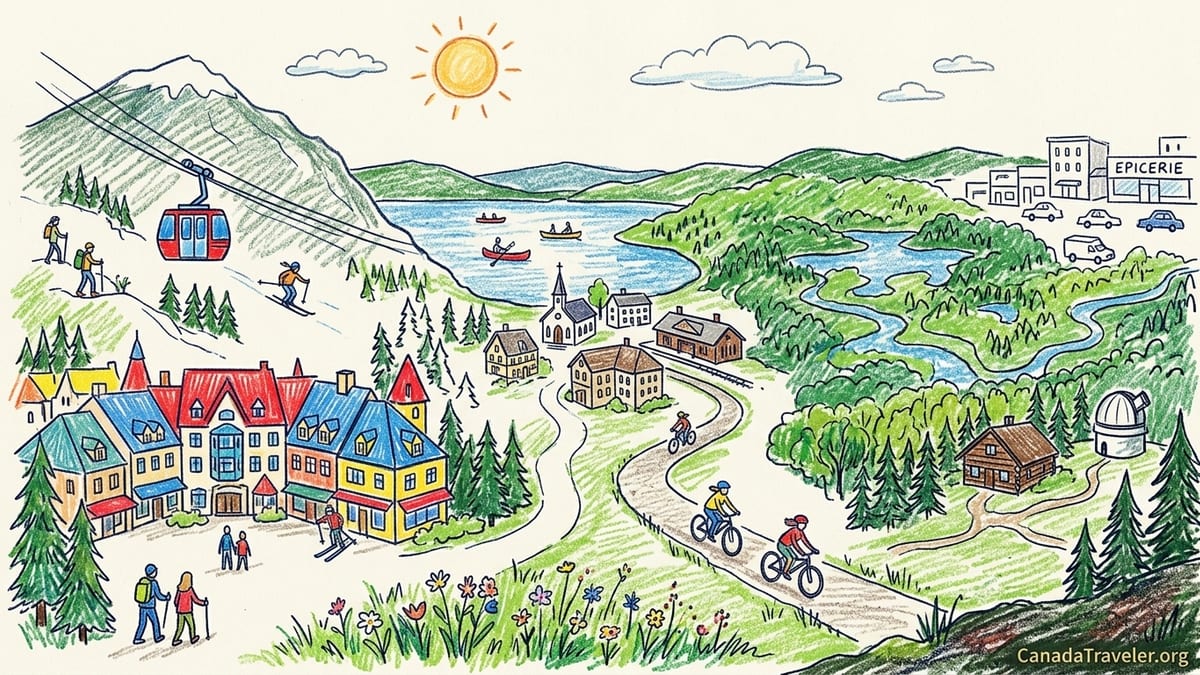
Understanding Mont-Tremblant’s Five Worlds
Official tourism for Mont-Tremblant divides the destination into five distinct sectors: the Tremblant Resort (the pedestrian village and ski area), the Village (often called the Vieux Village), downtown Mont-Tremblant around the former Saint-Jovite, Parc national du Mont-Tremblant, and the protected natural area of Domaine Saint-Bernard. The websites and brochures are very clear about this structure, describing each sector with its own character, services and activities, from boutiques and restaurants to dark-sky stargazing and long-distance hiking.
On the ground though, most international visitors I met used “Mont-Tremblant” as shorthand for the ski resort alone. When my airport shuttle driver asked where I was staying and I simply said “Mont-Tremblant,” he automatically replied, “So, in the resort village?” It was only later, when I pedaled along the P’tit Train du Nord rail trail toward the Village sector and drove out to Domaine Saint-Bernard, that I realized just how different the broader Mont-Tremblant area feels once you step away from that dense core of lifts, plazas and condos.
My own expectations were shaped by images of Parc national du Mont-Tremblant, which is managed by Sépaq as a vast protected landscape of lakes, rivers and forest. The park is proudly advertised as Quebec’s oldest provincial park and, since 2023, as an International Dark Sky Park with remarkably low light pollution. I thought I would be falling asleep there under a blanket of stars. Instead, my first night was spent in a slope-side hotel room with music from the village square faintly pulsating through the double glazing.
First Impressions of the Tremblant Resort Village
Arriving at Tremblant Resort feels more like entering a compact theme park than driving into a mountain town. You crest a hill and the pedestrian village appears, a cluster of brightly painted, steep-roofed buildings hugging the base of the mountain. Wayfinding signs point you to large surface parking lots and multi-level hotel garages, and buses shuttle visitors to the edge of the car-free core. The ski lifts rise directly above, one gondola climbing to the summit and another short one connecting the lower and upper parts of the village.
I checked into one of the Les Suites Tremblant properties right in the pedestrian area. At the front desk, I was told that parking in the hotel’s indoor garage was 23 Canadian dollars per night plus taxes, a rate confirmed in the resort’s lodging policies. The clerk slid a thick booklet of activity options across the counter: luge, zipline, mountain biking lessons, boat rentals at the lake, and various “combos” you can pre-purchase. It felt efficient and convenient, but not exactly the spontaneous mountain escape I had been picturing.
Stepping out into the village, I immediately joined a stream of families in branded ski jackets, couples carrying takeaway coffee, and groups of friends in athleisure headed toward the base of the lifts. Music played through outdoor speakers, and every few meters another storefront promised something fun. There were gear shops selling logoed hoodies, a chocolatier, several sit-down restaurants with patios, a microbrewery, and counters advertising everything from helicopter flights to Scandinavian-style spas. The effect was lively and undeniably festive, but also tightly curated, like a mall that had gone on a ski holiday.
Shops, Restaurants and the Price of Convenience
As someone who likes to wander into one-off local cafés and grocery stores, the resort’s retail and dining mix felt polished to the point of interchangeability. Breakfast options in the village were plentiful yet surprisingly standardized. I paid just under 20 Canadian dollars for a cappuccino and a breakfast plate at a casual spot facing the plaza. Dinner in a mid-range bistro ran close to 40 to 50 dollars per person before drinks for a main course and shared dessert, which is on par with prices in major Canadian cities rather than a rural town several hours from Montreal.
There are practical upsides. If you forgot ski socks, there is a shop that sells nothing but. If your child suddenly wants poutine at 4 p.m., there will be somewhere serving it. Menus are accessible in both French and English, and many waitstaff immediately switch to English when they hear an accent. For some travelers, that smooth frictionless experience is exactly the point. You do not need to parse unfamiliar grocery labels or puzzle over opening hours in a small village because everything is geared to your arrival window and your vacation rhythm.
For me, that efficiency came at the cost of a sense of place. It was difficult, walking past branded sports stores and multiple nearly similar terraces, to feel that I was in a corner of the Laurentians with its own history and community. When I later visited the Village sector down by the lake, with its former railway station and older church, the contrast made the resort’s commercial packaging stand out even more. The pedestrian village is atmospheric in its way, but it is atmosphere mostly designed for visitors.
Lifts, Activities and the Sticker Shock Factor
On my first full day I joined the morning rush to the gondola. In winter, Tremblant sells full-day lift tickets that, according to recent public price listings and traveler reports, can exceed 170 to 180 Canadian dollars for an adult when bought at or near the window during peak periods, with discounts offered through advance purchase, packages and passes. Even outside ski season, the mountain access is monetized. Summer sightseeing gondola rides and adventure packages are marketed as part of a four-season activity calendar, from alpine luge runs to aerial courses and mountain biking.
I opted for a basic summer combo that bundled a gondola ride, a luge run and access to the beach and tennis club on Lac Tremblant. The package was convenient to book through central reservations and attach to my room key, but by the time taxes were applied, the per-person cost for a few hours of entertainment sat closer to what I might expect at a major amusement park than at a mountain lake. None of the individual prices were outrageous, yet as the day went on I became keenly aware that each small choice had a cost attached.
What did soften the blow were the occasional inclusive touches: complimentary outdoor concerts in the plaza, a kids’ splash pad, free access to certain village-to-mountain shuttles, and seasonal events that did not require tickets. Still, there was no denying that the core resort experience is built around paid access, whether to lifts, branded activities or private lakeside facilities. If you budget for Tremblant as you would for a big North American ski destination, there are few surprises. If you arrive thinking “small Quebec mountain town,” the numbers can feel jarring.
Parking, Crowds and the Manufactured Mountain Town
Logistically, Tremblant Resort is very structured. The official parking information explains that overnight parking is restricted, that parking is prohibited along nearby roads such as chemin Duplessis, and that most visitors should use designated lots. Some parking areas are free in certain seasons, while preferred and indoor options carry fees. During my stay, driving into the resort on a sunny Saturday morning meant joining a queue of vehicles funneled toward the large surface lots, then lining up again for shuttle buses or walking up to the gondola base through a river of people.
The pedestrian-only nature of the village is pleasant once you are out of your car. Parents felt comfortable letting older kids run ahead, and the cobblestone streets and colorful facades made for pretty photos. At the same time, the choreography was impossible to ignore. Music is centrally piped. Entertainment schedules list when street performers will appear and when fireworks may go off. Even the spontaneous-looking fire pits had posted safety notices and branded signage. I caught myself wondering, more than once, whether I was in a mountain town or on a carefully controlled set.
That sense of being in a manufactured environment was not entirely negative. For visitors who want guaranteed bustle, predictable hours, and staff on hand to answer questions in multiple languages, Tremblant’s design delivers. Solo travelers may appreciate the safety of well-lit plazas and security staff. Families benefit from stroller-friendly pathways and centralized services. The question is less whether the resort is “too commercial” and more whether that curated energy matches what you personally want from the Laurentians.
Stepping Away: The Village and Downtown Mont-Tremblant
After two days in the resort bubble, I rented a city bike through a package that encouraged guests to explore beyond the pedestrian village. A paved trail led me along the lakeshore and then onto the P’tit Train du Nord linear park, following the old railway line. Within minutes, the soundtrack shifted from DJ sets and announcements to the buzz of insects and the crunch of gravel under my tires. My first destination was the Village sector, sometimes called the Vieux Village, which the tourism office describes as a place of historic buildings, cultural venues and easy access to trails.
In the Village, the architecture immediately felt more organic. The former train station now serves as an exhibition center, there is a small church, and modest inns and restaurants cluster along the main street. The pace was slower. Locals lingered over coffee on shaded patios, cyclists stopped to consult maps, and the overall soundscape was more birds and bicycles than loudspeakers. Prices at cafés and small eateries were often a notch lower than in the resort, with lunch plates in the 15 to 25 Canadian dollar range and less focus on resort-style theming.
Farther south, the downtown sector around the former town of Saint-Jovite presented yet another face of Mont-Tremblant. Official tourism material calls this the main service hub, and that is exactly how it felt: grocery stores, hardware shops, pharmacies, bakeries and everyday restaurants serving both residents and visitors. I grabbed groceries here at regular supermarket prices, stocked up on snacks for my park days, and appreciated being in a place that seemed to exist for reasons other than tourism alone. It drove home how small a footprint the highly marketed resort actually occupies within the larger municipality.
Finding Wilderness in Parc national du Mont-Tremblant
The Mont-Tremblant I had originally imagined was waiting a short drive away in Parc national du Mont-Tremblant. Managed by Sépaq, the park covers a vast area of forested hills, rivers and over a hundred lakes. Unlike the resort, access is regulated through a daily entry fee rather than parking charges and activity tickets. As of this year, Sépaq’s province-wide rate for day access to Quebec national parks is in the low tens of dollars per adult per day, with free entry for young children and annual passes available, although specific amounts change regularly and should be confirmed at the time of booking.
At the L’Entrée de la Diable sector, I checked in at a modest service center that sold simple snacks, maps and basic gear. The ranger at the counter answered questions about trail conditions, explained that camping or cabin reservations did not include the daily entry fee, and highlighted a few quieter loops that would be less busy than the signature viewpoints. Within half an hour I was at a trailhead where the only other vehicles were a couple of dusty hatchbacks and a pickup.
On the trail, Tremblant finally matched the image I had carried from guidebook photos. A narrow path wound through mossy forest, the air cooled noticeably in the shade, and occasional openings offered glimpses of small lakes where canoes moved silently across the water. There were no speakers, no banners, no bundled activities to upsell. Just wayfinding signs, simple footbridges and the sound of wind in the trees. Knowing that the park had been designated an International Dark Sky Park made me wish I had booked a night in one of the more remote camping areas to experience the stars with minimal artificial light.
Domaine Saint-Bernard: A Quieter Middle Ground
If Parc national du Mont-Tremblant is the full immersion into wilderness and the resort village is the curated entertainment hub, Domaine Saint-Bernard might be the comfortable middle ground. This 1,500-acre protected nature reserve sits within the Mont-Tremblant area and is explicitly dedicated to conservation and low-impact recreation. Official information emphasizes that it is a place where nature and community come together, with a network of walking, snowshoeing and ski trails, open meadows and access to lakes and rivers.
Walking its trails, I passed local families pushing strollers, trail runners, and couples with binoculars heading to birdwatching hides. There is an astronomical observatory that takes advantage of the region’s dark skies, but the built infrastructure remains discreet: a few heritage buildings, trail signs, and small parking areas. Access fees and rentals here are present but modest compared to the resort’s premium activity pricing. Renting cross-country skis or snowshoes for a day cost less than what I had paid for a single short activity in the pedestrian village, and parking was straightforward.
What struck me about Domaine Saint-Bernard was how rooted in local life it felt. The people I encountered seemed to be as likely to be residents as visitors, and conversations on the trail drifted from gear tips to school events. It offered me the sense of being in the Laurentians as a lived-in region rather than a temporarily themed backdrop. After a morning there, returning to the resort village was genuinely jarring. The same mountain peaks framed the skyline, but the experience was filtered through an entirely different lens.
Is Tremblant Resort Worth the Cost and Atmosphere?
By the end of my stay, I had stopped asking whether Tremblant Resort was “too commercial” and started asking whether its particular version of commercial made sense for me. There is no question that accommodation, dining and activities in the pedestrian village come at a premium compared with many small Quebec towns. Lodging inside the resort, with ski-in/ski-out access and amenities like pools and spas, is priced to match other high-profile North American ski and four-season destinations. Meals in the core village are convenient and international, but rarely feel like hidden bargains.
In return, you get ease and density. If you travel with children, elderly relatives or friends with different interests, the resort’s design can be a relief. One person can head to a morning bike lesson while another browses shops and someone else sits in a café by the plaza, and you all meet up by the clocktower without worrying about parking or long drives. Evening events come to you, whether that means live music in the square or a torchlit descent on the slopes. For groups who want to be entertained rather than to improvise, the resort model delivers very well.
For travelers like me who arrived with a mental image of canoes pulled up on a silent shore and cabins tucked into the woods, the resort village alone would have been a disappointment. The good news is that the official five-sector structure of Mont-Tremblant means you do not actually have to choose between resort convenience and wilderness immersion. You can sleep beside the lifts and still spend your days in the park or at Domaine Saint-Bernard, or you can stay in the Village or downtown and dip into the resort atmosphere only when you want its energy.
The Takeaway
Mont-Tremblant is not a single experience. It is a branded resort, a lakeside village, a functional small city, a vast provincial park and a community-run nature reserve layered on top of one another. My mistake was assuming that “going to Mont-Tremblant” meant disappearing into quiet forest right from my hotel door. What I actually booked first was a front-row seat at one of eastern North America’s more polished four-season resorts, complete with ticket windows, activity desks and a tightly curated pedestrian village.
Seen on its own terms, Tremblant Resort does exactly what it promises. It offers a dense menu of skiing, biking, hiking, golf and water sports options, packaged for people who value convenience, services and entertainment as much as scenery. It is perfect for families who need activities for multiple age groups without long drives, for friends celebrating a milestone who want nightlife without a big-city vibe, and for new mountain travelers who might feel intimidated by more remote backcountry settings. If you arrive wanting that, the resort atmosphere will feel lively rather than manufactured.
If, however, your heart is set on the Laurentian wilderness that appears in glossy photos of mist over lakes and stars over pine ridges, plan your trip to Mont-Tremblant as a multi-sector experience. Spend a night or two in the pedestrian village to enjoy the lifts, restaurants and events, then allocate full days to Parc national du Mont-Tremblant and Domaine Saint-Bernard. Use the Village and downtown sectors as your gateways for groceries, local cafés and a glimpse of year-round community life. That way, Mont-Tremblant becomes not just a resort, but a region where you can dial the volume up or down on the resort feeling as you go.
FAQ
Q1. Is Mont-Tremblant Resort the same place as Parc national du Mont-Tremblant?
Not exactly. Tremblant Resort is a privately operated ski and four-season resort with a pedestrian village and lifts. Parc national du Mont-Tremblant is a large provincial park managed by Sépaq, located nearby, with its own entry fees, trail network and campgrounds.
Q2. Are prices in the Tremblant pedestrian village higher than in the rest of Mont-Tremblant?
Generally yes. Hotels, sit-down restaurants and branded activities in the resort core tend to be priced closer to big Canadian cities or major ski areas, while cafés, grocery stores and motels in the Village and downtown sectors are often more moderate.
Q3. Do I need a car to experience the quieter sectors like the Village and Domaine Saint-Bernard?
A car gives you the most flexibility, especially for early-morning hikes or late returns from the park. However, in summer there are cycling routes such as the P’tit Train du Nord, and some lodgings offer shuttles or taxi options between sectors.
Q4. How much should I budget for park access at Parc national du Mont-Tremblant?
You pay a per-person daily access fee set by Sépaq, typically in the low tens of dollars for adults, with children often free and annual passes available. Camping, cabins and equipment rentals are charged separately.
Q5. Is it possible to stay in the park or Domaine Saint-Bernard instead of the resort?
Yes. Parc national du Mont-Tremblant offers campgrounds, ready-to-camp options and cabins in several sectors. Domaine Saint-Bernard has more limited on-site lodging but is close to small inns and guesthouses in the Village and surrounding countryside.
Q6. What kind of traveler will enjoy staying right in Tremblant Resort?
Travelers who value convenience, a walkable environment, organized activities and a lively atmosphere tend to love staying in the pedestrian village. Families, multi-generational groups and visitors on short breaks often find the resort format ideal.
Q7. Can I still find quiet hiking near Tremblant without going deep into the backcountry?
Yes. Both Parc national du Mont-Tremblant and Domaine Saint-Bernard have signed day-hike loops of varying difficulty. By starting early or choosing less famous trails, you can enjoy fairly quiet walks without technical gear or long drives.
Q8. How does parking work at the resort compared with the park?
At the resort, most guests use designated lots or hotel garages, and some options carry daily or nightly fees. In Parc national du Mont-Tremblant, parking is usually included with your park access at trailheads and visitor centers, though you still pay the separate entry fee.
Q9. Is the resort atmosphere very touristy even outside ski season?
Yes, to a degree. Tremblant actively promotes summer and fall activities such as gondola sightseeing, luge, ziplines, golf and lake sports, so the pedestrian village remains busy much of the year, especially on weekends and during school holidays.
Q10. How can I balance resort comforts with a more authentic Laurentian feel?
Consider splitting your time. Spend a couple of nights in the pedestrian village for easy access to lifts and restaurants, then base yourself in the Village or downtown for lower-key days, and dedicate full days to Parc national du Mont-Tremblant and Domaine Saint-Bernard for nature immersion.