


I arrived at Cape Breton’s Skyline Trail expecting a quiet, cinematic walk along open highlands and endless ocean cliffs. What I found in 2026 instead was a tightly managed, time-stamped experience built around a parking reservation, long stretches of ordinary woods, and a headland viewpoint that felt more like a parade route than a wilderness lookout.
Arriving With High Expectations and a Time Slot
The romance of the Skyline Trail starts long before you lace up your boots. Every brochure and social post seems to show the same image: a lone hiker on a swooping boardwalk, the Gulf of St. Lawrence glowing under them, no one else in sight. Driving the Cabot Trail north from Chéticamp, I had those photos in my head, along with the sense that this would be the defining wilderness moment of the drive, the quiet payoff after hours of hairpin turns.
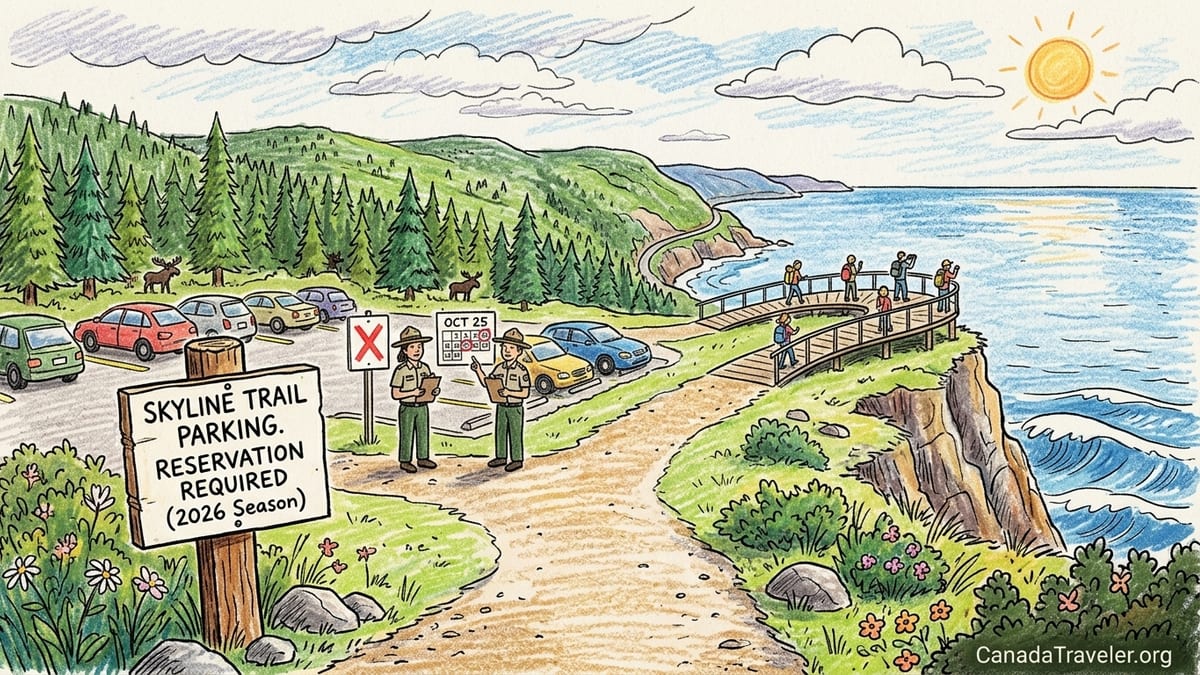
Reality began at the entrance to Cape Breton Highlands National Park, where I queued behind cars with the same idea. The ranger checked my park pass, then reminded me that for Skyline itself, the critical document was not my admission but my timed parking reservation. Between June 26 and October 25, 2026, anyone wanting to park at Skyline during peak season needed a four-hour parking slot, booked separately from park entry. The new system was meant to fix chronic overcrowding and ecological damage. What it did in practice was turn a supposedly spontaneous coastal hike into something that felt more like catching a flight.
The drive up to the Skyline parking lot is beautiful, with glimpses of cliffs and sea, but once you turn in, the logistics overshadow the landscape. Staff and signs funnel you to your reserved section of the lot, and you are reminded that there are no in-and-out privileges. Leave early, and your slot is forfeited. Show up too late, and you may not be allowed in at all. It is a controlled, clock-watching start to an experience still marketed as wild and free.
The 2026 Parking-Reservation System: Why It Exists and How It Feels
Parks Canada did not invent the Skyline parking-reservation system on a whim. For years the trail has been a victim of its own fame. Skyline is the best-known hike in Cape Breton Highlands National Park, and one of the most photographed in Atlantic Canada. As visitor numbers pushed toward the hundreds of thousands annually for the park, the modest parking lot beside the Cabot Trail repeatedly overflowed. Staff had to close the lot at peak times, cars spilled onto the shoulder, and the narrow road became a slow-moving bottleneck.
That popularity also damaged the landscape that made Skyline famous. The boardwalk and cliffs at the headland protect a fragile coastal heath ecosystem. Despite repeated signs, visitors stepped off the boardwalk for better angles, trampling vegetation that takes years to recover. Parks Canada has documented erosion, vegetation loss, and disturbed wildlife on the headland and has already partnered with researchers to rehabilitate the area. The reservation system is explicitly framed as a response to that pattern: a way to spread hikers out, reduce illegal parking, and keep the headland from being loved to death.
On paper, the system is simple. From June 26 to October 25, 2026, you must book a four-hour parking time slot to access the Skyline Trail lot. Online, the price is advertised around 13 Canadian dollars, including a booking fee. By phone the total climbs to roughly 15 dollars, and if you show up and try to reserve in person, expect to pay closer to 17.50. None of these amounts include standard national-park admission when applicable, which is an entirely separate fee. You are buying the right to park in a specific lot for a specific four-hour window, not access to the trail itself.
In practice, that structure changes the character of a Cabot Trail road trip. Instead of drifting with the weather and your energy, you have to back-time your day from a parking slot. Want to linger at a roadside lookout, or stop for an unplanned seafood lunch in Chéticamp because the chowder looks good? You start checking the clock instead of the waves. Spontaneous travel is replaced by a timeline, and if you hit construction, fog, or yet another photo stop, there is no guarantee you will still be allowed to park when you reach the lot.
When Logistics Undercut the Magic
The 2026 rules go further than simply requiring a reservation. You are expected to arrive during a narrow arrival window at the start of your four-hour block, not whenever you please within it. Same-day bookings are technically possible through the Parks Canada reservation system, but they come with a warning: only book if you can safely reach the lot by the end of the first hour of your slot. There are no refunds if you miscalculate. If traffic on the Cabot Trail slows to a crawl behind a motorhome or you get stuck behind cyclists on the climb, that is your problem, not the park’s.
The system also bans the workarounds many travelers instinctively consider. Roadside parking near the Skyline entrance is prohibited, and you are not allowed to be dropped off by a friend or tour operator and picked up later to dodge the parking fee. The park’s messaging is blunt: no parking or drop-offs along the highway, full stop. Rangers patrol and, anecdotally, have not hesitated to turn away vehicles that try to improvise. It keeps the roadside safer and clearer, but it also means the only legal way to walk Skyline in peak season is to participate in the reservation regime.
This rigidity would bother me less if the technology around it were seamless, but the Skyline trailhead sits in a pocket of shaky mobile coverage. Some visitors do manage to get enough signal in the Chéticamp visitor centre or along higher sections of the highway to book a same-day slot on a smartphone. Others find their connection drops as soon as they step away from the building, leaving them with a half-completed reservation and no confirmation. You can reserve by phone, but that costs more and assumes you knew this rule before you arrived. For a trail that attracts international visitors on long road trips, the lack of reliable connectivity at the very point where the reservation becomes mandatory feels like poor design.
Did the system improve the on-trail experience? To a point, yes. There were fewer cars in the lot than the photos of previous years with vehicles jammed into every ditch. But “less crowded” is not the same as “quiet,” and the reservation did not transform Skyline into an uncrowded wilderness walk. It simply turned an overcrowded free-for-all into a heavily booked attraction with a gate at the parking lot.
What the Trail Is Really Like: Woods, Wind and a Crowded Headland
The dissonance between expectation and reality continues once you actually start walking. Officially, the main Skyline Trail is 6.5 kilometres out and back, taking around two hours for most hikers. There is also a longer loop option of approximately 8.2 kilometres, usually completed in 2.5 to 3 hours. Both share the same starting point and the same famous boardwalk headland. What differs is the amount of quiet forest you walk through to get there and back.
If, like many visitors, you have absorbed the marketing photos, you might expect to walk along an open cliff edge almost the entire way. In reality, much of Skyline is a broad, well-groomed path through spruce and fir forest. The first stretch feels almost like a park road without cars, wide and relatively flat, with occasional glimpses of the plateau through the trees. The scenery is pleasant, but it is not the constant ocean drama that the brochures imply. You will spend a significant portion of your time simply walking in the woods.
Only when the trail begins to open onto the plateau, and eventually to the headland itself, do you get the views that made Skyline famous. Here the path funnels onto the wooden boardwalk that steps down toward the cliff edge. On a clear day, the Cabot Trail carves along the coast in the distance, and the Gulf of St. Lawrence stretches out in layered blues. These few viewpoints are indeed spectacular, and the wooden stairs frame them in a way that almost guarantees dramatic photographs.
They are also where the crowds compress. Every hiker who started in your time window eventually ends up in the same tight space: the stairs, the platforms, the railings where the classic shots are taken. If the weather is kind, you find yourself pacing behind photo shoots and slowing for groups that stop on the steps. If the wind is up or fog rolls in, the exposure becomes more obvious. Gusts can whip across the headland hard enough that you instinctively grab the railings, and when low cloud drops, all that is left is a line of people peering into whiteout.
The Loop Versus Out-and-Back: Not the Same Experience
On paper, the Skyline Trail gives you two choices: the popular 6.5-kilometre out-and-back, and the 8.2-kilometre loop. In practice, many visitors default to the shorter route because it promises the famous view for the least effort. Staying left at the trail fork takes you along the main forested path directly to the boardwalk. You descend the stairs, navigate the crowds at the railings, take your photos, then reverse your steps back to the parking lot along the same wide gravel path.
The loop, which branches right at the fork, offers a different flavour: a quieter, more traditional forest hike that eventually reconnects with the main trail and boardwalk before returning to the lot. It adds distance and a modest increase in time, usually bringing the outing to somewhere between 2.5 and 3 hours. The loop section tends to see fewer people, partly because many tour buses and tight itineraries push their groups onto the quickest option. If you want even a hint of solitude on Skyline, the loop is the better bet, but you still cannot escape the funnel at the headland.
Both routes share the same limitations. The famous coastal panorama is largely concentrated near the headland; you do not get sustained, uninterrupted sea views along most of the trail. If you are fit and hike regularly, you may find the bulk of Skyline surprisingly tame and repetitive. It is rated easy to moderate for good reason. There is very little elevation change compared to climbs like Franey or Wilkie Sugar Loaf elsewhere on the island, and the broad track accommodates everything from small children to seniors. That accessibility is a virtue, but it also means Skyline will not feel like a backcountry adventure, no matter which route you choose.
Time-wise, the four-hour parking limit is generous for most hikers, but it can quietly shape your behaviour. Want to linger on a bench or wait out a band of fog in hopes of a clearer view? You may find yourself checking your watch, calculating how long the return walk will take, and wondering what happens if you reach your car a few minutes after your slot expires. Again, the system pushes you to think like a timed visitor, not a wanderer.
Wildlife, Rules and the Myth of the Empty Trail
Part of Skyline’s mystique comes from wildlife. The plateau and surrounding forest are known for moose, and countless articles mention the possibility of spotting one from the trail or even near the boardwalk. Parks Canada also notes that black bears and coyotes inhabit the region, and the viewpoint itself sits above waters where whales and seabirds can sometimes be seen. It is easy to imagine yourself alone on the headland, watching a whale surface far below while a moose grazes in the distance.
In 2026, that image rarely matches reality. With timed parking feeding a steady flow of people into the trail, most wildlife reacts accordingly. A moose sighting becomes an event, instantly drawing a cluster of hikers jockeying for phone photos. The same is true for foxes and any bird or distant fin that might be a whale. Instead of quiet observation, you get crowd behaviour and raised voices. Parks Canada has long warned that people leaving the boardwalk, chasing angles, and cornering animals can increase the risk of dangerous encounters, which is one reason the boardwalk exists and why the reservation system is justified on safety grounds as well as ecology.
The management response includes a strict no-dogs rule on Skyline. This is not a suggestion. Dogs are not permitted on the trail at all, leashed or otherwise, because of wildlife sensitivity and previous incidents. For travelers doing the Cabot Trail with a pet, this creates an immediate logistical challenge. You either skip the hike, leave the dog crated or with someone off-site, or find a kennel or dog-friendly lodging that can keep your animal while you go. Given that many accommodations in nearby Chéticamp and Margaree are small inns and cottages, that is not always straightforward.
Just as importantly, Skyline is not the consistently empty highland walk people imagine from Instagram. Most days in summer and early fall feel more like a promenade. You hear multiple languages, snippets of tour-bus commentary, and the chiming of hiking poles on wood. At peak times, every bench and rail space at the headland is occupied. It is a social atmosphere, which some travelers enjoy, but calling it a peaceful wilderness hike feels misleading.
How Skyline Compares to Other Cape Breton Viewpoints
Skyline’s popularity makes it easy to forget that it is just one of many viewpoints in and around Cape Breton Highlands National Park. Franey, near Ingonish on the eastern side of the park, is probably the most direct comparison in terms of fame. It is steeper and more demanding than Skyline, climbing through forest to panoramas over the Clyburn Brook canyon and the Atlantic coastline, including Cape Smokey and the Middle Head peninsula. You will work harder on Franey, with more elevation gain and a rockier path, but the reward is a high, open perch that often feels less crowded and less choreographed than Skyline’s boardwalk.
Middle Head, which starts near the Keltic Lodge outside Ingonish, offers another oceanfront experience without the timed-parking dance. The trail follows a narrow peninsula into the Atlantic, providing repeated cliffside views, crashing surf, and a sense of being surrounded by water. It is not necessarily easier overall, with roots and short, sharp ups and downs, but the scenery is more continuous. You see, hear, and smell the ocean for most of the walk, not just at a single engineered viewpoint.
Closer to Chéticamp, Le Buttereau is a gentler, more historical option. It winds past old Acadian homesteads, with views back toward the coast and the village rather than out to the open gulf. It lacks Skyline’s drama, but offers far more quiet, and the sense of walking through a lived-in landscape rather than lining up at a platform. Other trails, like Broad Cove Mountain, Mica Hill, or Wilkie Sugar Loaf outside the park boundaries, deliver big payoffs in different combinations of distance and difficulty. Some require more climbing than Skyline, others are shorter but steeper, and most do not require you to book a specific parking time weeks in advance.
None of this is to pretend that every alternative is easier. Franey in particular is a real hike, not a stroll. Someone with limited mobility or a strong fear of steep, rocky ground might find Skyline’s broad path and moderate grade more manageable. For tour operators managing busloads of guests with a wide range of fitness levels, Skyline’s infrastructure and predictable timing are assets. But if you are relatively fit and in search of authentic quiet and continuous views, you may find that another trail offers a better balance of effort and reward, without the layers of management that now define Skyline.
The Takeaway
By the time I returned to the Skyline parking lot, my four-hour clock had not yet run out, but my patience had. The trail delivered exactly what the marketing promised in one narrow sense: a spectacular view from a cliffside boardwalk above the Cabot Trail and the Gulf of St. Lawrence. What it did not deliver was the feeling those photos suggest: of being alone with that landscape, or even of being free to come and go on my own schedule.
Several drawbacks stood out. First, the mandatory 2026 parking-reservation system, with its four-hour slots and layered fees, adds cost and complexity to what used to be a simple stop along the Cabot Trail. Second, the lack of reliable mobile coverage at the trailhead and along parts of the drive makes last-minute planning risky and occasionally impossible. Third, the prohibition on roadside parking and drop-offs removes flexibility, forcing every peak-season visitor into the same funnel regardless of individual needs or travel style.
Fourth, the trail experience itself is more ordinary than the myth. Long stretches of forest walking, compressed views only near the headland, and crowding on the boardwalk and stairs create a mood closer to a busy attraction than a wilderness outing. Fifth, the strict no-dogs rule, while understandable from a conservation standpoint, effectively excludes a growing number of travelers who build their road trips around hiking with their pets. Add in the ever-present wind and the very real possibility of fog erasing the panorama altogether, and the cost-benefit equation becomes even murkier.
Yet Skyline will still be the right choice for some people. If you are short on time, want a relatively gentle, well-groomed trail with a high chance of a big coastal payoff, and you do not mind planning your day around a reservation, Skyline remains a powerful introduction to the scale of Cape Breton’s highlands. It is also a good option for mixed-ability groups where some members might struggle on steeper climbs like Franey. For everyone else, especially repeat visitors or hikers who cherish spontaneity and solitude, it is worth questioning the default assumption that Skyline is the must-do hike of the Cabot Trail. The view is real, but so are the trade-offs.
FAQ
Q1. Do I really need a parking reservation to hike the Skyline Trail in 2026?
Yes. From June 26 to October 25, 2026, you must have a four-hour parking reservation to access the Skyline Trail parking lot during the main operating hours, separate from any park admission fee.
Q2. How much does the Skyline Trail parking reservation cost?
For 2026, the parking reservation is advertised at roughly 13 Canadian dollars when booked online, around 15 dollars by phone, and approximately 17.50 in person, not including regular park entry where applicable.
Q3. Can I just park on the side of the Cabot Trail and walk in without a reservation?
No. Roadside parking and drop-offs near the Skyline Trail are prohibited during the reservation period, and rangers can turn away or ticket vehicles that attempt to bypass the system.
Q4. Is there mobile phone service at the Skyline Trail parking lot?
Coverage at and near the Skyline trailhead is unreliable. You should not count on being able to make or modify reservations on your phone once you are at the lot or in nearby low-lying sections of road.
Q5. How long does it take to hike the Skyline Trail?
The main out-and-back route is about 6.5 kilometres and typically takes around two hours. The longer loop option is roughly 8.2 kilometres and usually requires 2.5 to 3 hours for most hikers.
Q6. Are dogs allowed on the Skyline Trail?
No. Dogs are not permitted on the Skyline Trail, even on a leash. This rule is in place to protect sensitive wildlife and vegetation and is actively enforced.
Q7. Will I have ocean views for the entire Skyline hike?
No. Much of the trail passes through forest or open highlands with limited views. The famous ocean panorama is concentrated around the headland boardwalk and the final lookout platforms.
Q8. Is the Skyline Trail suitable for beginners or less experienced hikers?
Yes in terms of terrain. The path is wide with modest elevation change, making it accessible to many beginners, families, and older hikers, provided they are comfortable with the distance and exposure to wind at the headland.
Q9. How does Skyline compare to Franey and Middle Head?
Skyline is longer but gentler, with most of the drama saved for one viewpoint. Franey is steeper with a more sustained climb to big canyon and ocean views, while Middle Head offers repeated coastal lookouts along a rugged peninsula without a timed parking system.
Q10. Who should still choose the Skyline Trail despite the drawbacks?
Travelers who value ease of terrain, clear signage, and a high-impact view in a limited time window, and who do not mind booking ahead and dealing with crowds, will likely find Skyline worthwhile, especially on a first visit to the Cabot Trail.