


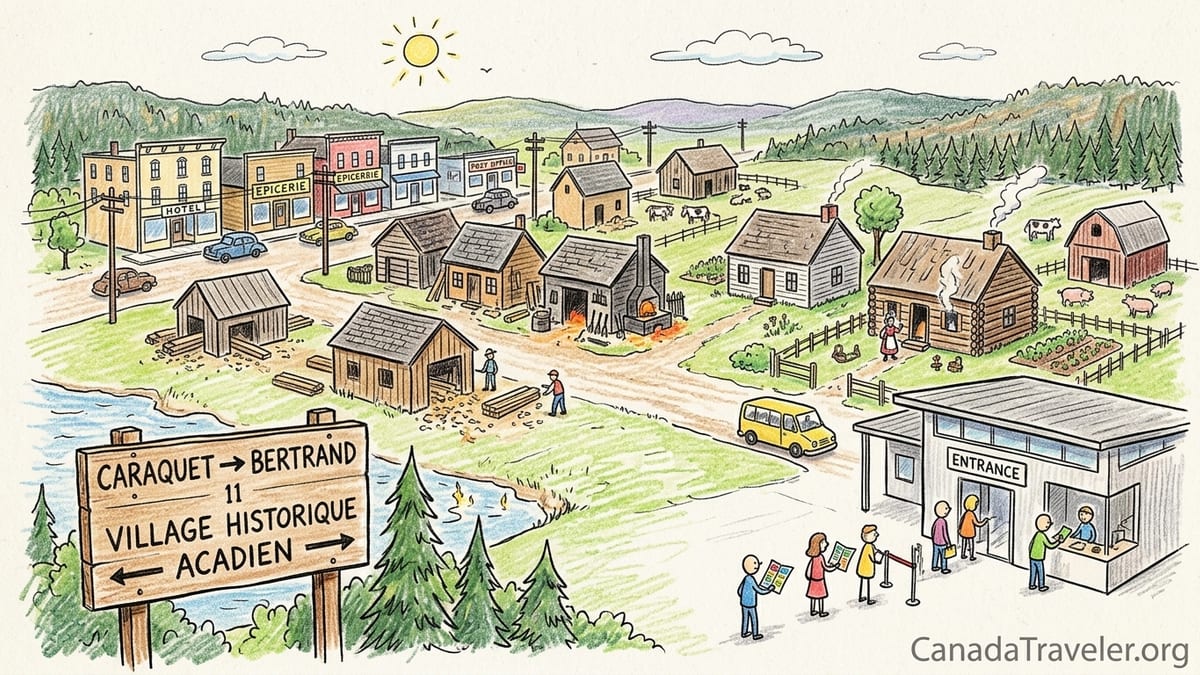
Driving north from Caraquet on a clear July morning, I thought I knew what to expect from Village Historique Acadien near Bertrand: another open-air museum with pretty old houses, a few static exhibits, and perhaps a costumed interpreter or two. What I found instead, over the course of a 2.2‑kilometre walk through more than 40 historic buildings, was an immersive timeline of Acadian life from 1770 to 1949 that reshaped how I understood this region and its people.
Arriving in Bertrand: Expectations Versus Reality
Coming from Caraquet, the drive to Village Historique Acadien took me about 15 minutes along Route 11, with the Bay of Chaleur often flickering through the trees on my right. The entrance to the site appears almost suddenly on the edge of Bertrand, announced by a low cluster of modern buildings that could belong to any contemporary visitor attraction. I pulled into the large, free parking lot and joined families, coach groups, and a few independent travelers queuing at the admissions counter inside the visitor centre.
Before this visit, I had pictured a compact heritage park, something I might cover comfortably in two hours. The English and French brochures made it immediately clear that this was more ambitious. Village Historique Acadien is a provincial park and living-history museum that reconstructs Acadian daily life between 1770 and 1949 across a 2.2‑kilometre trail lined with about forty buildings, from simple farmhouses to a full early‑20th‑century main street.
Admission in 2026 required a bit of attention to detail. The official provincial fee regulation sets a regular adult entrance fee of roughly 16 Canadian dollars for the period from April 1, 2026 to March 31, 2027, with lower rates for youth, students, and seniors, and free admission for children aged four and under. The site’s own rate page, however, listed an adult price of just over 19 dollars including tax, with students and seniors paying around 14 to 15 dollars and family tickets a little over 41 dollars. The difference lies in how taxes and seasonal promotions are applied, and staff explained that the posted prices already include sales tax and reflect current offers.
Residents of New Brunswick benefit from an additional 25 percent reduction on regular admission during the 2026 season, and a separate program offers free entrance for children 17 and under and half‑price tickets for visitors aged 18 to 24 for part of the summer. The result is a patchwork of discounts that rewards careful reading of the French and English information panels, which do not always present the details in identical ways. After clarifying that the higher, tax‑included site rate was what I would actually pay at the counter as a non‑resident adult, I received a bracelet valid for two visits during the current season and stepped toward the historic trail.
Understanding the Great Upheaval and Acadian Resettlement
Before plunging into 18th‑century kitchens and barnyards, I paused at the orientation panels that frame the story. Village Historique Acadien is not a village preserved intact from the past. Instead, it is a carefully assembled historical environment where buildings from across northern New Brunswick have been relocated, restored, or reconstructed to create a chronological walk through Acadian life. The curatorial choice is explicit: this is an interpretation, not a frozen-in-time community.
To understand why the trail begins around 1770, you have to go back to 1755 and the event Acadians call Le Grand Dérangement, the Great Upheaval. Starting that year, British authorities began deporting thousands of French‑speaking Acadians from what is now the Maritime provinces. Families were torn from their farms, loaded onto ships, and scattered to the Thirteen Colonies, Europe, and the Caribbean. Many died in transit. Others fled inland or hid in the forests and marshes to avoid expulsion.
Over the following decades, survivors gradually returned or resettled in new locations along the coasts and rivers of what is now New Brunswick. The period around 1770 marks the beginning of this rebuilding, when Acadian families negotiated land, rebuilt homes, and re‑established farms under new political and economic conditions. That is the world you enter at the beginning of the trail: not a romanticized “Acadia of old,” but a community starting over after trauma.
With this context in mind, I left the visitor centre and boarded the small shuttle that runs between the modern entrance and the far end of the historic site. The driver recommended riding to the terminus and then walking back in chronological order, which proved to be the best way to understand the progression from subsistence farms to twentieth‑century shops and hotels.
Late Eighteenth‑Century Homes: Starting Over After Deportation
The trail’s first cluster of buildings evokes the late 18th century, when Acadian families had returned to the region and were carving new lives from forest and marsh. The houses here are modest, often one‑and‑a‑half‑storey wooden structures with steep roofs designed to shed heavy snow. Interiors are low‑ceilinged and sparsely furnished, with wide floorboards, simple wooden bedsteads, and hand‑hewn beams that still bear the marks of axes and adzes.
In one early farmhouse kitchen, the heart of the room is an enormous open hearth with iron cranes and hooks for suspending pots. A heavy wooden table stands nearby, surrounded by straight‑backed chairs and a bench. The building catalogue lists this house as belonging to a modest farming family, and the objects on display tell the story of daily work after resettlement: rough pottery, woven baskets, simple iron tools, and homespun textiles.
Food preparation was the first thread that pulled me into these interiors. On the day of my visit, the hearth was lit and a costumed interpreter was tending a pot suspended over the coals. This was part of the site’s “Taste History” program, and visitors on that reserved tour clustered inside while the guide explained how 18th‑century Acadian families relied on root vegetables, salt pork, and preserved fish to get through long winters. The menu included samples of traditional dishes, and the smell of simmering onions and chicken stock drifted into the yard.
Outside, the surrounding landscape completes the picture. Modest garden plots lie close to the houses, planted with cabbage, beans, and medicinal herbs. Small outbuildings serve as sheds and barns, hinting at the mixed subsistence that sustained these communities: a few cows, some pigs, chickens in a simple coop. Farm tools lean against the walls, including wooden rakes, crude plough parts, and yokes for carrying water from nearby wells or streams. The setting is peaceful, but the simplicity of the structures underlines how precarious post‑deportation life would have been.
Everyday Work: Fields, Kitchens and the Rhythm of Survival
As I walked between the earliest houses, the building catalogue in hand allowed me to place each structure in time. One dwelling, slightly larger and more finished than the others, represented an Acadian family that had begun to prosper by the turn of the 19th century. The clapboard walls were painted, the interior boasted a few decorative touches, and a separate room off the main hall suggested more privacy and status. Yet the everyday work remained unmistakable.
The outbuildings here include a small barn and sheds filled with period farming equipment: wooden harrows, scythes with long curved blades, and a simple wooden winnowing machine for cleaning grain. These tools speak to a mixed agricultural economy in which families grew oats, buckwheat, and potatoes, kept livestock, and harvested hay in season. The neighbouring fields, managed by the museum, show how crops would have been laid out in long strips to make the most of limited arable land.
Inside the kitchen, domestic work at the end of the eighteenth century appears in the details. A loom set up near a window catches as much natural light as possible, surrounded by baskets of unspun wool and skeins of dyed yarn. A spinning wheel stands nearby, and shelves hold stacks of coarse linen and woolen cloth. Cooking implements range from heavy cast‑iron pots to wooden trenchers and pewter plates. Although some interpreters moved through the space answering questions in both French and English, the buildings themselves carry much of the story through these carefully chosen objects.
Standing in the doorway, I was struck by how little separation existed between work and home. Fields began almost at the threshold, and animal pens, gardens, and woodpiles crowded the space around the house. Children would have grown up surrounded by the sounds and smells of production: chopping wood, the creak of the loom, the hiss of fat in a pan, the lowing of cattle. Village Historique Acadien captures this intimacy by keeping distances small and avoiding overly manicured landscaping. Dirt paths, worn thresholds, and mixed‑use yards convey a sense of lived-in functionality rather than postcard charm.
Nineteenth‑Century Skills: Blacksmiths, Mills, and Carpenter’s Shops
Further along the trail, the houses become larger and more specialized outbuildings appear. This is where the 19th century comes into focus: a time when Acadian communities were more firmly established and trades emerged to serve local needs and growing markets. Not every workshop at Village Historique Acadien operates every day, however, so my experience reflected only the demonstrations actually running during my visit.
The first lively stop was the blacksmith’s shop. From the path, I heard the ring of hammer on anvil and stepped inside to find the forge glowing orange. Bellows pumped air into the coals, and the smith, in period clothing, shaped a red‑hot bar of iron into a hook. The building catalogue identifies this as a typical rural smithy, responsible for repairing tools, shoeing horses, and fabricating hardware for homes and barns. On racks along the wall, completed pieces showed the range of work: hinges, latches, plough points, and simple decorative objects.
Nearby, a carpenter’s workshop was also in operation. Shavings curled across the floor beneath a long workbench where hand planes and chisels lay within easy reach. Here the focus was on building and maintaining wooden structures and household objects: doors, window frames, furniture, even parts for carts and sleighs. While the interpreter explained techniques in French to a group of local visitors, English‑speaking travelers followed along by watching the work and reading the bilingual description panels that detailed the tools and processes of 19th‑century Acadian carpentry.
On the day of my visit, the sawmill and certain other specialized structures were quiet, their machinery at rest behind ropes or simple barriers. Even so, their presence in the building catalogue helps complete the picture of a rural economy connected to forests, rivers, and regional trade. Mills turned local timber into boards for construction; small shops crafted barrels, boats, and agricultural equipment. Walking past these workshops, active or not, you sense how skills and labour had diversified since the fragile years immediately after resettlement.
Into the Early Twentieth Century: Machines, Roads, and New Domestic Comforts
As the trail curves back toward the center of the site, the 20th century comes into view. Buildings shift from scattered farmsteads to a more village‑like layout: general stores, workshops, a post office, and eventually a recreated hotel and urban‑style houses. Dirt paths give way to wider lanes where early vehicles and modernized wagons sit beside older horse‑drawn carts.
Inside one early‑1900s house, the domestic interior feels instantly different from the 18th‑century homes at the start of the walk. There is still a central kitchen, but the stove is a cast‑iron cookstove rather than an open hearth, with stovepipes directing smoke outdoors. A hand‑powered washing machine shares space with enamel basins and more decorative tableware. The catalogue notes when electricity and telephones reached this type of house, and although the lights at Village Historique Acadien serve modern safety standards, the representation captures the transitional feel of the era.
Machinery appears more prominently in outbuildings and service structures. In a small garage and workshop, early 20th‑century engines and tools speak to the arrival of gasoline power and motorized transport. On the street, signage and storefronts in French underlined the persistence of Acadian identity within a broader anglophone province, while bilingual interpretation made the history accessible to visitors from elsewhere in Canada and abroad.
Perhaps the most striking contrast with the earliest era comes in the public and commercial spaces. The hotel, rebuilt on site based on historical models, evokes an Acadian community now connected to tourism, government, and outside markets. Here, fine woodwork, pressed‑tin ceilings, and printed advertising coexist with local crafts. The transition from subsistence and local exchange to wage labour and service industries becomes tangible as you move from barns and blacksmith forges into dining rooms and guest parlours.
Tasting the Past: The 2026 “Taste History” Program
Food is one of the most accessible entry points into another culture’s history, and Village Historique Acadien has formalized this insight with a themed guided tour called “A Taste of History.” In 2026, this program was scheduled on select dates in July and early August, with morning departures from the visitor centre. It is distinct from general admission, both in structure and price, and it shaped my day in important ways.
The 2.5‑hour tour cost 45 Canadian dollars for non‑members in 2026, tax included, with a slight discount for holders of the Village’s seasonal membership card. Numbers were limited, and advance reservations were strongly recommended. While some earlier seasons emphasized French‑language offerings, by summer 2026 the site was advertising an English‑only “Taste of History” departure on multiple dates, which is the version I joined. The guided group moved through kitchens and gardens spanning roughly 1770 to 1950, stopping at several houses to sample small portions of foods that represented different periods in Acadian culinary history.
The tour’s highlight was a bowl of traditional chicken fricot served at the Village Café‑Bistro near the visitor centre at the end of the circuit. Fricot is a hearty Acadian stew of chicken, potatoes, onions, and dumplings, seasoned simply and cooked slowly until the broth is rich and comforting. Eating it after spending the morning in and out of historic kitchens gave the dish deeper resonance. It was no longer just a regional speciality on a menu but a through‑line connecting centuries of adaptation to local ingredients and harsh winters.
Importantly, participation in “Taste History” does not replace regular admission. The 45‑dollar fee covers the guided tastings and fricot lunch; visitors must still hold a valid entrance bracelet for the day. This structure means that travelers on tighter budgets can explore the village with standard admission alone, reading interpretive panels and chatting with costumed staff, while those who want an explicitly culinary angle can add the paid program. It also underlines how language accessibility shapes experiences: while general interpretation is bilingual in most buildings, the guided tasting was offered in English on my date, which was ideal for many Canadian and international visitors but less appealing for francophone travelers seeking a fully French visit.
For anyone interested in food culture, the additional cost is worthwhile. The tour connects ingredients in the gardens, objects in the kitchens, and broader social changes such as access to imported goods and new technologies. At the same time, Village Historique Acadien clearly presents it as an optional add‑on rather than the core of the visit, which remains the chronological walk through the reconstructed village.
Language, Interpretation, and the Nature of a “Living” Village
Language is central to Acadian identity, and it is also a practical consideration for visitors. Throughout the site, most interpreters switch fluidly between French and English, and printed materials are fully bilingual. I heard families from Quebec conversing easily with staff in French, while visitors from Ontario and the United States received explanations in English without missing essential details. In a few moments, such as an impromptu story about a specific family who once lived in a relocated house, the depth of information available in French felt slightly greater, reflecting the fact that many of the sources and community memories exist primarily in that language.
The building catalogue was my anchor. Instead of inventing dialogues with interpreters, I spent time reading each entry, which identifies where a structure originally stood, which family or function it represents, and how it fits into the broader historical narrative. One house, for example, had been moved from its original riverside location to protect it from erosion, while a small workshop stood as a composite of several similar buildings once common in the region. These notes reinforce the important idea that Village Historique Acadien is an interpretive construction.
The site openly acknowledges that it is a curated ensemble rather than a village that somehow survived unchanged into the present. Buildings have been moved, modified, and in some cases reconstructed from scratch based on archival photographs, oral histories, and architectural studies. The goal is not strict antiquarian preservation but an educational experience that allows visitors to move physically through two centuries of Acadian life. Accepting this does not diminish the authenticity of the stories told; instead, it situates them within contemporary efforts by Acadian communities and the province to preserve and share their heritage.
This living quality is underscored by the seasonal rhythms of the village. In high summer, when I visited, gardens are in full growth, animals are on site, and many workshops operate throughout the day. Outside the peak period, some elements scale back or close, and severe heat can even trigger partial site closures under the museum’s heat‑wave policy. All of this reminds visitors that they are not stepping into a sealed diorama but into a working cultural landscape that must adapt to present‑day realities.
Practicalities: Transport, Time, and Planning Your Visit
By mid‑afternoon, my feet felt every kilometre of the 2.2‑kilometre route, and I was grateful for the shuttle that connects the entrance with key points on the trail. The official site description mentions the 2.2‑kilometre distance, while provincial tourism materials sometimes round it up to about 2.5 kilometres, a good shorthand if you take a few side loops and visit nearly every building. Most paths are well‑maintained, but you are still walking on packed earth and gravel rather than smooth pavement, so comfortable shoes are essential.
Getting to Village Historique Acadien from Caraquet is straightforward by car along Route 11, and the short drive makes it an easy day trip even for families with young children. There is no regular public transport between the towns, so independent travelers without a vehicle should plan on a taxi or rideshare. On arrival, parking is free and ample, and the modern visitor centre opens earlier than the historic village itself, allowing time to buy tickets, use washrooms, and pick up maps before the heritage buildings open.
So how much time do you need to understand Acadian identity through this site? Technically, you could rush through in three hours, especially if you board the shuttle to the far end and then walk back, stopping only briefly in each building. Doing so, however, would flatten the narrative into a visual checklist. My own visit stretched from opening until late afternoon, including the 2.5‑hour “Taste History” tour, time for photographs, and quiet moments spent absorbing the atmosphere in less crowded corners.
For travelers with a deep interest in history and culture, a full day offers a much richer grasp of how Acadian life changed between 1770 and 1949. It allows you to trace themes such as food, work, religion, and language across multiple time periods and to notice subtle shifts in architecture and interior design. Families with younger children or visitors pressed for time can still gain meaningful insights in half a day by focusing on one portion of the timeline, such as the early resettlement farms or the early‑20th‑century village core, and using the shuttle strategically.
The Takeaway
When I finally walked back to my car in the late afternoon light, Village Historique Acadien had thoroughly exceeded my initial expectations of a neat but static open-air museum. The long, looping trail through more than 40 buildings had carried me from the fragile world of post‑deportation farms to the threshold of the modern era, where Acadian communities engaged with tourism, wage labour, and motorized transport while preserving a distinct cultural identity.
What lingered most was the sense of continuity in the face of upheaval. The Great Upheaval of 1755 shattered families and scattered communities, yet the houses, workshops, and kitchens along this 2.2‑kilometre path testify to resilience and adaptation. Fricot simmering on a modern stove in a café links directly back to the 18th‑century hearth; blacksmith’s tools and carpenter’s benches echo in the finer finishes of early‑20th‑century hotels and shops.
Village Historique Acadien succeeds not because it pretends to be a perfectly preserved Acadian village but because it openly presents itself as an interpreted environment. By assembling buildings from across the region into a coherent timeline, it allows visitors to walk through two centuries of everyday life and to understand how Acadian identity has been continuously negotiated and renewed. Arriving from Caraquet with only a morning planned, I left at day’s end with a much deeper appreciation for this history, and a strong conviction that anyone interested in Atlantic Canada’s cultural roots should give the village as much time as their itinerary allows.
FAQ
Q1. Where is Village Historique Acadien located?
Village Historique Acadien is near the community of Bertrand in northeastern New Brunswick, a short drive northwest of Caraquet along Route 11.
Q2. How long is the walking route through the village?
The historic site is organized along about 2.2 kilometres of pathways, which can feel closer to 2.5 kilometres if you explore side loops and every cluster of buildings.
Q3. What time period does the village cover?
The site interprets Acadian daily life from roughly 1770 to 1949, beginning with post‑deportation resettlement farms and ending with early‑20th‑century village streets, shops, and a hotel.
Q4. Is Village Historique Acadien an original preserved village?
No. It is an interpreted historical environment where authentic and reconstructed buildings from across the region have been assembled to tell a chronological story of Acadian life.
Q5. How much is admission in 2026?
In 2026, the site lists regular adult admission at just over 19 Canadian dollars including tax, with reduced rates for youth, students, and seniors, and free entry for children four and under.
Q6. What is the “Taste History” program and what does it cost?
“Taste History” is a 2.5‑hour guided tour with kitchen and garden visits, tastings, and a traditional chicken fricot lunch, priced at 45 Canadian dollars tax‑included for non‑members in 2026.
Q7. Is the guided food tour included with general admission?
No. “Taste History” is a separate paid program. Visitors must also purchase regular admission to enter the historic village on the day of their tour.
Q8. In which languages is interpretation available?
Most on‑site interpretation is bilingual in French and English. Printed materials are in both languages, and specific guided tours are clearly labeled by language.
Q9. How do I get to the village from Caraquet?
From Caraquet, you reach the village by car via Route 11 in about 15 minutes. There is currently no regular public transit, so driving, taxi, or rideshare is necessary.
Q10. Should I plan a half day or full day to visit?
A half day allows a good overview, but a full day provides a deeper understanding of Acadian identity, especially if you join the “Taste History” tour or explore every building cluster.