


I arrived at Magnetic Hill in Moncton with the kind of quiet excitement that only a classic roadside mystery can inspire. Friends had sworn their cars “rolled uphill on their own.” Tourism photos showed vehicles gliding backward in apparent defiance of gravity. I had carved an afternoon out of a New Brunswick road trip for this single experience, imagining the uncanny sensation of my car creeping up a slope it clearly should not conquer. What I actually found was a well-managed toll booth, a very short stretch of ordinary-looking road, and an optical trick that was clever, interesting, and over in what felt like the time it took to exhale.
Arriving With High Hopes at a World-Famous Hill
Magnetic Hill sits on the northwestern edge of Moncton, next to a cluster of attractions that have borrowed its name over the decades. The drive out from downtown Moncton takes about 15 minutes by car, mostly along commercial arteries that quickly give way to low hills and big-box parking lots. Signs for Magnetic Hill appear well before you actually reach the illusion itself, promoting not just the hill but the zoo, water park, winery, and other nearby businesses that now define this side of the city.
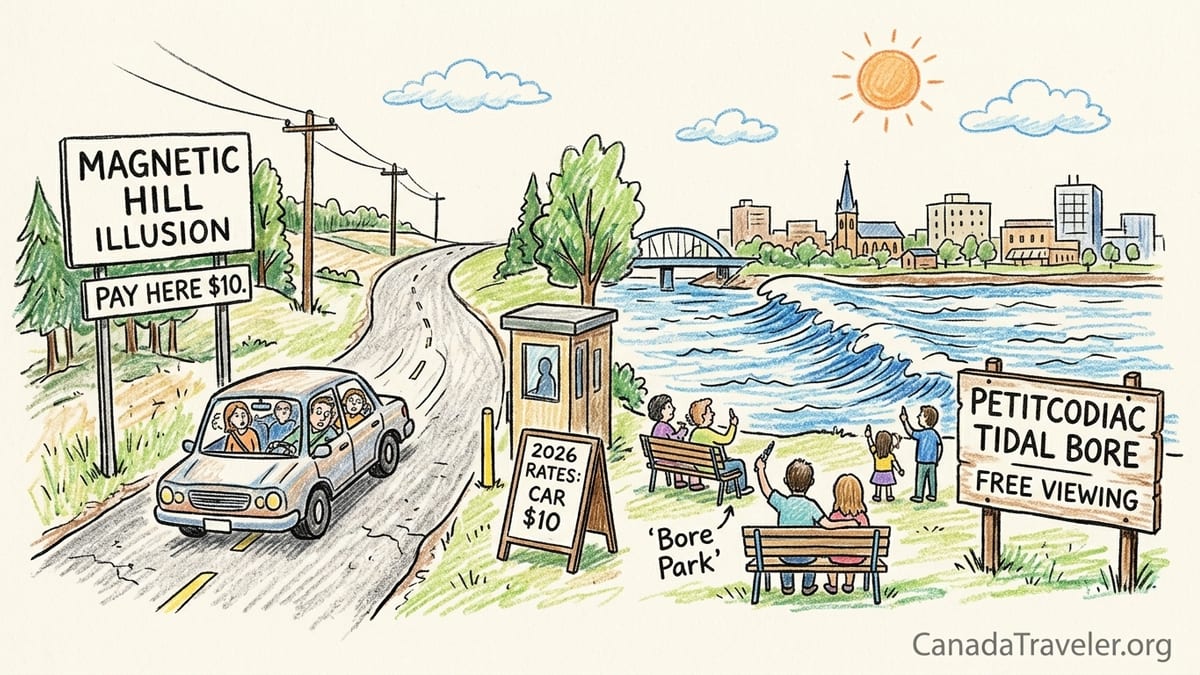
The illusion is operated directly by the City of Moncton at 2846 Mountain Road. Pulling in, the first thing I saw was not a mysterious hill but a modest entrance lane and a small operations booth. A board listed the 2026 rate of 10 Canadian dollars per car and 60 dollars per bus, matching the city’s posted schedule for the Magnetic Hill Illusion. The hill runs seasonally, generally from early May into late September, with the city specifying dates for when it is staffed, open, or closed to protect the road surface in winter conditions.
That seasonality matters. If you visit in October or April expecting to try the illusion, you may find barriers up and notices asking drivers not to access the hill. Road damage in freeze-thaw cycles is a real issue here, and the city explicitly closes the attraction through the colder months. Standing there on a warm afternoon, it already felt less like a mysterious natural wonder and more like a municipal facility, complete with hours, fees, and an off-season shutdown.
Still, the idea of a car rolling uphill is powerful. As I paid the fee and took the provided instructions, I wanted to believe there might be at least a moment of genuine confusion, a brief challenge to my sense of how the world works. Magnetic Hill has been famous across Canada for decades and appears in countless travel articles and even school textbooks. With that sort of cultural build-up, it is easy to walk in expecting something borderline supernatural.
What Actually Happens When You Drive the Hill
The process is simple, and staff are used to first-timers who look slightly bewildered. After the booth, you follow a short lane that curves gently and leads down to what appears to be the bottom of a hill. Painted markings and posted signs tell you where to stop. The instructions are straightforward: drive down to the line, come to a complete stop, keep your wheels straight, put the car in neutral, and take your foot off the brake. The key is not to overthink it and, perhaps more importantly, not to expect fireworks.
I eased my car forward to the indicated spot. From the driver’s seat, the road ahead looked like it rose gently away from me. A shallow valley of sorts, with trees and slopes framing the narrow strip of asphalt, partially blocked any clear view of the true horizon. A roadside ditch trailed along one side, but there were few vertical reference points like buildings or utility poles. The entire setup was quietly designed to confuse my sense of level.
Following directions, I shifted into neutral and lifted my foot from the brake. The car hesitated for a fraction of a second, then began to roll, apparently backward and up what looked like an incline. The movement felt natural, neither jerky nor particularly fast. In physical terms, nothing dramatic was happening. There was no tug, no feeling of a force acting against gravity, just the familiar sensation of a vehicle coasting under its own weight.
The strange part lay purely in what my eyes insisted they saw. Looking back over my shoulder, I could see the road surface behind me seemingly rising. The car continued to gain a little speed as we rolled. The impression that we were climbing against gravity lasted for perhaps ten or fifteen seconds before the car settled near the “top” of the segment and came to a stop. That was it. No magnets, no instruments swinging wildly, no unexpected lurches. Just a glide along a very slight slope framed by carefully chosen terrain.
The Science: A Gravity Hill, Not a Magnetic Miracle
Magnetic Hill belongs to a family of phenomena known as gravity hills. Around the world, these spots attract visitors with the promise of water running uphill, balls that roll the wrong way, or cars that drift “up” slopes. In every verified case, the effect is an optical illusion created by the landscape. Magnetic Hill in Moncton is no exception. The name suggests invisible forces or geological anomalies, but the physics is entirely ordinary.
At a gravity hill, the section of road where vehicles appear to roll uphill is actually a slight downhill grade. The trick lies in how the surrounding land tilts and blocks the true horizon. On Magnetic Hill, slopes from Lutes Mountain, roadside embankments, and tree lines collectively skew your visual frame of reference. Without a reliable horizontal line to compare against, your brain misinterprets the angle of the road. What your eyes label as “up” is simply less downhill than the area around it.
Surveying tools tell a very different story from your senses. When engineers measure gravity hills, they consistently find a measurable downhill gradient along the section where cars appear to climb. The same is true here: Magnetic Hill is part of a larger sloping landscape, and gravity pulls cars in the expected direction, from higher to lower elevation. The apparent paradox is purely cognitive. Your vestibular system, sensitive to acceleration and tilt, feels only a gentle coast consistent with a slight descent, while your eyes claim the opposite because of the visual context.
There is no evidence of unusual magnetism at the site. Compasses behave normally, car electronics function as expected, and there are no dead spots for mobile phones. Nor is there any credible data suggesting variations in local gravity that would account for the effect. The “magnetic” label emerged historically as a catchy explanation, not as a scientific diagnosis. When you pay your admission fee, what you are really buying is access to a carefully maintained optical illusion, not a physics anomaly.
From Farm Cart Path to National Curiosity
Part of what protects Magnetic Hill from being dismissed outright as a tourist trap is its age. This is not a modern roadside gimmick bolted together beside a highway. The hill began as a simple cart path at the base of Lutes Mountain, used by local farmers in the nineteenth and early twentieth centuries. Drivers of horse carts reportedly noticed that their animals seemed to strain less than expected in one direction and more in another, long before automobiles became common.
As cars spread through the region in the early twentieth century, motorists started reporting the odd experience of vehicles that appeared to roll uphill when left out of gear. By the 1930s, an enterprising local resident, Muriel Lutes (later Sikorski), is credited with giving the phenomenon a name, “Magnetic Hill,” and selling ice cream and souvenirs to a growing trickle of curious visitors. The city eventually embraced the attraction, re-routing roads to preserve the illusion and promoting it through tourism campaigns.
Over the following decades, particularly after the Second World War, Magnetic Hill became one of New Brunswick’s most famous roadside stops. It appeared in guidebooks, travel features, and school materials as a quirky Canadian oddity. The area around it evolved into a broader leisure district, with the later development of the Magnetic Hill Zoo, the Magic Mountain water park, and, more recently, the Magnetic Hill Winery and spa facilities nearby. All of these are separate businesses, independent from the city-run hill itself, but they collectively create the impression of a single, unified destination.
By the 1960s and 1970s, Magnetic Hill was firmly established as part of family road trip lore. Today, the city lists it as one of its signature attractions, alongside the Petitcodiac tidal bore and nearby coastal sites on the Bay of Fundy. The enduring popularity is understandable. Few places can honestly claim to offer the feeling of driving “uphill” under zero power, even if science has long since demystified what is happening.
Paying for a Ten-Second Illusion
The unavoidable question for modern travelers is whether the price matches the experience. In 2026, the City of Moncton charges 10 Canadian dollars per car and 60 dollars per bus to drive Magnetic Hill during its operating season, with staff at the entrance to collect payment and manage traffic. For a family of four in one vehicle, the per-person cost is modest. For solo travelers or budget-conscious backpackers, paying a fixed fee to roll down a hill once or twice feels less defensible.
The experience itself is brief. From the moment you stop at the marked line to the moment the car coasts to a halt, you are looking at perhaps 10 to 20 seconds of motion, depending on your vehicle and how far you let it roll. You can turn around at the bottom and repeat the process, but the novelty decays quickly. My second run was more an attempt to double-check what I had just felt than a source of new sensations. By the third pass, the illusion was fully catalogued and largely unremarkable.
The city does not dress the illusion up with extra theatrics. There are no elaborate interpretive exhibits at the roadside, no hands-on demonstrations of optical illusions, no small museum to contextualize gravity hills worldwide. The on-site infrastructure consists mainly of the operations booth, signage, and the short stretch of road that forms the illusion itself. If you expect a half-day attraction for your 10 dollars, you will be disappointed. In practical terms, most visitors will spend far more time driving out from downtown, queuing briefly, and looping back than they will actually spend coasting on the hill.
Of course, it is possible to argue that the small fee goes toward maintenance, staffing, and road upkeep. Without controlled access, the site would likely see heavy traffic, unsafe speeds, and winter damage. Yet from a traveler’s standpoint, the value calculation is blunt. You are paying a city toll to experience a natural optical illusion that requires no special equipment. It is difficult not to feel that you have purchased a story more than an activity.
Where Expectations Clash With Reality
The gap between Magnetic Hill’s reputation and the actual experience manifests in several concrete disappointments. The first is sheer brevity. Advertising copy and word-of-mouth tales make it sound as if you will spend meaningful time exploring a mysterious hill. In reality, the effect plays out in seconds. Even with a few repeat runs, it is hard to stretch the visit beyond ten minutes unless you linger to watch others attempt it.
The second disappointment is philosophical: you are paying for a roadside illusion. Nothing at Magnetic Hill is hidden behind walls or elaborate equipment. The illusion exists because the land slopes as it does, and the city has chosen to control vehicular access and charge for it. Many travelers will shrug and pay anyway, accepting the fee as a kind of novelty toll. Others, particularly those who arrive imagining a free oddity they can casually drive, may resent the commercialization of what is fundamentally a quirk of topography.
Third, and perhaps most obvious to anyone with a basic grasp of physics, there is no actual magnetic phenomenon involved. Compasses do not spin, phones do not glitch, and no one will measure unusual forces at work. The “magnetic” label, charming as it is, verges on misdirection for visitors who have not read about gravity hills. People sometimes arrive expecting something akin to a science museum demonstration of magnetism or a geological anomaly. What they get is a fun but ordinary optical trick, the same category of illusion that makes certain pictures appear to bulge or spiral when they are perfectly flat.
A fourth source of letdown is the narrowness of what you can do on-site. Beyond driving the hill, there are no built-in walking trails tied directly to the illusion, no shaded picnic area overlooking the slope, and no small interpretive center explaining the history of Magnetic Hill within the broader story of Moncton. If you want more to see and do, you must leave the hill and deliberately choose another venue, such as the Magnetic Hill Zoo, Magic Mountain water park, or the Magnetic Hill Winery. These are separate attractions, with separate admission fees and operating schedules, and they should not be conflated with the hill itself.
Finally, there is the seasonal closure. Many visitors encounter Magnetic Hill as a name on a map long before they arrive in New Brunswick. Reaching Moncton outside the May to September operating window can trigger a particularly frustrating realization that the hill is closed, barriers are in place, and the city explicitly requests that drivers stay away to avoid damaging the road. That makes sense for preservation and safety, but it also underscores how constrained the experience is. A truly compelling natural wonder rarely needs a sign to tell you when it is available.
Separating the Hill From Its Commercial Neighbours
Part of the confusion around expectations comes from the broader Magnetic Hill district, which stacks several attractions side by side. The Magnetic Hill Zoo is a sizeable facility in its own right, operated separately from the hill, with its own entrance, prices, and promotional campaigns. It is particularly busy in summer and even runs popular nighttime events in winter. Some visitors assume that entry to the hill includes at least partial access to the zoo, which is not the case.
Next door, Magic Mountain bills itself as one of Atlantic Canada’s major water parks, with water slides, a lazy river, pools, mini-golf, and seasonal ride operations. It is a full-day attraction for families and teenagers looking for rides and water play. Again, it has nothing to do with the gravity hill experience beyond sharing the name and location. Travelers booking accommodation nearby sometimes focus on the water park and zoo, treating Magnetic Hill proper as a ten-minute diversion tacked onto a longer stay.
The Magnetic Hill Winery, set in a heritage farmhouse overlooking the area, offers tastings, vineyard views, and event spaces. It leans into the region’s story, including references to the hill, but its draw is food, wine, and scenery, not car tricks. Spa and lodging options have also emerged in the vicinity, positioning the area as a multi-day gateway to the Bay of Fundy and coastal drives. There is real substance here for those willing to unpack the layers, but it is important to keep each experience distinct.
If your only goal is to see a car appear to roll uphill, you do not need to budget an entire day in the Magnetic Hill area. Conversely, if you are already planning to visit the zoo, splash at Magic Mountain, and enjoy an evening tasting local wine, treating the actual hill as one short curiosity among many makes far more sense than building your trip around it. Conflating them into one monolithic “Magnetic Hill attraction” almost guarantees either overplanning or disappointment.
Comparing Magnetic Hill With the Petitcodiac Tidal Bore
To understand the value question, it helps to contrast Magnetic Hill with another of Moncton’s signature phenomena: the Petitcodiac tidal bore. Twice a day, the immense tides of the Bay of Fundy send a wave of water surging up the Petitcodiac River against the normal downstream current. At Bore Park, right in downtown Moncton, you can watch this single wave roll past, followed by a rapid rise in water level along the riverbank. The city promotes it as a defining natural spectacle of the region, viewable year-round, with schedules posted so visitors know when to gather.
The tidal bore is free to watch. There are benches, railings, and open space along the riverfront where locals and tourists mingle as they wait for the wave. On some days the bore is modest, a low rolling front of churning brown water. On others, especially when tidal conditions line up, the wave can reach a noticeable height and power, attracting surfers and photographers. Either way, you are witnessing a real tidal event tied directly to the extraordinary range of the Bay of Fundy.
There is no equivalent gate or entry booth at Bore Park. You may pay for parking or a coffee from a nearby café, but the river itself remains open. The experience takes longer, too. You can arrive a little early, watch the river reverse direction, and linger as the water continues to rise. There is space for conversation, contemplation, and photography that does not feel rushed. Even on an unremarkable day, the sense of participating in an authentic natural cycle is difficult to replicate at a gravity hill that lasts only seconds.
Standing at Bore Park after visiting Magnetic Hill, the contrast felt sharp. At the hill, I had paid a fixed fee to access a road section designed to emphasize a visual trick. At the river, I was free to engage with a genuine tidal phenomenon shaped by geography and the moon. Magnetic Hill is clever and amusing; the tidal bore, even in its quieter moods, is elemental. Travelers with limited time in Moncton would be wise to weigh this comparison carefully when deciding how to spend an afternoon.
The Takeaway
So is Magnetic Hill a tourist trap or a charming regional quirk worth a detour? The answer depends heavily on how you frame it. As a destination in its own right, demanding a special journey to Moncton, the hill falls short. The experience is too brief, too simple, and too entirely explained by basic optics to justify building an itinerary around it. If you have driven hours solely to watch your car glide for ten seconds along a cleverly sloped road, some disappointment is almost guaranteed.
As a ten-minute novelty folded into a broader day around Moncton, however, Magnetic Hill makes more sense. If you are already spending time at the Magnetic Hill Zoo, plunging down slides at Magic Mountain, or tasting wines nearby, the 10 dollar car fee becomes part of a larger outing. You stop by, roll your vehicle “uphill,” enjoy the dissonance between what your eyes see and what your body feels, and move on with a mildly better story to tell. In that context, the hill belongs in the same mental category as world’s-largest roadside statues or quirky photo stops, not must-see wonders.
What matters most is expectation management. Arrive knowing that you will not encounter magnets, secret machines, or unexplained forces. Understand that you are paying for controlled access to a very short stretch of road whose magic exists only in your brain’s interpretation of slopes and horizons. Recognize that the commercial bustle around the hill belongs to separate businesses and that the city-operated illusion stands alone as a simple, historic curiosity.
If you can accept all that, Magnetic Hill offers a brief but legitimate thrill: the unsettling, childlike moment when your senses argue over whether water can run uphill and cars can coast against gravity. It will not change your life, and it should not dominate your travel plans, but as a side dish to the richer experiences of Moncton, it can still earn its place on the plate.
FAQ
Q1. Is there really anything magnetic about Magnetic Hill in Moncton?
The name is purely historical and promotional. The effect is a gravity-hill optical illusion created by the surrounding terrain and an obscured horizon, not by magnetism or unusual forces.
Q2. How much does it cost to drive on Magnetic Hill in 2026?
The City of Moncton lists a 2026 admission fee of 10 Canadian dollars per car and 60 dollars per bus for the staffed Magnetic Hill Illusion road segment.
Q3. How long does the Magnetic Hill experience actually last?
From stopping at the marked line to coasting to a halt, the apparent “uphill” roll typically lasts only about 10 to 20 seconds, though you can repeat it by looping around.
Q4. When is Magnetic Hill open during the year?
The hill operates seasonally. The city’s schedule generally runs from early May into late September, with specific periods when it is staffed daily and shoulder periods with limited days.
Q5. Can I visit Magnetic Hill in winter?
No. The City of Moncton closes the hill in the fall and winter to protect the road and ensure safety, and asks drivers to respect barriers and not use the hill in cold-weather months.
Q6. Is Magnetic Hill the same thing as the Magnetic Hill Zoo or Magic Mountain?
No. The hill, zoo, Magic Mountain water park, and Magnetic Hill Winery are separate attractions in the same district, each with its own entrance, fees, and operating hours.
Q7. Is Magnetic Hill worth the money compared with free sights in Moncton?
It depends on expectations. The illusion is brief and simple, while free attractions like the Petitcodiac tidal bore at Bore Park offer longer, genuine natural spectacles without a gate fee.
Q8. How does Magnetic Hill compare to other gravity hills around the world?
Magnetic Hill is one of the better-known gravity hills and has a long history as a roadside attraction, but scientifically it works the same way as similar optical illusions elsewhere.
Q9. Can I walk or cycle Magnetic Hill instead of driving?
The classic experience is to drive and roll in neutral, and vehicle access is controlled by the city. Walking or cycling would change the effect and is subject to local rules and safety considerations on the road.
Q10. Should I plan a special trip just to see Magnetic Hill?
For most travelers, Magnetic Hill is best treated as a quick novelty while already in the Moncton area, not as a standalone reason to plan a long journey.