


The first hint that I was really leaving Halifax behind came just past Bridgewater, when the salt smell faded from the air and the road narrowed into the forest. Two hours earlier I had pulled away from the glass towers on Hollis Street and the container cranes of the harbour, following Highway 103 southwest before turning inland on the Kejimkujik Scenic Drive. By the time I passed Caledonia and the sign for Kejimkujik National Park and National Historic Site, the landscape had shifted from coastal towns and clearcuts to continuous Acadian forest, low drumlin hills and sudden flashes of dark water between the trees. I had come for one weekend with three goals in mind: to paddle Keji’s quiet freshwater routes, to learn something real about the Mi’kmaw cultural landscape here, and to see what the sky actually looks like in a designated Dark-Sky Preserve.
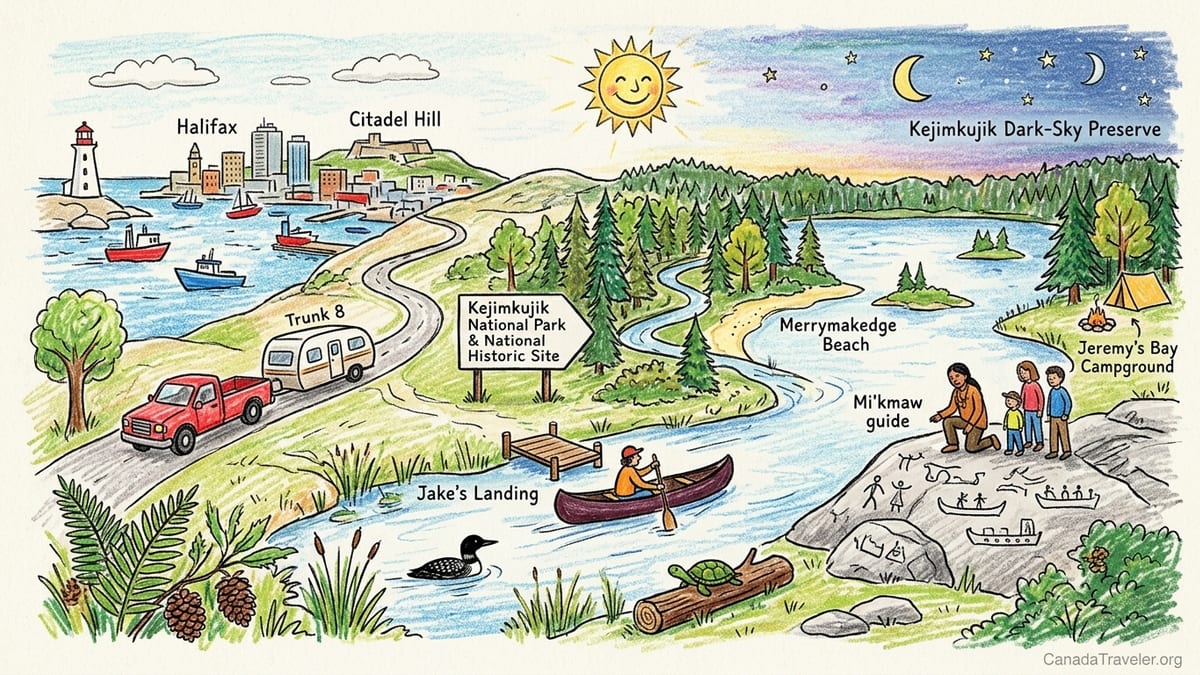
Getting Inland: From Halifax Harbour to Mi’kmaw Forest
I left downtown Halifax in late July on a clear Saturday morning, aiming for a mid-morning arrival at the park. The official Parks Canada directions put Kejimkujik about 167 kilometres and roughly two hours from the city, and that estimate proved accurate for me. I followed Highway 103 past Hubbards and Mahone Bay, then turned off near Bridgewater and joined Trunk 8, which locals know as the Kejimkujik Scenic Drive. The traffic thinned to the occasional pickup or RV, and the road began to roll through long stretches of mixed spruce, hemlock and maple.
The transition from saltwater to freshwater felt gradual but unmistakable. Near Liverpool, the coastal rivers still carried the memory of tidal influence, with wide, flat estuaries that seemed to breathe with the ocean. By the time I was north of Milton on Trunk 8, the Mersey River had narrowed into something entirely different: dark, tannin-stained water slipping between granite boulders and cedar shadows. There were fewer houses, more marshes edging the road, and regular glimpses of small lakes that did not have so much as a cottage or wharf on them.
The final approach to the park gate passes through Maitland Bridge, a modest rural community that feels like a threshold. A sign at the entrance makes clear that Kejimkujik is not only a national park but also a National Historic Site, set in the unceded traditional territory of the Mi’kmaq within the district of Kespukwitk. That dual status matters. This is not just a place for camping and canoeing. It is formally recognized as a Mi’kmaw cultural landscape, shaped by millennia of travel routes, seasonal camps and stories carried along the waterways.
At the Visitor Centre I paid the daily Parks Canada admission, picked up a current map and confirmed two practical points that would shape my weekend. First, motorized boats are not permitted on Kejimkujik’s lakes and rivers without special authorization, something Parks Canada reinforced in its 2026 guidance to protect water quality and the quiet character of the backcountry. Second, that same guidance framed the day-use paddling time I had in mind: roughly one to two hours is considered an easier outing on the Mersey River, while two to three hours is a reasonable window for a short lake-and-islands loop on Kejimkujik Lake.
Day One on the Water: Paddling from Jake’s Landing
My first stop after the Visitor Centre was Jake’s Landing, about a five-minute drive deeper into the park. This is where Whynot Adventure, known as The Keji Outfitters, runs canoe, kayak and stand-up paddleboard rentals. Their small wooden office and dock sit directly on the Mersey River, with Kejimkujik Lake just around the bend. The scene felt almost improbably gentle for a national park: loons calling in the distance, a few families sliding canoes into the water, and no engine noise at all.
At the rental desk I opted for a twelve-foot solo canoe for two hours, enough time for a relaxed Mersey River paddle with room to linger. Prices can change from season to season, but during my visit the hourly rental fell in the mid-twenties in Canadian dollars, including paddle, personal flotation device and the required safety kit. The staff asked about my paddling experience, gave a concise safety talk that echoed Parks Canada’s own advice, and suggested a simple route: launch at Jake’s Landing, follow the slow current downriver toward Kejimkujik Lake for half an hour, then turn back and explore one of the side channels before returning.
The Mersey here is broad and slow, more like the long upper arm of a lake than a classic river. The water, stained the colour of strong tea by the surrounding bogs, carried a faint resin scent. In late July the level was moderate, with very little perceptible current in either direction. This matched what I had read in the park’s paddling descriptions, which note that the section between Jake’s Landing and the lake is well suited to beginners and families looking for roughly one to two hours on the water in normal conditions.
Navigation was straightforward. I followed the right-hand shoreline on the way out, using prominent white pines and smooth granite outcrops as waypoints. There are no buoys or channel markers here, just occasional backcountry campsite signs set discretely in the woods and the distant line of Merrymakedge Beach on the far side of the lake. Paddling into a light headwind, my progress felt unhurried but steady, and within about 25 minutes I reached the broad opening where the Mersey spills into Kejimkujik Lake. The lake itself was nearly flat, with a low, rhythmic chop that stayed under a foot high, and no boat wakes to contend with.
Wildlife appeared in brief, quiet moments. A loon surfaced roughly twenty metres from my canoe, gave me a long, appraising look and then slid silently under again. Swallows worked the air above the shoreline, scooping up insects. Along one marshy bend, a painted turtle basked on a half-submerged log, motionless until my bow drifted too close and it plopped into the water with a quick splash. On the return trip up the river I hugged the opposite bank, slipping into a shallow side channel where the current almost stopped completely and the surface mirrored the sky.
Physically, this outing sat on the easy end of the spectrum. With no portages and minimal current, the main work was in maintaining a relaxed, steady stroke into and then back out of the light wind. The effort added up, but it never felt strenuous, and I reached the dock at Jake’s Landing comfortably within my two-hour rental window. What complicated the experience, in a good way, were the reminders that this was not “wilderness” in the sense of untouched land. Interpretive signs at the Visitor Centre and in park publications emphasize that the canoe routes here follow traditional Mi’kmaw travel corridors that once linked the Bay of Fundy to the Atlantic coast.
It is one thing to read that the Mersey and Kejimkujik Lake were used for thousands of years as transportation and trade routes by the Mi’kmaq, and another to sit in a canoe and imagine these same low, forested shorelines in winter, spring and summer, with birchbark canoes hauling families, furs, fish and stories. The bends that modern paddlers treat as pleasant diversions were, for generations, part of practical wayfinding through Kespukwitk. Recognizing that long-standing cultural importance shifted my own outlook. I was not just recreating on a scenic river. I was briefly sharing space with a deep, layered history that predates any national park boundary.
Walking With Stories: Joining a Mi’kmaw-Led Petroglyph Tour
That afternoon I left the boat racks behind and drove over to the Merrymakedge area to join an authorized petroglyph tour. The petroglyphs at Kejimkujik, carved into slate bedrock along the lakeshore, are one of the main reasons the site is recognized as a national historic site. They include images of Mi’kmaw people, canoes and European ships, among others, and they sit in a restricted area that is not open for casual exploring. Parks Canada is clear that guided tours are the only way visitors can access these rocks.
I had pre-registered earlier in the week through the park, which turned out to be essential. For 2026, the public petroglyph tour was offered as a free program with park admission, but registration was required and each outing had a maximum of about twenty participants. The group size cap made sense as soon as we assembled at the meeting point. A Mi’kmaw interpreter and a Parks Canada staff member greeted us, checked our names against the list, and led us along a short path toward the lakeshore.
The walk itself covered only a few hundred metres, but it felt like entering another layer of the park. Before we reached the rocks, the interpreter spoke about Kejimkujik as part of a broader Mi’kmaw cultural landscape, not just a collection of artifacts. She situated the petroglyphs within patterns of seasonal movement, travel routes and family histories. It was clear that these carvings are not just pictures; they are expressions of relationships, events and ways of seeing the world. She did not translate or interpret every image in detail, and she was explicit about not sharing stories that were not meant for public retelling.
At the rock shelves themselves, photography was tightly controlled. The guide asked us to put our phones and cameras away, explaining that both Parks Canada and Mi’kmaw partners want to prevent uncontrolled online circulation and potential misuse of the images. As the group took turns kneeling to see particular carvings, the interpreter pointed out shapes with a soft brush and small mirror to angle the light. Some figures were immediately recognizable, like canoes with human figures, while others were faint outlines that she did not define for us at all. More than once, she reminded us that certain meanings are held within the Mi’kmaw community and are not for visitors to interpret on their own.
The tour lasted roughly seventy-five minutes from the initial welcome to our return to the trailhead, fitting within Parks Canada’s stated 60 to 90 minute window. It never felt rushed. There was time for questions about how the carvings were made, about the impact of water levels and ice, and about how the community and Parks Canada work together to care for the site. When someone in the group asked whether the petroglyphs were mainly a tourist attraction now, the interpreter’s answer was gentle but firm. She described them as part of a living cultural landscape, still connected to present-day Mi’kmaw people and governance, and emphasized that the tours are one way to invite visitors into a relationship of respect rather than spectacle.
Walking back to the parking area, I realized that this hour on the rocks had reshaped my sense of the entire park. The canoe routes, beaches and campsites I had seen on the map were layered onto an older network of meaning that I had only glimpsed. That did not diminish the simple pleasures of paddling and swimming. Instead, it gave those activities a different context, making it harder to treat Kejimkujik as just another place to “do” in a weekend.
Evening Under a Dark Sky: Stars, Clouds and Real Conditions
Kejimkujik was recognized as a Dark-Sky Preserve by the Royal Astronomical Society of Canada years ago, and much of its inland area still enjoys very low light pollution. That does not mean that every night delivers a postcard-perfect Milky Way. Weather, haze and the moon all shape what you actually see. For my July visit, I checked a clear sky chart and the weather forecast before leaving Halifax. Both suggested a mostly clear night with some high cloud and a waxing crescent moon that would set relatively early, leaving several hours of dark sky before dawn.
After an early evening meal at my campsite in Jeremy’s Bay Campground, I drove the short distance to the park’s designated sky-viewing area near the central field often used for astronomy programs. Official night-sky events vary year by year, but during my weekend Parks Canada staff and volunteers from a local astronomy group were present with a few small telescopes and binoculars for informal viewing. A red-light rule was in effect to protect night vision, so visitors were asked to cover flashlights and phone screens with red film or use purpose-made red lamps.
Conditions at dusk were promising but not flawless. The western horizon glowed softly from the last of the sunset, and a thin veil of cloud streaked the zenith. As the sky darkened, the crescent moon hung low for an hour, lighting the treetops and casting faint silver on the grass. Once it set, the sky did deepen significantly. The Milky Way became visible as a pale, mottled band running from south to northeast, but it was not as sharply defined as it can be on the very clearest nights. A trace of summer humidity softened the contrast, and occasional wisps of cloud drifted through Cygnus and Aquila.
What struck me most was the breadth of the sky rather than its drama. Away from streetlights, billboards and porch lamps, the number of visible stars expanded remarkably, even under less-than-perfect conditions. The park field opened a wide window above the surrounding forest, giving unobstructed views of the Summer Triangle, the curve of the Big Dipper tipping toward the horizon, and bright Arcturus sinking in the west. With binoculars, star clusters such as the Wild Duck in Scutum popped out easily, though faint galaxies required more patience and darker transparency than I had that night.
I never saw the aurora, and I did not come away with professional-grade astrophotography. Instead, I lay on a blanket and watched satellites and the occasional meteor surf across the sky, listening to barred owls somewhere in the forest and the quiet murmur of other visitors identifying constellations. The experience felt grounded rather than spectacular. Kejimkujik’s dark-sky status is not a guarantee of theatrical skies on any given date, but it does dramatically improve your odds of seeing a sky that still resembles what people here would have known before electric light, provided you pay attention to moon phase and cloud forecasts.
Day Two: Swimming, Short Trails and Separating Inland from Seaside
Sunday dawned warmer and slightly more humid, with thin cloud lingering after sunrise. Having spent the first day largely on the river, I wanted an easy combination of swimming and walking before the drive back to Halifax. After coffee and a simple camp breakfast, I headed to Merrymakedge Beach, a popular day-use area that offers changing facilities, picnic tables and a gentle, sandy entry into Kejimkujik Lake.
The lake water in late July hovered in the low twenties Celsius, cool at first touch but comfortable once fully submerged. Because motorized boats are restricted, the swimming area felt notably calm. Small waves lapped the shore under a light southwest breeze, and paddlers in canoes and kayaks passed at a respectful distance offshore. I swam parallel to the beach for about twenty minutes, alternating between relaxed front crawl and floating on my back to look up at the same sky I had studied more intently the night before.
Later in the morning I traded swimwear for hiking shoes and chose one of the shorter inland trails near Jeremy’s Bay, keeping my ambitions modest to match the afternoon drive. A loop of roughly five kilometres wound through mixed Acadian forest, crossing small brooks on wooden bridges and passing occasional interpretive panels that touched on Mi’kmaw land use, the importance of hemlock stands and the role of fire. The terrain was mostly gentle, with a few short rooty sections and some boardwalk over wetter ground. In mid-summer the undergrowth was thick, and I did encounter blackflies and mosquitoes in the shadier stretches, making insect repellent and light long sleeves very welcome.
At one lookout over a smaller interior lake, the continuity of the paddling network became clear. Even from shore, the view suggested how easily one could move from lake to lake with short portages, threading through a landscape designed by water. It underscored something I had heard repeated in park materials and from the petroglyph interpreter: the Mi’kmaw routes here were not random wanderings. They were efficient, knowledgeable use of currents, landforms and seasons, a sophisticated travel system evolved over thousands of years.
Before leaving, I made a deliberate decision not to squeeze in a side trip to Kejimkujik Seaside. Many visitors assume the “seaside adjunct” is a quick extension of the inland visit, but it is in fact a separate coastal section near Port Joli, roughly an hour or a bit more by road from the main inland park, depending on the route. The seaside area offers white sand beaches, coastal barrens and views of seals, but it operates almost like a different park, with its own trailheads off Highway 103 and Trunk 3. Trying to visit both inland Keji and the seaside section in the same short weekend would have meant shortchanging one or the other. For this trip, I chose to let the freshwater, forest and stars be enough.
Practicalities: Camping, Gear, Insects and Costs
For accommodation I booked a drive-in campsite at Jeremy’s Bay Campground, the main frontcountry camping area at Kejimkujik. Reservation fees and site prices can shift from season to season, but during 2026 a basic unserviced site in mid-summer typically fell in the mid-thirties to low-forties range per night in Canadian dollars, plus a modest reservation charge. My site offered a level tent pad, fire pit with grill, picnic table and access to shared washrooms with potable water taps nearby. The campground was active but not rowdy, with a quiet-hours policy that was generally respected, especially by those staying up for stargazing.
In terms of equipment, I brought a three-season tent, self-inflating sleeping pad, synthetic sleeping bag rated slightly below forecast overnight lows, and a simple camp kitchen kit. Because of Kejimkujik’s healthy wildlife populations, I stored all food, coolers, toiletries and scented items in my car when not actively cooking or eating. Parks Canada signage in the campground reiterated the importance of not leaving food out, both to protect bears, raccoons and smaller animals and to avoid campsite damage. I did not see a bear during my stay, but I did encounter bold red squirrels and ravens ready to investigate any unattended snacks.
Insects were a real factor. Even in late July, blacklegged ticks are present in the park, and they are known carriers of the bacteria that cause Lyme disease. Information panels and brochures from Parks Canada recommend tucking pants into socks on brushy trails, using insect repellent that contains DEET or another approved ingredient, and doing thorough tick checks at day’s end. Mosquitoes and blackflies were most noticeable at dusk and in shaded, damp forest sections. A lightweight head net stayed in my pocket, and I was glad to have it on one particularly still evening near a bog.
Over two days, my major expenses broke down roughly into fuel for the return drive from Halifax, park admission, one night of camping and the two-hour canoe rental. Because I brought my own food, cooking on a small stove and occasionally using the campsite fire grate, I did not spend much on restaurant meals. A traveler relying more on prepared food from Bridgewater or Liverpool on the way in would want to budget for those costs, as well as potential stops at the small café near Jake’s Landing that operates in season.
All told, a modest but comfortable Kejimkujik weekend from Halifax for one person with existing camping gear can be kept under a few hundred Canadian dollars, including fuel, fees and one or two activity rentals. Adding more extensive outfitted trips, guided paddling excursions or restaurant dining would increase that total, but the park remains relatively accessible compared with more remote Canadian national parks that require flights or ferries.
The Takeaway
Driving back toward Halifax on Sunday afternoon, retracing Trunk 8 to Highway 103, I felt the subtle shift as forest and lakes gradually gave way to larger towns, billboards and finally the familiar industrial edges of the city. The weekend had been brief and, in some ways, simple. I had paddled only a short stretch of the Mersey, walked a modest loop, joined one guided tour and spent a single night under Keji’s dark sky. Yet it felt complete in a way that many more crowded, checklist-driven trips do not.
Part of that completeness came from the park’s own structure. Kejimkujik’s inland section is compact enough that you can move easily between Jake’s Landing, Merrymakedge, the campground and the dark-sky viewing field without spending your whole visit in the car. At the same time, the cultural and natural layers run deep. Recognizing that the lakes and rivers are long-standing Mi’kmaw travel routes, not just scenic backdrops, gives even a casual paddle more weight. Standing at the petroglyph rocks on an authorized tour, under the guidance of a Mi’kmaw interpreter, made it impossible to treat the place as a neutral wilderness playground.
Would I recommend Kejimkujik as a day trip from Halifax? It is technically possible. With about two hours of driving each way, Parkbus services on select days for those without cars, and day-use passes available, a determined visitor could squeeze in a quick paddle and a short hike before heading back. But having now spent a full weekend, I would argue that Keji deserves at least two days, and ideally longer. The rhythm of the place suits early morning fog on the lake, unhurried afternoons and long evenings watching the sky darken, not a rushed checklist between highway stints.
If you arrive expecting spectacle on demand, you may be disappointed. Clouds may blunt your view of the Milky Way. The petroglyph tour may be full unless you register in advance. Loons might keep their distance. Yet if you come willing to pay attention to real conditions and to the stories that predate your visit by centuries, Kejimkujik quietly offers something more enduring: a chance to travel, however briefly, through a living Mi’kmaw landscape, to move at the pace of paddle strokes rather than engines, and to look up at a night sky that still feels connected to the one those paddlers would have known.
FAQ
Q1. How long does it take to drive from Halifax to Kejimkujik National Park?
Driving from downtown Halifax to the inland entrance of Kejimkujik is roughly 160 to 170 kilometres and usually takes just over two hours in normal traffic via Highway 103 and Trunk 8.
Q2. Do I need to book canoe or kayak rentals at Kejimkujik in advance?
Advance reservations for rentals from the outfitter at Jake’s Landing are strongly recommended in summer and on weekends, especially if you want specific boat types or multi-hour bookings.
Q3. How difficult is the Mersey River paddle from Jake’s Landing?
The section between Jake’s Landing and Kejimkujik Lake is generally considered easy, with slow current and no portages, fitting well into a one to two hour outing for beginners.
Q4. Can I see the petroglyphs on my own without a tour?
No. The petroglyph site is in a restricted area, and public access is only through guided tours that require registration and have limited group sizes.
Q5. Are the petroglyph tours at Kejimkujik free?
For the 2026 season the standard public petroglyph walking tour was included with park admission but still required advance registration to manage numbers.
Q6. Will I definitely see the Milky Way or aurora at Kejimkujik?
Even in a Dark-Sky Preserve nothing is guaranteed. Visibility depends on cloud cover, humidity, light pollution and the moon phase during your visit, so conditions vary night by night.
Q7. Is Kejimkujik Seaside in the same place as the inland park?
No. Kejimkujik Seaside is a separate coastal section near Port Joli, roughly an hour or more by road from the inland park, with its own trailhead and parking areas.
Q8. What kind of wildlife encounters should I expect?
Common sightings include loons, turtles, songbirds and small mammals. Black bears live in the park but are usually wary; proper food storage and clean camps help avoid conflicts.
Q9. How bad are the insects in summer at Kejimkujik?
In late spring and summer you can expect mosquitoes, blackflies and the presence of blacklegged ticks. Using repellent, wearing long sleeves and doing tick checks are all important.
Q10. Is one day enough, or should I plan a full weekend at Kejimkujik?
A single day allows only a brief sample of paddling or hiking. A full weekend gives time for at least one paddle, a guided cultural program and an evening under the dark sky without feeling rushed.