


The first time I turned off Highway 101 toward Grand Pré, the landscape did not look like a world heritage site. It looked, quite simply, like farmland: flat green fields, a silver line of dykes along the horizon, and the Minas Basin glinting beyond. Yet as I stepped out of the car and felt the damp wind off the Bay of Fundy, I realized I had entered a place where ordinary scenery carries an extraordinary weight of memory. My journey from Grand Pré to Annapolis Royal was not a casual road trip, but a deliberate walk through Acadian history, from ingenious marshland agriculture to the brutal deportations of 1755, and into the living conversations today between Acadian and Mi’kmaw communities about what this history means.
Walking Into the Landscape of Grand Pré
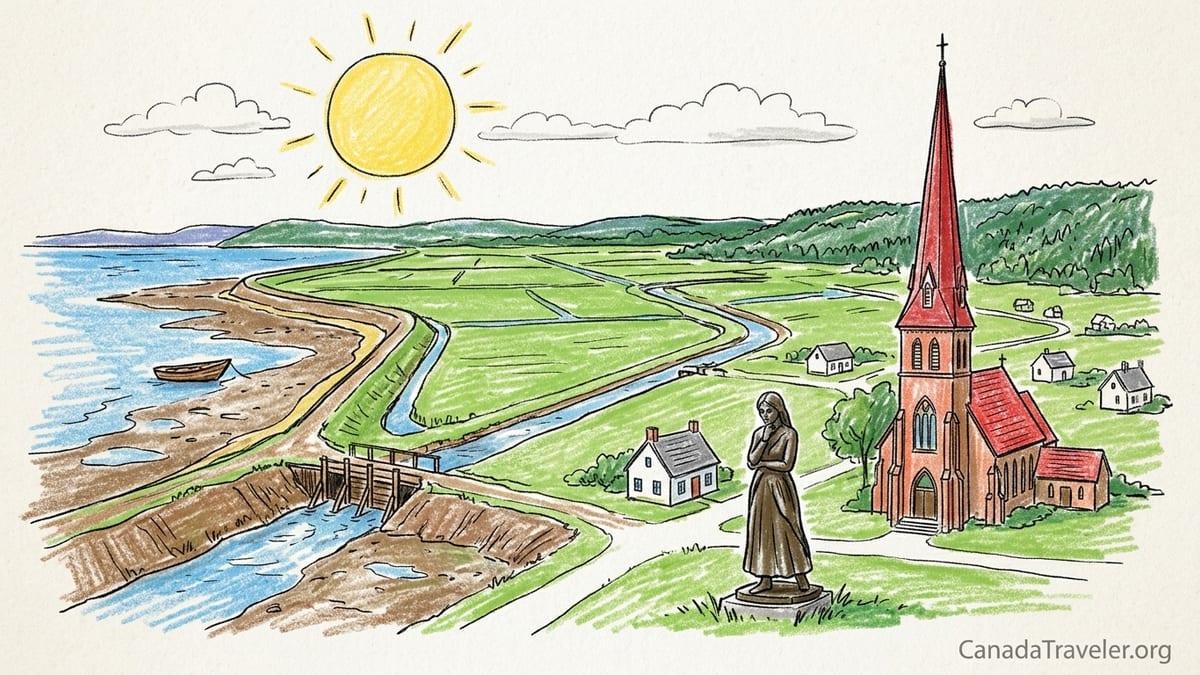
At Grand-Pré National Historic Site, I began not in the museum but outside, on the path that leads toward the fields. A low sea wind pushed over the dykelands, bringing the smell of salt and mud from the Minas Basin. Before me stretched the cultural landscape that UNESCO recognized in 2012 as the Landscape of Grand Pré, roughly 1,323 hectares of reclaimed marsh and settled upland along the southern shore of the basin. From ground level, it is a patchwork of hayfields, pasture, and drainage ditches. Only when I stopped and traced the faint ridges of the dykes with my eyes did its human design begin to emerge.
Standing at the viewpoint, interpretive panels helped me read the land. They explained how Acadian settlers began, in the 17th century, to wall off sections of tidal marsh from the Minas Basin’s powerful tides using earthen dykes. Within those dykes they installed wooden sluices called aboiteaux to let freshwater drain out while holding back seawater. Over years of careful maintenance, salt marsh grasses died and decomposed, leaving behind a deep, fertile soil that could support crops and livestock. UNESCO recognized this system, developed here and maintained across centuries, as an outstanding example of polder agriculture in an extreme tidal environment where water levels can shift by many meters each day.
It is one thing to read about aboiteaux in a history book. It is another to stand on the grass and hear the hollow sound when your boot heel hits the line of an old dyke, and to imagine that each contour represents generations of backbreaking work. The tidal flats beyond, streaked with copper and gray, still rise and fall with some of the highest tides in the world. The Acadians, and later New England Planters and present-day farmers, turned that volatility into predictability by watching, adjusting, and rebuilding these earthworks season after season. This is why the Landscape of Grand Pré appears almost understated: the engineering is buried in the soil itself.
Behind me, the distinctive Memorial Church of Grand Pré rose above the lawns and gardens. Its stone walls and tall spire look centuries old, but interpretive material makes clear that the building is a 20th-century memorial, not an original Acadian church. The real parish church of Saint-Charles-des-Mines stood somewhere nearby in the early 1700s and was long ago lost. Archaeological work has found traces of Acadian houses and a cemetery, but the exact footprint of the original church remains uncertain. This mixture of visible memorial and partly hidden archaeology sets the tone for a visit here. Grand Pré is a place where absence is as important as presence.
Inside Grand-Pré National Historic Site: Memory and Deportation
Stepping into the visitor center at Grand Pré, I found cool air, hushed voices, and an unflinching narrative. Parks Canada presents the site as the heart of Acadian settlement in the Minas Basin between 1682 and 1755 and as a key stage for the Deportation of the Acadians that began in 1755. Exhibits walk visitors from the first families who arrived from France and Port-Royal, through the expansion of the dykelands, to the crisis that erupted during what Europeans called the Seven Years’ War.
One display focuses on the question of loyalty that lay at the center of Acadian-British relations. After Britain gained control of mainland Nova Scotia in 1713, Acadian settlers, French-speaking Catholics, found themselves under a Protestant British crown. Many took a modified oath of allegiance that recognized the king but included verbal understandings that they would not be forced to bear arms against France or the Mi’kmaq. This policy of neutrality held, imperfectly, for decades. Then, in 1755, British authorities in Nova Scotia demanded that Acadians take an unconditional oath. When many refused, unwilling to risk fighting against kin and allies, the colonial government chose deportation as a solution to what it saw as a security threat in wartime.
Maps and panels detail how the deportations unfolded. In the Minas region known as Les Mines, which included Grand Pré and nearby communities, British troops summoned Acadian men and boys to meetings under false pretenses and then detained them. Parks Canada estimates that roughly 2,200 men, women, and children were deported from Les Mines in 1755 alone, as part of an operation that expelled nearly 6,000 Acadians from Nova Scotia that year. Families were herded to embarkation points, including shores near Grand Pré, loaded onto overcrowded ships, and scattered to British colonies along the Atlantic seaboard, to Britain, and to France. Some vessels wrecked. Others delivered their human cargo into hostile communities where Acadians were viewed as enemies.
Inside the Memorial Church, stained glass windows and plaques convey this trauma. One window shows Acadian families being forced onto boats, guarded by soldiers with muskets. The sanctuary, with its polished wood and quiet benches, invites reflection. Yet it also challenges visitors not to sentimentalize the past. Guides and signage emphasize that the story of deportation is documented through official correspondence, parish records, and survivor accounts, not only through later poetry. Families were broken apart, land that had been reclaimed from the sea over generations was confiscated, and a people were dispersed into what became a global Acadian diaspora stretching from Louisiana to the Caribbean and back to the Maritimes.
Evangeline and the Power and Limits of Myth
Outside the Memorial Church, beneath mature trees, stands the bronze statue of Evangeline, the heroine of Henry Wadsworth Longfellow’s 1847 epic poem. She is pensive, head bowed, hands clasped, a figure that has become almost synonymous with Grand Pré. For 19th- and early 20th-century visitors, Evangeline personified Acadian loss and fidelity. It can be tempting, when you first see her, to imagine that you are standing on the trail of a single real woman who wandered North America in search of her lost love.
The interpretive material on site is careful to correct that impression. Longfellow wrote Evangeline as a work of fiction inspired by secondhand stories of the deportation and by romantic literary trends of his era. There is no archival evidence of a specific woman whose biography matches the poem, trekking from Nova Scotia to Louisiana in lifelong pursuit of a fiancé. Instead, Evangeline became a symbol of Acadian endurance and suffering, embraced by Acadian communities in the late 19th century as they fought to assert their identity in the face of assimilation.
Understanding Evangeline as a symbol rather than a biographical subject changes the way you move through Grand Pré. When I walked past her statue and into the gardens, I tried to hold both the myth and the documentary record in mind. The poem magnified one aspect of Acadian experience, the tragedy of separation, and gave English-speaking audiences in North America a memorable image of injustice. But in the galleries, I read about dozens of actual families, their names painstakingly reconstructed from parish registers and shipping lists, whose stories were less tidy than Longfellow’s narrative. Some members died in transit. Others escaped into the woods and found refuge with Mi’kmaw communities. Still others eventually resettled parts of Nova Scotia, New Brunswick, and Quebec after 1764, only to discover that their former dykelands had already been granted to New England Planter families.
By the time I stepped back outside, the Grand Pré landscape looked different to me. The dykes and fields were no longer a backdrop for a single fictional couple. They were the setting for a collective history that included both ingenious adaptation to an extreme environment and calculated, state-directed removal. Evangeline’s clasped hands began to seem less like an endpoint and more like an invitation to ask harder questions about what happened here and who benefits when some stories are simplified into legend.
Driving the Annapolis Valley: Farmland as Archive
Leaving Grand Pré, I followed Highway 101 west along the spine of the Annapolis Valley. On either side, rows of apple trees, vineyards, and dairy farms slid past the car windows. Roadside farm markets advertised Honeycrisp apples, local cheese, and in summer, fresh strawberries. Town names like Wolfville, New Minas, and Kentville marked the gradual transition from the Minas Basin region toward the lower valley around Annapolis Royal.
It would be easy, at highway speed, to take this as just another rural drive. But once you have walked the dykes of Grand Pré, the valley feels like an extended archive written in topsoil. Some of the flat fields I passed still rest on former tidal marsh reclaimed first by Acadian aboiteaux and later maintained by Planter and Loyalist farmers. In places, modern steel culverts and straight ditches have replaced older wooden sluices and winding channels, but the basic idea remains the same: control the Fundy tides, convert marsh to arable land, and manage water and soil in a landscape that is always trying to revert to wetland.
Along the way, I noticed road signs pointing toward small Acadian and Mi’kmaw communities, churches with Acadian flags in their windows, and businesses advertising bilingual services in French and English. In gas stations and cafes between Grand Pré and Annapolis Royal, I overheard conversations that slipped between languages or used Acadian surnames I had just seen on 18th-century deportation lists inside the Grand Pré museum. It drove home the point that this is not a vanished culture, but a living one that carries the memory of deportation while continuing to farm, work, and raise families on the same land.
The practical details of the drive reinforce how accessible this historical route has become. On a recent visit, a compact rental car picked up at Halifax Stanfield International Airport cost in the range of 70 to 120 Canadian dollars per day, depending on season and availability, with fuel for a full day of valley driving adding another 25 to 40 dollars at prevailing prices. Admission to federal historic sites such as Grand-Pré, Fort Anne, and Port-Royal is governed by Parks Canada’s annual fee schedule. At the time of writing, an adult day entry to a single national historic site in Nova Scotia typically falls under a modest threshold compared to many international attractions, and Parks Canada also offers annual Discovery passes that can be cost-effective for travelers visiting multiple sites across the country. Checking current rates before travel is essential, since fees are reviewed periodically.
Fort Anne: A Fortified Hill Above a Tidal River
As the road descended toward Annapolis Royal, the valley narrowed and the Annapolis River broadened into a tidal estuary. Fort Anne National Historic Site occupies a grassy hill above a bend in the river, its earthwork ramparts forming sharp green angles against the sky. This is one of the oldest and most contested colonial sites in what is now Canada, a place where French, Scottish, British, Acadian, and Mi’kmaw histories collide.
Walking through the gate, I climbed onto the ramparts and looked down at the town and river. The Annapolis River is calm here, but interpretive signs explain that it, too, is tidal, rising and falling with the Bay of Fundy’s pulse far downstream. Long before Europeans fortified this hill, the area around Allains Creek at the edge of the site was an important Mi’kmaw camp along key canoe and portage routes across southwestern Nova Scotia. For the Mi’kmaq, this region, known as Kespukwitk or Land’s End, was one district within a much larger homeland. European fortifications arrived late in their story.
The museum inside the former British officers’ quarters traces Fort Anne’s layered history. Early in the 17th century, Scottish colonists attempted to plant a settlement here as part of the short-lived colony of Nova Scotia granted to Sir William Alexander. Later, French authorities took control, establishing Port-Royal nearby as the capital of Acadia. Over the next century and a half, this site and its predecessors were attacked and besieged repeatedly as French and British empires struggled for control of the region. From the Acadian perspective, Fort Anne was both seat of authority and a place where their neutrality was tested, where deputies negotiated oaths, land tenure, and relations with the Mi’kmaq under the watchful eyes of imperial officers.
Exhibits do not shy away from showing how Mi’kmaw communities were drawn into these imperial conflicts. At times, Mi’kmaq allied with the French against British expansion, launching raids on New England shipping and fur traders. At other moments, they signed peace and friendship treaties with the British, including agreements ratified at Annapolis Royal in the 1720s. Modern Mi’kmaw interpreters and community voices, through recorded audio and collaborative exhibits, describe how those treaties, though often violated by colonial authorities, continue to underpin Mi’kmaw assertions of rights and title in Nova Scotia today. Standing on the ramparts, I could see Fort Anne not just as a preserved military structure but as a focal point in the ongoing story of treaty relationships.
In the old Garrison Graveyard below the fort, gravestones carved in French, English, and Latin mark the presence of Acadian and British dead side by side. Guided tours, sometimes led by Acadian descendants from Annapolis Royal, invite visitors to consider how lives intertwined here: marriages between Acadian and Mi’kmaw families, merchants trading across cultural lines, and soldiers posted far from home. After learning about the deportations at Grand Pré, it was sobering to realize that some Acadians buried beneath my feet may have had relatives who were later expelled from the Minas Basin, while others chose or were forced to leave these lands long before 1755.
Port-Royal Habitation: A Reconstruction That Reveals the Original
A short drive from Annapolis Royal along a winding coastal road brought me to Port-Royal National Historic Site. Here, on the north shore of the Annapolis Basin, stands one of the most evocative historic reconstructions in Canada: the Habitation at Port-Royal. From the parking area, the structure looks like a compact, square wooden compound of steep-roofed buildings arranged around a central courtyard, set just above the waterline.
The staff and interpretive panels are explicit that what visitors see today is a 20th-century reconstruction, not the original 1605 settlement surviving intact. The first Habitation was built in 1605 by French colonists under Pierre Dugua de Mons and Samuel de Champlain, in partnership with Mi’kmaw leaders such as Membertou. That early settlement became a hub for fur trading and cultural exchange until 1613, when it was destroyed by an English raiding party from Virginia. The current buildings were reconstructed in the 1930s using historical drawings and archaeological evidence, and they were completed with hand-hewn timbers that themselves are now historic artifacts from the era of cultural commemoration.
Inside the Habitation, costumed interpreters demonstrate blacksmithing, bread baking, and woodworking using tools based on early 17th-century designs. It would be easy to be swept up in the charm of the setting and forget that this is essentially a three-dimensional historical argument about what the original might have looked like. To their credit, interpreters regularly remind visitors that every doorway and wall here is an informed approximation. You are not walking where Champlain walked, but you are occupying a space that allows you to understand the cramped rooms, communal sleeping arrangements, and stockade-like defenses that shaped daily life for a few dozen men in the early years of French colonization.
Mi’kmaw perspectives are woven into the Port-Royal narrative. Exhibits and guides discuss how Mi’kmaw people taught the French which plants and animals could sustain them through long winters, shared knowledge of seasonal migration routes, and maintained control over the wider territory. Artifacts and interpretive panels describe alliances sealed by kinship and conversion to Catholicism, while also acknowledging that French and later British expansions disrupted Mi’kmaw ways of life, contributed to new diseases, and reoriented trade toward European markets. One display highlights Membertou, the Kji-Saqmaw, or grand chief, who agreed to house the abandoned Habitation after the French temporarily returned to Europe in 1607, a reminder that indigenous communities were never passive spectators in this story.
Standing on the wooden walkway outside the reconstructed palisade, looking out over the calm water of the basin, I felt the temporal layering of this site. Below the surface lie the remains of the original French structures and Mi’kmaw camps. Above them stand the 20th-century buildings that reflect early Canadian nationalism and Acadian cultural revival. Around all of it, the tidal flats and forests that sustained Mi’kmaw communities for millennia continue to shape the rhythms of life. Recognizing the Habitation as a reconstruction does not diminish its value. Instead, it invites visitors to think critically about how societies choose which stories to rebuild, and whose labor goes into making those stories visible.
Costs, Logistics, and a One- or Two-Day Route
For travelers who want to follow this Acadian heritage journey rather than simply drive through the scenery, it is possible to structure a one- or two-day itinerary that connects Grand Pré, Fort Anne, and Port-Royal without rushing. On a one-day trip from Halifax, an early start is essential. The drive from Halifax to Grand-Pré National Historic Site takes roughly an hour to an hour and a half by car, depending on traffic. Arriving around opening time allows two to three hours to walk the dykelands, visit the visitor center and Memorial Church, and spend time in the gardens and archaeological interpretation areas.
From Grand Pré, continuing along Highway 101 to Annapolis Royal generally requires about two hours of driving. A brief stop in a town like Berwick or Middleton for lunch can keep the day manageable. In Annapolis Royal, Fort Anne sits within walking distance of cafes and inns, making it easy to park once and explore on foot. Allow at least an hour and a half for the fort’s ramparts, museum exhibits, and graveyard. If daylight and opening hours permit, you can then continue another 15 to 20 minutes by car to Port-Royal National Historic Site for a late-afternoon visit of roughly two hours before beginning the return drive to Halifax in the evening.
A two-day version of this route is less compressed and allows deeper engagement. After visiting Grand Pré on day one, travelers can detour into Wolfville to stay overnight in a local inn or bed-and-breakfast, with typical off-season rates often starting in the low hundreds of dollars per night for a mid-range room and rising during peak summer and fall foliage periods. Alternatively, continuing directly to Annapolis Royal and staying there creates a logical base. Historic guesthouses and small hotels in the town frequently cluster in a similar price range, with budget options somewhat lower. In either case, booking ahead is wise in July, August, and early October, when both domestic and international travelers are most numerous.
Parks Canada publishes current entry fees each season for Grand-Pré, Fort Anne, and Port-Royal, usually listing separate rates for adults, seniors, youth, and families, along with free or reduced entry on specific commemorative days. For travelers visiting multiple sites in the same year, Parks Canada’s Discovery Pass can represent good value, granting unlimited entry to participating national parks and historic sites for a set annual price that can be recouped after several site visits. Because fee structures and taxes can change, it is important to consult Parks Canada’s most recent schedules or contact their information lines when planning your budget, rather than relying on older guidebooks.
Food and fuel costs on this route are also manageable with forethought. Cafes in Wolfville and Annapolis Royal typically charge prices comparable to other small Canadian towns for coffee, sandwiches, and daily specials, with a sit-down lunch often landing in the 15 to 25 dollar range before tax and tip. Gasoline prices in Nova Scotia fluctuate with global markets and provincial regulations, but planning to top up in larger service centers like Windsor, Kentville, or Middleton gives more choice and sometimes slightly better rates than smaller rural stations. None of these expenses compare to long-haul travel, but they shape who can afford to linger in these landscapes and learn from them.
The Takeaway
When I finally turned back toward Halifax from Annapolis Royal, the Annapolis Valley evening light washed the fields in soft gold. At first glance, they looked as they might have looked to any traveler: ordinary pasture, rows of crops, scattered farmhouses. Yet after a day and a half walking dykes, reading deportation orders, standing in reconstructed barracks, and listening to Mi’kmaw and Acadian voices interpret their own histories, those same fields had changed in my eyes.
Understanding Acadian history from Grand Pré to Annapolis Royal transforms the valley into a lived archive. The quiet dykelands at Grand Pré become evidence of a sophisticated response to a challenging tidal environment, engineered by Acadians and maintained by later communities. The tranquil lawns at Fort Anne reveal themselves as a stage for decisions that disrupted lives across an entire region, where British officials debated oaths and security while Mi’kmaw leaders asserted treaty rights and Acadian deputies tried to preserve neutrality. The weathered clapboards of the Port-Royal Habitation, though reconstructed, open a window into the earliest sustained encounters between French settlers and Mi’kmaw hosts along these shores.
Heritage travel along this route is not about collecting picturesque fortresses and churches. It is about learning to read the landscape for traces of struggle, creativity, and survival. It asks visitors to recognize that for Acadian communities, the Deportation is not a closed chapter but a reference point that still shapes identity and place attachment today. For the Mi’kmaq, these sites are embedded within a much longer story of occupation, diplomacy, and resistance in Kespukwitk. For everyone who moves through the valley, understanding that history can deepen respect for the people who continue to live, farm, and advocate for their rights here.
By the time the highway rose back toward the inland forests, I realized that I would never again see a Nova Scotia dyke as a simple strip of grass, or a salt marsh as empty land awaiting development. Each embankment and drainage ditch speaks of decisions taken centuries ago: to divert a tide, to cultivate a field, to sign a treaty, or to load a family onto a ship. Traveling from Grand Pré to Annapolis Royal with those stories in mind is not only an act of education. It is a way of acknowledging that even the most ordinary-looking farmland can carry the weight of extraordinary human experience.
FAQ
Q1. Is the church at Grand-Pré National Historic Site an original Acadian building?
The church at Grand Pré is a 20th-century memorial structure, built to commemorate Acadian history. The original Acadian parish church of Saint-Charles-des-Mines no longer survives, although archaeological work has uncovered nearby Acadian foundations and a cemetery.
Q2. How many Acadians were deported from the Grand Pré area in 1755?
Parks Canada estimates that roughly 2,200 Acadian men, women, and children were deported from the Minas region known as Les Mines, which included Grand Pré and nearby communities, during the 1755 deportations.
Q3. Why did UNESCO inscribe the Landscape of Grand Pré as a World Heritage site?
UNESCO recognized the Landscape of Grand Pré in 2012 because it preserves an extensive cultural landscape of reclaimed marshland created with dykes and aboiteaux in an area with extreme tides, and because it is closely associated with Acadian history, including settlement and deportation.
Q4. Is Evangeline, the figure commemorated at Grand Pré, a real historical person?
Evangeline is a fictional character created by poet Henry Wadsworth Longfellow. She has become a powerful symbol of Acadian loss and resilience, but there is no documented historical woman whose life matches the poem.
Q5. How long does it take to drive from Grand Pré to Annapolis Royal?
The drive from Grand Pré to Annapolis Royal along Highway 101 usually takes about two hours by car, not counting stops for food, fuel, or viewpoints along the Annapolis Valley.
Q6. Are Fort Anne and Port-Royal original structures from the 17th century?
Fort Anne preserves earthwork ramparts, a historic powder magazine, and other surviving elements from the 18th century, though some buildings have been reconstructed. The Port-Royal Habitation is a 20th-century reconstruction of the early 17th-century French settlement, built on or near the original site but not composed of original 1605 timbers.
Q7. Where do Mi’kmaw perspectives appear along this route?
Mi’kmaw perspectives are present in interpretive materials at Fort Anne and Port-Royal, where exhibits and audio describe Mi’kmaw use of the land, treaty relationships, and alliances with Europeans. Mi’kmaw place names and community initiatives in the wider region also highlight their ongoing presence.
Q8. Can I visit all three sites in a single day from Halifax?
It is possible, with an early start and careful timing, to visit Grand Pré, Fort Anne, and Port-Royal in a long day trip from Halifax, but many travelers prefer to spread the route over one and a half or two days to allow more time at each site.
Q9. How much should I budget for entry fees to these historic sites?
Parks Canada reviews its fee schedule regularly, but as of recent seasons, individual adult day entries to each site have been set at modest levels by international standards, with discounts for youth, seniors, and families. Checking current Parks Canada rates or considering an annual Discovery Pass before travel will give the most accurate cost information.
Q10. What is the best time of year to explore Acadian history in the Annapolis Valley?
Late spring to early fall offers the most reliable access, with historic sites fully open and the dykelands and farms at their greenest. Summer and early autumn usually provide the widest range of tours and programs, though shoulder seasons can be quieter and less crowded.