


I arrived at Parlee Beach this September with the same image many Canadian families carry in their heads: wide golden sand, famously warm saltwater and kids splashing in gentle, shallow waves while parents relax nearby. Parlee’s reputation as one of the warmest saltwater beaches in Canada is powerful, and on a late-summer weekend in Pointe-du-Chêne, I wanted to see whether that promise still justifies the rising fees, heavy crowds and lingering questions about water quality.
First Impressions at Pointe-du-Chêne
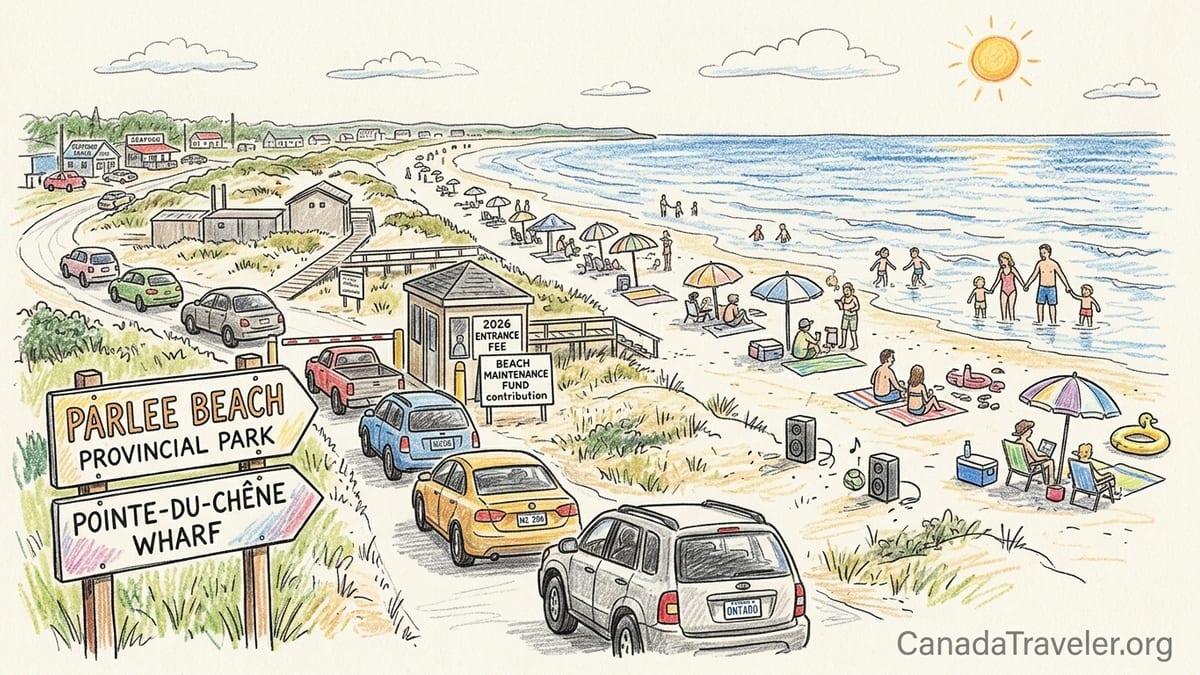
Driving into Pointe-du-Chêne, the small community that hosts Parlee Beach Provincial Park, the road narrows and the businesses turn unmistakably beach-town: small motels, ice cream stands, seafood shacks and surf shops. On a sunny September afternoon, traffic moved slowly but steadily toward the park gates, a convoy of Quebec and New Brunswick plates mixed with a noticeable number from Ontario and the northeastern United States. This does not feel like a hidden cove. It feels like a regional beach resort, with all the energy and congestion that implies.
The approach sets expectations high. Promotional materials and word of mouth focus on Parlee’s exceptionally warm, shallow water on the Northumberland Strait, which can feel more like a lake in July and August than the open Atlantic. Families talk about toddlers happily wading in knee-deep water that stays comfortable for long stretches of the summer. That reputation is what convinces many visitors, especially those traveling long distances, to plan around this particular patch of coast.
By the time I reached the provincial park entrance, that dream of an easy, affordable day at the beach was already colliding with reality. A prominent sign detailed the 2026 daily fees for vehicles, including the non-resident rate that has become a flash point in local conversations. Staff at the gate reminded drivers that this charge is not just a parking fee; it also includes a provincially mandated contribution toward maintaining the beach itself.
Even so, as I waited in the queue behind minivans loaded with paddleboards and coolers, I could not help doing mental math. When you market a beach strongly on its family appeal, every dollar at the gate becomes part of the value equation for parents who have already paid for fuel, accommodation and gear before even touching the sand.
The Real Cost of a “Simple” Day at Parlee
For 2026, New Brunswick has set a specific daily fee for non-resident vehicles entering Parlee Beach Provincial Park. For a standard car, the posted vehicle entrance fee is C$17.83 before tax, with an additional beach maintenance or nourishment component added on top. Provincial regulations outline that Parlee carries a separate “beach maintenance” amount per vehicle that is earmarked to help maintain the shoreline, manage sand and support infrastructure rather than functioning solely as revenue for parking operations. In practice, visitors pay a bundled amount at the gate that combines access and this maintenance contribution.
On the ground, that distinction is not always obvious to families. The attendant at the gate explained that part of what I was paying would fund ongoing beach nourishment and upkeep, including work related to sand management and erosion. For the province, this is an important point. For a family in a compact SUV with two adults, two children and a dog waiting impatiently in the back, the concrete reality is a single, unavoidable gate fee that is already approaching the twenty-dollar mark once tax is applied.
That fee also sits on top of everything required to get here. A family driving from Moncton might add roughly C$15 to C$25 in fuel for the round trip, depending on vehicle and gas prices. Visitors from Halifax or Fredericton can expect fuel costs closer to C$50 or more for the day. Add in C$30 to C$60 for takeaway food like fried clams, lobster rolls and ice cream from vendors near the beach, plus another C$20 to C$40 in sunshade rentals, beach toys or forgotten essentials from local shops, and what looks like a modest day out starts to push beyond C$100.
For overnight visitors, accommodation inflates that budget significantly. Basic roadside motels within a short drive of Parlee sometimes advertise summer rates in the C$140 to C$200 per night range, while small cottages and vacation rentals around Shediac can easily surpass C$250 per night in peak weeks. A two-night stay with gate fees, fuel, meals and a few family treats can quickly move into the C$500 to C$700 territory. None of this is unusual for a popular seasonal destination, but it does mean that Parlee’s warm-water promise has to carry substantial weight to justify the total family outlay.
Parking, Facilities and the Walk to the Sand
Once through the gate, the layout is functional rather than charming. The main parking lots are broad, paved expanses set back from the dunes, with painted lines and a steady stream of vehicles searching for spots on busy days. I arrived mid-afternoon on a Saturday and still found a space within a few minutes, but earlier arrivals would have had more choice, especially closer to the main access points. During peak July weekends, locals report that lots can feel close to capacity by late morning, and the sense of crowding begins in the parking area before anyone reaches the water.
The changing facilities and washrooms sit just beyond the lots, in low, utilitarian buildings. Inside, they resemble many provincial park amenities across Canada: concrete floors, basic partitions, metal fixtures. They are not luxurious, but they are serviceable. On the day I visited, the washrooms were reasonably clean given the volume of use, though lines developed at key times, particularly when weather shifted and families rushed to change.
The walk to the sand runs along boardwalks that thread over the dunes and through low vegetation. These structures are practical, protecting fragile dune systems while giving visitors a defined path. From the top of the main access, the beach spreads out in a wide arc of pale sand, interrupted by clusters of umbrellas, blankets and portable canopies. On a sunny weekend, expect a distinctly busy atmosphere. There is space to spread out if you walk farther along the shore, but near the main entrances, families are set up towel-to-towel in places, with children weaving through beach chairs and coolers.
At first, the scene might feel crowded for travelers used to more remote Atlantic Canada beaches, but it also carries the energy of a classic summer day out. Music drifts from portable speakers, bilingual chatter rises and falls with the waves, and lifeguards keep watch over designated swimming zones. If you come expecting a quiet, contemplative shoreline, Parlee will likely disappoint. If you are looking for a social, family-forward beach with services at hand, this density may feel like part of the appeal, assuming you are comfortable with the cost that underwrites it.
Warm Water, Shallow Flats and Honest Swimming Conditions
Parlee’s selling point is its water, and on that front, my experience aligned with its reputation. Walking into the Northumberland Strait at mid-tide, the temperature felt noticeably warmer than typical Atlantic beaches even this late in the season. The bottom shelved gently, allowing me to wade out a long distance before the water reached my chest, and the warmth held consistently across the shallows. Children around me stayed in the water for extended stretches without the blue lips and shivering that are standard at many colder coastal spots.
The shallowness, however, is a double-edged sword. It contributes to the warming effect, since a wide, shallow shelf heats more quickly under summer sun, but it also means that at low tide the waterline can retreat a considerable distance. Families that set up closer to the dunes sometimes found themselves facing an unexpectedly long walk across wet sand to reach swimmable depth later in the afternoon. For parents juggling small children, that trek with inflatables, snacks and towels can feel like a minor expedition.
On my visit, waves remained gentle, with small chop rather than significant surf, making conditions friendly for less confident swimmers and young children under supervision. Lifeguard coverage in the designated areas added an extra layer of reassurance. That said, conditions are not static. Wind direction, recent rainfall and tide cycle affect water clarity and comfort. On windy days, the shallow water can become turbid, and strong sun combined with calm conditions can, in some years, contribute to issues like algal growth, although those risks are closely watched by provincial health authorities.
Is the warm water alone worth the cost and planning uncertainty? For some families, yes. Parents around me mentioned choosing Parlee over cooler beaches precisely because their children could stay in the water longer. One family from Quebec City told me they built a week-long Maritimes itinerary around this stop, accepting the fees as the “price of warm ocean.” Others were more ambivalent, pointing out that on days when weather is mixed or winds shift offshore, the water does not always feel dramatically warmer than at less crowded, cheaper beaches along the same strait.
Accessibility: Progress and Remaining Barriers
Parlee has made visible efforts to improve accessibility in recent years, and these are apparent as soon as you leave the parking lot. Accessible parking bays sit close to main entrances, and the route from lot to boardwalk includes curb cuts and slopes instead of abrupt steps. The park provides accessible washrooms near the main facilities area, marked with clear signage, with wider doorways and grab bars intended to accommodate mobility aids.
One of the most significant additions for many visitors is the presence of beach access mats. These firm, textured pathways are laid over the sand from the end of the boardwalks toward the upper beach, creating a relatively stable surface for wheelchairs, walkers and strollers. On the day I toured the area, a parent pushed a double stroller along the mat while a grandparent using a small wheeled walker followed behind. Without that infrastructure, both journeys would have been much more difficult, if not impossible.
Still, accessibility at a dynamic sandy beach has natural limits. Beyond the end of the mat, soft sand and shifting surfaces remain a real obstacle, particularly closer to the waterline where the mat does not extend. Crowds introduce their own complications, as chairs, coolers and beach toys sometimes encroach on the mat’s edges, narrowing effective space. For visitors who need a firm surface all the way to the water, or who rely on specialized beach wheelchairs, advance planning and support from companions remain essential.
Weather and tide can also affect accessibility conditions. After heavy rainfall, puddles and wet patches may collect around access points. High tide can narrow the dry beach, forcing more people into a smaller area and making it harder for mobility-impaired visitors to navigate between groups. In that sense, Parlee illustrates a broader truth about accessible coastal tourism: infrastructure like mats and washrooms are critical, but they do not eliminate all barriers posed by sand, crowds and changing conditions. The result is a beach that is more accessible than many in Atlantic Canada, yet still challenging for some.
Water Quality: Daily Monitoring, Real Concerns and Changing Conditions
Parlee’s warm shallows come with a history of public scrutiny around water quality. Community concern escalated after high-profile contamination episodes earlier in the last decade, which prompted the province to refine its monitoring and public reporting. Today, New Brunswick’s Department of Health treats Parlee as one of its most closely watched beaches, using daily sampling during the summer along with a predictive model tailored specifically to local conditions.
For visitors, three key terms define the provincial system at monitored beaches like Parlee. Results are publicly categorized as “Suitable for Swimming” when bacteria levels meet Health Canada’s recreational water quality guidelines. When monitored bacteria concentrations rise above those guideline thresholds, a “No Swimming Advisory” is issued. In that case, the beach itself remains open, but the public is advised not to enter the water for recreational activities that involve contact such as swimming. In more serious situations, for example in the presence of a confirmed sewage spill, harmful algal bloom or other acute hazard, the province can order a full “Beach Closed” status, which restricts both water contact and broader recreational use in the affected area.
The province maintains an online beach information portal where Parlee’s daily status is posted, usually by late morning or early afternoon. In September 2026, those results highlighted how quickly conditions can change and why individual dates matter. On September 19 and September 20, the portal listed Parlee as “Suitable for Swimming,” indicating that recent samples met guideline criteria. However, by September 23, the listing for Parlee showed “Unavailable” for water quality data, reflecting an absence of usable sample results for that particular day. For a family planning a visit, that difference between a clearly suitable status and an information gap can be significant.
Health officials and independent researchers emphasize that this variability is a fundamental feature of beach water quality, not a unique failing of Parlee. Studies on the Northumberland Strait coastline note that episodic spikes in bacteria levels can coincide with heavy rainfall events, combined sewer overflows, warm, stagnant conditions or intense local use. The province’s own communication materials underline that water quality can shift within hours, which is why Parlee’s monitoring has become more frequent and is tied to a model that takes into account weather, tides and other variables.
It is important to be precise here. The existence of past contamination events and occasional advisories does not mean Parlee is chronically unsafe. On many days each summer, the beach posts results that meet or exceed national guidelines, and families swim without incident. At the same time, the record shows that Parlee has experienced enough exceedances over the years to justify continued vigilance. For travelers, that translates into a need for active, same-day checking of conditions rather than assuming that historical concerns are either entirely resolved or permanently damning.
The Shediac Bay Watershed Plan: Fixing Problems at Their Source
Behind Parlee’s daily status reports lies a broader attempt to address water quality at its watershed scale. In October 2021, the province of New Brunswick, working closely with the Shediac Bay Watershed Association and local stakeholders, released the Shediac Bay Integrated Watershed Management Plan, covering the years 2021 to 2031. This long-range plan explicitly targets the human sources of bacteria and excess nutrients that have contributed to past contamination episodes at Parlee.
The plan identifies several key sources of concern in the Shediac Bay watershed, including aging or overloaded sewage and septic systems, runoff from agricultural lands, stormwater flowing from developed areas and infrastructure, and the cumulative effect of dense seasonal development near the coast. Rather than treating Parlee’s water as an isolated issue at the shoreline, the plan treats the beach as a downstream indicator of what happens across the wider bay and its feeder rivers and streams.
Concrete actions under the 2021–2031 framework include upgrading municipal wastewater treatment capacity, improving inspection and enforcement around private septic systems, promoting better stormwater management in growing communities, and working with farmers on practices that reduce nutrient and bacteria runoff. Recent progress reports from the Shediac Bay Watershed Association suggest that some of these measures are underway, with collaborative projects between provincial departments, municipalities and local groups designed to reduce loading into the bay over time.
For visitors, the critical point is that historical problems at Parlee are not being ignored, but neither are they fixed overnight. The fact that authorities have invested in a decade-long plan acknowledges both the seriousness of past issues and the expectation that gradual improvement is possible. Travelers who last followed Parlee’s story around 2017 may remember headlines about contamination and controversy. In 2026, the picture is more nuanced: a beach with better monitoring, a transparent reporting system and an active watershed program that aims to reduce the very inputs that led to past exceedances. None of this guarantees perfect water every day, but it does mean that conditions today should not simply be assumed to match the worst chapters of its history.
Parlee vs Aboiteau, Murray Beach and Kellys Beach
No evaluation of Parlee is complete without comparing it to other notable New Brunswick beaches. Along the same general stretch of the Northumberland Strait, Aboiteau Beach near Cap-Pelé is a strong alternative for travelers seeking a mix of services and a more relaxed atmosphere. Aboiteau also offers warmish waters, facilities like a boardwalk and food options, and charges its own access or parking fees, though these typically feel less prominent than the bundled provincial park gate fee and beach maintenance charge at Parlee. Visitors often describe Aboiteau as lively but not as intensely crowded, with a slightly more local feel and a compact service area.
Murray Beach Provincial Park, located farther southeast near the Confederation Bridge, tends to appeal to those who prioritize a quieter, more natural setting. Its sand is narrower in places and facilities are more modest, but it offers camping, views across to Prince Edward Island and a calmer environment where you can still find relatively warm water in mid-summer thanks to the same strait. The trade-off is fewer amenities within walking distance and a less pronounced family resort atmosphere. For some, that is a significant advantage.
On the other side of the province, Kellys Beach in Kouchibouguac National Park offers a dramatically different experience. Accessed by a long boardwalk through protected dunes and lagoons, Kellys is part of a national park system that prioritizes conservation. Facilities are well maintained, and there is a sense of wildness and space that is largely absent at Parlee on busy days. The water along this stretch of coast is usually cooler than Parlee’s Northumberland warmth, and national park entry fees apply, but many travelers find the combination of beaches, trails and salt marsh scenery gives better overall value, especially for multi-day stays.
When you put these options side by side, Parlee stands out for its dense concentration of services, its highly marketed warm water and its convenient proximity to the tourist infrastructure of Shediac and Pointe-du-Chêne. Aboiteau offers a slightly lower-key version of the warm-water, serviced-beach experience. Murray Beach and Kellys Beach lean more toward natural atmosphere and space, with fewer crowds and more emphasis on landscape than amenities. For budget-conscious families, especially those driving long distances, the question becomes whether Parlee’s specific mix of warmth, facilities and energy is compelling enough to justify its higher apparent price of entry.
When Parlee Is Worth the Money, and When to Look Elsewhere
After a full day walking Parlee, talking with families and comparing it with nearby alternatives, my answer is conditional. Parlee is worth paying for when warm, swimmable saltwater is your top priority and when you can be flexible around conditions. Families with young children who feel the cold acutely stand to benefit the most. On a clear, calm July or August day, with a “Suitable for Swimming” status posted by late morning, the combination of warm shallows, lifeguards, food kiosks and nearby attractions like Shediac’s marinas and cruises can deliver exactly the classic beach day that people imagine when they see Parlee on travel posters.
To protect that value, however, families should build same-day water quality checking into their plans. Before leaving your hotel or campsite, visit the provincial beach information portal or contact the park to confirm Parlee’s current status. If it is listed as “Suitable for Swimming” for that date, you can proceed with reasonable confidence. If a “No Swimming Advisory” is in effect, consider whether you are still comfortable paying the full vehicle fee for a day on the sand without going into the water. Some families I spoke with chose to stay and treat it as a picnic and shell-hunting day. Others pivoted to an inland activity or a different beach.
On days when the status shows “Unavailable,” the decision becomes more personal. Some visitors, particularly those with small children or anyone immunocompromised, prefer to take a conservative approach and either avoid swimming or choose a different beach altogether when data are missing. Others are comfortable assessing conditions on arrival and limiting full-immersion swimming, especially after heavy rainfall or visible runoff. In all cases, the key is recognizing that Parlee’s water quality story is dynamic. The same beach can be a safe, delightful place to swim one afternoon and a spot to avoid entering the water the next morning after storms.
If you are drawn more to open space, quiet or a closer connection to dunes and wildlife than to snack bars and crowds, alternatives may give better value. Aboiteau suits travelers who still want services but dislike Parlee’s peak-season density. Murray Beach and Kellys Beach reward those who are content with cooler water in exchange for longer stretches of uncrowded shoreline. For multi-day coastal trips, an itinerary that includes one carefully timed day at Parlee for the warm-water experience, balanced with additional days at these quieter beaches, can deliver the best of both worlds without committing your entire vacation budget to a single, crowd-heavy spot.
FAQ
Q1. How much does it cost to park at Parlee Beach in 2026 for non-residents?
The 2026 daily vehicle fee for non-resident visitors at Parlee Beach is set at C$17.83 before tax for a standard vehicle, with an additional beach maintenance component included in the bundled amount paid at the gate.
Q2. Is that fee just for parking, or does it include other costs?
The payment made at the park entrance covers both vehicle access and a designated beach maintenance or nourishment fee that helps fund shoreline management and infrastructure, so it is more than a simple parking charge.
Q3. How warm is the water at Parlee compared with other Atlantic beaches?
Parlee sits on the shallow Northumberland Strait, which warms significantly in summer, so water temperatures are often noticeably higher than at open Atlantic beaches, especially in July and August, and many visitors find they can swim comfortably for longer periods.
Q4. How can I check current water quality at Parlee Beach?
Before you go, review the latest provincial beach water quality updates for Parlee, which are usually posted daily in summer, or contact park staff directly on the day of your visit for the most current status.
Q5. What do “Suitable for Swimming,” “No Swimming Advisory” and “Beach Closed” actually mean?
“Suitable for Swimming” indicates recent test results meet national guidelines, “No Swimming Advisory” means bacteria levels are elevated and entering the water is not recommended, while “Beach Closed” is reserved for more serious hazards when both water use and some beach activities are restricted.
Q6. Was Parlee Beach safe for swimming in late September 2026?
Monitoring records show that Parlee was listed as suitable for swimming on September 19 and 20, 2026, but water quality information was unavailable on September 23, underscoring the need to check individual dates rather than rely on general seasonal assumptions.
Q7. What accessibility features does Parlee offer?
Parlee provides accessible parking, accessible washrooms near main facilities and beach access mats laid over the sand from the boardwalks toward the upper beach, which help many wheelchair users, people with walkers and families with strollers reach the sand more easily.
Q8. How does Parlee compare with Aboiteau Beach for families?
Aboiteau also has services and relatively warm water but tends to feel less crowded and more local in character, so some families prefer it when they want amenities without the dense crowds and higher-profile reputation that come with Parlee.
Q9. Are Murray Beach and Kellys Beach good alternatives if I want a quieter experience?
Yes, Murray Beach Provincial Park and Kellys Beach in Kouchibouguac National Park both offer more natural, spacious settings with fewer crowds, though their water is often cooler and facilities are generally more low-key than at Parlee.
Q10. When is Parlee Beach genuinely worth the expense?
Parlee is most worth the cost on warm, calm summer days when the official status is suitable for swimming, especially for families who value warm saltwater, lifeguarded zones and convenient food and services enough to accept higher fees and a busy, resort-like atmosphere.