


The first time I saw Lunenburg, the town appeared suddenly below the crest of Blockhouse Hill, a jumble of brightly painted wooden houses tumbling down toward a harbour filled with fishing boats and masts. It looked almost too pretty to be real. Yet as I rolled down toward the waterfront, past coils of rope and the smell of bait, it was clear this was not a museum village. Lunenburg’s colours sit on top of a working Atlantic fishing and shipbuilding town, and spending a full day here, capped by a sail on the Bluenose II, is one of the best ways to understand that contrast.
Arriving at the Waterfront: First Impressions of a Working Harbour
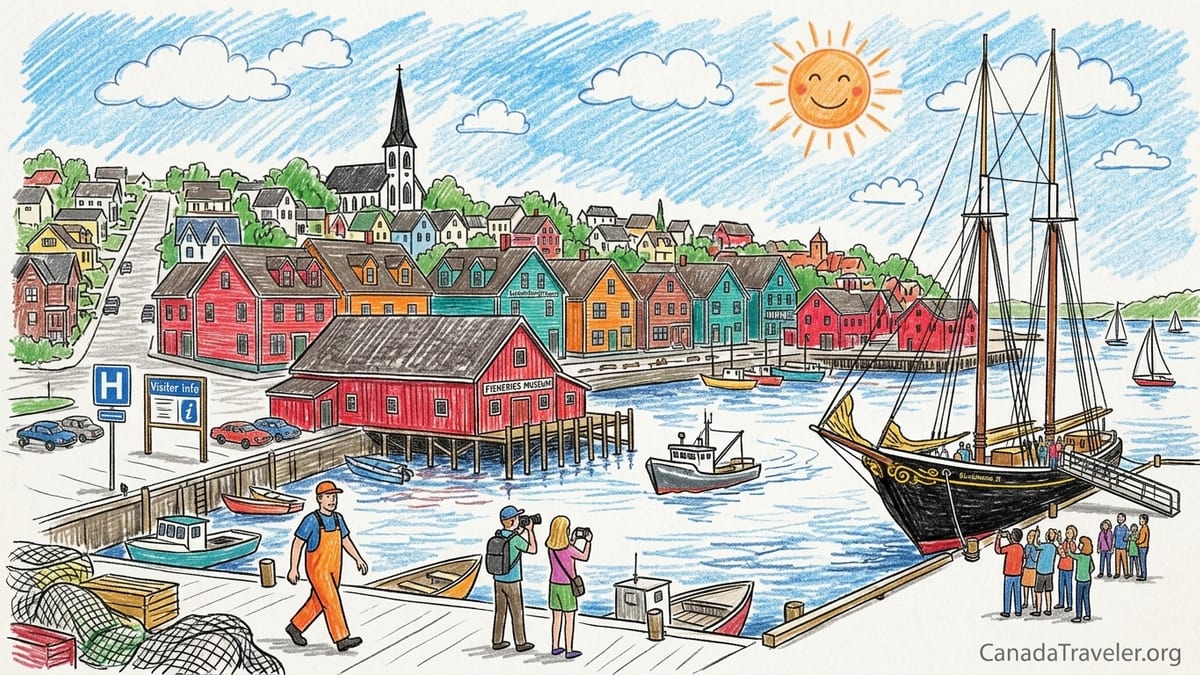
I arrived mid-morning on a mild July day and followed the signs down to the waterfront, where the town’s famous postcard view opens up. Instead of hunting for a curbside space on Montague Street, I pulled into the large pay parking lot beside the Fisheries Museum of the Atlantic on Bluenose Drive. Parking in this prime location is metered and enforced in summer, but the convenience was worth a few Canadian dollars for several hours. Within a minute of stepping out of the car, I could hear the clank of halyards and the thrum of a diesel engine from a small trawler idling at the pier.
From the edge of the lot, the panorama made sense of Lunenburg’s UNESCO status in an instant. The waterfront is a long band of wharves and wooden buildings in reds and rusty oranges, some now housing cafes and galleries, others still serving as workshops for boatbuilders and marine suppliers. Behind them, the town climbs the hill in a strict grid of cross streets and straight lines, an eighteenth-century British plan that still dictates the shape of daily life. Fishing gear was stacked next to picnic tables; a man in rubber bibs walked past tourists with cameras. This was my introduction to Lunenburg’s dual personality.
Just a short stroll along Bluenose Drive reveals how intertwined the old and new economies have become. There are lobster boats with paint worn thin from real work, but also charter sailboats loaded with visitors. A small shipyard shed door sat open, the smell of sawdust and epoxy spilling out, even as a nearby kiosk sold ice cream. I had come here thinking mostly of colourful houses; what I found first was a busy, if scaled-down, maritime industry still alive under the preservation policies.
With a two-hour afternoon cruise booked on Bluenose II, I knew I wanted to orient myself along the waterfront before heading up the hill. I checked in at the visitor information board near the museum to confirm walking times and stair locations, then made a mental note of the Bluenose II gangway, where people were already pausing for photos in front of the schooner’s black hull and gold scrollwork.
Walking Montague Street: Colour, Commerce, and Lunenburg Bumps
From the waterfront, I climbed a short set of stairs to Montague Street, one block up the hill and the main commercial spine that parallels the harbour. The distance from the waterfront to the top of Montague is short, but the grade is enough that you feel it in your calves. In less than five minutes I had gone from the smell of bait and diesel to the scent of coffee and fresh pastries.
Montague Street is where the Instagram image of Lunenburg really comes alive. Shopfronts are painted in saturated shades of teal, lemon yellow, and cranberry, with carved wooden signs swinging overhead. Yet once I started looking more closely, the architecture told a deeper story than mere prettiness. Many of the two-and-a-half-storey wooden houses had the feature that locals call the Lunenburg bump: a projecting, overhanging dormer that pushes out over the front door, sometimes with three windows, sometimes just one, often capped with its own little gable roof.
The Lunenburg bump is more than a quirky ornament. It grew out of the town’s eighteenth and nineteenth-century carpenter-built tradition, when shipbuilders applied their framing skills to houses. The bump created extra light and space for a front room or landing without expanding the footprint, a pragmatic solution in a tight, gridded town. Walking along Montague Street, you can see how these bumps vary, from modest projections barely extending beyond the facade to bold, boxy bays that seem to balance precariously over the sidewalk. This variety within a consistent wooden language is part of what UNESCO recognized in 1995: a highly intact ensemble of wooden vernacular architecture that evolved over two centuries rather than a single frozen moment.
I stopped for an early lunch on Montague Street at a casual seafood restaurant overlooking the harbour, where a window table gave me a side-on view of both the street and the water. A fish and chips plate, made with local haddock, cost just under 20 Canadian dollars including tax, and a non-alcoholic drink added a few dollars more. While I ate, a group of workers in hi-vis vests came in and ordered take-out chowder, another reminder that this is still a town where people work with boats and not simply serve visitors.
Inside the Fisheries Museum of the Atlantic: Memory of a Working Port
After lunch I walked the short block back down to the waterfront for my visit to the Fisheries Museum of the Atlantic, which occupies a cluster of red wooden waterfront buildings on stilts over the harbour. The walk from my restaurant on Montague to the museum door took less than five minutes and only a short downhill, making this an easy loop even for less mobile travelers.
At the entrance, I paid for an adult ticket. For the 2026 season, admission is listed around 13 Canadian dollars for adults, with reduced rates for seniors and youth and free entry for very young children. The ticket includes access to multi-level exhibits inside, as well as to historic vessels tied up at the museum wharf in season. I stowed my rain jacket in a locker and stepped into a building that feels part gallery, part community memory box.
The exhibits walk you through Atlantic fisheries from traditional schooner-based cod fishing to modern steel trawlers. One floor is dominated by a reconstructed wheelhouse and engine room, where you can sit in the captain’s chair and look out over the harbour through real windows. Another section tells stories from the 1990s groundfish moratorium and its impact on towns like Lunenburg, when shipyards pivoted from sailing schooners to trawlers and other vessels. Reading the interpretive panels while looking out at today’s smaller mixed fleet underlined that this waterfront has never been static, even if the town’s grid and building styles have changed slowly.
My favourite part of the museum visit was stepping out on the dock to tour the historic vessels, which on my visit included a retired side trawler and smaller wooden craft. The smell of creosote, salt, and aging rope is unmistakable. Being able to move between climate-controlled exhibits and the open-air wharf in the space of a few minutes makes the museum feel integrated with the living harbour rather than separate from it. After about ninety minutes exploring, I felt I had enough context to appreciate both Lunenburg’s past and the Bluenose II experience that awaited me later that afternoon.
Climbing the Historic Grid: St John’s Anglican Church and Steep Streets
From the museum wharf, I started my climb up into Old Town Lunenburg. The grid is easy to understand: streets running parallel to the harbour are crossed at right angles by steep perpendicular streets marching up the hill. I followed Montague Street up a block, then turned inland and almost immediately felt the incline. Within a couple of minutes I reached St John’s Anglican Church, one of the town’s most striking landmarks and a National Historic Site.
St John’s, rebuilt after a serious fire in 2001, is a Gothic Revival wooden church painted in black and white, with intricate trim and a tall spire visible from the harbour. The reconstruction respected the original nineteenth-century design, so it still contributes to the townscape UNESCO considered in 1995, when it cited Old Town Lunenburg as an outstanding example of a planned British colonial settlement in North America. The church sits within the original eighteenth-century grid laid out in 1753 when British authorities settled German, Swiss, and French Protestant immigrants here under a regimented town plan of narrow lots and straight streets.
I spent some time on a bench outside the church, catching my breath and watching how daily life plays out within that grid. Schoolchildren walked home along sidewalks neatly aligned with the lot lines; delivery vans navigated the steep cross streets; a local carried groceries up toward the higher terraces. The colourful houses you see in photographs become a lived-in backdrop when you are at street level, passing vegetable gardens, laundry lines, and cars squeezed into short driveways. Many of these houses still display the Lunenburg bump dormers I had admired on Montague Street, but here on the steeper blocks they perch even more dramatically above the slope.
Continuing uphill, I followed the grid three or four blocks inland. The climb is not long in absolute distance, perhaps ten to fifteen minutes of steady walking, but the grades are real and require comfortable shoes. At the higher vantage points, gaps between houses reveal slices of blue harbour and the masts of boats below. It is from here that you can most clearly see what UNESCO meant when it inscribed Lunenburg under cultural criteria related to its town plan and wooden architecture rather than any single monument. The whole layout, from wharves to ridge line, is the heritage object.
Understanding Lunenburg’s UNESCO Status: More Than Bright Paint
Before visiting, I had often seen Lunenburg promoted with photos of candy-coloured houses and waterfront restaurants. On the ground, and with a bit of reading, the UNESCO designation from 1995 made more sense and felt far more serious than a marketing label. Old Town Lunenburg was inscribed because it preserves, almost intact, an eighteenth-century British colonial town plan imposed on a narrow peninsula and then filled in with wooden buildings that evolved from that original grid while respecting its logic.
That plan is still legible in the strict right angles of the streets, the narrow rectangular lots running up and down the hill, and the way public buildings like churches and schools anchor key intersections. Even newer structures tend to follow the same alignments, so that the fabric feels remarkably cohesive. Preservation is not just about freezing buildings in time. In Lunenburg, traditional forms like gabled roofs, clapboard siding, and dormers such as the Lunenburg bump have been adapted and reused over centuries, giving the town a layered wooden architecture that remains functional for residents today.
UNESCO evaluators also recognized that Lunenburg represents a particular moment in Atlantic colonial history, when Britain was trying to consolidate control over Nova Scotia by settling Protestant Europeans in a strategic coastal location. The survival of that settlement pattern, combined with the town’s maritime economy, makes Lunenburg a cultural landscape of sorts. Walking the streets, you notice small details that speak to that continuity: house plaques noting build dates in the 1800s, shipwrights’ workshops tucked behind homes, modern fishing gear stored on lots first divided in the 1750s.
If you come expecting a purely picturesque village arranged for visitors, you might be surprised by how ordinary many corners of Lunenburg look: satellite dishes on historic facades, recycling bins stacked beside heritage plaques, kids’ bicycles leaning against hand-carved balusters. For me, this mix is precisely what makes the UNESCO designation feel alive rather than rehearsed. The value lies in a living town that still follows its eighteenth-century bones, not a static heritage park.
Sailing Aboard Bluenose II: From Dockside Icon to Open Harbour
In the afternoon I headed back down the hill for the highlight of my day: a two-hour harbour cruise on Bluenose II. The original Bluenose, launched in Lunenburg in 1921, was a fishing and racing schooner that became famous for dominating international schooner races and symbolizing Nova Scotia’s maritime skill. That vessel was lost in the Caribbean in 1946, but the name lived on in Canadian culture, most visibly on the Canadian dime. Bluenose II, built in 1963 as a near-replica, carries on the legacy today as Nova Scotia’s sailing ambassador.
My ticket for the 2026 season two-hour cruise cost 110 Canadian dollars for an adult. Children aged 3 to 12 are charged 45 dollars, while infants are typically free but must be included in the booking. The price includes taxes and fees and reflects not only the cost of the sail but the upkeep of a complex wooden tall ship and a professional crew. I had reserved online a few weeks in advance, since summer sailings can sell out, especially on weekends when both day-trippers and tour groups converge on town.
It is important to understand the different ways you can experience Bluenose II. When the schooner is in port at Lunenburg, the ship is usually open during the day for free public deck visits, when you can walk aboard, chat with crew, and explore the open deck without going out to sea. You simply line up at the gangway during posted hours. Separately, there are the paid sailing excursions like the one I booked. On a sailing day, there are typically two two-hour harbour cruises, one in late morning and one in mid-afternoon, though the exact times can change with schedule and weather.
On my cruise, check-in began about 30 minutes before departure at a small kiosk near the gangway on Bluenose Drive. The weather had stayed fair: high cloud, about 22 degrees Celsius, and a light but steady breeze rippling Lunenburg Harbour. After a safety briefing and roll call, we stepped aboard and spread out along the wide decks. The crew encouraged us to sit on the cabin top, lean against the bulwarks, or find a spot near the base of the mainmast if we wanted to help with lines.
Under Sail and Under Power: What the Cruise Really Feels Like
One detail that surprised several people on board was how much the experience depends on the wind. The crew explained at the start that Bluenose II is a sailing vessel first, but that for safety and scheduling she sometimes motors for part or even most of a cruise if the wind is too light, too strong, or blowing from an awkward direction. On my afternoon outing, the breeze was just strong enough that we motored out of the inner harbour, then set sail beyond the ferry route, turning off the engine for long stretches.
Hauling on lines with other passengers as the crew hoisted the mainsail and foresail was a tangible way to connect with the ship’s working heritage. This is not a luxury yacht but a working schooner, and the canvas goes up with real effort. When the engine cut, the sudden quiet felt almost shocking. Only the creak of rigging and the slap of waves against the hull remained, with Lunenburg’s colourful hillside receding behind us.
The route took us along the coastline outside the harbour, with views back to Old Town and ahead toward the open Atlantic. Crew members circulated, answering questions about the original 1921 Bluenose, pointing out how the replica’s lines follow the same design, and explaining the maintenance work that keeps a wooden vessel of this size in shape. They were candid that the ship spends as much time and money in refits and inspections as she does sailing, and that ticket sales are part of what supports this heritage effort.
During quieter moments I sat along the starboard rail, legs braced against the deck, watching small lobster boats pass and seabirds skim the waves. Even at an easy pace, the ship heels gently under sail, and the combination of movement and fresh air can be tiring. I was glad I had brought a light fleece and a windproof layer; the temperature on the water felt several degrees cooler than in town. By the time we motored back into the harbour, sails furled, the town’s grid of streets and bumps and spires looked both familiar and newly impressive, framed now by rigging I understood a bit better.
Practicalities: Parking, Meals, Distances, and Weather in a Single Day
Looking back on the day, what stood out was how compact Lunenburg is, and how much walking shaped my experience. From the waterfront parking lot beside the Fisheries Museum to St John’s Anglican Church and the upper streets, I probably covered no more than three to four kilometres total, but with repeated climbs and descents. None of the individual segments took more than fifteen minutes, yet the cumulative effect of walking on steep grades made me grateful for comfortable shoes and a slower pace.
Parking proved straightforward by using the main waterfront lot near the museum, which is clearly signed and close to both Bluenose II and Montague Street. Paid parking is in place across much of the downtown core during the main season, with meters and pay stations. For travelers arriving in larger camper vans or planning longer stays, town-operated long-stay lots exist a bit farther from the core, but for a single day focused on the harbour and Old Town, the waterfront option kept logistics easy.
In addition to my fish and chips lunch on Montague Street, I grabbed a late-afternoon coffee and pastry from a small bakery on a side street off the main grid, spending under 10 Canadian dollars. Dinner that evening, after my sail, was back along the waterfront, where I ordered a bowl of seafood chowder and a side salad for roughly 25 dollars before tip. Prices are comparable to other tourist-oriented coastal towns in Canada, and most menus clearly identify local seafood options for those wanting to connect their plate with the working harbour they have just explored.
Weather is the wild card. On my July visit, conditions were ideal: dry, mild, and breezy. But this is the Atlantic coast, and fog, drizzle, or sudden shifts in wind are common. A layered approach worked best: a base layer for walking uphill, a light sweater or fleece for time by the water, and a waterproof shell for both unexpected showers and wind chill on the Bluenose II cruise. The town’s compactness means you are never far from shelter, but you may appreciate having those layers in your day pack so you can stay out exploring longer without retreating to your car or accommodation.
The Takeaway: Day Trip or Overnight on Nova Scotia’s South Shore
By the time I walked back to my car in the waterfront lot, the light had shifted to early evening gold and the masts along the harbour cast long reflections on the water. It had been a full but manageable day: arrival before lunch, a long walk up through the historic grid, time at the Fisheries Museum, and a two-hour sail on Bluenose II, all without feeling rushed. My step counter claimed just over 8,000 steps, most of them up or down hill.
Could Lunenburg justify an overnight stay rather than a day trip? For me, the answer depends on the kind of traveler you are. As a focused cultural and maritime experience, Lunenburg works very well as part of a broader South Shore road trip that might also include Mahone Bay, the beaches near Hubbards, or the rugged coastline around LaHave. In one long day you can grasp the historic town plan, see the Lunenburg bump architecture up close, visit the Fisheries Museum, and either tour or sail on Bluenose II.
At the same time, I left feeling that an overnight would deepen the experience. Staying in one of the restored inns within the UNESCO core would allow you to see the town in early morning and late evening, when day-trippers have gone and the working rhythm is more evident. You would also have more flexibility to shift a Bluenose II cruise to a better-weather window or to linger longer in cafes, galleries, or along side streets that I only glimpsed in passing.
In the end, my single day in Lunenburg felt complete but also like an introduction. I drove away along the South Shore with the image of the town’s hill and harbour receding in my rearview mirror, the memory of wooden decks underfoot and the stories of fishers and shipwrights in my head. Whether you choose a concentrated day or a slower overnight, Lunenburg rewards visitors who look beyond the bright paint to the underlying grid and the still-active life of a North Atlantic port.
FAQ
Q1. How long do I need to explore Lunenburg and sail on Bluenose II in one day?
Most travelers can comfortably explore Old Town on foot, visit the Fisheries Museum, and take a two-hour Bluenose II harbour cruise in a full day of around eight hours.
Q2. How much does a Bluenose II two-hour cruise cost in 2026?
For the 2026 season, a standard two-hour harbour cruise on Bluenose II costs about 110 Canadian dollars per adult and 45 dollars for children aged 3 to 12, including taxes and fees.
Q3. Do I have to sail to visit Bluenose II, or can I just go on board at the dock?
You do not have to sail. When the ship is in port and open, visitors can usually board for free daytime deck visits, separate from the paid harbour cruises that go out on the water.
Q4. How steep are Lunenburg’s streets, and is the town walkable?
The grid climbs a noticeable hill from the harbour, with several short but fairly steep blocks. Distances are small, so most visitors can explore on foot, but good walking shoes help.
Q5. Why did UNESCO inscribe Old Town Lunenburg in 1995?
UNESCO recognized Lunenburg for preserving an eighteenth-century planned British colonial town layout and a remarkably intact ensemble of wooden architecture, not only for its colourful paint.
Q6. What is the Lunenburg bump, and where will I see it?
The Lunenburg bump is a distinctive overhanging front dormer that projects above a house’s entrance. You will notice it on many wooden houses along streets like Montague and throughout Old Town.
Q7. How much time should I allow for the Fisheries Museum of the Atlantic?
Most visitors spend between one and two hours at the Fisheries Museum, enough to see key exhibits inside and tour the historic vessels moored at the museum wharf in season.
Q8. Is parking easy near Lunenburg’s waterfront?
In peak season, street parking fills quickly, but the pay lot beside the Fisheries Museum on Bluenose Drive is usually the simplest option for day visitors to the harbour and Old Town.
Q9. What should I wear for a summer visit and Bluenose II cruise?
Layered clothing works best: comfortable shoes for hills, a light sweater or fleece, and a windproof or waterproof jacket for cooler conditions on the water or sudden showers.
Q10. Is Lunenburg better as a standalone destination or part of a South Shore road trip?
Lunenburg can fill a rewarding single day or relaxed overnight, but it often works best combined with other South Shore stops such as Mahone Bay or nearby beaches on a short road trip.