


Old Québec is one of those places that looks almost unreal in photos, a fortified hill town perched above the St. Lawrence River that somehow survived four centuries of conflict and redevelopment. Walking its 4.6 kilometers of walls and cobbled streets confirmed that the city’s UNESCO World Heritage status is absolutely deserved. What I did not fully anticipate was just how heavily oriented the historic district has become toward tourism, especially in high season. After several days inside and around the fortifications, I came away both deeply impressed and a little overwhelmed, with a clear idea of how I would visit differently next time.
The First Impression: A Fortified Storybook Above the River
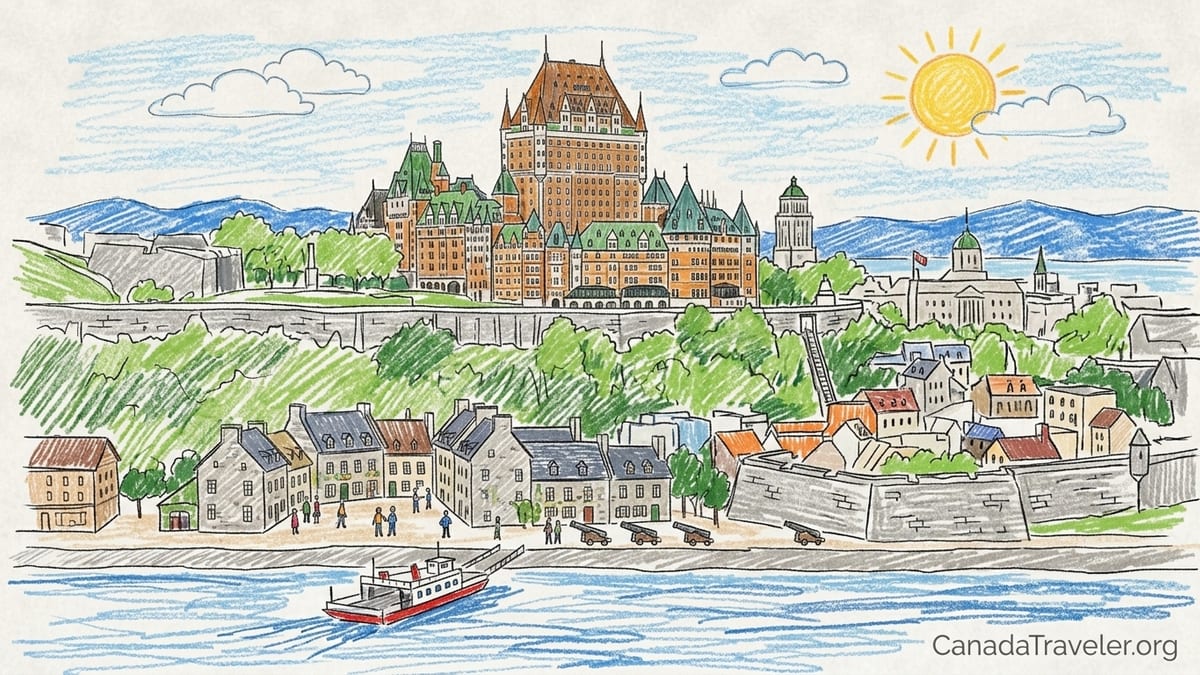
My first glimpse of Old Québec came from the upper deck of a bus rolling across one of the bridges from the south shore. The Upper Town rose straight from the cliff line, crowned by the copper roof and turrets of the Château Frontenac and ringed by intact ramparts. Several UNESCO-listed historic centers in Europe have fragments of walls or a preserved gate, but here the fortifications still sweep around the hilltop for about 4.6 kilometers, enclosing a dense heritage core in a way that feels unusually complete and legible as a former stronghold.
Inside the walls, the sense of walking through layers of New France and British colonial history is immediate. Streets like Rue Saint-Louis and Rue Saint-Jean still follow 17th century lines, and many facades display modest interpretive plaques that quietly date a house to the 1600s or tie a modest doorway to a siege or governor. It hit me that this was not just a scenic old quarter tacked onto a modern city but the original colonial capital that shaped much of the continent’s history, recognized formally when UNESCO inscribed the Historic District of Old Québec as a World Heritage Site in 1985.
Even in the bustle, there were moments when I stopped noticing the shops and simply reacted to the physical form of the city. The height difference between the Upper Town and Lower Town is dramatic, and every opening in the walls toward the St. Lawrence becomes a natural viewpoint. Looking east along the river from near the Saint-Jean gate, with modern container ships sliding past the site of Samuel de Champlain’s 1608 habitation, I felt that familiar vertigo of standing somewhere that has mattered for centuries.
That first afternoon, as tour buses circled and groups followed guides with raised umbrellas, I still felt mostly awed. I had not yet walked the same lanes three or four times, and the enchantment of stone, slate roofs, and cannon-lined terraces easily outweighed the commercial side. It took another day for the tension between exceptional heritage and heavy tourism to become impossible to ignore.
What Truly Impressed Me: Walls, Streets, and That Château
The fortifications themselves ended up being my favorite part of Old Québec. Managed as the Fortifications of Québec National Historic Site, the ramparts form a continuous pedestrian route that allows you to circle much of the Upper Town at wall height. In the early evening, I walked from the Saint-Louis gate toward the Citadelle and on to the Saint-Jean gate, looking down into back gardens, quiet seminary courtyards, and the bustle on Rue Saint-Jean. Those elevated views stitched the city’s story together far better than any single museum room.
Château Frontenac, which functions both as a luxury hotel and the city’s visual emblem, was another highlight. In photos it can look almost like theme-park architecture, but standing on Terrasse Dufferin with the building towering above, its steep copper roofs catching the light, it feels solid and properly monumental. The way it anchors the cliff edge and frames views of the river, Lévis on the far bank, and the distant Île d’Orléans may be the single most successful marriage of grand hotel and historic setting I have seen in North America.
I was equally taken with the Lower Town around Place Royale and Quartier Petit Champlain once the day-tripper wave subsided. In the evening, when the shop shutters came down, the small scale of the stone houses and the tight geometry of streets like Rue Notre-Dame and Rue Sous-le-Fort made the place feel closer to a working colonial port. Looking up from Rue du Petit-Champlain to see the cliff face, funicular track, and Château Frontenac silhouetted above is a striking visual summary of how geography dictated the city’s form.
Old Québec also impressed me with the way heritage interpretation has been woven into everyday surfaces. Large outdoor panels near Place Royale and on certain stretches of the wall explain how the defensive system evolved from earthworks to masonry, and how the city was nearly stripped of its fortifications in the nineteenth century before a preservation movement intervened. Guided walking tours and costumed interpreters obviously add a layer of performance for visitors, but beneath that is serious, long-term investment in conserving and explaining a unique colonial urban ensemble.
The Less Beautiful Reality: Crowds, Commerce, and Photo Queues
Once the initial wonder faded, the sheer volume of visitors and tourist-facing businesses inside the walls became impossible to ignore. On a mid-summer Saturday afternoon, Rue du Petit-Champlain in the Lower Town was so crowded that it took several minutes to walk a single short block. Cruise ship excursions and bus groups converged at the same time, producing near-gridlock under the festive string lights and seasonal decorations. The architecture was as lovely as advertised, but the lived experience was shoulder-to-shoulder and slow-moving.
That congestion magnified how commercial some streets have become. Segments of Petit Champlain and certain parts of Rue Saint-Jean and Rue Saint-Louis felt dominated by souvenir shops selling maple syrup in novelty bottles, keychains, and T-shirts, as well as candy stores and ice cream counters stacked one after another. There is nothing inherently wrong with these businesses, and several independent boutiques clearly invest in local craft and design, but it did not take many laps to realize that a significant share of the ground floor space inside the walls now exists primarily to serve short-term visitors rather than residents.
The economic logic shows up in restaurant pricing as well. Menus along the most central stretches of Rue Saint-Louis or overlooking Terrasse Dufferin frequently listed main courses in the 35 to 50 Canadian dollar range, with prix-fixe menus that could easily take an evening’s total to well above 90 dollars per person once drinks, tax, and tip were included. Quebec City overall is not considered one of Canada’s most expensive places to eat, yet the concentration of high-priced tables targeting visitors within the fortifications gives a different impression than you get in neighborhoods just outside the walls.
Accommodation inside or just next to the heritage core can feel similar. Many small hotels and inns rightly charge a premium for their location and historic character, and that price can be worth it. But if you search last-minute for a room in peak season, it is common to see simple double rooms inside or just below the walls listed at rates that would also buy a spacious apartment or modern hotel room further up the hill or in Saint-Roch. The result is a district where both daily consumption and nightly stays are, to a large degree, calibrated around a steady flow of tourists.
Most Overhyped: Rue du Petit-Champlain at Midday
Every postcard rack and promotional magazine seems to showcase Rue du Petit-Champlain, a short, stone-lined commercial street at the foot of the cliff in the Lower Town that claims to be one of the oldest active commercial streets in North America. The combination of 17th and 18th century facades, seasonal décor, and the looming rock wall above is visually irresistible. I arrived on my first full day with expectations set very high, reinforced by descriptions of it as one of the most photographed streets in Canada and one of the city’s essential experiences.
Seen through a camera lens, the street delivers exactly what the brochures promise. The problem, for me, was that experiencing it at midday felt less like walking a historic commercial lane and more like moving through an open-air corridor of visitor-oriented retail. Many shopfronts leaned heavily into generalized “cute” tourism aesthetics rather than anything particularly rooted in Quebec culture. Queues formed at a few especially Instagrammed viewpoints, especially near any steps or hanging seasonal installation, and it was common to see people waiting several minutes for a chance to pose without strangers in the background.
The funicular that shuttles between the base of Petit Champlain and Terrasse Dufferin is convenient and historically interesting as a piece of nineteenth-century infrastructure, but in the middle of the day there were lines here too. The short ride compresses the vertical climb into a couple of minutes, but it temporarily removes you from the city’s fabric. I took it once in each direction, glad to have experienced the tilted view between riverfront and clifftop, but concluded that in such a compact district I preferred simply walking the steep stairs instead.
By the end of my first afternoon, I realized that the lower section of Petit Champlain, which I had assumed would be my favorite corner of the city, was actually where I spent the least time. I found myself passing through quickly before peeling off toward quieter back streets or looping back up to the walls to regain some sense of space and context.
Unexpected Favorite: Quiet Ramparts and Back Streets at Dusk
The part of Old Québec that surprised me most was not a single square or museum but the atmosphere along the upper ramparts and less-trafficked streets after the day trippers had gone. One evening, around 8:30, I followed the stretch of wall from near the Saint-Jean gate toward the Citadelle. The sun was low over the Plains of Abraham, the cannons cast long shadows, and only a handful of other walkers shared the path. From the parapet, the city’s skyline broke into layers: church spires in the Upper Town, the bulk of Château Frontenac, and clusters of roofs descending toward the port.
Down in the streets, I grew particularly fond of the lanes behind the Château that run between Rue Sainte-Anne and Rue d’Auteuil. Here, the mix of stone houses, small inns, and institutional buildings like the Ursuline complex creates a softer, more residential feel. Several façades carry discrete plaques noting their age or former occupants, but the ground floors are not saturated with souvenir displays. In the blue hour, when lights began to glow in upper windows and the last tour groups faded away, these blocks felt more like a small European town than a stage set.
Another unexpectedly peaceful pocket was the Old Port area a few blocks beyond Place Royale, where warehouses and former customs buildings now host galleries, cafés, and apartments. The streets here are still very much part of the UNESCO historic district, yet they receive a fraction of the intense foot traffic that converges on Petit Champlain and Terrasse Dufferin. Standing near the water, watching a river shuttle cross between Québec and Lévis under the cliffs, I felt much closer to the working river city than I had amid the souvenir stands.
These quieter corners did not erase the more tourist-oriented reality elsewhere, but they balanced it. They also showed me that Old Québec still has space for ordinary routines and local life, especially once the peak visiting hours pass. If I had structured my days differently from the beginning, I would have spent far more time in these marginal streets and along the ramparts and far less in the narrowest, most commercialized lanes.
How Timing Changed Everything: Mornings, Evenings, and Overnights
Spending several nights inside or immediately beside the fortifications transformed my sense of Old Québec. Each morning, I walked out before eight, when delivery trucks were still unloading and café chairs were being arranged. At that hour, Rue Saint-Jean belonged mostly to residents heading to work, runners cutting through on their way to the Plains of Abraham, and a few photographers taking advantage of soft light on the stone façades. I walked from the Saint-Jean gate to the Château in under ten minutes without once needing to step around a tour group.
The same streets felt almost like a different city by mid-morning, when buses began disgorging groups near the gates and cruise passengers appeared in identifiable waves. That contrast was even sharper in the Lower Town. Place Royale, nearly empty at 7:30 with just one or two people sitting on the church steps, was ringed by guided groups by 10:00. The ability to experience the square both ways came entirely from sleeping nearby and being willing to set an early alarm.
Evenings offered a similar duality. Around sunset, Terrasse Dufferin still bustled, with buskers performing and visitors queuing for their turn at the railing. Later at night, after 10:30, only a fraction of that crowd remained. Couples strolled the boardwalk, hotel guests drifted in and out of the Château, and the click of heels on the wooden planks carried clearly in the cooler air. Standing at the far end of the terrace looking back at the illuminated hotel and the faint outline of the Citadelle, I finally felt the kind of contemplative appreciation I had expected from the start.
Staying overnight also revealed practical rhythms that day visitors rarely see. Garbage and recycling collection, staff moving between hotels and restaurants, and residents walking dogs along the wall path all became part of the picture. These mundane details may not appear in tourist brochures, but they helped me see Old Québec less as a preserved attraction and more as a lived-in quarter layered onto a globally recognized heritage site. The tension between those roles is still evident, but timing my walks before and after the daily peak softened the sharpest edges of the tourist machine.
Heritage vs. Tourism: A District Serving Two Masters
Old Québec’s UNESCO status and four centuries of built history exist in constant conversation with its reality as one of Canada’s most visited historic centers. Local and provincial authorities have invested heavily in preserving and interpreting the fortifications, churches, convents, and early streetscapes. The fact that the ramparts are largely intact, that the Upper Town still echoes its seventeenth-century layout, and that Lower Town waterfront blocks did not disappear under modern roads is a testament to that long-term commitment.
At the same time, the economic importance of tourism is hard to miss. Quartier Petit Champlain, recognized even by the city as a commercial sector, has deliberately reinvented itself since the 1970s as a picturesque shopping and dining district aimed at visitors. Seasonal decorations, coordinated façades, and frequent events keep foot traffic flowing, and reports from business owners and local media make it clear that cruise passengers and summer vacationers provide a significant share of revenue in high season.
The result is not a simple “tourist trap” situation. Many individual businesses inside the walls are thoughtful and locally grounded. Restaurants highlight Quebec produce and traditional dishes. Museums and interpretation centers tell complex stories of conquest, religious life, and colonial administration. The fortifications and major religious buildings are protected through law and funding, not dependent on ticket sales alone. Yet in the tightest and most visible lanes, the percentage of square meters devoted to short-term visitor consumption is high enough that everyday residential life can feel pushed to the margins.
For travelers, that means the heritage district itself deserves respect and time, while individual streets or commercial sections within it may warrant a shorter visit. Old Québec is not, in my view, a tourist trap. It is a world-class historic landscape that also happens to function as a tourism engine, and the challenge is to engage deeply with the first while being clear-eyed about the second.
The Takeaway: How I Would Visit Old Québec Differently
With a first full visit behind me, I would design a return trip to Old Québec around its strengths as a heritage district rather than its most photographed commercial corners. If my budget allowed, I would stay inside the walls again or immediately below them in the Lower Town, not because the rooms are better value than in outlying neighborhoods but because waking up and stepping directly into near-empty streets before the groups arrive is worth a modest price premium.
I would plan my walks along the fortifications, through the streets behind Château Frontenac, and around the Old Port in the early morning and late evening, using the hours between roughly 10:00 and 17:00 for museum visits, longer lunches on quieter terraces, or tram and bus trips to other neighborhoods. When choosing where to eat, I would look one or two blocks away from the most obvious postcard views, prioritizing independent bistros and cafés that draw a mix of locals and visitors instead of only those with multilingual menus and the highest terrace premiums.
On this revised itinerary, Rue du Petit-Champlain would be a brief, off-peak stop rather than the centerpiece of the day. I would still walk it, preferably soon after opening or in the evening, but I would not devote hours to shopping there. Instead, I would follow the riverfront, wander the quieter lanes behind the Château, or cross into adjacent districts like Saint-Jean-Baptiste or Saint-Roch to experience more of contemporary Québec City’s food and cultural scene. Combining the fortified core with these surrounding neighborhoods prevents the trip from becoming an exercise in looping endlessly through the same photogenic alleys.
Most importantly, I would keep reminding myself that Old Québec is both an exceptional historic environment and a place where the pressure of global tourism is very real. Respecting the heritage means not only photographing the stone walls and church spires, but also supporting businesses that contribute thoughtfully to the district’s life, leaving the most crowded streets when they begin to feel like corridors of consumption, and carving out time to experience the city at its quietest. Approached this way, Old Québec shifts from a beautiful but overwhelming postcard to a layered, living place that rewards patience and curiosity.
FAQ
Q1. Is Old Québec worth visiting if it is so tourist-oriented?
Yes. The intact fortifications, riverside setting, and concentration of historic buildings make Old Québec one of the most compelling urban heritage sites in North America, despite the commercial pressure in its busiest lanes.
Q2. When is the best time of day to walk the most popular streets?
Early morning and late evening are ideal. Before about 9:00 and after 21:30, streets like Rue Saint-Jean, Place Royale, and even parts of Rue du Petit-Champlain are far quieter and easier to enjoy.
Q3. Should I stay inside the walls or in a nearby neighborhood?
If your budget allows, staying inside or just below the fortifications gives you access to the district during its calmest hours. If prices feel too high, areas just beyond the walls still offer easy access on foot while often costing less.
Q4. How many days do I need in Old Québec?
A full day and night inside or next to the walls is enough to see the major highlights at a relaxed pace, but two or three nights let you experience different times of day and explore nearby neighborhoods beyond the core.
Q5. Is Rue du Petit-Champlain a must-see?
It is worth walking once, preferably outside the midday rush, to appreciate the cliffside setting and historic facades, but it does not need to dominate your itinerary and can feel very commercial at peak times.
Q6. Are there quieter alternatives to the busiest streets?
Yes. Sections of the ramparts near the Saint-Jean gate, the back streets behind Château Frontenac, and the Old Port beyond Place Royale all offer historic character with fewer crowds than the most promoted lanes.
Q7. How can I avoid overpriced restaurants in the heritage district?
Look a block or two away from the most postcard-famous views, check menus before sitting, and aim for places that seem to attract a mix of locals and visitors rather than only those directly on the main tourist corridors.
Q8. Is Old Québec easy to explore on foot?
Yes, although the hills between Upper and Lower Town can be steep. The compact size allows you to cover the main highlights on foot, with the stairs and ramparts providing some of the most interesting routes.
Q9. Can I enjoy Old Québec on a moderate budget?
It is possible by staying slightly outside the walls, eating some meals in less central streets, and focusing on free experiences such as walking the fortifications and exploring the public squares rather than relying on paid attractions.
Q10. How can I balance Old Québec with other parts of Québec City?
Use one or two days for the fortified core, then spend additional time in districts like Saint-Jean-Baptiste, Saint-Roch, or Limoilou to experience local cafés, markets, and everyday life beyond the postcard zone.