


The first time I drove out along Digby Neck toward Brier Island, my day hinged on two short ferry crossings that felt as wild and unpredictable as the whales I hoped to see. What looks like a simple line on the map quickly revealed itself as a small logistical puzzle of timing, tides and chance encounters, where missing a single boat could derail an entire whale watching trip.
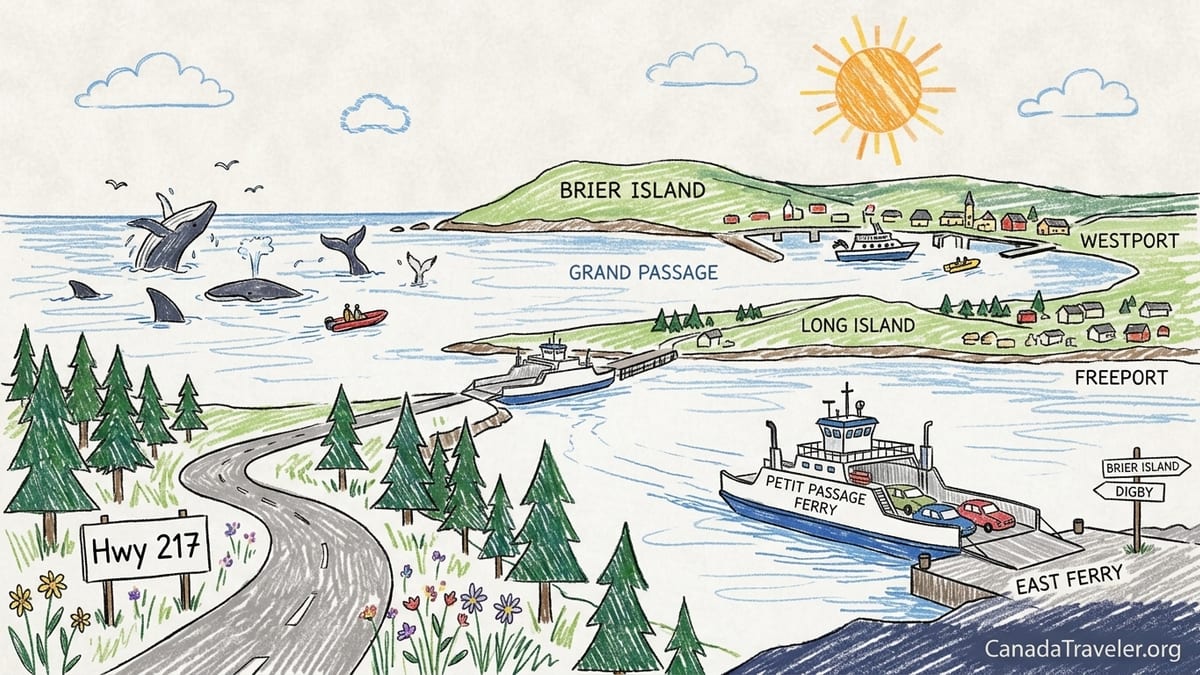
From Digby to East Ferry Along Highway 217
I left Digby with a thermos of coffee and a printout of my whale watching confirmation on the passenger seat, pointing the car west along Highway 217. The road immediately felt different from the busier routes inland. It narrowed and began to follow the spine of Digby Neck, a long, thin peninsula stretching into the Bay of Fundy, with glimpses of water flashing between spruce and fir.
The drive from Digby to East Ferry is often described as about 90 minutes, but that depends on how many times you pull over to look at the water, the fishing sheds and the occasional bald eagle circling above the shoreline. I left around 9:30 in the morning for a 1:00 p.m. whale watching departure from Westport on Brier Island, giving myself what felt like generous padding. It was only once I did the math against the ferry schedule that I realized how little slack I actually had.
Highway 217 has the unhurried feel of a local road. There are stretches of asphalt patched and repatched by winters, modest homes facing the bay, and more pickup trucks than rental cars. Every few kilometres a hand-painted sign advertised lobster, scallops or a small craft shop. It was hard not to stop, but the clock on the dashboard, and my mental image of the first ferry pulling away from East Ferry without me, kept me rolling.
As the neck narrows toward its western end, the road begins to rise and fall more sharply. The forest opens in places to views of the Bay of Fundy on one side and St. Marys Bay on the other. The last few kilometres into East Ferry felt like a slow approach to the edge of the continent, with the pavement finally dropping toward a cluster of buildings, a short stretch of shoreline and the slipway where the Petit Passage ferry crosses to Tiverton on Long Island.
The First Hop: East Ferry to Tiverton on Long Island
The real key to this journey is understanding the pattern of the provincial ferries. According to Nova Scotia’s Department of Public Works, the Petit Passage ferry between East Ferry and Tiverton operates 24 hours a day, on an hourly rhythm: departures from East Ferry on the half hour and from Tiverton on the hour, with no fare charged for vehicles or passengers at the time of my visit. That matched what local whale watching operators emphasize when they warn guests to build extra time into their plans.
I arrived at East Ferry at 10:18 a.m. and joined a small line of cars already waiting. The ferry was on the Tiverton side, finishing its loading, and the sight of the boat edging out into the channel finally made the time pressure real. The crossing itself takes only a few minutes, but with sailings on the half hour from East Ferry, missing one can push your entire day back by an hour, and that hour matters when a whale watching boat is scheduled to leave without you.
At 10:30 sharp the ferry nosed into the East Ferry slipway, lowered its ramp and began to unload. The process is informal but orderly. A deckhand waved each car forward in turn and, with a clang of metal, we rolled aboard. The crossing felt more like an extension of the road than a separate journey: there was no ticket booth, no turnstiles, just a shuffle of vehicles and a short glide across Petit Passage with the current tugging at the hull.
Out on deck, the wind carried a chill even in summer. Seabirds worked the current lines, and the cliffs of Long Island rose ahead. It was my first real sense that I was entering a chain of islands where the sea decided the pace of everything. In less than ten minutes we were easing into Tiverton. The ramp dropped, the crew waved us off, and in a matter of seconds Highway 217 simply resumed on the far side as though nothing had happened.
Driving the Length of Long Island to Freeport
Long Island, strung between the currents of the Bay of Fundy and St. Marys Bay, is a linear world. Route 217 runs its length from Tiverton at the eastern end to Freeport at the western ferry slip for Brier Island. It is only about 20 kilometres, but it feels like its own little road trip, passing small villages, fishing stages and weathered wharves where stacks of lobster traps hint at the year-round work that sustains the islands.
From Tiverton, I drove slowly, partly for the scenery and partly because I knew the second ferry followed its own timetable. The province lists the Grand Passage ferry, between Freeport and Westport on Brier Island, as another 24-hour, on-demand service, but it works to a predictable hourly pattern: departures from Freeport at the top of the hour and from Westport at about 25 minutes past. Whale watch operators repeat this message again and again, because the two ferries are designed to mesh: if you catch the East Ferry boat at 10:30, you can usually reach Freeport comfortably for the 11:00 Brier Island departure.
The road stitched through small clearings, with views westward toward the open mouth of the Bay of Fundy. I passed a trailhead for Balancing Rock, where a tall basalt pillar stands improbably on the edge of a cliff, and promised myself I would stop on the way back. For now, my goal was to stay ahead of the clock. A couple of times I pulled over briefly to let local drivers pass, not wanting to be the slow tourist who cost anyone their ferry connection or disrupted their errands between islands.
By the time Freeport came into view, the village curled around a sheltered harbour, it was 10:50. I could see the Grand Passage ferry already loading on the far shore at Westport. The water between us looked narrow, but I knew that missing this boat meant waiting on the dock until noon and arriving tight, perhaps too tight, for my 1:00 p.m. whale watching departure in Westport.
The Second Crossing: Freeport to Westport on Brier Island
The Grand Passage ferry crossing is quick, usually less than ten minutes, but it carries a lot on its deck. Residents rely on it for everything from groceries to school and medical appointments, while visitors quietly cross their fingers that their timing is on point. According to the provincial schedule, the boat departs Freeport on the hour and Westport at about 25 minutes past, around the clock, conditions permitting.
At 10:58 a.m. I pulled into the staging lane in Freeport, right as the crew began flagging vehicles onto the ramp. Once again there was no ticket booth and no exchange of money. Since 2020 the province has eliminated fares on these ferries, which used to charge a modest fee for cars and light trucks. That change subtly shifts the experience; the crossings feel like part of the public road system, even as you are acutely aware that they are ships subject to tide, fog and mechanical realities.
Out on deck, the panorama widened. Behind us, Long Island fell away, its shoreline scalloped with coves and low cliffs. Ahead, Brier Island rose in low dark humps, with the village of Westport strung along the sheltered side. Gulls and cormorants contested perches on navigation markers as the ferry nosed across the channel. The crossing was short enough that I never bothered to sit down, simply leaning on the rail as the crew readied lines.
By 11:10 a.m. I was driving up off the ramp and into Westport, suddenly on an island that feels almost like a frontier outpost. At this point, the timing puzzle becomes clear. With a 1:00 p.m. whale watch booked, I had less than two hours to check in at the office, find a quick lunch and be ready to board. If I had missed either ferry, I would have been cutting it dangerously close, especially since operators ask guests to arrive 30 to 45 minutes before departure.
Choosing a Whale Watching Operator and Boat
Westport may be small, but it supports two well-established whale watching companies that work the rich feeding grounds at the mouth of the Bay of Fundy. I booked with Brier Island Whale & Seabird Cruises, which operates both a larger vessel, the Mega Nova, and a high-speed Zodiac-style boat often used for more adventurous outings. Their tours typically run between about 2.5 and 4 hours depending on conditions and wildlife encounters, with several departures daily in peak summer.
On the day of my visit, I chose the Mega Nova, a 15-metre Cape Island style tour boat that offers indoor shelter, a washroom and plenty of seating. The standard adult fare for the main season in 2026 was listed at just under 80 Canadian dollars before tax for the larger boat, with slightly higher prices for the Zodiac option. There were also promotional dates in July, August and September where the operator offered special anniversary pricing on select Mega Nova sailings.
Checking in at the small waterfront office felt relaxed in tone but precise in paperwork. Staff ticked my name off the manifest, confirmed that I understood the approximate duration and reminded everyone to layer up, no matter how warm it felt in the village. The Bay of Fundy is refrigerated by cold upwelling water, and wind over the open bay can drop the apparent temperature by several degrees, especially once the boat is running at speed.
I had considered booking a Zodiac-style tour instead. Those smaller rigid-hulled inflatable boats offer a more visceral experience: lower to the water, closer to spray and swell, with fewer passengers and a stronger sense of speed. They are, however, more physically demanding, with limited shelter and no washroom. Having never been to Brier Island before, I decided to start with the larger, more stable vessel and keep the Zodiac option for a future visit.
On the Water: Whales, Birds and a Wild Horizon
We cast off under a high, thin overcast, the sort of grey that flattens land but brings out the steely tones of the sea. As Mega Nova eased past the wharf and into the channel, I found a spot along the rail near the bow and watched the village slip away behind us. Within minutes, Brier Island’s low houses and fish plants were reduced to a narrow band of colour against a larger expanse of water and sky.
The guides began with a safety briefing, then shifted quickly into natural history. This corner of the Bay of Fundy attracts several whale species in summer and early autumn, including humpback, fin and minke whales. Harbour porpoises and Atlantic white-sided dolphins are also regular visitors, along with an array of seabirds that includes shearwaters, storm-petrels and, in some seasons, Atlantic puffins. But the crew was careful to emphasize that nothing is guaranteed. These animals follow food, not timetables.
It took about 40 minutes of steady steaming before we saw our first sign of life. At first it was a low, inconspicuous puff on the horizon, a white breath hanging above the water. The captain altered course and slowed as we approached. Soon a broad, dark back rolled to the surface, followed by the distinct knuckles of tail stock. “Humpback,” the guide announced, almost in a whisper, and a soft cheer moved down the rail.
Over the next two hours we saw at least four individual humpback whales, identifiable by the patterns on their flukes which the crew photographed for research catalogues. At one point a whale surfaced within what felt like a few car lengths of the boat, exhaling with a deep, hollow roar before arching down again. We also encountered several minke whales, which showed only briefly, sleek and torpedo-like, and a small group of harbour porpoises slicing through the surface like dark commas. No dolphins appeared that day, but the guide pointed to areas where Atlantic white-sided dolphins are often seen riding the bow wave on other trips.
Large Boat Comfort Versus Zodiac Exposure
Watching the horizon for blows and dorsal fins, I found myself comparing my experience on the Mega Nova with the Zodiac tours I had taken elsewhere. The larger boat’s main advantage was comfort. I could step inside to warm up, use the washroom, or sit on a bench with a hot drink from the small onboard canteen between wildlife sightings. The upper deck provided a stable, elevated platform for photography with room to move without jostling others.
The trade-off was exposure to the elements and proximity to the water. From the rail of the larger vessel, I was several metres above sea level, with the whales often slightly below my line of sight. It felt respectful and steady, but not as visceral as the times when I have been in a Zodiac with spray hitting my face and the rise and fall of the swells transmitting through my knees.
I watched one of the company’s Zodiac boats at a distance that afternoon, its passengers in bright flotation suits, sitting astride the pontoons as the craft rose and fell more sharply in the chop. They would have felt the speed and turns more intensely and may have had slightly closer views when conditions allowed, but they also lacked the shelter and amenities that mattered to me on a cool, breezy day.
Accessibility also weighed heavily in my choice. The Mega Nova has railings, stairs with handholds and a boarding process that can accommodate a wider range of mobility levels than a Zodiac, where passengers usually need to step down into the inflatable from the dock and brace themselves through bumpy sections. For families with young children, older travellers or anyone unsure of their sea legs, the larger boat is, in my experience, the safer and more forgiving option.
When the Whales Do Not Show
On my trip the whales did show, but over coffee later that evening at my guesthouse I met a couple who had sailed earlier in the season and seen only distant blows that never developed into close encounters. They spoke frankly about the disappointment of spending several hours scanning grey water under a cold sky, only to return with a few brief sightings and a camera roll dominated by empty ocean.
The operators on Brier Island acknowledge this possibility and build it into their policies. Brier Island Whale & Seabird Cruises, like several Bay of Fundy companies, offers a form of guarantee that focuses on future opportunity rather than cash reimbursement. If a tour returns without what the crew considers a meaningful whale sighting, guests are typically offered a complimentary pass for another trip on a later date, subject to availability.
This approach reflects the reality that no legitimate whale watching operation can promise wildlife on command. The whales are wild, and their movements depend on shifting prey and ocean conditions. By offering return passes instead of refunds, companies balance financial viability with a good faith effort to ensure visitors eventually experience the animals they came so far to see.
For travellers coming from far away, that policy has practical implications. If you cannot easily return within the same season, a future-pass guarantee may not hold the same value as it does for regional visitors who can plan a second attempt. It is worth understanding this before you book, and factoring it into whether you schedule one tour or build in time and budget for a second trip later in your stay.
Exploring Brier Island: Lighthouses, Trails and Birds
After the tour, with the sea still swaying somewhere in my inner ear, I drove slowly along the island’s few roads. Brier Island is compact but layered, a place where the shoreline shifts every few hundred metres from rock ledges to cobble beaches to marshy inlets. The western and northern edges in particular are magnets for birdwatchers, who come for migrating shorebirds, seabirds and songbirds that funnel through this offshore outpost.
I followed Lighthouse Road toward Western Light, also known as the Brier Island Lighthouse, which stands guard at the island’s western tip. The road became rougher near the end, but my small car managed without trouble. At the lighthouse, a cool wind came off the open Bay of Fundy and the surf rolled in from far horizons. Even without whales in view, standing there gave me a visceral sense of the ocean engine that brings nutrients, fish and, ultimately, marine mammals into these waters.
On the northern side of the island, shorter coastal walks led to low headlands where I could watch gannets plunge-dive offshore and scanning lines of migrating shorebirds. A few interpretive panels explained the island’s role in bird migration and the work of local and national conservation organizations that protect critical habitats here. The combination of whales, birds and rugged shoreline makes Brier Island feel more like a small natural laboratory than a simple tourist destination.
By late afternoon the light grew softer, throwing a subdued glow over the harbour at Westport. Fishing boats rocked gently at their moorings, and the Grand Passage ferry continued its metronomic shuttling back and forth. Watching it from the shoreline, I was acutely aware that my own departure, and perhaps my ability to make it back to Digby before dark, depended on catching one of those hourly sailings.
Timing, Costs and the Case for Staying Overnight
The return leg to Digby retraced the same choreography in reverse: Grand Passage ferry from Westport to Freeport, the short drive across Long Island, and Petit Passage ferry from Tiverton to East Ferry, then Highway 217 back along Digby Neck. Factoring everything together, my day looked roughly like this: departure from Digby around 9:30 a.m., arrival in Westport about 11:10 a.m., 1:00 p.m. to roughly 4:00 p.m. whale watching tour, late afternoon exploring, then an early evening return that had me rolling back into Digby after 8:00 p.m.
From a cost perspective, the provincial ferries currently charge no vehicle or passenger fares on both Petit Passage and Grand Passage, which is a significant saving compared with islands elsewhere that rely on private operators. The main expenses for the day were fuel, food and the whale watching ticket itself, which for an adult on a standard-season cruise aboard Mega Nova in 2026 was just under 80 Canadian dollars before tax, with discounts for children and occasional special promotional sailings.
Is it realistic to do all of this as a day trip from Digby? It is certainly possible if you secure a mid-day whale watch, drive efficiently and hit your ferry connections cleanly. However, the experience is far more relaxed if you stay overnight on Brier Island or even on Long Island. By basing yourself in Westport, you can take an early-morning or late-afternoon tour, walk the coastal trails when the light is best, and not worry about racing back to make the last connections that feel comfortable before dark.
Several modest accommodations in Westport and nearby offer packages that pair rooms with whale watching tickets, and an overnight stay allows flexibility if your first outing is fogged out or yields few whales. Given the hourly ferry rhythm and the unpredictability of marine wildlife, my strong recommendation after this trip is to treat Brier Island not as a rushed add-on to a Digby stay, but as a destination in its own right, worthy of at least one night on the island.
The Takeaway
My trip to Brier Island taught me that whale watching here is as much about the journey as the sightings themselves. The two short ferry crossings, the drive along Highway 217 and the small logistical dance of departures and arrivals are not inconveniences to be endured. They are part of the fabric of life in this corner of Nova Scotia and a key to understanding how tightly the community’s rhythms are tied to the sea.
From the moment I left Digby, I had to think like an islander, accounting for hourly ferry patterns, weather and the simple fact that water interrupts the road in two places. That mindset carried naturally into the whale watching experience, where the operators were clear that humpbacks, fins, minkes, porpoises and dolphins may be common visitors but are never guaranteed. Some days, like mine, the animals appear in generous numbers. Other days the ocean keeps its secrets.
In the end, the combination of ferries, whales, lighthouses and birds made Brier Island feel less like a single attraction and more like a multi-layered journey into a working seascape. The fact that the ferries are free removes a financial barrier, but their hourly rhythm still imposes a discipline that rewards those who plan carefully and, when possible, linger longer than a single day. If your schedule allows, pack an overnight bag, book a room in Westport and let the Bay of Fundy set the pace.
FAQ
Q1. How long does it take to drive from Digby to the first ferry at East Ferry?
The drive from Digby to East Ferry along Highway 217 typically takes about 75 to 90 minutes, depending on traffic, weather and how often you stop for views or services.
Q2. How often do the ferries run between Digby Neck, Long Island and Brier Island?
The Petit Passage ferry between East Ferry and Tiverton on Long Island and the Grand Passage ferry between Freeport and Westport on Brier Island both operate around the clock, normally following an hourly pattern with East Ferry departures on the half hour and Freeport departures on the hour.
Q3. Do I have to pay to take my car on the ferries to Brier Island?
At the time of writing there is no fare charged for vehicles or passengers on either the Petit Passage or Grand Passage ferries, as provincial ferry fees have been removed.
Q4. Which whale watching operator did you use on Brier Island?
I sailed with Brier Island Whale & Seabird Cruises, a long-established operator based in Westport that runs tours on the larger vessel Mega Nova as well as Zodiac-style trips.
Q5. How much did the whale watching tour cost?
For the 2026 season, standard adult fares for a main-season cruise aboard the Mega Nova were listed at just under 80 Canadian dollars before tax, with different pricing for children and occasional promotional sailings.
Q6. What kinds of whales and other wildlife can visitors expect to see?
Common seasonal visitors include humpback, fin and minke whales, harbour porpoises and Atlantic white-sided dolphins, along with seabirds such as gannets and shearwaters, but no particular species or sighting can ever be guaranteed.
Q7. What happens if no whales are seen on a tour?
Operators on Brier Island typically offer a future tour pass rather than a cash refund when a trip returns without what they consider meaningful whale sightings, allowing guests to try again on a later date.
Q8. Is a larger boat or a Zodiac better for whale watching on Brier Island?
Larger boats like the Mega Nova offer more stability, indoor shelter and washroom facilities, which suits many families and first-time visitors, while Zodiac tours provide a faster, more exposed ride closer to the water that can feel more adventurous but is physically more demanding.
Q9. Can I visit Brier Island and do a whale watching tour as a day trip from Digby?
It is possible to make the trip in one day if you time the ferries carefully and book a mid-day tour, but many visitors find the experience more relaxed and flexible if they stay overnight in Westport or nearby.
Q10. Besides whale watching, what else is there to do on Brier Island?
Visitors can explore lighthouses such as Western Light, walk short coastal trails, and enjoy excellent birdwatching along headlands and shorelines, especially during migration periods.