


Auyuittuq National Park on southeastern Baffin Island is one of the most dramatic landscapes in the Canadian Arctic, a world of vertical granite walls, glaciers and wide U-shaped valleys carved by ice. It is also one of the country’s most demanding parks, with almost no facilities, real polar-bear risk and logistics that can surprise even seasoned travelers. This guide is designed to help ordinary visitors understand what is realistically accessible on guided day trips versus what belongs in the realm of serious backcountry expeditions, so you can plan an inspiring Arctic adventure that matches your skills, budget and risk tolerance.
Understanding Auyuittuq: Land at the Edge of the Arctic Circle
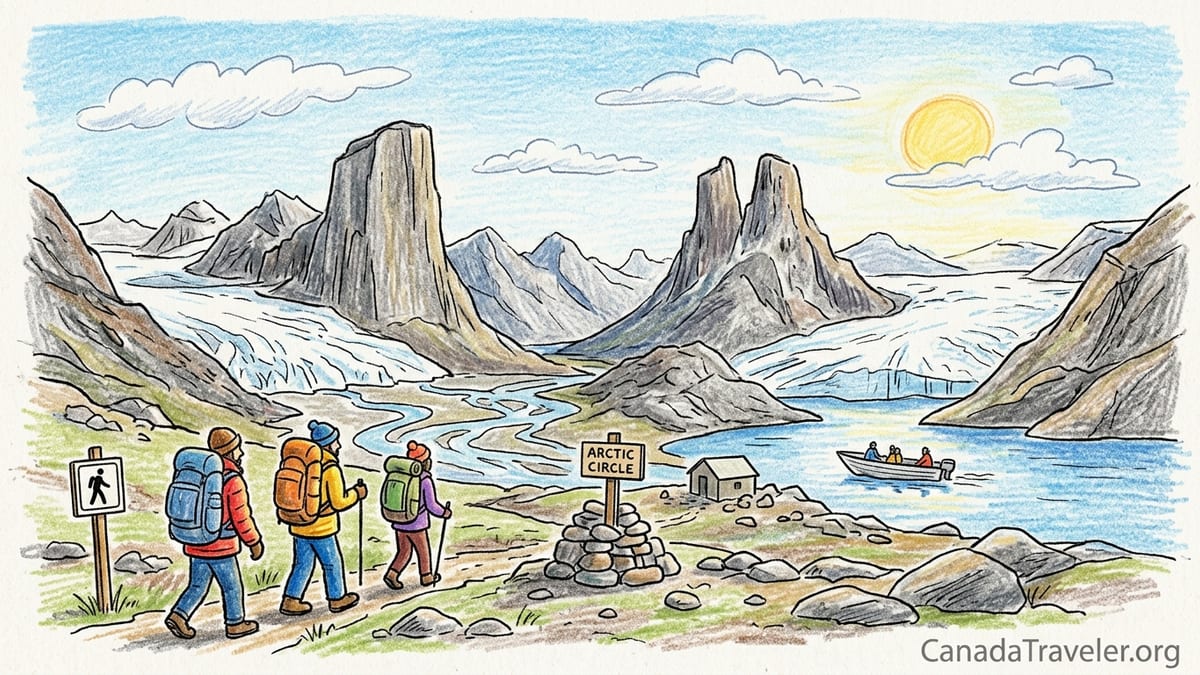
Auyuittuq National Park covers a slice of the Cumberland Peninsula on Baffin Island in Nunavut. The park’s name comes from Inuktitut and is often translated as “the land that never melts,” a reference to its icefields, glaciers and polar-desert climate. The park straddles the Arctic Circle, and many visitors come specifically to walk past the simple Arctic Circle marker in the broad valley of Akshayuk Pass, surrounded by glaciated peaks. Summer brings long daylight and often 24-hour sun in June and early July, while shoulder seasons see quickly changing conditions that can flip from sun to sleet in an afternoon.
The scenery has become famous far beyond the small communities that border the park. Mount Thor, with one of the world’s greatest vertical rock faces, and twin-towered Mount Asgard are familiar to climbers and photographers. Yet their remote positions in the middle of Akshayuk Pass mean they are not casual day-hike destinations. To stand beneath Thor’s wall, for example, you must first reach deep into the park along a valley cut by braided rivers and flanked by glaciers. That remoteness is central to Auyuittuq’s appeal and also to its risks. There are no roads into the park, no campgrounds with services, no restaurants, and no cell phone coverage.
Travelers should approach Auyuittuq less like a northern version of Banff and more like a true Arctic expedition environment. Parks Canada requires all visitors entering the park to register in person at a park office, complete a mandatory orientation and then de-register when they leave. The orientation is not a formality. Staff will walk you through river crossing hazards, current polar-bear activity, weather patterns and emergency shelters inside the pass. This is your chance to ask specific questions about your route, experience level and equipment before committing to a trip where outside help may be many hours or even days away.
Getting There: Flights, Pangnirtung, Qikiqtarjuaq and Weather Delays
Reaching Auyuittuq starts with commercial flights to Nunavut. Most travelers fly from southern Canadian cities such as Ottawa or Montreal to Iqaluit on Baffin Island, then connect onward to either Pangnirtung (often called “Pang”) on the south side of the park or Qikiqtarjuaq (“Qikiq”) on the north. These final legs are usually on small regional aircraft, and schedules and prices vary through the year. A simple itinerary from Ottawa to Pangnirtung with one of the main northern airlines can easily cost several thousand Canadian dollars round trip once local legs are included, which is why careful budgeting and early booking are important.
Pangnirtung is the more commonly used gateway for first-time visitors. It has a small hotel, local guesthouses, a grocery store and the Parks Canada office where you complete registration for trips starting in the south. Qikiqtarjuaq serves as the northern access point and is smaller but still offers basic accommodation, a store and a Parks Canada office. Many expedition hikers walk Akshayuk Pass one way and then fly out of the opposite community, for example starting in Qikiqtarjuaq, exiting at the head of North Pangnirtung Fiord and boating to Pangnirtung for their return flight.
Weather disruptions are a fact of life. Low cloud, fog, crosswinds and blowing snow can delay flights into Pangnirtung or Qikiqtarjuaq by a day or more. Travelers occasionally spend unplanned nights in Iqaluit or find their trip shortened when their outbound flight is rescheduled. When planning, build at least one or two buffer days on each end of your schedule and avoid booking non-refundable connections in the south immediately after your planned return from the park. Many experienced visitors plan a full extra day in Pangnirtung or Qikiqtarjuaq at the end of a backcountry trip, using it to rest, buy local art and learn about Inuit culture while they wait for flights.
Boat vs Snowmobile: How You Actually Enter the Park
There are no roads into Auyuittuq. Access is by water or snow, using local outfitters based in Pangnirtung and Qikiqtarjuaq. In summer, visitors typically hire a local boat operator to travel the length of Pangnirtung Fiord or North Pangnirtung Fiord to the park entry points. In spring and early summer, depending on sea ice conditions, travel may be by snowmobile (locally called a “snow machine”) towing komatik sleds. Parks Canada strongly recommends using local outfitters rather than attempting to travel independently along the coast, largely because of sea ice hazards, tidal currents and polar bears concentrated near the shore.
Pricing varies by season, distance and group size. As a ballpark example, a private boat charter from Pangnirtung to the trailhead at Overlord or the Crater Lake area for a day trip can cost several hundred Canadian dollars, while a full drop-off at the head of the fiord for an Akshayuk Pass traverse may run to more than a thousand dollars per group. Outfitters often charge per boat rather than per person, so a party of four will usually pay far less per traveler than a solo hiker. Snowmobile trips to the Arctic Circle area in late spring are sometimes priced similarly to summer boat runs, though exact costs depend on fuel prices and conditions.
Because tides and ice dictate safe travel, your outfitter will set departure times. In early season, that might mean leaving Pangnirtung very early in the morning to take advantage of a specific tidal window, or waiting in Qikiqtarjuaq for several hours until wind drops and the sea state improves. Travelers should be prepared to shift plans by a day, carry an extra day of food and keep communication open with both Parks Canada and their outfitter. It is not unusual for an outfitter to call at short notice to say that ice movements make a boat trip unsafe, and you may need to wait or consider an alternate destination such as a closer fiord outing or a shorter snowmobile excursion instead.
Akshayuk Pass, Mount Thor and Mount Asgard: What Is Realistically Reachable
Akshayuk Pass is the broad valley that cuts through Auyuittuq from the fiords near Pangnirtung in the south to the ocean approaches near Qikiqtarjuaq in the north. A full traverse of the pass is roughly 100 to 110 kilometres depending on route variations. Most strong backpackers spend 7 to 10 days walking it one way, not including travel days at either end. This is a serious undertaking that involves multiple unbridged river crossings, route-finding across glacial outwash plains and complete self-sufficiency between emergency shelters.
Mount Thor and Mount Asgard sit deep in the interior of this valley. While you can see parts of the skyline from the coastal approaches, actually standing near Thor’s famous vertical face requires multiple days of hiking from either end of the pass. There is no legal or practical way for tour operators to drop day visitors at the base of Thor in midsummer and pick them up again in the evening. Helicopter sightseeing occasionally appears in films and climbing expeditions, but for ordinary travelers Thor is best considered a multi-day objective, either as part of the full traverse or as a return hike from one side of the pass that still requires strong backpacking skills and careful planning.
For context, an experienced party might arrange a boat drop from Pangnirtung to the southern end of the pass, spend three or four days hiking north with backpacks to reach the Thor area, camp for a night or two under the cliffs and then either continue toward Summit Lake and Glacier Lake or turn back. Such an itinerary quickly becomes 7 to 10 days just to reach and return from a single landmark. Mount Asgard lies even farther north, near Summit Lake, and is simply not realistic for anyone on a short visit. Travelers interested in these iconic formations but not ready for that level of commitment should focus on viewpoints along the southern part of the valley and on flights into Pangnirtung or Qikiqtarjuaq that often give spectacular aerial views of the granite walls when weather allows.
Guided Day Trips vs Serious Wilderness Journeys
Most visitors with a few days in Pangnirtung or Qikiqtarjuaq can still enjoy meaningful, accessible experiences that do not involve crossing the entire park. The key is to distinguish between short guided outings and expedition-level trips. In practice, this means deciding whether you want a day around the edges of Auyuittuq with a local guide, or whether you are willing and able to carry a heavy pack for a week through trackless terrain with real objective hazards.
From Pangnirtung, popular day options include a boat ride up Pangnirtung Fiord to the park boundary and a short hike inland toward Overlord or Crater Lake. In summer, this might look like leaving Pangnirtung at 8 a.m., riding an open aluminum boat for one to two hours, then hiking several kilometres up the valley to reach a viewpoint over braided rivers and glaciers before returning in late afternoon. Some local operators also offer day or overnight trips toward the simple Arctic Circle marker or to nearby peaks outside the strict park boundary. These trips typically involve modest hiking distances on uneven ground, with your guide carrying a shotgun for polar-bear defense and managing tides and weather on your behalf.
In winter and spring, snowmobile day trips from either Pangnirtung or Qikiqtarjuaq can take visitors partway into the valley, often to frozen waterfalls, glacier viewpoints or the Arctic Circle region. You ride on wooden sleds behind the machines, bundled in heavy parkas and boots that outfitters may supply if you do not own Arctic-grade gear. Stops for tea on the snow with views of granite walls give a taste of the park without the commitment of a full expedition. These outings are still weather dependent and can be cold and bumpy, but they are within reach of reasonably fit travelers willing to dress warmly.
By contrast, a full Akshayuk Pass traverse or a multi-day trek to the Mount Thor area is a wilderness journey where you carry all your food, fuel, shelter and safety equipment. There are a handful of emergency shelters along the pass, but no staffed huts or services. Groups must manage river crossings that can rise rapidly with afternoon meltwater, navigate around glacial streams with no bridges, and maintain polar-bear safety protocols day and night. Commercial guiding companies occasionally offer fully guided traverses where they provide tents, communal gear and leadership. These trips can cost many thousands of dollars per person, reflecting the logistics of flying in guides, shipping gear and chartering boats at both ends.
Facilities, Self-Reliance and Polar-Bear Safety
Auyuittuq’s facilities are intentionally minimal. Inside the park there are emergency shelters spaced along the main valley route, usually simple huts with bunks, a stove and a radio or emergency communication system maintained by Parks Canada. These are not meant as routine accommodations for all visitors but as safe havens in storms or polar-bear situations. There are no staffed campgrounds, no food caches, no outhouses dotted along the trail system. Backcountry travelers are expected to use lightweight camp toilets or dig catholes in appropriate locations where the ground permits, pack out trash and practice strict Leave No Trace principles.
Parks Canada’s orientation emphasizes that Auyuittuq is polar-bear country. Bears may roam far up the valleys, and tracks have been seen well inland, not just on the coast. Visitors are urged to travel in groups, avoid camping close to the coast in North Pangnirtung Fiord, store food in bear-resistant ways and keep a constant watch around camp. Many independent groups carry 12-gauge shotguns and bear deterrents such as flares, which can often be rented or arranged through local outfitters in Pangnirtung or Qikiqtarjuaq. On guided trips, the guide is normally responsible for firearms and watches, but participants should still learn the basics of bear behavior and how to respond to encounters.
Emergency response in the park is limited by distance and weather. While helicopter rescues do happen, you should not count on rapid evacuation. A broken ankle could mean hours or even a day of waiting in an emergency shelter until a helicopter can fly, and marginal weather may stretch that timeline further. Satellite communication devices such as inReach or satellite phones are recommended for independent groups, and even guided groups commonly carry at least one device. This level of self-reliance is a major difference from more accessible mountain parks where trailheads are close to roads and professional rescue teams can arrive quickly.
Seasons, Weather and Arctic Circle Experiences
There is no single “best” season to visit Auyuittuq, only trade-offs. Summer, typically from late June through August, brings open water for boats, milder temperatures that may reach the low teens Celsius and relatively easy river crossings early in the day. It also brings mosquitoes in sheltered areas, though the valley’s wind often keeps them manageable. Long daylight hours are ideal for photography and for longer hiking days, but meltwater can swell rivers dramatically by late afternoon, making timing critical for safe fords.
Spring, often from April into early June, is prime for snowmobile-based experiences and ski expeditions. Sea ice can still support travel from Pangnirtung and Qikiqtarjuaq, and the snowpack in the pass allows skis or snowshoes instead of postholing through thawing ground. Temperatures can remain well below freezing, and strong winds amplify the cold. For many visitors, standing at the Arctic Circle marker under a pale spring sun, with frost crystals sparkling across the valley and snowmobiles humming in the distance, is a highlight that feels unmistakably polar.
Autumn comes quickly. By September, nights are longer, temperatures drop toward freezing, and new snow can fall on the high ground. Some experienced parties enjoy the quieter feel of early autumn hikes, but conditions can deteriorate suddenly, and many outfitters are winding down their boat operations as sea ice begins to form. Winter is a season of long darkness that appeals mainly to local residents and specialized expeditions. Prospective visitors who imagine seeing the northern lights over Mount Thor should understand that this would mean tolerating deep cold, limited daylight and extremely challenging logistics that go far beyond typical tourist travel.
Practical Planning: Costs, Gear and Choosing the Right Trip
The cost of visiting Auyuittuq is high compared with many mountain destinations in the south. Flights from major Canadian cities to Iqaluit can easily run over a thousand dollars per person, with additional legs to Pangnirtung or Qikiqtarjuaq adding several hundred dollars more. Boat or snowmobile charters for day trips might cost the equivalent of a city break in Europe, while guided expeditions across Akshayuk Pass can rival the price of a small-group trek in the Himalaya. When budgeting, include Parks Canada park entry fees, potential gear rental in the north, extra nights in Iqaluit or the gateway communities due to weather delays, and an emergency fund for unexpected schedule changes.
For day experiences, gear lists are more forgiving but still serious. Warm layers, a waterproof jacket and pants, a windproof hat, gloves and insulated boots are essential even in midsummer. Many visitors underestimate how quickly wind over the fiords can chill exposed skin on a boat ride. Local guides often recommend bringing a thermos, high-energy snacks and dry bags to keep cameras and phones safe from spray. For backcountry journeys, full four-season camping equipment is the norm: a sturdy tent capable of withstanding high winds, a sleeping bag rated well below freezing, a reliable stove with enough fuel, and river-crossing footwear such as neoprene socks or sandals to avoid doing fords barefoot in near-freezing water.
When choosing the right trip, be realistic about your experience. If your backpacking background is limited to marked trails in national parks with frequent campsites, jumping straight to a solo Akshayuk Pass traverse is a major leap. A more appropriate introduction might be a guided three or four-day hike from one end of the pass with a commercial operator who manages logistics and risk, or a couple of day trips from Pangnirtung that combine boat travel with moderate hikes. Travelers with no cold-weather experience at all will likely get more from a carefully chosen summer visit than from a winter or early-spring attempt that adds extreme cold to the park’s inherent challenges.
The Takeaway
Auyuittuq National Park rewards those who approach it with humility and preparation. It is not an Arctic theme park where you can casually tick off Mount Thor, Mount Asgard and the Arctic Circle in a single weekend. It is a place where logistics, weather, polar bears and distance all demand respect, and where even a day trip depends on the judgment of local outfitters reading tides and ice conditions. Yet within those constraints lies one of the most powerful landscapes on Earth, a valley of granite and ice that leaves a lasting impression on everyone who sees it.
For many ordinary travelers, the most satisfying approach is to start modestly: fly to Pangnirtung, spend time in the community, join a guided boat or snowmobile trip into the lower reaches of Akshayuk Pass, and stand quietly at a viewpoint where the walls of Auyuittuq rise around you. If that experience ignites a deeper passion for the Arctic, you can then return with the skills, partners and time required for a full traverse or a closer encounter with Mount Thor. Either way, planning carefully, listening to local advice and respecting the power of the environment will give you the best chance of leaving Auyuittuq with great memories rather than emergency stories.
FAQ
Q1. Can I see Mount Thor on a simple day trip into Auyuittuq?
In practical terms, no. Mount Thor is located deep inside Akshayuk Pass and normally requires several days of backpacking from either end of the valley. Day trips from Pangnirtung or Qikiqtarjuaq offer impressive granite scenery but do not reach Thor’s base.
Q2. Do I need a guide to visit Auyuittuq National Park?
You are not legally required to hire a guide for backcountry travel, but using local outfitters for boat or snowmobile access is strongly recommended, and many visitors choose guided trips for safety, navigation and polar-bear management.
Q3. How difficult is the Akshayuk Pass traverse?
The traverse is a serious undertaking of roughly 100 kilometres that typically takes 7 to 10 days. It involves unbridged river crossings, variable weather, heavy packs and complete self-reliance between emergency shelters, so it suits experienced backcountry travelers only.
Q4. When is the best time of year to visit Auyuittuq?
Summer from late June to August is most popular for hiking and boat access, while April to early June works well for snowmobile and ski trips. Each season has trade-offs in temperature, daylight, river conditions and sea ice.
Q5. Are there hotels or lodges inside the park?
No. There are no lodges, hotels or serviced campgrounds inside Auyuittuq. Accommodation is in basic emergency shelters in limited locations or in your own tent. Hotels and guesthouses are found only in Pangnirtung and Qikiqtarjuaq.
Q6. How real is the risk of polar bears for visitors?
The risk is genuine. Polar bears can be encountered both along the coast and inland in the valleys. Travelers must follow Parks Canada’s polar-bear safety guidance, consider carrying deterrents or firearms and remain vigilant, especially around camp and near the shore.
Q7. What kind of fitness level do I need for a guided day trip?
Most guided day trips require the ability to walk several kilometres over uneven, rocky terrain while carrying a small pack. You do not need expedition-level fitness, but you should be comfortable with rough ground, stairs and short climbs.
Q8. What happens if my flight to Pangnirtung or Qikiqtarjuaq is delayed?
Weather delays are common. You may spend extra nights in Iqaluit or the gateway community, and your outfitter may need to adjust boat or snowmobile schedules. Always plan buffer days and avoid tight connections back to southern cities.
Q9. Can I rent camping gear in Pangnirtung or Qikiqtarjuaq?
Some local outfitters can provide or rent key items such as tents, stoves or cold-weather clothing, especially for guided trips, but selection is limited. Most independent backcountry travelers bring their own proven four-season equipment from the south.
Q10. Is it possible to do a family-friendly visit to Auyuittuq?
Yes, if expectations are realistic. Families often choose short guided boat or snowmobile excursions combined with light hiking near the park boundary, returning to comfortable lodging in Pangnirtung or Qikiqtarjuaq rather than attempting multi-day expeditions with children.