


Reaching Nunavut is unlike flying to almost anywhere else in North America. There are no highways linking its communities, limited marine access, and a small group of airlines operating lifeline routes across tundra, sea ice and polar deserts. Planning how to get there means understanding a real Arctic gateway system, working around weather, and building extra time into every stage of your journey.
Understanding Nunavut’s Arctic Gateway System
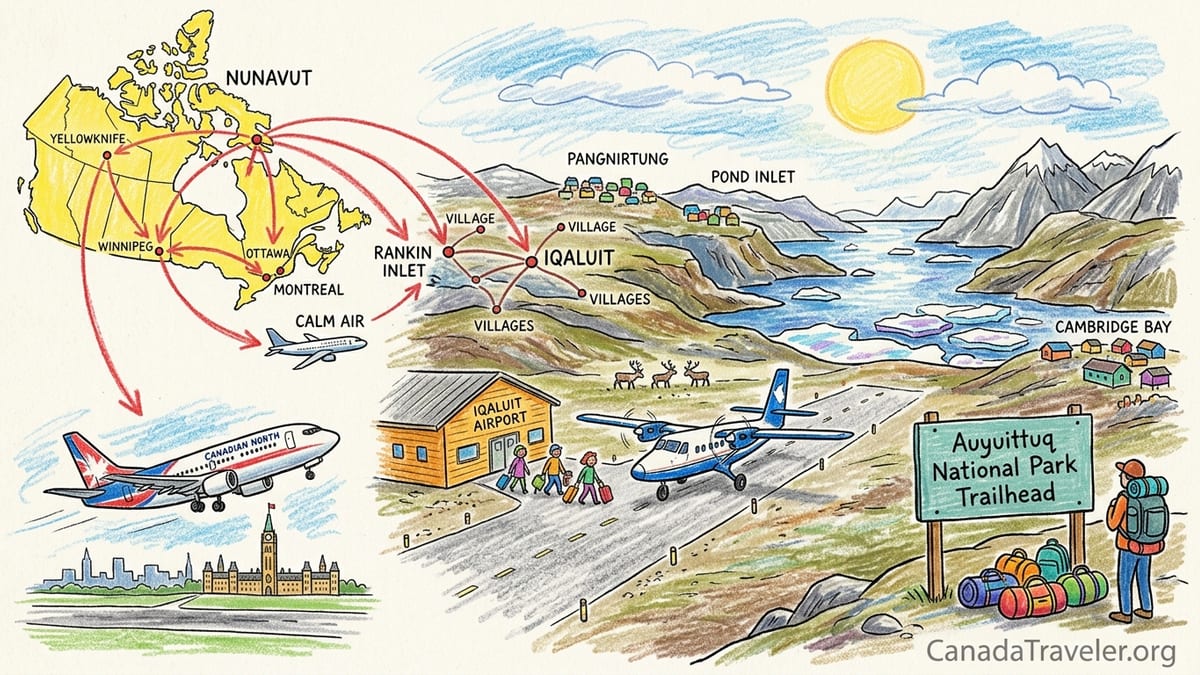
Nunavut is vast and roadless. Communities are not linked by highways, and there are no long-distance rail lines to fall back on. Outside a brief summer shipping season for cargo, virtually all passenger movement in and out of the territory happens by air. That makes a handful of southern and northern cities into “gateways” that funnel travelers toward different regions of Nunavut.
For most visitors coming from southern Canada or abroad, Ottawa, Montreal, Winnipeg and Yellowknife act as the main jumping-off points. From these hubs, scheduled flights fan out to Iqaluit on Baffin Island, Rankin Inlet and other central Nunavut communities, and western Nunavut towns such as Cambridge Bay. Iqaluit itself is also a gateway for smaller Baffin communities and even the High Arctic, including Resolute.
This hub-and-spoke pattern matters because there is rarely a single, simple ticket that whisks you to an expedition trailhead. Instead, you combine one or two southern segments with at least one northern “milk run” that might touch several communities along the way. A traveler heading for Pond Inlet, for instance, will usually route via Ottawa or Montreal to Iqaluit, then board a smaller aircraft north to Baffin’s glacier-carved fjords.
Weather, aircraft availability and freight demand all influence how this system runs on any given week. Flights can and do change seasonally, and same-day connections that look tight on paper may unravel when crosswinds pick up in Iqaluit or sea fog rolls over Cambridge Bay. Successful trip planning in Nunavut starts with understanding these hubs and treating connections as flexible, not guaranteed.
Flying from Ottawa and Montreal to Iqaluit
Iqaluit, Nunavut’s capital on Baffin Island, is the primary aerial doorway into the eastern Arctic. Canadian North operates direct flights between Ottawa and Iqaluit, with a typical flying time of around three hours and a pattern of one to two departures a day depending on the season. In practical terms, that means a traveler from Toronto or New York will usually connect through Ottawa on a morning flight and arrive in Iqaluit by early afternoon, assuming everything runs on time.
Fares on this route fluctuate widely but often sit in the high hundreds of Canadian dollars for a return ticket when booked several months out, and more when purchased closer to departure or during peak summer travel. Travelers sometimes redeem frequent-flyer miles, such as Aeroplan points, to soften the cost, but taxes and fees can still amount to several hundred dollars. Because Canadian North is effectively the lifeline carrier, there is little true competition on this corridor, and price drops of the sort you might expect on leisure routes are rare.
Montreal has historically offered connections into Iqaluit as well, sometimes via intermediate stops in northern Quebec such as Kuujjuaq. Route structures have evolved, with Air Inuit and Canadian North adjusting who flies which leg, and schedule changes are not uncommon year to year. Today, many travelers from Europe or eastern North America still find it convenient to route into Montreal and then connect north, especially if they are already spending time in Quebec or Nunavik before heading to Nunavut.
Because of limited frequencies, both Ottawa and Montreal flights should be treated as crucial building blocks. If you are planning an Auyuittuq National Park trek starting from Pangnirtung, for example, you might fly into Ottawa the night before, overnight near the airport, and board the morning Canadian North flight to Iqaluit. Only after reaching Iqaluit would you continue to Pangnirtung on a separate, shorter sector. That separation of tickets and ample buffer time reduces the risk that a single weather delay in the south causes a cascade of missed Arctic connections.
Winnipeg and the Central Nunavut Corridor
While Ottawa and Montreal feed the eastern Arctic, Winnipeg acts as a principal southern gateway to central Nunavut. Calm Air, in partnership with Canadian North on some sectors, operates direct flights from Winnipeg to Rankin Inlet, a key hub on the western shore of Hudson Bay. Typical flight time is about three hours on regional aircraft, often in the 30 to 50 seat range.
From Rankin Inlet, travelers can connect onward to a network of Kivalliq communities and, in some cases, link across to Baffin or further north. For example, a wildlife photographer planning a spring floe-edge safari near Igloolik might travel from Winnipeg to Rankin Inlet, then connect onward through one or two intermediate communities. Similarly, some itineraries toward central parks or mining camps route via Winnipeg and Rankin instead of via Ottawa and Iqaluit.
Prices out of Winnipeg to Nunavut can surprise newcomers. A simple round-trip economy ticket between Winnipeg and Rankin Inlet can easily cost over one thousand Canadian dollars, even outside peak months, reflecting the high cost of operating long regional sectors with limited demand. Local residents often rely on special northern fares and tax deductions, but visitors should budget conservatively and book early. Because these flights double as cargo lifelines, they may also be heavily booked with freight and rotational workers, particularly around shift-change dates at mines.
For a traveler whose main goal is an Iqaluit city break, Winnipeg is usually not the most direct gateway unless they are combining multiple regions of Nunavut. However, if your dream is a central Nunavut aurora trip around Rankin Inlet in late winter, or a visit to friends in communities such as Arviat or Baker Lake, building your itinerary around Winnipeg and its northbound flights often makes the most sense.
Yellowknife and Access to Western Nunavut and the High Arctic
Yellowknife in the Northwest Territories serves as the western overland and air gateway into Nunavut. From Yellowknife, regional carriers operate flights roughly east and north to Cambridge Bay on Victoria Island and, via longer routes often connecting through Iqaluit or other hubs, on toward Resolute in the High Arctic. Air Tindi has periodically offered services from Yellowknife to Cambridge Bay, sometimes on a limited, every-second-Tuesday basis for certain sectors, while Canadian North has long linked Yellowknife with Nunavut communities as part of its pan-Arctic network.
Cambridge Bay acts as an important nodal point for western Nunavut. It is a community in its own right and a staging area for science, mining and adventure tourism activities across Victoria Island and the adjacent mainland. Travelers coming from Vancouver, Calgary or Edmonton might find it more efficient to route to Yellowknife first, then continue on a dedicated northern service into Cambridge Bay, rather than backtracking through Ottawa or Montreal to reach Iqaluit.
Resolute is one of the key launching pads for High Arctic expeditions, including trips to Quttinirpaaq National Park on Ellesmere Island and specialized polar ski or science expeditions. Scheduled options are few, and seats in peak season are heavily pre-allocated to government, research and logistics customers. Canadian North has at times offered regular services to Resolute via Iqaluit from Ottawa, Montreal and Yellowknife, but the exact pattern fluctuates with demand and contracts. For most visitors, access to Resolute is arranged as part of an expedition package, with the operator blocking group space months or even a year in advance on the limited flights.
Because Yellowknife also experiences its own bouts of extreme cold, wildfire smoke and low visibility, travelers planning to connect there should allow at least a full day’s buffer before a critical onward charter or national park trip. A typical High Arctic itinerary might see you fly commercial into Yellowknife, overnight there, connect on to Iqaluit or Cambridge Bay the next day, then continue further north to Resolute once everyone and all the gear have successfully made it through the chain.
Connecting Onward to Pangnirtung, Pond Inlet, Qikiqtarjuaq, Cambridge Bay and Resolute
Once you reach an Arctic hub like Iqaluit, Rankin Inlet, Cambridge Bay or Yellowknife, the real adventure begins: fanning out into smaller communities aboard turboprops and, sometimes, very small aircraft. Iqaluit in particular links directly to a range of Baffin Island communities, including Pangnirtung (YXP), Pond Inlet (YIO) and Qikiqtarjuaq (YVM), along with others such as Clyde River and Arctic Bay. These routes typically use 30 to 40 seat aircraft, though in some cases you may find yourself on smaller planes with fewer than 20 seats.
Pangnirtung, gateway to Auyuittuq National Park, lies only a short hop from Iqaluit, with a scheduled flight time close to an hour. Pond Inlet, with its dramatic views of Bylot Island and the Lancaster Sound floe edge, is significantly farther and often takes more than three hours of flying time including intermediate stops. Qikiqtarjuaq, perched along the east coast of Baffin Island, is somewhere in between, generally around two hours from Iqaluit when flown directly. These sectors may operate as multi-stop “milk runs,” where passengers board in Iqaluit, touch down in one or two communities, and then continue to their final destination.
Cambridge Bay and Resolute are part of a separate western and High Arctic pattern. Reaching Cambridge Bay might involve a Yellowknife–Cambridge Bay non-stop on a regional carrier, or a more complex routing via Rankin Inlet or Iqaluit, depending on seasonal schedules. Resolute, further north, is usually served as a special sector out of Iqaluit, occasionally with intermediate stops in communities such as Arctic Bay or Grise Fiord when aircraft are repositioning or moving freight. Because these flights are few and far between, independent travelers often have to match their plans to the limited days on which aircraft actually operate.
It is important to understand that these routes are utilitarian rather than tourist-focused. A flight from Iqaluit to Pond Inlet might carry hunters, schoolchildren, medical passengers and boxes of fresh produce alongside a handful of visitors. Cabin baggage may be tightly controlled because the aircraft is also full of freight, and last-minute weight-and-balance issues can bump passengers to the next available service. For this reason, local operators who run Auyuittuq trips or floe-edge safaris usually build in extra nights in Iqaluit or the gateway community to absorb these uncertainties.
Aircraft Types, No Highways and Why Weather Rules Everything
Nunavut’s communities are not connected by highways, and many are separated by fiords, sea ice and open ocean. In winter, local residents sometimes travel between towns over sea ice or on snowmobile trails, but there is no equivalent to driving from one small town to the next along a paved road. From a visitor’s perspective, that means every major movement between communities will happen in an aircraft or, in summer in some regions, occasionally by boat as part of a guided trip.
The aircraft serving these routes are chosen for short gravel or paved runways and harsh conditions. On main corridors like Ottawa to Iqaluit or Winnipeg to Rankin Inlet, you are likely to fly on regional jets or larger turboprops seating 50 to 100 passengers. On community legs, you may board a 30-seat turboprop, while some charter legs into High Arctic national parks rely on even smaller planes or twin-engine bush aircraft. Cabins can be cozy, and overhead bin space limited; bulky expedition duffels are often checked as cargo, not carried on.
Weather is the single biggest factor shaping how and when these aircraft move. Even in mid-summer, fog drifting in off Frobisher Bay can close Iqaluit to landings, leading to diversions or delays that ripple through the schedule. In winter, blizzards, crosswinds and severe cold can all ground flights. Western hubs like Cambridge Bay and Yellowknife also see whiteouts and extreme wind chills that make even short hops unpredictable. Travelers report sometimes spending unexpected nights in Iqaluit or a regional hub while waiting for conditions to improve.
For transport planning, that reality translates into one basic rule: always expect delays and missed connections, and never schedule critical activities immediately after a northern flight. If you have a nonrefundable floe-edge safari starting from Pond Inlet, you might build in two or even three buffer nights in Iqaluit and Pond Inlet combined before your actual departure onto the sea ice. The more remote and weather-dependent your adventure, the more generous your buffers should be.
Planning Transport for an Iqaluit City Trip
An Iqaluit city trip is the simplest Nunavut itinerary from a transportation perspective. A typical visitor from Ottawa or Montreal might fly north for a long weekend to experience Inuit culture, sample local restaurants and walk out along the tundra just beyond town. Because the entire trip revolves around Iqaluit, there are fewer moving parts than a multi-community expedition.
In practical terms, you might fly into Ottawa on a Thursday evening, stay at an airport hotel, and catch a Friday morning Canadian North flight to Iqaluit. With a flight time of just over three hours, you would land midday, check into a local hotel or guesthouse, and have the afternoon free to explore. After two or three nights in town, you would take a Monday flight back to Ottawa, connecting home that same evening or the next day.
Even this straightforward plan benefits from built-in slack. If your Thursday flight into Ottawa is delayed, you still have the overnight cushion before heading north. On the return, you might avoid booking the last possible connection out of Ottawa, opting instead for a flexible fare or an overnight if your budget allows. Weather can still disrupt flights even in shoulder seasons like October, and many visitors have stories of unplanned extra nights in Iqaluit when fog or crosswinds shut the airport.
Costs for an Iqaluit getaway are driven mainly by the Ottawa–Iqaluit air ticket and local accommodation. While visitors sometimes spot promotions or use miles to reduce the fare, it is wise to budget in the low four figures in Canadian dollars for flights and lodging for a long weekend, then add costs for tours, meals and local transportation.
Transport Strategy for an Auyuittuq Expedition
A trek through Auyuittuq National Park, with its granite walls and glacier valleys, typically begins and ends in Pangnirtung or Qikiqtarjuaq. Most independent travelers and guided groups route through Iqaluit, then use scheduled community flights to reach their trailhead. Because those community flights are on smaller aircraft with limited seats, park-bound travelers often book many months in advance, especially for popular summer windows.
A common pattern from southern Canada might look like this: fly to Ottawa on Day 1, overnight, fly Ottawa to Iqaluit on Day 2, overnight in Iqaluit, then fly Iqaluit to Pangnirtung on Day 3. Only on Day 4 would your trek into Auyuittuq actually begin. The return is similarly staged, with at least one night in Pangnirtung at the end of your hike and another buffer night in Iqaluit before flying south. Guiding companies routinely insist on this kind of staged schedule because a single weather delay on the Pangnirtung leg could otherwise wipe out your first trekking day or cause you to miss a southbound flight entirely.
Travelers should also consider baggage rules carefully. Expedition gear for Auyuittuq, including tents, cold-weather clothing and several days of food, often pushes against standard baggage allowances. Some visitors pre-ship dry food or specialized equipment to an outfitter in Iqaluit or Pangnirtung to avoid excess-baggage shocks at check-in. Others plan a rest day in Iqaluit for last-minute gear purchases and repacking before boarding the smaller community flight.
The key difference between an Iqaluit city break and an Auyuittuq expedition is how far ahead you must lock in flights and how much redundancy you build into the schedule. For a trek that may cost several thousand dollars in guiding fees alone, it is rarely worth gambling on same-day connections between Ottawa, Iqaluit and Pangnirtung. Adding two or three extra hotel nights to protect the expedition is, in most cases, a sound investment.
Building in Buffers for Floe-Edge Safaris and High Arctic Park Trips
Floe-edge safaris, where you travel onto the spring sea ice to watch narwhals, seals and polar bears along the melting edge, are among the most logistically complex trips in Nunavut. Many of the classic floe-edge experiences operate out of communities like Pond Inlet on northern Baffin Island. To get there, a visitor from southern Canada might string together three or even four flight segments: a southern city to Ottawa or Montreal, then on to Iqaluit, then to Pond Inlet, and possibly a short transfer by snowmobile or boat from the community to a remote camp.
Because the camp’s operating window is short, and wildlife movements are highly seasonal, operators design set departure dates and ask guests to arrive in Pond Inlet at least one full day before heading out on the ice. In practice, many experienced travelers add a second buffer day in Iqaluit as well, so that a delayed community flight does not cause them to miss the first snowmobile departure. In some seasons, operators may block space on particular flights and advise clients to avoid tight same-day connections that depend on perfect weather in multiple communities.
High Arctic national park trips, such as journeys to Quttinirpaaq National Park, add another layer of complexity. Access usually involves flying into Resolute on a scheduled or semi-scheduled service, then taking a charter flight even farther north to a remote airstrip or ice strip near Tanquary Fiord or Lake Hazen. Expedition companies often charter entire aircraft for a group, spreading the high cost across multiple travelers. Any delay in getting people or cargo to the Resolute staging point can ripple through the whole plan and, in a worst-case scenario, force costly rescheduling of the charter.
For these reasons, High Arctic itineraries are commonly built with multiple buffer days on each end. A sample plan might include flying into Ottawa or Yellowknife two days before the scheduled Iqaluit or Cambridge Bay connection, then spending another night or two in Iqaluit or Resolute before the charter north. On the return, operators often avoid booking guests on same-day southbound flights, choosing instead to have everyone overnight in Iqaluit or Yellowknife before heading back to southern Canada. In such remote regions, the motto is simple: time is your safety margin.
The Takeaway
Travel to Nunavut is shaped by a distinctive gateway system that routes travelers through hubs like Ottawa, Montreal, Winnipeg, Yellowknife, Iqaluit, Rankin Inlet, Cambridge Bay and Resolute. Communities are not linked by highways, and small aircraft operating on short, weather-exposed runways provide the final links into places like Pangnirtung, Pond Inlet and Qikiqtarjuaq. Understanding this structure and the realities of Arctic aviation is the foundation of any successful itinerary.
Whether your goal is a weekend in Iqaluit, a traverse of Auyuittuq National Park, a spring floe-edge safari or a High Arctic journey to Quttinirpaaq, transportation planning is as important as your gear list. Build extra nights into your schedule, expect weather delays, and treat each gateway as a staging post rather than just another connection. With realistic expectations and generous buffers, the same flights that sustain daily life across Nunavut can also carry you safely into some of the most remarkable landscapes on Earth.
FAQ
Q1. Can I drive to Nunavut or between its communities?
There are no highway links into Nunavut or between its communities. Visitors arrive and move around almost entirely by air, with occasional boat or snowmobile travel on guided trips.
Q2. Which southern cities are the main gateways for flights to Nunavut?
Ottawa and Montreal are the primary gateways to Iqaluit and eastern Nunavut, while Winnipeg serves central Nunavut and Yellowknife connects into western Nunavut and some High Arctic routes.
Q3. How long is the flight from Ottawa to Iqaluit?
The direct flight from Ottawa to Iqaluit typically takes a little over three hours, not including any time for boarding, de-icing or potential delays.
Q4. How far in advance should I book flights for an Auyuittuq National Park trek?
It is wise to book several months in advance, especially for summer. Many travelers secure flights 6 to 9 months ahead and add extra nights in Iqaluit and Pangnirtung or Qikiqtarjuaq.
Q5. Are weather delays really that common in Nunavut?
Yes. Fog, snow, high winds and low visibility regularly disrupt flights year-round. Travelers should expect possible delays or overnight stops in hubs such as Iqaluit or Rankin Inlet.
Q6. What kind of planes will I fly on between Nunavut communities?
Main gateway legs often use regional jets or larger turboprops, while community flights typically use smaller turboprops with around 20 to 40 seats, and some charters rely on even smaller aircraft.
Q7. How expensive are flights from southern Canada to Nunavut?
Fares vary, but return tickets from cities like Ottawa or Winnipeg to Nunavut hubs often run into the high hundreds or more in Canadian dollars, especially during peak seasons.
Q8. Do I need extra days in my itinerary for a floe-edge safari?
Yes. Many operators recommend at least one full buffer day in Iqaluit and another in the community where your safari begins, such as Pond Inlet, to account for flight disruptions.
Q9. How do I reach High Arctic parks like Quttinirpaaq?
Most visitors travel on expedition packages that combine scheduled flights to Resolute with charter flights farther north. These trips usually require multiple buffer days on each end.
Q10. Can I rely on same-day connections in Nunavut like I would in southern hubs?
It is risky. Because flight frequencies are low and weather delays are common, most travelers avoid tight same-day connections, especially when connecting to remote communities or charters.