


The Northwest Passage has shifted from an almost mythical prize for explorers to one of the most exclusive expedition cruise routes on earth. For travelers, that means the chance to sail through Canada’s Arctic Archipelago, visit remote communities like Pond Inlet and Gjoa Haven, watch for polar bears on sea ice, and trace the dramatic history of the Franklin Expedition. It also means five-figure price tags, complex logistics and a growing number of ship options. This guide focuses on modern Northwest Passage voyages through the Canadian Arctic, helping you understand routes, wildlife, cultural programming, booking costs and what to expect before you commit.
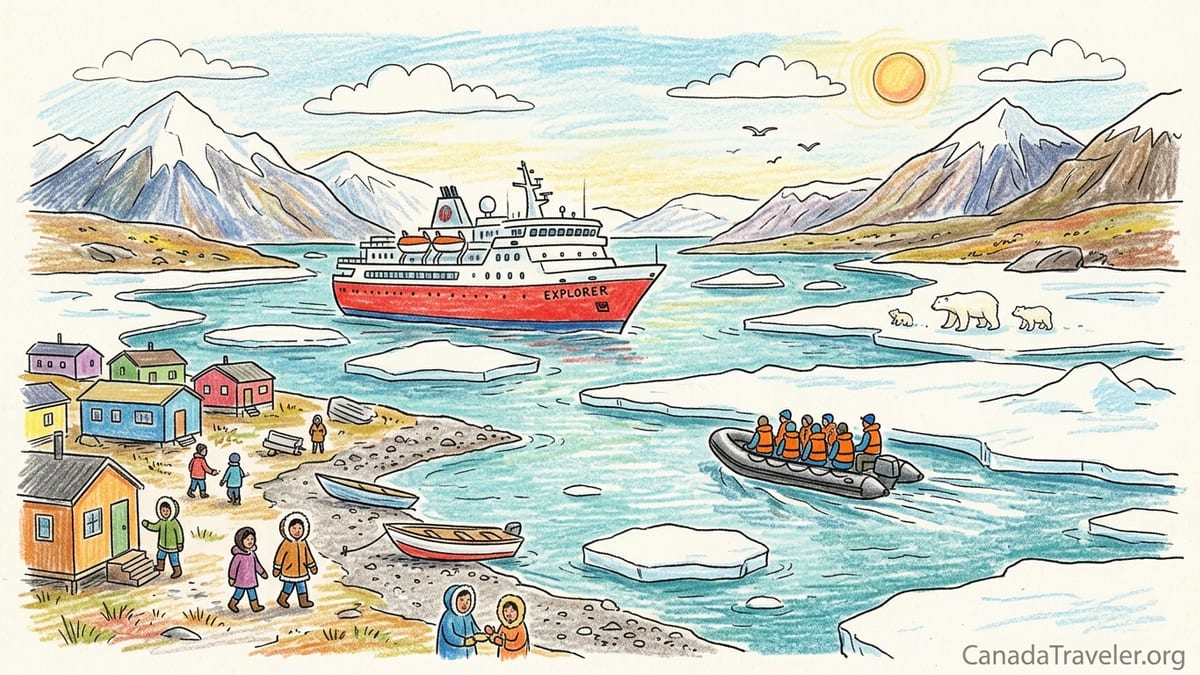
Understanding the Northwest Passage Route
When cruise companies talk about the Northwest Passage, they are referring to a network of channels cutting through Canada’s Arctic Archipelago between Baffin Bay in the east and the Beaufort or Bering seas in the west. Classic expedition itineraries typically thread west from the Greenland coast or Baffin Island into Lancaster Sound, then continue through key choke points such as Peel Sound, Queen Maud Gulf and Amundsen Gulf, depending on sea ice conditions. Operators do not guarantee a precise line on the map; instead, captains work with daily ice charts and often adjust the course in real time.
In practical terms, a guest on a 17 to 29 day Northwest Passage voyage in 2026 or 2027 might embark in Kangerlussuaq or Nuuk in Greenland, cross Baffin Bay to Pond Inlet in Nunavut, then continue west to Resolute, Beechey Island, Gjoa Haven, Cambridge Bay and eventually disembark in western Arctic gateways like Kugluktuk, Nome or occasionally northern Alaska ports. One recent 29 day “Traversing the Northwest Passage” voyage on the Greg Mortimer, for example, is scheduled from Greenland to Alaska with pricing starting just above the low forty-thousand-dollar range per person for 2026 departures, underlining how long and remote these sailings are.
Most operators describe the route as “following in the wake” of historic expeditions rather than promising a textbook transit. In some seasons, heavy multiyear ice in Victoria Strait can force ships south into Queen Maud Gulf or prevent a full through-passage at all. Travelers should expect that their voyage will be an exploration of the Canadian High Arctic rather than a rigid line between two geographic points.
Key Communities: Pond Inlet, Resolute, Gjoa Haven and Cambridge Bay
Modern Northwest Passage itineraries are as much about people and culture as they are about geography. Pond Inlet, known locally as Mittimatalik, is a common eastern gateway to the Canadian Arctic. On many sailings you will clear Canadian customs here, then join guided walks through town, visit the community hall for drum dancing or throat singing demonstrations, and browse locally carved soapstone or ivory (from legally harvested sources) at craft cooperatives. The surrounding landscape of Bylot Island and Eclipse Sound also offers some of the most photogenic mountain scenery on the route.
Farther west, Resolute is one of the northernmost settlements in Nunavut and a logistic hub for Arctic research, search and rescue, and charter flights. Some expedition itineraries use its gravel airstrip to turn over passengers, with guests flying in on specially arranged charters from southern Canada to meet the ship. Even when Resolute is not a turnaround port, many ships call to refuel or embark local guides, and guests often have the chance to walk the tundra around town with naturalists and Inuit cultural educators.
Gjoa Haven, on King William Island, is arguably the emotional heart of many Northwest Passage cruises. Named after Roald Amundsen’s ship Gjøa, it is closely tied to the Franklin Expedition story. Travelers typically visit the Nattilik Heritage Centre to see exhibits about both Franklin and traditional Inuit life, and some voyages time community visits with local performances or storytelling sessions in the school gym or community center. The stop is often remembered less for its austere landscape and more for conversations over bannock and tea with residents.
Cambridge Bay, a key settlement in western Nunavut, frequently marks either the end of a partial passage itinerary or a midpoint refueling and resupply stop. Here you may tour research facilities, see remains of earlier DEW Line radar sites, or simply appreciate how a modern Arctic community functions. For many guests, the biggest surprise is how central these communities are to the overall voyage experience: Zodiac transfers to shore, informal chats on the pier and handicraft markets add a level of immediacy that scenery alone cannot provide.
Franklin Expedition History, Sea Ice and Climate Realities
Every Northwest Passage expedition weaves in the story of Sir John Franklin’s doomed 1845 voyage, which vanished with 129 men after becoming trapped in sea ice. Most ships attempt to visit Beechey Island, where the graves of three Franklin crew members overlook the channel and rusted food tins still lie on the gravel. Lectures on board often cover the search efforts that followed and the modern discoveries of Franklin’s ships Erebus and Terror, blending 19th century history with 21st century underwater archaeology.
Understanding the Franklin tragedy also means understanding sea ice. Even in a warming Arctic, multi-year pack ice can still choke narrow channels like Larsen Sound and Victoria Strait well into August. Satellite ice charts, icebreaker escort availability and real-time reconnaissance flights all feed into routing decisions. Travelers in 2026 or 2027 should expect that captains may deviate significantly from the advertised itinerary to avoid dense ice, and in extreme years a full through-transit may simply not be possible.
Climate change has simultaneously opened the region to more regular navigation and put its ecosystems under new stress. Guests often hear onboard talks about shrinking summer sea ice, changing migration patterns for bowhead whales and the challenges that new ship traffic poses for Inuit communities and wildlife. Operators respond with low-sulfur fuel mandates, pledges to avoid sensitive walrus haul-outs and caps on passenger numbers per landing, but the reality remains that a Northwest Passage cruise is both a rare privilege and an environmental responsibility.
Wildlife Watching and Zodiac Excursions
Wildlife is a major draw for Northwest Passage travelers, but sightings are never guaranteed. That uncertainty is part of the appeal. Along the ice edge in Lancaster Sound or near Conningham Bay, guests may see polar bears hunting seals on the floes, sometimes from the open decks and sometimes from Zodiacs drifting quietly along the edge of the pack. Beluga and bowhead whales occasionally surface near the ship or in shallow bays used by local hunters, while rough-legged hawks, jaegers and ivory gulls patrol the skies overhead.
Most days at sea, the expedition team uses Zodiacs to access shore landing sites or to cruise along bird cliffs and glacier fronts. On a typical 17 day “Epic High Arctic” Northwest Passage sailing, you might spend a morning in Zodiacs beneath a kittiwake colony on Devon Island, then land on a cobble beach to walk the tundra and examine ancient Thule archaeological sites under the guidance of an archaeologist and an Inuit culturalist. Another day might involve a Zodiac tour through sea ice near Resolute, the sound of the rubber hulls nudging floes adding to the sense of immersion.
Because conditions change quickly, flexibility is vital. Strong katabatic winds blowing off ice caps can cancel planned Zodiac excursions with only minutes’ notice, and polar bear sightings ashore may force a landing to shift to a safer site. Most operators outline this in their pre-departure materials: all shore visits and Zodiac cruises are subject to weather, ice and wildlife considerations. Travelers who approach the voyage as an open-ended expedition rather than a fixed checklist of landings tend to come away most satisfied.
Inuit Cultural Programming and Responsible Engagement
Inuit cultural programming has become central to Canadian Arctic expedition cruising. Many cruise lines now partner with local co-operatives, regional organizations or individual cultural ambassadors who sail for part or all of a voyage. Onboard, you might attend talks on traditional navigation, hunting practices, or the Inuktitut language, followed by practical workshops on throat singing or drum dancing led by Inuit performers. Storytelling evenings, where elders describe life on the land and the impacts of relocation or residential schools, can be some of the most powerful moments of the entire trip.
On shore in communities like Pond Inlet, Gjoa Haven and Cambridge Bay, ship operators typically coordinate with local hamlets months in advance. That planning ensures that craft markets, cultural demonstrations and school visits are voluntary and fairly compensated. Travelers may be invited to a community center performance or a guided walk that touches on everything from housing shortages to the cost of groceries flown in from the south. These visits offer context that is often missing from purely scenic Arctic trips.
For guests, responsible engagement starts with listening. Buying locally produced art instead of imported souvenirs, following guidelines on when and how to photograph people, and respecting designated no-go zones in town all contribute to a more balanced relationship between visitors and hosts. When evaluating cruise options, look for operators that highlight Inuit partnerships by name and describe concrete benefits to communities, such as funding cultural programs or hiring local bear guards and guides, rather than using generic language about “visiting villages.”
Full Transits vs Partial Northwest Passage Itineraries
Not all “Northwest Passage” cruises are created equal. Full transits typically run 24 to 29 days and aim to connect the Atlantic and Pacific (or Beaufort) Oceans in a single voyage, often between Greenland and Alaska. An example is a late August 2026 itinerary on an expedition ship like the Greg Mortimer, which schedules almost a month between embarkation in Greenland and disembarkation in Nome, with starting prices in the low to mid forty-thousand-dollar range per person for standard cabins. This kind of trip appeals to travelers who want to collect a true through-passage and can handle a long time at sea.
Partial itineraries, by contrast, usually span 12 to 18 days and focus on either the eastern or western sections of the archipelago. A good example is Adventure Canada’s “Out of the Northwest Passage” voyage, which in September 2026 is priced roughly from the high teens to mid-thirty-thousand dollars per person, depending on cabin category. That sailing concentrates on Greenland’s coast, Lancaster Sound, several Nunavut communities and the central channels but does not attempt a full Atlantic to Pacific link in one go.
There are also hybrid options, such as Greenland round-trips that loop into the eastern entrance of the Passage without venturing far west, or Baffin Island circumnavigations marketed as “Northwest Passage & Nunavut expeditions.” These can be attractive for travelers with limited time or who prioritize wildlife-rich areas like Lancaster Sound and Baffin Bay over the satisfaction of completing a full historic transit. When comparing itineraries, read route maps carefully and note whether the ship actually crosses the full archipelago or explores only its gateways.
Departure Logistics: Greenland, Nunavut and Western Arctic Gateways
Reaching the starting point of a Northwest Passage cruise is often more complex than the voyage itself. Eastern departures commonly use Kangerlussuaq or Nuuk in Greenland. Guests typically fly from major North American or European hubs to Iceland or Copenhagen, then onward on a charter or regional flight to Greenland on embarkation day. Hotels pre- and post-cruise are sometimes bundled into the package, particularly when charter flights operate on fixed schedules that do not align well with regular airline timetables.
On the Canadian side, charter flights from Ottawa, Calgary or Edmonton are often used to ferry passengers to Arctic airports such as Resolute, Pond Inlet or Cambridge Bay. For example, some “Into the Northwest Passage” or “Out of the Northwest Passage” sailings published for 2026 bundle mandatory charters within their pricing, while others list an additional internal air package in the roughly two-thousand-dollar-per-person range. These flights are usually nonrefundable and tightly integrated with the ship schedule, meaning independent flight arrangements are rarely possible.
Western endpoints add another layer of planning. Full transits that end in Nome or other western Arctic ports typically include a group charter to Anchorage or a similar gateway city, from which guests can connect to homebound flights. Travelers beginning or ending in Canadian western Arctic communities like Kugluktuk or Sachs Harbour should be prepared for minimal local infrastructure and rely on the cruise line’s transfer arrangements rather than assuming frequent scheduled service. Given the complexity, it is wise to add buffer days on either end of the trip and to consider comprehensive travel insurance that covers missed connections due to weather or mechanical delays.
Ships, Cabins, Gear and What Your Fare Includes
Northwest Passage cruises are almost exclusively operated by small expedition ships rather than traditional big-box cruise liners. Vessels from brands such as HX (formerly Hurtigruten Expeditions), Adventure Canada, Lindblad Expeditions and other polar-specialist operators typically carry between 120 and 250 guests. Many are Polar Class or ice-strengthened ships with advanced navigation systems, dynamic positioning and environmentally focused features like waste-to-energy systems or hybrid propulsion.
Cabin options range from compact porthole rooms in the high-teens-thousands of dollars per person on shorter partial routes to balcony suites and junior suites that can approach or exceed the mid-thirty-thousand-dollar range on the same itineraries. On longer, more luxurious full transits, entry-level cabins often start from the low to mid-twenty-thousand-dollar range per person, while premium suites can stretch into the fifty-thousand-dollar bracket. For instance, some 2026 Northwest Passage sailings published by major expedition brands list basic cabins from the low-twenty-thousands and top-tier accommodations above forty or fifty thousand per guest.
Fares usually include all meals on board, Zodiac excursions and guided landings, lectures, basic Wi-Fi, and expedition gear such as waterproof boots and a loaner parka. Several operators provide a complimentary expedition jacket that guests can keep, as well as dry bags for shore landings. Charter flights between gateway cities and Arctic embarkation ports may be either included in the core price or offered as a mandatory add-on, so it is essential to check the fine print when comparing quotes. Gratuities, bar drinks and premium Wi-Fi upgrades may or may not be bundled depending on the line and promotional offers at booking time.
Pricing, Booking Strategy and Change Policies
As of late 2026, published prices for Northwest Passage cruises in 2026 and 2027 consistently sit in the five-figure range per person. Shorter partial itineraries of around 16 or 17 days often start around the high-teens to low-twenty-thousand-dollars per person for entry-level cabins. Longer full transits stretching close to a month more commonly begin in the low to mid-twenty-thousand-dollar range and can climb to sixty-thousand dollars or more per person in top suites on luxury brands. National Geographic and Lindblad’s combined Northwest Passage voyages, for example, list select 2026 and 2027 departures at starting prices in the low-sixty-thousand-dollar range per person.
Promotions can make a substantial difference. Some operators offer early-booking discounts of 20 to 25 percent, reduced single supplements for solo travelers, or bundled charter flight and hotel packages valued at around two thousand dollars per person. Others may provide onboard credit or category upgrades during sales windows. Because capacity is limited and 2026 and 2027 sailings are already well into their selling cycles, travelers seeking specific dates or cabin types should be prepared to place deposits many months, often more than a year, in advance.
Prospective guests should pay close attention to cancellation and itinerary-change policies. Given the role of sea ice, most contracts reserve broad rights for the operator to alter routes, skip ports or even reverse an itinerary without compensation beyond what is required for safety or regulatory compliance. Full cancellations by the operator, for instance due to ice conditions or mechanical issues, are typically reimbursed with a combination of cash refunds and future cruise credits. However, reimbursement for independently booked flights is often excluded, reinforcing the importance of travel insurance that covers both cancellation and interruption.
From the traveler’s side, cancellation penalties usually ramp up as departure nears, with partial forfeiture of the deposit months out and full fare becoming nonrefundable closer to sailing. Up-front deposits on these itineraries are commonly in the low to mid-thousands of dollars per person. Before you commit, request a full copy of the operator’s terms and conditions, including details on medical evacuation coverage and minimum health requirements, and consider purchasing third-party insurance with high coverage limits, given the remote nature of the route and the cost of potential evacuations.
The Takeaway
A Northwest Passage cruise through the Canadian Arctic is not a conventional vacation. It is a complex, expensive and often unpredictable expedition into one of the most remote regions on the planet. Travelers who choose these voyages are buying not just a bed on a ship but access to Inuit communities, lectures on polar history and science, Zodiac landings on rarely visited shores and the chance, not the promise, to see polar bears, whales and other iconic Arctic wildlife in their natural habitat.
For 2026 and 2027, expect five-figure per-person pricing, mandatory charter flights and stringent terms and conditions that reflect the region’s logistical and environmental challenges. The most successful travelers tend to be those who embrace flexibility, prepare carefully for cold and changeable conditions, and approach community visits with respect and curiosity. If you are drawn to big landscapes, big stories and the sense of being at the edge of what is navigable, the Northwest Passage remains one of the most compelling itineraries in expedition cruising.
FAQ
Q1. How much does a Northwest Passage cruise typically cost per person?
Most 2026 and 2027 Northwest Passage voyages cost in the mid to high five figures per person. Shorter partial itineraries of around 16 or 17 days often start in the high teens to low twenty-thousand-dollar range, while full transits close to a month long typically begin in the low to mid-twenty-thousand-dollar range and can exceed fifty-thousand dollars per person in premium suites.
Q2. When is the best time of year to cruise the Northwest Passage?
The cruising window is short, usually from mid-August through early or mid-September, when sea ice is at its seasonal minimum and daylight is still plentiful. Most 2026 and 2027 itineraries are scheduled during this period, though exact dates vary by operator and route.
Q3. What kind of wildlife can I realistically expect to see?
Common sightings include seabirds such as kittiwakes and fulmars, seals and the occasional polar bear on sea ice, as well as possible encounters with beluga or bowhead whales. Wildlife is never guaranteed, but areas like Lancaster Sound and the ice edges near Devon Island and Conningham Bay tend to be among the most productive.
Q4. How physically demanding are shore landings and Zodiac excursions?
Passengers generally need to be able to climb in and out of Zodiacs with assistance, walk on uneven, sometimes icy terrain, and manage a few steps or ladders between ship and boat decks. Most operators can accommodate a range of fitness levels, but mobility limitations should be discussed with the cruise line or a specialist agent before booking.
Q5. Are charter flights usually included in the fare?
Some Northwest Passage packages include charter flights between gateway cities such as Ottawa, Calgary or Anchorage and Arctic embarkation ports like Resolute, Pond Inlet, Cambridge Bay or Nome. Others list these flights as a mandatory additional package in roughly the low thousands of dollars per person. Always verify whether internal flights are included when comparing prices.
Q6. What clothing and gear will I need to bring?
Expedition lines typically supply waterproof boots and may loan or gift a heavy parka, but guests should pack layered base and mid-layers, windproof and waterproof outer shells, hats, gloves and warm socks. Sunglasses, sunscreen and a camera with weather-protected gear are also strongly recommended, as light reflecting off ice and water can be intense even in cold conditions.
Q7. How stable are the ships, and will I get seasick?
Expedition ships operating the Northwest Passage are ice-strengthened and often feature stabilizers, but guests can still experience motion, especially on open water crossings such as Baffin Bay. If you are prone to seasickness, bring recommended medication or patches, and choose a midship, lower-deck cabin where movement tends to be less pronounced.
Q8. Can I do a Northwest Passage cruise as a solo traveler?
Yes, but you should expect higher per-person prices unless you can take advantage of specific solo traveler promotions. Some operators periodically offer low or zero single supplements on select departures or cabin categories, which can halve the usual cost for solo guests compared with paying full double-occupancy rates.
Q9. How likely is it that my itinerary will change due to ice or weather?
Itinerary changes are common in the Northwest Passage. Captains routinely adjust routes, landing sites and timing in response to sea ice, weather and wildlife considerations. While full cancellations are rare, you should expect that specific communities or landing sites cannot be guaranteed and that flexibility is part of the experience.
Q10. Is travel insurance really necessary for a Northwest Passage cruise?
Given the remote location, high trip cost and reliance on charter flights, comprehensive travel insurance is strongly recommended. Look for policies that cover trip cancellation and interruption, medical expenses, evacuation and repatriation, as well as missed or delayed flights, and verify that Arctic expedition cruising is not excluded from coverage.