


Banff and Jasper both deliver the kind of Canadian Rockies scenery that fills calendars and screen savers, but they feel very different on the ground. If you do not have time to do both properly, choosing the right base can shape your entire trip. This guide compares Banff and Jasper in plain language, using real examples from 2026, so you can decide where to spend your precious days in the mountains.
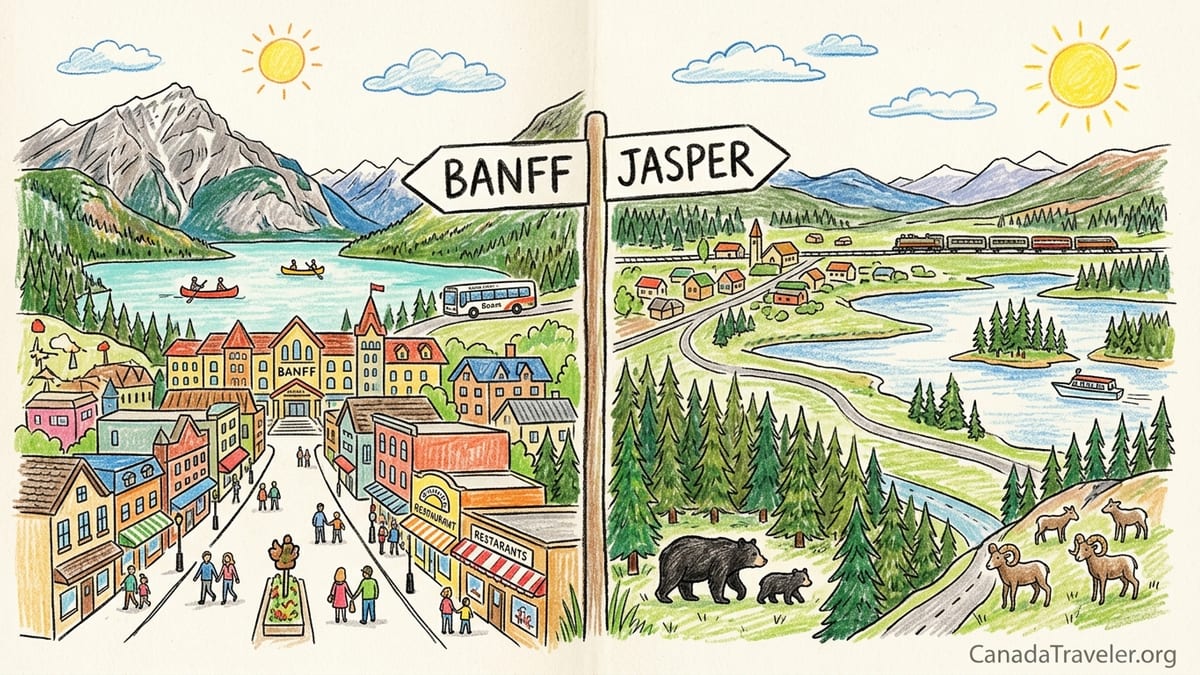
Big Picture: What It Feels Like To Stay in Banff vs Jasper
Banff is the classic first-timer base: a busy resort town surrounded by steep peaks, with a compact center full of hotels, restaurants, gear shops and shuttle stops. If you base yourself in Banff, you can walk from a midrange hotel near Banff Avenue to dinner, then to a grocery store or the Roam Transit stop in a few minutes. It feels lively and international in summer, more like a small ski town than a remote outpost.
Jasper feels smaller and more low-key, even though Jasper National Park is larger. The townsite has a handful of traffic lights, a modest main street with locally owned cafes and outfitters, and dark, quiet streets once the sun goes down. You can still find a pub or pizza late in the evening, but the overall mood is calmer. Many visitors describe Jasper as feeling closer to a traditional railway or mountain town than a purpose-built resort.
If you like having a lot of infrastructure around you, Banff is usually the easier adjustment, especially for first-time international travelers or families who want a wide choice of restaurants and activities. If you prefer a quieter base where it is easier to imagine you are deep in the wilderness, Jasper tends to fit better, even though it still gets busy in July and August.
In terms of prices, Banff generally runs a bit higher for accommodation and dining. For example, a basic but central hotel room in Banff in peak summer might run in the range of a couple of hundred Canadian dollars per night, while a comparable room in Jasper often comes in somewhat lower. That difference adds up over a week, especially for families or groups booking multiple rooms.
Mountain Scenery and Iconic Lakes
When travelers picture the Canadian Rockies, they often think of Lake Louise’s milky turquoise water beneath glacier-covered peaks or Moraine Lake’s famous Ten Peaks skyline. Both of these lakes sit in Banff National Park, and Banff is the stronger base if these highlights are top of your list. In 2026, the easiest way to reach Lake Louise and Moraine Lake is on the Parks Canada shuttles from the Lake Louise Park and Ride near the ski resort, or on Roam Transit and private shuttles. Shuttles to Lake Louise start running in mid May and to Moraine Lake in early June, with departures roughly every 30 minutes through early October.
Moraine Lake Road remains closed to private vehicles, so having Banff or Lake Louise village as a base makes controlling your shuttle times and early starts much simpler. You can, for example, spend a night in Lake Louise village, catch an early Parks Canada shuttle to Moraine Lake, hike the lakeshore or Larch Valley, then connect back to Lake Louise on the Lake Connector shuttle, all without worrying about parking.
Jasper’s scenery is different rather than lesser. The Maligne Valley is the star: Maligne Canyon’s narrow limestone gorge, Medicine Lake’s changing water levels, and the long turquoise reach of Maligne Lake itself. From Jasper town, it is an approximately 45 to 60 minute drive along Maligne Lake Road to reach the lake, with frequent stops for viewpoints and short walks. From there, classic activities include the Maligne Lake boat cruise out to Spirit Island, canoe rentals along the shoreline, or hikes like the Mary Schäffer Loop.
If your dream images are Lake Louise and Moraine Lake specifically, Banff is the clear choice. If you are more interested in a variety of viewpoints, from Pyramid Lake and Patricia Lake to the wide Athabasca River valley and Maligne Lake, Jasper gives you a broader feeling of space and less of the single “postcard” pressure.
Wildlife, Trails and Time Outdoors
Both parks offer a real chance of seeing wildlife, but Jasper generally has the reputation for feeling wilder, especially in the shoulder seasons. It is common in summer to encounter elk grazing near the townsite, bighorn sheep along Highway 16 or the Icefields Parkway, and occasionally black bears at a safe distance along Maligne Lake Road. Wildlife viewing tours depart from Jasper focusing on dawn and dusk drives where guides help spot animals and keep visitors at responsible distances.
Banff has plenty of wildlife too, including elk herds that wander right through town, but the density of visitors around the most famous lakes and viewpoints often means you share the experience with more people. You might see mountain goats on the cliffs along the Icefields Parkway between Lake Louise and Jasper, or bears from the car near Bow Valley Parkway on restricted-access cycling days, but you are rarely alone at classic pullouts in peak summer. For many travelers, that is an acceptable trade-off for the ease of access.
For hiking, Banff offers a huge spread of trails within an hour of town: Johnston Canyon to its waterfalls, Sulphur Mountain trails above the Banff Gondola, the Sunshine Meadows area in summer, and the famous Lake Agnes and Plain of Six Glaciers routes above Lake Louise. Most are reachable by car or shuttle and offer well-marked, often busy paths. That makes Banff excellent for first-timers and families who want clear, popular hikes where they will pass other people regularly.
Jasper’s hiking feels a bit more spread out and, in many cases, less crowded. Classic half-day options like Valley of the Five Lakes, Old Fort Point, or trails around Pyramid Lake are close to town, while longer outings into the Tonquin Valley or Skyline Trail demand more logistics or backpacking experience. If you are a strong hiker wanting to log full days on trail without constant crowds, Jasper usually has the edge, as long as you are comfortable with slightly more route-finding and fewer amenities at the trailheads.
Eating, Sleeping and Dealing With Crowds
Banff wins decisively on variety of restaurants and accommodation. Within a 10 minute walk of Banff Avenue you can find everything from quick-serve tacos and cafés to higher-end dining in hotel lounges. Large properties offer on-site restaurants, spas and guided excursions, and there is a solid range of apartment-style or condo-style units for families who want kitchen facilities. Lake Louise village adds a second cluster of lodging options, from the well known lakeside hotel to simpler inns closer to the highway.
This density comes with crowds. In July and August, Banff Avenue can feel like a busy ski resort on a holiday weekend. Dinner reservations are strongly recommended for popular spots, and parking in town can be tight in midday if you are not using hotel parking. The same applies at Lake Louise lakeshore and Moraine Lake, where the dependency on shuttles means you must think about booking windows and departure times rather than just driving whenever you like.
Jasper’s restaurant scene is more compact. You will find a handful of solid breakfast places, several pubs, pizza and burger joints, and a scattering of more upscale options. The choice is big enough for a week’s stay without repetition if you mix in takeout and groceries, but not nearly as broad as Banff. On the other hand, it is often easier to walk in and find a table, especially outside the absolute peak of summer and long weekends.
Accommodation in Jasper includes motels along Connaught Drive, small inns on side streets, cabins near lakes, and a few full service hotels. Prices in high season are not cheap, but you often get a little more space or a quieter setting for what you pay compared with Banff. If you are someone who feels overwhelmed by large, busy resorts, Jasper’s lodging mix may feel more relaxed and human scale.
Getting Around Without a Car and Reaching Each Park
From an access perspective, Banff is significantly easier, especially from Calgary. The drive from Calgary International Airport to Banff town is around an hour and a half on a major highway, and there are multiple shuttle companies running direct transfers several times per day. Once in Banff, the local Roam Transit network connects the town to Lake Minnewanka, the Banff Gondola area, and seasonally to Lake Louise and the Lake Louise Park and Ride. Combined with Parks Canada shuttles, this makes a car-free Banff and Lake Louise trip very realistic in 2026.
Reaching Jasper generally requires more effort. From Edmonton International Airport, you are looking at roughly a four to five hour drive to Jasper, mostly on Highway 16. There are some bus and shuttle services, but they run less frequently than the Calgary to Banff corridor. Many visitors reach Jasper by driving the Icefields Parkway from Lake Louise, which is itself around a three and a half hour scenic drive without stops. That route is spectacular but is more tiring to manage if you are arriving directly after a long flight.
Within Jasper, there is a small local transit system and some seasonal shuttle services, including new and expanded offerings to Maligne Lake. However, many of the best viewpoints, lakes and trailheads are still most conveniently reached by car or by guided tour that includes transportation. If you prioritize a car-free holiday and plan to rely heavily on buses and shuttles, Banff is the more straightforward choice.
For travelers who do rent a vehicle, driving in both parks is relatively simple, but you should factor in busy parking lots, strict speed limits to protect wildlife, and possible wildfire or construction-related delays in peak season. In both Banff and Jasper, arriving at trailheads early in the morning not only improves your parking chances but also reduces crowds and tends to increase wildlife sightings.
Winter Experiences and Shoulder Seasons
In winter, Banff transforms into a full-service ski base, while Jasper feels more like a quieter winter escape. Banff is close to several major ski areas, including Sunshine Village and a large resort at Lake Louise. Ski shuttles run from town to the mountains, and the après ski scene along Banff Avenue stays lively with bars, hot pools, and winter festivals in many seasons. If downhill skiing or snowboarding is central to your trip, Banff is usually the better hub.
Non-skiers in Banff also have plenty of options. There are guided snowshoe tours, winter hikes in Johnston Canyon, fat biking trails, and the Banff Gondola, which operates year round and offers a boardwalk along the summit of Sulphur Mountain. Icewalk tours through frozen canyons and outdoor skating on maintained rinks or on natural ice when conditions allow round out a robust winter menu.
Jasper has its own ski hill at Marmot Basin, which is usually less crowded than the larger Banff area resorts. The terrain is popular with locals from Edmonton and with visitors who appreciate shorter lift lines and a more laid-back feel. Winter in Jasper also means cross-country ski trails, fat biking, and the chance to see Jasper Dark Sky Preserve-quality stars on clear nights. Because Jasper is farther north and slightly higher in elevation in some valleys, you can also encounter more wintry road conditions earlier and later in the season.
In shoulder seasons like late May or October, both parks see more unpredictable weather. Some higher trails around Lake Louise, Moraine Lake and Maligne Lake may still hold snow or be muddy, and certain services, such as boat cruises and some shuttles, operate on reduced schedules. Banff’s larger year-round infrastructure can make it more comfortable in these months, with more indoor activities, museums and hot springs to fill days when trails are not yet fully open.
Who Should Choose Banff, Who Should Choose Jasper
For first-time visitors with 3 to 5 days, Banff is usually the safest and most rewarding single base. You can see Lake Louise and Moraine Lake using the Parks Canada shuttle system, ride the Banff Gondola, walk along the Bow River in town, and fit in classic day hikes like Johnston Canyon or Lake Agnes. You will deal with more people, but you will also have a much wider choice of tours, restaurants and public transit, which takes pressure off planning.
For strong hikers and repeat visitors who want longer days on trail and a calmer pace, Jasper becomes very attractive. Basing in Jasper for 4 to 6 days lets you hike quieter routes like Skyline Trail sections, Wilcox Pass near the Icefields, or full days around Maligne Lake, then relax beside Pyramid Lake or in a cabin setting that feels more removed from town. You can still drive or bus the Icefields Parkway one way as a highlight, but your daily rhythm will likely feel less rushed.
Families often gravitate to Banff because it is easier with kids. Strollers or small children fit better into a world of short, popular trails, grab and go food, easy grocery options, and frequent buses. For example, a family can stay near central Banff, walk to a playground, catch a Roam bus to Lake Minnewanka for a boat cruise, and be back in town without touching the car. Jasper can also work very well for families who want cabins, lakeside picnics and wildlife watching, but you should be prepared for slightly longer drives to activities.
Travelers who put wildlife and fewer crowds at the top of their wish list typically lean toward Jasper. By staying in Jasper, you can time dawn and dusk drives along Maligne Lake Road or around Pyramid Bench when animals are most active and traffic is lighter. That does not guarantee sightings, but your odds of a quiet pullout with only one or two other vehicles are better than around Lake Louise and Moraine Lake in summer. Just remember that animals are wild in both parks, and viewing should always happen from safe distances, ideally with binoculars or a long camera lens.
The Takeaway
Banff and Jasper share the same spine of the Canadian Rockies, but they deliver it in different ways. Banff gives you headline attractions like Lake Louise and Moraine Lake, a busy but convenient town, and a well-developed network of shuttles and tours. It is ideal if you want maximum scenery in minimum time and prefer having many services close at hand. The trade-off is higher prices and heavier crowds, especially from late June through early September.
Jasper offers a quieter townsite, easier access to open valley views and the Maligne area, and a better chance of feeling like you are in a big landscape with fewer people around. It requires more driving and is harder to tackle without a car, but rewards you with calmer trailheads and more breathing room. The northern section of the Icefields Parkway up to Jasper also gives you some of the most dramatic mountain vistas in the Rockies, with frequent pullouts and short walks to glaciers and waterfalls.
If you truly cannot visit both and need a simple rule, choose Banff for a short first trip, especially if your must-see list includes Lake Louise and Moraine Lake, and choose Jasper if you have already experienced Banff or if your priority is quieter days, wildlife watching and longer hikes. Either way, planning ahead for shuttles, accommodation and driving times will matter more than squeezing in every famous photo stop. Focus on a few key areas, leave space for weather and rest, and you are likely to come home convinced that you need to return to the Canadian Rockies again.
FAQ
Q1. If I only have three full days, should I base in Banff or Jasper?
With just three days, Banff is usually the better base because it offers easier access from Calgary, more frequent public transit, and convenient shuttles to Lake Louise and Moraine Lake, letting you see several highlights without long transfer days.
Q2. Is it realistic to visit Jasper as a day trip from Banff?
It is technically possible to drive the Icefields Parkway to Jasper and back in one very long day, but it is not recommended if you want to enjoy the viewpoints and short walks. Most travelers either stay at least one night near the Columbia Icefield or base in Jasper for several nights instead of rushing out and back from Banff.
Q3. Which park is better if I will not rent a car?
Banff is better without a car because of its stronger public transportation network. You can reach Banff by shuttle from Calgary, then use Roam Transit and Parks Canada shuttles to get to Lake Minnewanka, Lake Louise, Moraine Lake and other major attractions, which is far harder to replicate in Jasper.
Q4. Where am I more likely to see wildlife, Banff or Jasper?
Wildlife is present in both parks, but Jasper often feels richer in wildlife encounters, especially along roads like Maligne Lake Road and near Pyramid Lake, where traffic is lighter and there is more open valley habitat. Banff also offers regular sightings, but usually with more vehicles and people around.
Q5. Are Lake Louise and Moraine Lake accessible if I stay in Jasper?
They are accessible, but it is not convenient as a day trip. You would need to drive several hours down the Icefields Parkway, then coordinate shuttle reservations from the Lake Louise Park and Ride. For practical purposes, travelers who prioritize those lakes should sleep in Banff or Lake Louise rather than Jasper.
Q6. Which town has better restaurant options?
Banff has a wider range of restaurants, from casual cafés to high-end hotel dining, and more late-night options. Jasper has good food but fewer choices overall, so Banff is the better fit if you care a lot about dining variety or have a large group with mixed tastes.
Q7. Is Jasper really less crowded than Banff in summer?
Jasper still gets busy in July and August, especially around popular lakes and viewpoints, but it generally feels less crowded than Banff and Lake Louise. Parking lots fill more slowly, and it is easier to find trail sections or viewpoints where you can enjoy the scenery without constant crowds.
Q8. Which base works better for families with young children?
Banff usually suits families better because of shorter travel times from Calgary, plenty of easy walks, playgrounds, grocery stores, and frequent transit links to nearby attractions. Jasper can also work well, especially with cabin stays by lakes, but involves longer drives to many activities.
Q9. How should hikers decide between Banff and Jasper?
If you prefer well-known, clearly signed trails with plenty of other hikers around, Banff and Lake Louise are ideal. If you want longer and sometimes quieter routes, such as trips into the Maligne area or multi-day backcountry routes like the Skyline Trail, Jasper is often more appealing.
Q10. What if my top priority is avoiding crowds as much as possible?
If minimizing crowds is your priority, lean toward Jasper, travel outside the peak of July and early August, and plan early starts on popular routes. If you do choose Banff, consider visiting in late spring or autumn, booking early shuttle slots, and focusing on lesser-known hikes and lakes slightly away from the Lake Louise and Moraine Lake hotspots.