


The Canadian Rockies stretch across hundreds of kilometres of peaks, glaciers and turquoise lakes, and yet most travellers have only a week or two to explore. The key decision is not how many viewpoints you can tick off, but which bases you choose. Banff, Jasper, Lake Louise, Yoho, Kootenay, Canmore and Kananaskis, plus nearby Mount Robson, all offer very different versions of the Rockies experience. Use this guide as a destination selector to decide where to sleep, how long to stay and how to link these places into a logical route.
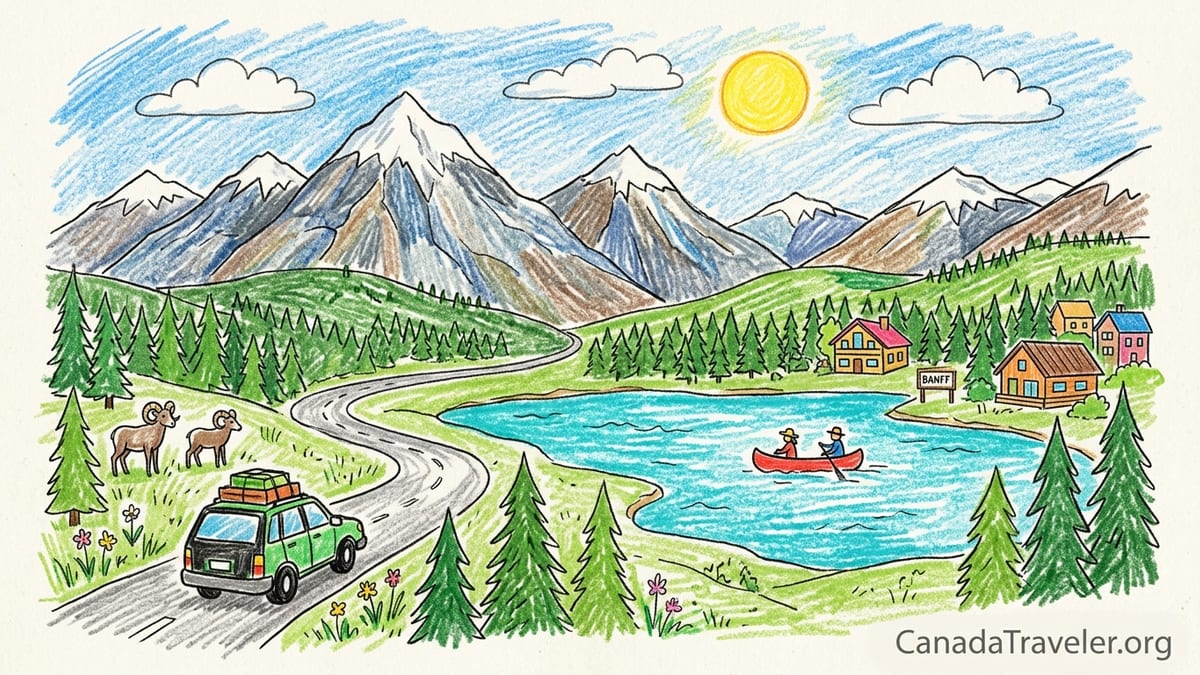
How to Think About the Canadian Rockies as a Whole
Most trips to the Canadian Rockies start and end in Calgary, with a classic loop that runs Calgary to Canmore and Banff, on to Lake Louise and Yoho, up the Icefields Parkway to Jasper, then back toward the prairies. Banff National Park sits roughly 90 minutes by highway from Calgary, while Jasper is about four hours north of Lake Louise via the Icefields Parkway, a 230 kilometre drive often described as one of the most scenic roads in North America. In between, you pass glaciers, roadside viewpoints and short walks that can easily double a three hour drive into a full day.
Instead of planning around a long list of individual attractions, think in terms of bases, each with its own character. Banff town is the most built-up hub with hotels at every price point and easy access to big-name sights such as Lake Minnewanka and the Banff Gondola. Lake Louise is quieter and more compact, focused on alpine lakes and trailheads. Jasper feels more like a small mountain community, with fewer people and exceptional wildlife viewing. Yoho and Kootenay, in neighbouring British Columbia, offer big scenery with lighter crowds, while Canmore and Kananaskis provide a more local, less resort-like base just outside the national park gates.
Driving times between these bases are manageable, which makes it tempting to change hotels every night. In practice, you will see more by slowing down. A good rule of thumb is to aim for at least two or three nights in each major base so you are not packing the car every morning. For example, many travellers find that three nights in Banff, two nights in Lake Louise or Field for Yoho, and three nights in Jasper, plus one or two nights in Kananaskis or Radium Hot Springs for Kootenay, makes a full but realistic ten-day trip.
When comparing places, also consider your travel style. If you like walking to restaurants and having multiple coffee shops on your doorstep, Banff or Canmore will suit you better than Lake Louise or Field. If your priority is hiking and sunrise photography, being based at Lake Louise or along the Icefields Parkway cuts your dawn driving time. Wildlife enthusiasts tend to gravitate toward Jasper and the quieter river valleys of Kootenay and Kananaskis, where dawn and dusk often mean encounters with elk, deer or bighorn sheep along the road.
Banff: Iconic Scenery and the Classic First Base
Banff is the most obvious starting point for a Rockies itinerary and has the strongest concentration of instantly recognisable views within a short drive. The town sits in a broad valley framed by peaks like Cascade Mountain and Mount Rundle, with the Trans Canada Highway running right past it. From here you can reach Lake Minnewanka in about 15 minutes, the Banff Gondola base station in roughly 10 minutes, and the Bow Valley Parkway, a scenic alternative to the main highway, in under 20 minutes. That density of sights makes Banff ideal if you want to see a lot without spending all day in the car.
For most visitors, two or three nights in Banff works well. With two full days you can ride the gondola or hike up Sulphur Mountain, drive the Bow Valley Parkway to Johnston Canyon, and leave time for a lake cruise on Lake Minnewanka or an easy bike ride on the Banff Legacy Trail that links Banff with Canmore. Staying three nights gives you room to factor in a bad weather day or a slower morning at Banff Upper Hot Springs, where a family of four typically pays in the range of a casual dinner out to soak in naturally heated pools overlooking the valley.
Banff connects naturally with almost every other destination in this guide. From Calgary International Airport you reach Banff in about 90 minutes on a four-lane highway that is cleared year-round, then continue 40 to 45 minutes further to Lake Louise. To reach Kootenay National Park and the village of Radium Hot Springs, you take Highway 93 South over the Continental Divide from Castle Junction, a junction midway between Banff and Lake Louise. Yoho National Park lies to the west, just beyond the Alberta–British Columbia border, while Kananaskis Country lies to the southeast, accessible from the Trans Canada Highway near Canmore.
Because Banff has the widest range of accommodation, from hostels and simple motels to luxury properties, it also works well as a return base. Many travellers on eight to ten day trips will start in Banff for two nights, head north to Jasper and Lake Louise, and then come back for a final night before flying out of Calgary. In peak summer, restaurant waits can be long and parking tight around central Banff Avenue, so it can be worth choosing a hotel within walking distance of town or planning to use the local Roam Transit buses to avoid circling for a space.
Lake Louise: Alpine Lakes and Trailheads at Your Door
Lake Louise is the Rockies distilled. Within a short radius you have the milky turquoise waters of Lake Louise itself, the famous teahouse hikes above the lake, and Moraine Lake with its glacier-fed, intensely blue water set against the Valley of the Ten Peaks. There are far fewer services than in Banff, but if your priority is hiking and photography, there is a strong argument for sleeping here, particularly if you want to see sunrise at Moraine Lake or start popular trails before day trippers arrive.
Two nights in Lake Louise is usually the minimum that feels worthwhile, and three is ideal if you are keen on longer walks such as the Plain of Six Glaciers or the Lake Agnes to Big Beehive circuit. Lake Louise Village, down in the valley, has a handful of lodges, a small grocery store and a fuel station. Up at the lake there are a couple of large, resort-style hotels and limited day parking. In recent years, access to Moraine Lake has moved to shuttles and commercial tours for most visitors, which means your days tend to organise themselves around shuttle departure times rather than spontaneous drives.
Geographically, Lake Louise is a key junction. Heading north, the Icefields Parkway begins here and runs all the way to Jasper, with major sights such as Bow Lake, Peyto Lake, the Columbia Icefield and Sunwapta Falls along the way. Heading west, the Trans Canada Highway drops into British Columbia and Yoho National Park; it is about a 30 minute drive from Lake Louise to the tiny community of Field, which functions as a base for Yoho. Heading east, you are back to Banff in roughly 45 minutes. This central location makes Lake Louise a natural connector between Banff, Jasper and Yoho.
If you are travelling in July or August, staying in Lake Louise can also save you time queuing for shuttles from Banff or having to leave Banff before sunrise to secure parking spaces. Room rates are among the highest in the Rockies at this time, particularly at lakeshore hotels, so many travellers compromise by staying in the village or in the lower-priced motels at Castle Junction and driving up in the morning. In shoulder seasons like late May or late September, prices soften somewhat and some trails can still hold snow, so bringing microspikes or hiking poles can be a practical precaution.
Jasper: Wildlife, Space and a Quieter Mountain Town
Jasper National Park is the largest of the Canadian Rockies parks and feels wilder and more spread out than Banff. The town of Jasper is smaller and less resort-like, with fewer chain hotels and more motels, cabins and campgrounds. For many travellers, the strongest reason to base here is wildlife. The valley bottoms around Jasper frequently host elk, deer and bighorn sheep, and in spring and autumn it is common to see animals browsing near the roads at dawn or dusk, especially along quieter stretches of Highway 16 and the Pyramid Lake Road.
Three nights in Jasper is a good starting point, giving you two full days to explore Maligne Lake and Maligne Canyon, visit Pyramid Island, and perhaps drive to Miette Hot Springs for an evening soak. With four nights, you can add a day hike such as the Sulphur Skyline trail, a boat cruise on Maligne Lake to Spirit Island, or a guided wildlife tour which focuses on viewing animals from the road and offers commentary on behaviour and safety. Because the park is designated as a dark sky preserve, October’s dark sky festival and clear winter nights are particularly attractive for travellers interested in astrophotography or simply stargazing away from town lights.
Most travellers arrive in Jasper from the south by driving the Icefields Parkway from Lake Louise. Without stops, the drive can be completed in around three hours, but in practice it commonly takes six to eight hours because of viewpoints and short walks, including Columbia Icefield, Athabasca Glacier walks with an outfitter, and waterfalls such as Athabasca Falls. Coming from the north, Jasper is around four hours by road from Edmonton along the Yellowhead Highway. This northern approach is less obviously scenic but can be useful if you are combining a Rockies trip with urban time in Edmonton.
Given the time to reach Jasper, it rarely makes sense to stay just one night. The town works best as a multi-night base combined with Banff or Lake Louise. A common loop has travellers starting in Banff, driving to Jasper via the Icefields Parkway, then returning to Calgary either by retracing their route or by dropping south on Highway 93 and then east via the David Thompson Highway and Red Deer. For a first visit, repeating the Icefields Parkway in different light often feels worthwhile, as clouds, snowlines and wildlife sightings can change the character of the drive from one direction to the other.
Yoho: Emerald Lake, Falls and a Compact Base at Field
Yoho National Park lies just across the provincial border in British Columbia and is easy to combine with Lake Louise. Its strongest single draw is Emerald Lake, which lives up to its name on calm summer days with vivid green water backed by steep peaks. A simple 5 kilometre path loops around the shoreline and canoe rentals are usually available in high season, often priced roughly in line with other major lakes in the region. Yoho also offers dramatic waterfalls, especially Takakkaw Falls, where the water drops hundreds of metres in a plume that can soak you in fine mist at the base.
Because Yoho is compact and most of its main sights sit off a single highway, two nights are often enough if you are also staying at Lake Louise. This gives you one full day for Emerald Lake, the Natural Bridge on the Kicking Horse River and a late afternoon or evening at Takakkaw Falls, plus another day for a longer hike such as the Iceline Trail above the Yoho Valley. Many travellers who prefer not to change hotels will instead base themselves at Lake Louise or in Banff and treat Yoho as a long day trip, driving across Kicking Horse Pass for the day and returning to Alberta in the evening.
The village of Field, roughly 20 to 30 minutes from Lake Louise by car, serves as Yoho’s main service centre. It has a small number of guesthouses and a cafe or two rather than a full resort town’s amenities. If you choose to sleep here, you trade nightlife and shopping for quiet nights and short drives to trailheads. Takakkaw Falls is typically accessed via a short but steep secondary road off the main highway that has tight switchbacks; drivers of large motorhomes often park below the steepest section and walk or shuttle up, while regular passenger vehicles navigate the road in a few minutes.
Yoho combines naturally with both Lake Louise and Kootenay. From Field it is about a 90 minute drive south and east to Radium Hot Springs via the Kootenay corridor, though travellers usually reach Kootenay through Castle Junction south of Banff. If you have a week, one efficient pattern is two or three nights in Banff, two nights in Lake Louise with a day trip into Yoho, and three nights in Jasper, leaving Kootenay and Radium for a future visit when you have more time for hot springs and quieter trails.
Kootenay: Road Trip Scenery and Hot Springs
Kootenay National Park stretches along Highway 93 South between Castle Junction in Alberta and the village of Radium Hot Springs in British Columbia. The biggest reason to include it on your itinerary is the combination of scenic driving and natural hot springs. Many travellers stay in Radium Hot Springs or the nearby Columbia Valley communities such as Invermere and Fairmont Hot Springs, then make day trips into the park for walks in Marble Canyon or along the Kootenay River, followed by an evening soak in the Radium Hot Springs pools, which are operated by Parks Canada and typically cost less than a restaurant meal per person.
One or two nights is usually sufficient if your main goal is to enjoy the hot springs and sample a few short trails. If you are using Radium as a budget-friendly base to explore both Banff and Yoho, which some travellers do when accommodation prices spike in high season, then three or four nights can make sense, with early morning drives back into the national parks. The trade-off is that you will spend more time each day in the car: it is roughly two hours from Radium to Banff and about the same to Lake Louise, depending on stops and traffic.
Driving Kootenay from north to south, you leave the Trans Canada Highway near Castle Junction and climb through Vermilion Pass before descending through a landscape of red rock canyons and the broad Kootenay Valley. Roadside pullouts access deep gorges such as Marble Canyon and open river views where you can see evidence of past wildfires, with young forest regrowth. In summer, this drive works well as an alternative route between Banff and the Okanagan or Vancouver region. In winter, conditions can be snowy and it is wise to check road reports before committing to a long drive after dark.
Kootenay links smoothly with both Banff and Yoho. Travellers with ten days might spend three nights in Banff, then drive south through Kootenay to Radium Hot Springs for two nights, soaking and walking on quieter trails, before continuing to Yoho and Lake Louise and then on to Jasper via the Icefields Parkway. This pattern balances the heavily visited hubs with calmer days in the Columbia Valley, where evenings are more about small-town restaurants and local pubs than busy resort streets.
Canmore and Kananaskis: Outside the Parks, Close to the Peaks
Canmore sits just outside the eastern gate of Banff National Park and has grown from a mining town into a lively mountain community. It is often the most practical base for travellers who want more affordable lodging and self-catering options while staying within a 20 to 30 minute drive of Banff’s sights. Condos with kitchenettes, large grocery stores and a wide choice of cafes and bakeries make it easy to pack picnic lunches for days in the park. The town also has its own network of trails, including the popular Grassi Lakes hike and riverside paths with views of the Three Sisters peaks.
Two or three nights in Canmore can replace or complement time in Banff. Some visitors choose to stay their entire week here, driving into Banff and Lake Louise on day trips to avoid changing accommodation. Others split their time, spending the first two nights in Canmore to shake off jet lag and pick up supplies, then moving into the park for a couple of nights at Lake Louise or Jasper. Because Canmore is outside the national park boundary, you will not need a park pass for days you stay in town and do not drive through the park gates, which can matter if you are on a tight budget and mixing hiking days with relaxed town days.
South of Canmore, Kananaskis Country offers a very different feel from Banff despite being less than an hour from Calgary. This patchwork of provincial parks and recreation areas is known for its trail network, campgrounds and a handful of lodges that feel more retreat-like than resort-like. The reason to base here is to access quieter hikes and, outside of peak long weekends, trailheads that rarely feel as busy as the ones around Lake Louise. Classic Kananaskis routes like Ptarmigan Cirque or the hikes around Upper and Lower Kananaskis Lakes reward visitors with big-mountain scenery without the same volume of coach traffic.
Canmore and Kananaskis combine naturally with both Banff and Calgary. Many travellers flying in late at night opt to stay their first night in Calgary, then drive to Canmore for two or three nights, enjoying local trails and adjusting to the altitude. They then continue to Banff and beyond. On the return, a final night in Canmore or Kananaskis before an early morning flight can be more relaxing than driving from Jasper or Lake Louise straight to the airport in one long day.
Mount Robson and Beyond: Remote Peaks at the Edge of the Circuit
Mount Robson Provincial Park in British Columbia lies just west of Jasper along Highway 16 and is home to the highest peak in the Canadian Rockies. It sits outside the federal national park system but is part of the same UNESCO World Heritage designation. The main draw here is a sense of remoteness and big mountain scenery without a town at its core. Travellers stop to photograph Mount Robson from the roadside visitor centre and, for those with more time, tackle the Berg Lake Trail, although sections of this trail have seen closures and reroutes in recent years due to flood and infrastructure damage.
If you are simply passing through on your way between Jasper and Prince George or Vancouver, a half-day stop can be enough for views and a short walk from the visitor centre area. To justify a dedicated overnight, you generally need to be planning a longer hike or camping trip. Two nights in or near the park allows one full day on the trail, while three or more nights make sense only for backpackers or those combining Mount Robson with other northern Rockies destinations, such as Mount Revelstoke or Glacier National Park of Canada, on a longer road trip.
Driving connections are straightforward. It is about an hour from Jasper town to the Mount Robson visitor centre, mostly on good two-lane highway. Continuing west, it is several more hours to the nearest larger centres, so this segment suits travellers comfortable with longer drives and fewer services. Fuel is available at a handful of small stations along Highway 16, but it is wise to fill up in Jasper before heading west to avoid arriving at a pump with limited opening hours or higher prices reflecting the remoteness.
Mount Robson combines naturally with Jasper as an extension for travellers who prefer less structured days. A sample pattern might be four nights in Jasper, with one day on the Maligne Lake road, one day exploring the Athabasca Falls area and a third spent driving to Mount Robson for a long hike and returning in the evening. Alternatively, if you are continuing on to British Columbia’s interior or the Pacific Coast, staying one night near Mount Robson breaks up the long drive from Jasper to Prince George or Kamloops and lets you see sunrise or sunset on the peak.
Putting It Together: How Many Nights Where
When you translate this into an actual itinerary, a few patterns tend to work particularly well for first-time visitors. With seven nights, a common choice is two nights in Banff or Canmore, two nights in Lake Louise with time for a Yoho day trip, and three nights in Jasper. This gives you one full day in each of the major hubs plus a travel day along the Icefields Parkway. You can add Kootenay as a scenic drive on your way back toward Calgary if you accept a long but rewarding day in the car.
With ten nights, you can comfortably add Kootenay and perhaps a night in Kananaskis. One workable loop is to start with two nights in Canmore, then two nights in Banff, two in Lake Louise, three in Jasper and one in Kananaskis before flying out. Another option for hot springs fans is three nights in Banff, two nights in Radium Hot Springs for Kootenay, two nights at Lake Louise or Field for Yoho, and three nights in Jasper. This version gives you hot springs in both Banff and Radium, plus full days in Yoho and along the Icefields Parkway.
Whatever pattern you choose, avoid breaking your trip into too many single-night stays. Each hotel change eats into your sightseeing time and adds stress, especially if you are travelling with children or large luggage. Fewer bases with more nights in each allows you to respond to the weather. For example, if low cloud hides the views on your planned Lake Louise hiking day, you can swap in a canyon walk or hot springs day and wait for clearer skies. The Rockies reward flexibility more than rigid checklists.
It is also worth planning rest in among the highlights. A slow morning in Jasper at a local cafe, a picnic lunch by the Bow River in Banff, or an unscheduled afternoon in Canmore’s town park can be as memorable as any viewpoint. Building in these pauses helps prevent the common feeling, at the end of a Rockies trip, that you saw everything but never really stopped to feel what it was like to be in the mountains.
FAQ
Q1. How many days do I need for a first trip to the Canadian Rockies?
Most travellers find that seven to ten days is a good starting point, allowing time for Banff, Lake Louise, Jasper and at least a brief visit to Yoho or Kootenay without rushing every day.
Q2. Should I stay in Banff or Canmore as my main base?
Banff is inside the national park with immediate access to classic sights but higher prices and heavier crowds, while Canmore is 20 to 30 minutes away with more apartments, grocery stores and a local-town feel.
Q3. Is Jasper worth the long drive from Banff and Lake Louise?
Yes, especially if you care about wildlife and quieter trails. The Icefields Parkway drive itself is a highlight, and three nights in Jasper usually feels like time well spent.
Q4. Do I need to change hotels to see Yoho National Park?
No, many visitors base in Lake Louise or Banff and visit Yoho as a day trip, but spending a night or two in Field or at Emerald Lake shortens drives and offers calmer evenings.
Q5. Where should I stay if I want to visit hot springs?
Banff Upper Hot Springs and the pools at Radium Hot Springs are the most accessible options, so basing in Banff or Radium, or including both in a loop, works well for hot springs fans.
Q6. Is Kootenay National Park suitable for short visits?
Yes, you can experience Marble Canyon, roadside river views and an evening soak in Radium Hot Springs in one or two nights, especially when driving between Banff and British Columbia.
Q7. How far is Lake Louise from Banff by car?
Lake Louise is roughly a 40 to 45 minute drive from Banff along the Trans Canada Highway, depending on traffic and construction, so it is feasible as either a day trip or a separate base.
Q8. When is the best time of year to see wildlife in Jasper?
Spring and autumn often provide the best chances, particularly around dawn and dusk, when elk and other animals are more active in the valley bottoms and near the roads.
Q9. Is Mount Robson a good idea for a short detour from Jasper?
It can be, especially if you enjoy long day hikes. The visitor centre is about an hour from Jasper, making it manageable as a day trip or a single overnight stop on a longer loop.
Q10. Do I need a car to explore Banff, Jasper and the surrounding parks?
A car offers the most flexibility, particularly for trailheads and early starts, but shuttle buses and guided tours can cover major highlights if you prefer not to drive.