


Nova Scotia’s coastline stretches for more than 7,000 kilometres, but not all of those shores feel the same when you step into the water. Families chasing genuinely warm summer swimming often have a different wish list than surfers looking for Atlantic swell or photographers hunting white sand and turquoise-looking shallows. This guide focuses on a practical distinction that matters once you arrive: the relatively warm, shallow Northumberland Strait beaches on Nova Scotia’s Northumberland Shore, versus the colder, surf-exposed Atlantic coast that wraps around Halifax, the South Shore and Cape Breton.
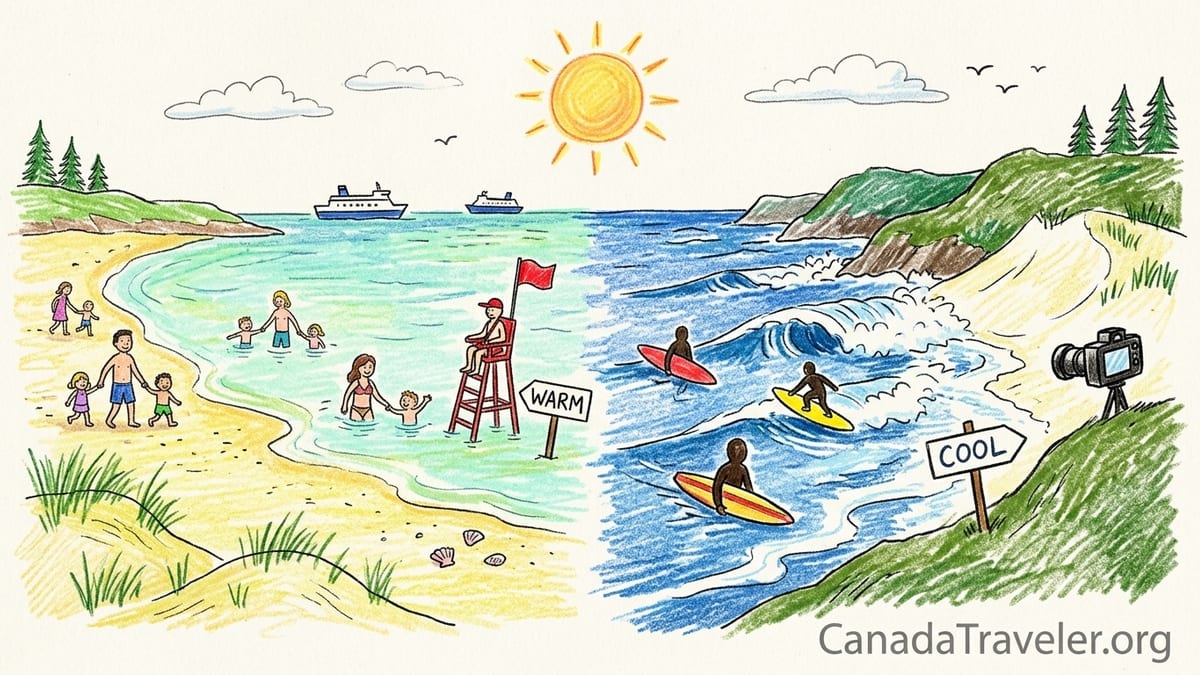
Understanding Nova Scotia’s Two Beach Personalities
Nova Scotia tourism materials regularly highlight the Northumberland Shore as having more warm-water ocean beaches than anywhere else in Canada, with summer water that can exceed 22 degrees Celsius in sheltered shallows. This stretch of coastline, facing Prince Edward Island across the Northumberland Strait, includes Melmerby, Pomquet, Caribou–Munroes Island, Rushtons and Heather Beach. Protected from the cold offshore currents that chill much of Atlantic Canada, these beaches are where locals go when they want to actually linger in the ocean with young children rather than sprint in and out.
By contrast, the Atlantic side of Nova Scotia, including famous surf beaches like Lawrencetown and Martinique, feels dramatically cooler even in August. Typical mid-summer sea surface temperatures on that open coast often remain below 18 degrees Celsius, and many local surfers use full wetsuits year-round. These beaches compensate with consistent waves, wild headlands and the kind of rugged scenery that makes photographers reach for a wide-angle lens, but they are rarely the first choice for toddlers who want bathtub-warm shallows.
For trip planning, this split is more useful than any abstract north versus south description. Families whose priority is warm water and easy wading will usually be happiest along the Northumberland Strait or at a few more sheltered bays like Mavillette. Travelers drawn to surfing, dramatic dunes or white sand and turquoise-looking water should look to the Atlantic and South Shore, but with clear expectations that the water will feel cold, even on a hot day. The following sections break down specific beaches, facilities and conditions so you can match each stretch of sand to your style of holiday.
All details here, from lifeguard schedules to parking layouts, are based on recent provincial park information and local tourism guides as of summer 2026. Because water temperature and safety advisories can change quickly, always confirm current conditions with Nova Scotia Parks or local tourism offices in the days before you drive out.
Melmerby Beach: Benchmark for Warm Saltwater Swimming
Melmerby Beach Provincial Park on the Northumberland Shore is one of Nova Scotia’s best-known warm-water beaches and a useful benchmark for planning. Provincial and regional guides describe this roughly two kilometre long sandy beach as having some of the warmest saltwater in the province, with summer surface temperatures reported above 19 degrees Celsius and often higher in the shallows on calm August afternoons. Families frequently report being able to stay in the water for long stretches without a wetsuit, something that is far less common on the Atlantic side.
Access is straightforward. Melmerby is about a 25-minute drive from New Glasgow and roughly two hours from Halifax, largely on paved roads. The provincial park has a sizeable parking lot close to the sand, so on typical July weekdays you can often park within a short walk of the beach boardwalks. In peak periods such as long weekends, locals advise arriving by late morning to avoid circling for a spot. Park facilities include flush toilets, change houses and outdoor showers, which makes the day smoother with children.
Summer lifeguard supervision is a key advantage here. Melmerby is one of the beaches covered by the Nova Scotia Lifeguard Service, with guards typically on duty daily in July and August from late morning to early evening. Red and yellow flags mark the supervised swim zone. The beach faces generally gentle surf on most summer days, but sandbars and tidal changes can still create currents and deeper channels. Parents are wise to keep children within the flagged area, where lifeguards actively monitor conditions.
Melmerby’s accessibility is moderate. Boardwalks and packed pathways from the parking area help strollers and wheeled coolers, though soft sand remains a challenge for some mobility devices. Nearby accommodation ranges from campgrounds and cottage rentals in the New Glasgow and Pictou area to chain hotels roughly 20 to 30 minutes away. Dogs are usually restricted from the supervised section during lifeguard hours in peak season, so travelers with pets should check current rules or look to less formal stretches of coast nearby for off-peak walks.
Other Warm-Water Northumberland Shore Beaches
Several other Northumberland Shore beaches share Melmerby’s essential traits of relatively warm water, gradual sand shelves and lifeguard presence in mid-summer. Together, they give families options depending on where they base themselves. Tourism fact sheets for the region point to beaches like Pomquet, Caribou–Munroes Island, Rushtons, Heather and Blue Sea as examples where sheltered Northumberland Strait waters can average above 22 degrees Celsius during warm spells, especially in late July and August.
Pomquet Beach Provincial Park, east of Antigonish, is notable for its wide dune-backed sand and supervised swimming during July and August. Access is via a paved road off Highway 104 followed by a short drive to a main parking lot behind the dunes. Facilities include vault toilets and change areas. The beach stretches for several kilometres, with the supervised swimming zone marked near the main boardwalk. Families often appreciate that the shallows here warm up by mid-afternoon on sunny days, helped by the gentle slope and sheltered location in St. George’s Bay. Rip currents can develop near inlets or steeper sections so it remains important to swim between the flags.
Caribou–Munroes Island Provincial Park, near the ferry terminal to Prince Edward Island, combines camping and day-use beach access. The sandy shore along the park offers views of ferries crossing the strait and, in settled weather, water that feels distinctly milder than the Atlantic coast. Parking for day visitors is usually in a designated area near the beach path, while campers have direct access from many sites. Basic toilets and taps serve the park, and families often choose this beach when they want to combine a warm swim with a picnic and an overnight stay. Lifeguard presence can vary here, so travelers should verify each season whether supervised swimming is offered.
Further along the coast, Rushtons Beach Provincial Park and Heather Beach Provincial Park are smaller but well-loved by locals for their calm, shallow water. Both parks typically have parking close to the sand, basic toilet facilities and a mix of day visitors and nearby cottage owners. On warm August days, the water near shore can feel almost lake-like, especially at low tide when sandbars heat up in the sun. These beaches tend not to draw large tour buses, so they can be good choices for travelers seeking a quieter, family-oriented atmosphere. As with Caribou–Munroes, lifeguard coverage is not guaranteed each year at every site, so it is important to check current Nova Scotia Lifeguard Service listings before you go.
Atlantic Surf Beaches: Lawrencetown and Martinique
For many visitors, Nova Scotia’s beach identity is tied as much to Atlantic surf breaks as to warm family swimming. Lawrencetown Beach Provincial Park, about 30 to 45 minutes east of downtown Halifax by car depending on traffic, is the province’s best-known surf hub. The beach curves along a 1.5 kilometre strand backed by cliffs and a parking lot that fills with vans and roof-racks on good swell days. Several surf schools, including long-running outfits that operate from May into late autumn, offer lessons that include boards and full wetsuits.
Water at Lawrencetown remains cold compared with the Northumberland Shore. Summer visitors often find sea temperatures around the mid-teens in degrees Celsius, warming slightly in August but still cool enough that most people use at least a 3/2 or 4/3-millimetre wetsuit for extended sessions. Air temperatures can be pleasantly warm on the beach while the water delivers an instant wake-up. Lifeguards are typically present in July and August, with a supervised swim area marked by flags; outside those flags, surfers and strong swimmers share the break while dealing with rip currents that can be strong when swell is running.
From a practical standpoint, Lawrencetown offers paved parking, pit toilets, a few sheltered picnic areas and direct access paths over the cobblestones and sand. Accessibility is more limited than at some Northumberland parks, partly because of the natural terrain and stone berms. Dogs are generally required to be on leash, and local bylaw enforcement occasionally patrols popular days. Nearby accommodation includes cottage rentals in East Lawrencetown, small inns along the Eastern Shore and urban hotel options in Halifax for those willing to make it a day trip.
Martinique Beach Provincial Park, about one hour from Halifax by car, stretches along a barrier beach more than four kilometres long, making it one of the longest sandy beaches in the province. It is another key surf spot, known among local surfers for consistent waves and room to spread out. Recent park upgrades have focused on improving access roads, parking and lifeguard facilities after periods of construction-related closure. Like Lawrencetown, Martinique usually sees lifeguard supervision in July and August near the main access points, with flags marking the safest swimming zone.
Summer water temperatures at Martinique are similar to Lawrencetown. Even on a hot day when the sand feels scorching, the Atlantic here remains chilly enough that few adults linger long without neoprene. Surf schools sometimes bring beginners to Martinique when conditions are mellow, because the long, gradually sloping beach can produce forgiving whitewater waves ideal for first rides. However, rip currents and shifting sandbars are a consistent reality. Non-surfers should stay in the flagged zone, heed any posted warnings and be prepared for the shock of cold water if they are used to Northumberland beaches.
South Shore Scenery: Rissers, Summerville, Crescent, Hirtle’s and Carter’s
Nova Scotia’s South Shore between Halifax and Yarmouth offers some of the province’s most photogenic beaches. Names like Rissers, Summerville, Crescent, Hirtle’s and Carter’s Beach often appear in magazines and social media posts showing white sand, clear shallows and water that appears almost Caribbean in colour on sunny days. It is important for travelers to understand that the water here is not tropical. These are Atlantic beaches, and even in late August many visitors find the water bracing, especially on windy days or when upwelling brings colder offshore water close to shore.
Rissers Beach Provincial Park, near Petite Riviere, combines a long sandy beach with a salt marsh boardwalk and a popular campground. Access is via a paved road from Highway 331, with a day-use parking area close to the main beach. Facilities include flush toilets, change houses and outdoor showers in peak season, which makes it convenient for families on a day trip from Lunenburg or Bridgewater. Lifeguard supervision has historically been offered in July and August, but travelers should always confirm the current year’s schedule. Even on calm days, cold water can take young swimmers by surprise, so many families bring short wetsuits or focus on sand play and splash time.
Summerville Beach Provincial Park, near Liverpool, is another South Shore highlight. Backed by low dunes and a modest parking area, it is sometimes paired with stays at nearby seaside resorts and cottages. Toilets are basic but functional, and a short path leads from the lot to the sand. The bay shape offers some shelter, yet water temperatures remain closer to Atlantic norms. On warm, calm afternoons the shallows can feel refreshing rather than frigid, but long immersive swims without suits can be uncomfortable for many visitors. Lifeguard coverage has varied over the years; checking Nova Scotia Lifeguard Service listings or local tourism information before arrival is prudent.
Crescent Beach, near the LaHave River ferry, provides a different South Shore experience. Here, a drivable sand causeway connects the mainland to LaHave Islands, and cars share space with walkers on a long, flat strip of sand and packed gravel. There is roadside parking along the beach, but formal facilities are limited, with only a few portable toilets in season and no large change house. The beach’s shape and exposure mean water temperatures can fluctuate, with some sheltered pockets warming on calm days while open stretches stay cold. Families with toddlers often stick close to tidal pools and very shallow edges, where the sun can take off some of the bite.
Hirtle’s Beach near Lunenburg and Carter’s Beach near Port Mouton round out the South Shore’s scenic standouts. Hirtle’s begins with a cobble section that transitions to sand, framed by dramatic headlands and backed by a coastal hiking trail. Facilities are minimal, with a small parking area and basic toilets. Strong surf and steep drop-offs can create hazardous swimming conditions when swell is up. Carter’s Beach, by contrast, features three small coves of remarkably white sand and vivid turquoise-looking water created by light reflecting off the sand and shallow seabed. There is a small unpaved parking area and limited toilets. Signage often reminds visitors that despite the tropical appearance, the water is cold and subject to currents. Neither Hirtle’s nor Carter’s is an ideal choice for young children seeking warm, gentle swimming, though both reward photographers and experienced cold-water swimmers.
Special Cases: Ingonish Beach and Mavillette Beach
Cape Breton and the Bay of Fundy each offer distinctive beach experiences that do not fit neatly into the Northumberland versus Atlantic framework. Ingonish Beach in Cape Breton Highlands National Park is one of them. Here, a classic Atlantic cobble and sand beach sits beside Freshwater Lake, a separate body of water just inland from the shore. On many summer days, the lake is noticeably warmer and calmer than the open ocean, giving families a choice between quick dips in the chilly surf and extended play in freshwater shallows.
Access to Ingonish Beach is via the Cabot Trail, with clear national park signage directing drivers to a parking lot near the shore. Facilities typically include washrooms, change areas and picnic tables. Parks Canada often posts information about rip currents and cold-water risk on the ocean side, especially when swell is forecast. Lifeguard supervision has at times been offered at the beach or lake during peak summer, but coverage can change with park staffing. Travelers should check the current season’s park bulletins or visitor centre information. Accommodation options nearby range from campgrounds and national park oTENTiks to inns and lodges in the Ingonish area, which makes this a practical base for multi-day stays.
Mavillette Beach Provincial Park in southwestern Nova Scotia faces St. Marys Bay on the Bay of Fundy. It is known for its expansive tidal flats, which can stretch far out at low tide and warm in the sun before the sea returns. As a result, knee-deep water in the flooded flats can feel relatively mild on warm days, even though the larger bay is influenced by cold currents. Families often visit during mid to late afternoon on rising tide, when the warmed flats turn into a broad, shallow wading area ideal for young children who like to splash rather than swim.
Access to Mavillette is via secondary highways west of Yarmouth, with a dedicated parking lot, boardwalks across dunes and basic toilet facilities. Lifeguard supervision has not been as consistently prominent here as at Melmerby or Lawrencetown, so visitors should be prepared for unsupervised conditions. The main hazards are tidal; the Bay of Fundy has some of the highest tidal ranges in the world, and currents can be strong as water moves in and out. Fog is also common in this region, reducing visibility at times. Nearby accommodation includes small motels, bed and breakfasts and seaside cottages along the French Acadian shore, many within a 10 to 20 minute drive.
Safety, Water Quality and Practical Planning
Nova Scotia’s beach safety picture combines cold-water risk, surf hazards and occasional water-quality advisories after heavy rain. Cold shock and rapid cooling are genuine concerns on the Atlantic coast. Even experienced swimmers can find their breathing disrupted when they first submerge in water below about 15 degrees Celsius. Wearing a wetsuit extends safe play time significantly and is standard gear for local surfers at Lawrencetown, Martinique, Hirtle’s and often on the South Shore. On the warmer Northumberland beaches, cold shock is less of an issue in August shallows, but early-season visits in June can still feel brisk.
Rip currents are a key hazard at exposed Atlantic beaches. Lifeguard services at places such as Lawrencetown, Martinique and some South Shore parks actively mark safer zones with flags and may close sections of water when rips intensify. Visitors should take time upon arrival to read the day’s posted notices, look for any red flags or closed signs and attend occasional on-beach briefings if offered. On unsupervised beaches, a conservative approach is best: avoid swimming near headlands, rocky outcrops or inlets where water funnels, and keep children on the inside of breaking waves where they can easily stand.
Water-quality advisories sometimes follow heavy rainfall, especially near urban areas or rivers. Provincial and municipal health authorities publish up-to-date lists of beaches where bacteria counts exceed guidelines, and signage is generally posted at affected sites. Before setting out, travelers can call local information lines or check online resources for the latest advisories. On the Northumberland Shore and in less developed areas of the South Shore and Cape Breton, advisories are less frequent but still possible after extreme weather.
Accessibility and dog rules vary widely. Some provincial parks offer boardwalks suitable for strollers and limited-mobility visitors, while others require crossing soft sand or steep dune paths. Service animals are typically permitted, but general pet access can be restricted during peak season or within designated supervised swim zones. For example, at many lifeguarded beaches, dogs must be kept on leash and away from the flagged area between 10 a.m. and 6 p.m. Accommodation near these beaches ranges from basic campgrounds at Rissers, Caribou–Munroes or Ingonish to resort-style stays near Summerville and independent cottages near Carter’s and the Northumberland Shore. Booking well ahead for July and August weekends is essential, as coastal inventory is limited and popular days often sell out months in advance.
The Takeaway
Nova Scotia rewards beach travelers who match their expectations to its geography. If your priority is warm ocean water for small children, the Northumberland Shore is where you should start your search. Melmerby, with its two kilometres of sand, reported summer water above 19 degrees Celsius and reliable July–August lifeguard supervision, sets the bar. Pomquet, Caribou–Munroes Island, Rushtons and Heather Beach expand the options with similar warm, shallow conditions and a quieter, local feel that many families prefer for long holiday stays.
For surfing and dramatic Atlantic scenery, Lawrencetown and Martinique are compelling, even if the water is much colder. Consistent waves, surf schools providing full wetsuits and a dedicated surf culture make these beaches ideal for teenagers and adults who want to learn to ride waves within an easy drive of Halifax. South Shore beaches like Rissers, Summerville, Crescent, Hirtle’s and Carter’s add white sand and turquoise-looking water to the mix, but they are best approached as scenic, often chilly playgrounds rather than tropical swim spots.
Special cases like Ingonish Beach, with its Atlantic shore and adjacent Freshwater Lake, or Mavillette Beach with its sun-warmed tidal flats, offer creative compromises for mixed groups. They show that even in a province better known for fog and fishing villages than palm-fringed bays, there are pockets where the water can feel inviting on the right day. Across all these beaches, success comes from planning around tides, checking lifeguard schedules and advisories, packing extra layers and wetsuits, and being clear about whether you are travelling for warm swims, wave riding, photography or simply the sound of surf in the background of a seaside picnic.
Seen through this practical lens, Nova Scotia’s beaches are not one-size-fits-all. Instead, they form a coastal toolkit. Choose Northumberland for warm family swimming, the Eastern Shore and South Shore for surf and scenery, Cape Breton and the Bay of Fundy for distinctive hybrids, and you will arrive with expectations that match the water under your feet.
FAQ
Q1. Which Nova Scotia beach has the warmest ocean water for swimming?
Many locals and tourism materials point to the Northumberland Shore, especially Melmerby, Rushtons, Heather and nearby beaches, as having the province’s warmest saltwater in late July and August, with shallow areas that can exceed 20 degrees Celsius in settled weather.
Q2. Is Lawrencetown Beach too cold for casual swimming in summer?
Lawrencetown’s Atlantic water usually feels cold compared with Northumberland beaches. Strong swimmers sometimes go in without wetsuits on hot August days, but most people prefer at least a short wetsuit if they plan to stay in the water longer than a quick dip.
Q3. Are Nova Scotia’s surf beaches safe for beginners?
Yes, with guidance. Surf schools at Lawrencetown and Martinique provide boards, wetsuits and instruction tailored to first-timers, and they choose tides and sandbars that are most forgiving. On your own, you should treat these beaches cautiously due to rip currents and cold water.
Q4. Where should families with toddlers stay for mostly warm, shallow water?
Families focused on warm paddling and gentle waves often choose accommodations near Melmerby, Pomquet, Rushtons or Heather Beach, or camp at Caribou–Munroes Island, then plan beach days around mid to late afternoon when the sun has warmed the shallows.
Q5. Are dogs allowed on Nova Scotia beaches in summer?
Policies vary by park and municipality. Many provincial beaches allow dogs on leash but restrict them from supervised swim zones during lifeguard hours. Some scenic coves have more relaxed rules outside peak times. Always check local signage at the parking lot when you arrive.
Q6. How close are good beaches to downtown Halifax for a day trip?
Lawrencetown is about 30 to 45 minutes from central Halifax by car, while Martinique usually takes about an hour. South Shore spots like Rissers or Hirtle’s are typically 90 minutes to two hours away, making them realistic day trips with an early start.
Q7. Do Nova Scotia beaches often close due to water-quality issues?
Closures and advisories do occur, especially after heavy rain near urban centres, but many rural beaches go an entire season with no issues. It is wise to check provincial or municipal beach reports the morning of your visit, especially around Halifax and Dartmouth.
Q8. What kind of wetsuit should I bring for summer surfing?
In July and August, many local surfers use a 3/2 or 4/3-millimetre full wetsuit on the Atlantic coast, sometimes with booties on colder days. If you book a lesson, the surf school typically provides an appropriate suit as part of the package.
Q9. Are there beaches that work for both swimmers and photographers?
Yes. Carter’s and Hirtle’s offer striking turquoise-looking water and dramatic headlands for photography, while Northumberland beaches like Melmerby and Pomquet provide warmer, more comfortable swimming along scenic dune-backed shores, especially at sunset.
Q10. How should I choose a beach if my group includes toddlers, teenagers and surfers?
Consider splitting time between Northumberland beaches for warm, shallow play and an Atlantic surf beach like Lawrencetown for lessons or wave-watching. Base yourself near a town such as New Glasgow, Antigonish or Halifax and plan day trips that match each group member’s priorities.