


British Columbia is one of the world’s great whale watching destinations, with resident and migrating whales travelling along a maze of fjords, island channels and wild Pacific coastline. Yet the experience can vary dramatically depending on where you go, which species you hope to see and how you like to be on the water. This guide compares the main whale watching hubs in Victoria, Vancouver, Tofino, Campbell River, Telegraph Cove, Port Hardy and Prince Rupert, so you can match your expectations with the right destination and travel style.
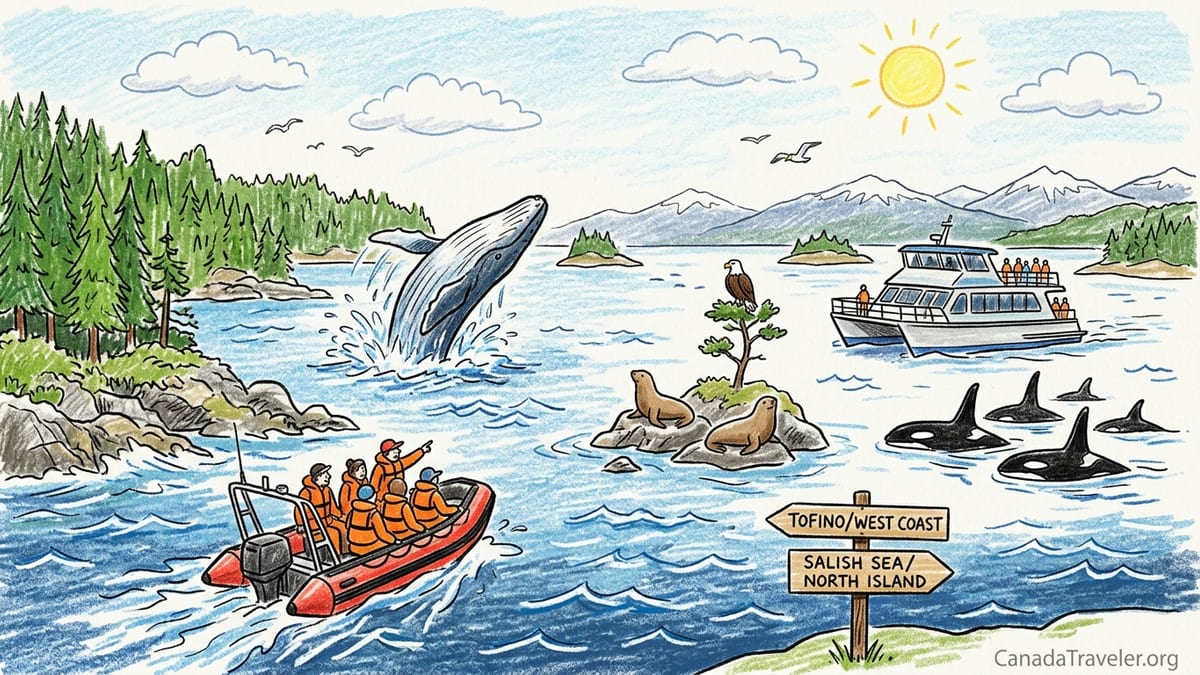
Whale Watching Basics in British Columbia
British Columbia’s waters support several whale species, but for most visitors the headline act is orcas (killer whales) and humpbacks. Along the outer west coast of Vancouver Island, particularly around Tofino and Ucluelet, you may also encounter migrating gray whales in spring as they move between Baja California and Alaska, with some individuals lingering in Clayoquot and Barkley Sound through summer to feed. Around the Inner Coast and Salish Sea, humpbacks have made a notable comeback over the past decade, and are now regular summer and fall visitors alongside transient (Bigg’s) orcas.
The practical whale watching season for most boat operators in British Columbia runs roughly from March or April through October, with peak departures in June, July, August and early September. Spring trips around Tofino often focus on the gray whale migration, while summer departures from Victoria, Vancouver, Campbell River and the North Island concentrate on humpbacks and orcas that follow salmon and baitfish through the inlets and straits. In Prince Rupert and the North Coast, humpbacks feeding in rich upwelling zones are a major draw through summer into early fall.
Typical tours last between 3 and 5 hours, using either fast open zodiacs or larger covered vessels with indoor seating. Prices as of 2026 commonly fall in the range of about 150 to 220 Canadian dollars per adult for a 3 hour cruise, with longer full day or combo trips costing more. Many operators advertise high “success rates,” especially in peak season, but it is crucial for travelers to understand that sightings of any specific species are never guaranteed, and itineraries are dictated by where whales actually are on a given day.
British Columbia has adopted minimum approach distances and many tour companies promote their membership in programs that emphasize responsible behavior. Reputable operators keep appropriate distances, reduce speed around whales, cut engines when animals surface nearby and avoid surrounding or “leapfrogging” pods. When comparing destinations in this guide, consider not only how likely you are to see whales, but also whether the style of touring and local conditions match your comfort level, mobility needs and wider trip goals.
Victoria vs Vancouver: Salish Sea Staples
Victoria and Vancouver are the most accessible jumping off points for many international visitors. Both cities send boats into the same general region of the Salish Sea, where humpbacks and Bigg’s orcas move between Canadian and US waters in a complex network of channels around the Gulf and San Juan Islands. From downtown Victoria’s Inner Harbour, operators run both open zodiacs and large covered catamarans on 3 hour trips that can reach the Strait of Juan de Fuca, Haro Strait or Boundary Pass depending on recent reports. Similar offshore-style tours depart from Vancouver’s Coal Harbour and Granville Island, typically adding around an hour of transit each way to reach the core whale habitat.
In practical terms, Victoria offers slightly shorter travel times to the main whale watching grounds and a more compact, walkable base. Visitors can step off a cruise ship or seaplane and be on a boat within minutes, which suits short stays or families with limited flexibility. Vancouver tours, while often comparable in price and quality of guiding, involve longer runs through Burrard Inlet and the Strait of Georgia before reaching the same whale areas, so expect a full half day on the water. For travelers already spending several days in either city, choosing a departure point usually comes down to convenience relative to hotels and wider sightseeing plans.
Seasonally, both Victoria and Vancouver see increasing whale activity from about May through October, with the strongest chance of encounters in June, July, August and early September. Humpbacks have become a consistent feature of summer trips, and Bigg’s orcas that prey on seals and porpoises are encountered regularly. Historically famous southern resident orcas that specialize in chinook salmon are now critically endangered and are not the primary focus for most operators. Regulations keep vessels at greater distances from these whales, and many companies emphasize that they seek out healthier Bigg’s orcas and humpbacks instead.
Boat choice matters here. A common scenario is an afternoon Victoria departure on a 3 to 4 hour covered catamaran that includes indoor seating, outdoor viewing decks, washrooms and refreshments, which is well suited to multi-generational families and those prone to seasickness. Alternatively, a morning zodiac tour from a Vancouver dock might appeal to adventurous travelers who do not mind exposure to wind and spray in exchange for a more visceral, low-to-the-water feeling. In both cities, whale watching can comfortably be one memorable activity among many, rather than the sole reason to visit.
Tofino and the Wild West Coast
Tofino, on Vancouver Island’s outer west coast, offers a very different whale watching experience from the sheltered Salish Sea. Here, you are closer to the open Pacific, with trips heading into Clayoquot Sound and along a rugged archipelago of forested islands, sandy beaches and rocky outcrops. The whale season in Tofino typically begins in March, in step with the gray whale migration, when thousands of whales move north along the coast. Many tours in March and April specifically advertise gray whale viewing, though sightings can involve distant blows and backs rolling at the surface rather than dramatic breaching.
Through late spring and summer, humpbacks become more prominent, lingering to feed in offshore and nearshore waters. On a typical 2.5 to 3 hour Tofino trip in July or August, visitors might see feeding humpbacks, sea otters resting in kelp beds and bald eagles perched in shoreline trees. Zodiacs are common here due to the need for responsive boats in swell and chop, though some operators use semi-covered vessels for added comfort. Conditions can be cool and damp even in peak summer, with ocean fog and wind-chill a real factor, so high-quality waterproof outerwear and layers are essential.
Tofino is also notable for its mix of whale watching, bear watching and hot springs excursions. Many travelers combine a morning on the water with an afternoon at nearby beaches like Chesterman or Cox Bay, or plan a trip around the spring Pacific Rim Whale Festival, which celebrates the gray whale migration with events in nearby towns. Given the five to six hour drive from Victoria or Nanaimo, however, whale watching is rarely a casual add-on; Tofino is best treated as a dedicated coastal getaway where ocean-based wildlife experiences are a core reason to visit.
Because Tofino trips often operate in more exposed conditions than sheltered inside waters, they may be less comfortable for people highly prone to motion sickness or those with limited mobility. Children who enjoy waves and spray can find zodiacs thrilling, but families with infants or very young kids may prefer the calmer, more predictable conditions around Victoria or Vancouver. If your main goal is to embed whale watching within a broader beach, surf and coastal hiking holiday, though, Tofino remains one of British Columbia’s standout choices.
Campbell River and the North Vancouver Island Hotspots
Campbell River sits on the east coast of central Vancouver Island, facing Discovery Passage and the intricate channels of the Inside Passage. This region has become known for excellent humpback and orca encounters in late spring, summer and early fall. Tours commonly run from May through October, with peak whale activity from roughly June to September. On a typical 4 hour Campbell River tour in August, guests might watch humpbacks lunge feeding in current lines, encounter Bigg’s orcas travelling along steep forested shorelines and see Steller sea lions hauled out on rocky islets.
Compared with Victoria and Vancouver, Campbell River trips often spend more time in narrower channels where whales travel close to land, which can create dramatic viewing opportunities and allow relatively quick repositioning between sightings. Many local operators use enclosed or semi-enclosed boats with outside decks, while others rely on high-powered zodiacs capable of covering long distances into Johnstone Strait and the Broughton Archipelago. Prices and tour lengths reflect these extended ranges, with 4 to 6 hour excursions common and some multi-day packages combining whale watching with grizzly bear viewing in nearby inlets.
Further north, Telegraph Cove and Port Hardy provide access to Johnstone Strait, Blackfish Sound and Queen Charlotte Strait. These waters are renowned for orcas and humpbacks, particularly in mid to late summer when salmon runs peak. Telegraph Cove in particular is a tiny historic boardwalk settlement where most visitors stay in lodges or cabins clustered around the harbour, walking straight from their room to the dock. From June through early September, daily whale watching departures operate on both zodiacs and covered vessels, often staying in a relatively compact area rich with marine life, which can mean more time watching and less time transiting.
Port Hardy, about a 40 minute drive north of Port McNeill, is less overtly focused on whale watching but offers access to trips that explore more remote stretches of the coast and, for some operators, multi-day kayak or camping-based encounters with whales in quiet coves. For travelers willing to commit the extra travel time from southern Vancouver Island or Vancouver, the North Island region can deliver some of the most immersive whale watching in British Columbia, especially when combined with other wildlife tours and coastal hiking. In this part of the province, whales are a strong primary reason to visit rather than just an add-on activity.
Prince Rupert and the Remote North Coast
Prince Rupert, on British Columbia’s North Coast, offers a more remote and less-touristed whale watching experience than the Salish Sea or even northern Vancouver Island. Set against the backdrop of the Great Bear Rainforest, the city’s harbour opens into Chatham Sound and a network of channels where humpback and orca sightings are common in summer. The same nutrient-rich waters that support salmon runs and dense populations of eagles and bears also attract feeding whales, especially from roughly June through September, with some activity continuing into early fall.
Whale watching here tends to be more weather-dependent than in the more sheltered southern straits. Trips may run on medium-sized covered vessels that combine wildlife viewing with scenic cruising among rugged islands and steep mountain fjords. Some operators also tie whale watching into day trips that include opportunities to see grizzly bears or other mammals, reflecting the multi-species richness of the region. Because tourism volumes are lower than in Victoria, Vancouver or Tofino, expect fewer daily departures and more need to plan around specific sailing days and minimum passenger numbers.
For many travelers, Prince Rupert is reached as part of a longer journey, such as travelling on the Inside Passage ferry between Port Hardy and the North Coast or taking the Skeena train from Prince George. In that context, whale watching is both a highlight and an extension of the broader wilderness experience rather than a standalone city attraction. It appeals especially to those who value a less developed tourism scene, do not mind flexible itineraries and want to combine whales with bear viewing, coastal culture and remote landscapes.
Because of its location and climate, Prince Rupert sees frequent rain, low cloud and shifting sea conditions. Visitors should build buffer days for tours that might be rescheduled due to weather and pack full waterproof outerwear rather than relying on loaned gear alone. When the weather cooperates, however, the sight of humpbacks bubble-net feeding against a backdrop of forested peaks or orcas travelling through narrow misty channels can be among the most memorable wildlife experiences in British Columbia.
Zodiacs vs Covered Boats, Durations and Comfort
Across British Columbia’s whale watching destinations, travelers are usually choosing between two broad types of boats: open zodiacs and larger covered vessels. Zodiacs are rigid-hull inflatable boats with jockey-style or bench seating, designed to travel quickly and maneuver nimbly. Passengers wear full-body flotation suits that provide buoyancy and wind protection. These boats are common out of Victoria, Vancouver, Tofino, Campbell River and Telegraph Cove, and are often marketed to adventure-oriented guests. A morning zodiac trip from Victoria or Campbell River in August, for example, may cover a large area in search of whales, with guests bracing as the boat skips across chop.
Covered boats are typically larger, more stable vessels with indoor heated cabins, washrooms and multi-level outdoor viewing decks. Examples include spacious catamarans operating from Victoria’s Inner Harbour or enclosed cabin boats used by some North Island and Prince Rupert operators. These are generally more comfortable for families with small children, older travelers, anyone with back issues and those who prefer some shelter from wind and spray. While they may be slightly slower than the fastest zodiacs, the difference in actual time to reach whales is often modest on standard 3 to 4 hour tours in the Salish Sea and Inside Passage.
Tour duration is another key variable. In Victoria and Vancouver, 3 hour departures are the norm, often with both morning and afternoon sailings. Campbell River and Telegraph Cove frequently offer 4 to 5 hour trips to allow time to reach multiple hotspots, and some Prince Rupert and Port Hardy tours can also run longer due to distances involved. Prices scale with duration and vessel type, with longer North Island and North Coast tours typically costing more than short city-based excursions. When planning your day, remember that check-in and suiting up add time on either end, so a “3 hour” trip might realistically occupy 4 to 5 hours door to door.
Travelers should be realistic about physical limitations. Zodiacs are usually not recommended for pregnant people or those with significant back or joint issues, and children must meet a minimum height or age that varies by operator. Covered vessels, while more forgiving, can still encounter rough water, especially around Tofino, the open Strait of Juan de Fuca and the North Coast. If motion sickness is a concern, consider taking preventative medication in advance, choosing a larger covered boat, and picking morning departures when winds are often lighter. Dressing for conditions on the water, which can be 5 to 10 degrees cooler than in town, makes a major difference to overall comfort.
Responsible Wildlife Viewing and Managing Expectations
Wherever you choose to go whale watching in British Columbia, it is essential to approach the experience with realistic expectations and a focus on responsible wildlife viewing. Whales are wild, free-ranging animals that follow their own prey, social needs and migratory patterns. No reputable operator can honestly guarantee sightings of a particular species, and even generalized “whale sightings” guarantees are usually structured as offers to rebook you on another trip if wildlife is not found, rather than cash refunds. It is entirely possible to have a quiet day with only distant blows or brief surfacings, even in peak season.
Look for companies that highlight their adherence to federal marine mammal regulations and voluntary guidelines. In practice, this should mean slowing down in known whale areas, maintaining legal minimum distances, approaching at an angle rather than cutting across an animal’s path and limiting the total time spent with a single group of whales so others can also observe without crowding. Some British Columbia operators emphasize hydrophone use to let guests listen to vocalizations without getting closer, as well as naturalist commentary that interprets behavior and explains conservation challenges such as ship strikes, noise and changing prey availability.
As a guest, you can support responsible practices by choosing operators with clear environmental commitments, accepting that naturalists cannot “drive closer” upon request and being patient if conditions or regulations keep the boat farther from whales than you might see in social media clips. Avoid pressuring staff to bend rules for the sake of a better photograph or closer encounter. Consider adding land-based whale watching to your plans as well, such as scanning from coastal headlands near Tofino or watching from ferries and waterfront trails around Victoria and Vancouver, where accidental encounters with whales can be equally memorable and involve no vessel noise targeted at them.
Responsible viewing also extends to your own preparation. Arriving properly dressed with a willingness to be out in wind, cool air and occasional rain helps you enjoy time in whale habitat even before animals appear. Bringing binoculars and long lenses for cameras can make respectful distances feel closer without asking the captain to move nearer. Finally, remember that whale watching is about more than a single iconic tail fluke photograph; observing seabirds feeding, sea lions porpoising or the subtle movements of whales in misty light can all be part of a meaningful encounter with British Columbia’s marine ecosystems.
The Takeaway
Matching the best whale watching destination in British Columbia to your travel style starts with clarifying your priorities. If ease of access and pairing whales with city attractions matters most, Victoria and Vancouver both deliver reliable summer sightings of humpbacks and Bigg’s orcas on 3 hour tours, with Victoria having a slight edge in travel time to key whale areas. If you dream of standing on sandy beaches and combining whale watching with surfing and storm-watching, Tofino’s wild Pacific setting makes whales one highlight of a broader coastal escape, especially in March and April for gray whales and in summer for humpbacks.
For travelers willing to journey farther, Campbell River, Telegraph Cove and Port Hardy place you deep within inside channels where humpbacks and orcas often travel close to steep forested shorelines. Multi-hour and multi-day trips can provide some of the province’s most immersive whale experiences, making wildlife a primary reason to go north. Prince Rupert and the North Coast, meanwhile, appeal to those seeking fewer crowds and a strong sense of remote wilderness, with whale watching woven into a broader Great Bear Rainforest journey by ferry, train or coastal road.
First time visitors who want a straightforward, high-comfort trip often do best starting in Victoria or Vancouver on a covered catamaran, ideally with a morning departure between June and early September when conditions and sighting probabilities are generally favorable. Families with young children typically appreciate short walkable transfers from hotel to harbour, warm indoor seating and stable boats that minimize bouncing. Photographers may favor Campbell River or Telegraph Cove, where whales sometimes surface near shorelines that add scale and context, and where longer tours increase chances of varied behavior and light.
For travelers already planning a Vancouver Island or North Coast trip, the choice is more about integration than picking a single “best” place. Add a half day tour from Victoria at the start or end of an island loop, schedule a summer humpback and orca day from Campbell River as you drive north, or book a dedicated whale and bear viewing package from Telegraph Cove, Port Hardy or Prince Rupert to anchor a wilderness-focused itinerary. In every case, build flexibility into your plans, treat sightings as a privilege rather than a purchase and choose operators committed to both guest safety and whale well-being.
FAQ
Q1. When is the best time of year to see whales in British Columbia? The most reliable months for whale watching boat tours across British Columbia are generally June through early September, when humpbacks and Bigg’s orcas are most consistently present and weather is usually mild. Spring shoulder season can be excellent for gray whales around Tofino, while some operators in Victoria, Vancouver and Campbell River may offer limited trips from March or April into October depending on demand and conditions.
Q2. Which destination is best if I only have time for one whale watching trip? If you are flying into Vancouver and have limited days, Victoria is often the most efficient choice thanks to its compact harbour, shorter travel times to whale areas and mix of covered and open boats. However, if you prefer to stay in Vancouver, tours from Coal Harbour or Granville Island still give you access to the same general Salish Sea habitat. If your itinerary already includes Tofino or Campbell River, those can be equally strong choices without adding extra travel solely for whales.
Q3. Where are my chances best for seeing orcas specifically? Bigg’s orcas are encountered throughout the Salish Sea and Inside Passage, so Victoria, Vancouver, Campbell River and the North Island all offer realistic opportunities in summer. Johnstone Strait and Blackfish Sound near Telegraph Cove and Port Hardy are particularly renowned for orcas during salmon season, while Campbell River sees both orcas and humpbacks using narrow channels that can bring whales close to shore. Even in these hotspots, though, orca sightings are never guaranteed on a specific date.
Q4. Are sightings guaranteed, and what happens if we do not see whales? No responsible operator can guarantee you will see whales, and conditions such as fog, wind or shifting prey can all affect sightings. Many companies offer a “whale guarantee” framed as an invitation to join another tour for free or at a reduced rate if no whales are seen, but this is usually subject to availability and may not help if your travel schedule is tight. Always read the fine print and treat any guarantee as a bonus rather than a promise.
Q5. Should I choose a zodiac or a covered boat? Zodiacs suit guests who are physically fit, enjoy speed and do not mind exposure to wind, spray and occasional bumps. They are common in Victoria, Vancouver, Tofino, Campbell River and Telegraph Cove. Covered vessels are better for families with young children, older travelers, those with back or joint concerns and anyone who prefers warmth and shelter. If unsure, a covered catamaran or enclosed boat is usually the safer default, especially for a first whale watching experience.
Q6. Is Tofino a good idea for families with young kids? Tofino can be wonderful for families thanks to its beaches and casual coastal vibe, but open-ocean conditions can be challenging for very young or motion-sensitive children. Many operators set minimum age or height limits for zodiacs, and even covered boats can encounter swell. Families with toddlers or those who prioritize smooth rides and short transfers from hotel to harbour may find Victoria or Vancouver more straightforward as a first whale watching destination.
Q7. How far in advance should I book whale watching tours in peak season? In July and August, tours from Victoria, Vancouver and Tofino often sell out several days or more in advance, especially for prime morning departures and covered vessels. North Island and Prince Rupert trips may have fewer daily departures and limited seats, so booking a week or two ahead is sensible if your schedule is fixed. Shoulder season dates can be more flexible, but advance reservations still help you secure preferred times and boat types.
Q8. What should I wear and bring on the boat? Plan for conditions that feel several degrees cooler and windier than on land. Even in mid summer, wear warm layers, a windproof or waterproof jacket, closed shoes, a hat and gloves if you chill easily. Many operators provide flotation suits or waterproof overalls, but you should still arrive dressed warmly underneath. Bring sunscreen, sunglasses, a strap for your glasses, a water bottle, motion sickness remedies if needed and a camera or binoculars if you have them.
Q9. Are whale watching tours suitable for people with limited mobility? Accessibility varies widely by operator and vessel. Larger covered boats in Victoria and Vancouver often have ramps, stable boarding and indoor seating that can accommodate some mobility challenges, though washroom access and deck thresholds may still present obstacles. Zodiacs usually require climbing into deep seats and may not be appropriate for anyone with significant mobility limitations. If accessibility is a priority, contact operators directly in advance to discuss specific needs and boat options.
Q10. Is it ethical to go whale watching on boats? Many travelers wrestle with the ethics of boat-based whale watching. When done under strict regulations by responsible operators, tours can support conservation through education and provide economic incentives for protecting marine ecosystems. However, vessel noise and crowding can disturb whales if guidelines are ignored. You can reduce your impact by choosing operators that emphasize responsible practices, accepting respectful viewing distances and complementing boat trips with land-based whale watching from ferries, coastal trails or headlands.