


The journey between Vancouver and Victoria is one of the classic routes in British Columbia, and for most travelers it starts with a simple question: ferry, flight or seaplane? The Tsawwassen to Swartz Bay ferry remains the backbone connection between the Lower Mainland and Vancouver Island, but how you link that crossing to central Vancouver and central Victoria can dramatically change your total travel time, stress level and cost. This guide walks through the real door to door experience, from SkyTrain platforms and bus bays to car decks and seaplane docks, so you can choose the option that fits your trip, budget and schedule.
Understanding the Vancouver to Victoria Route
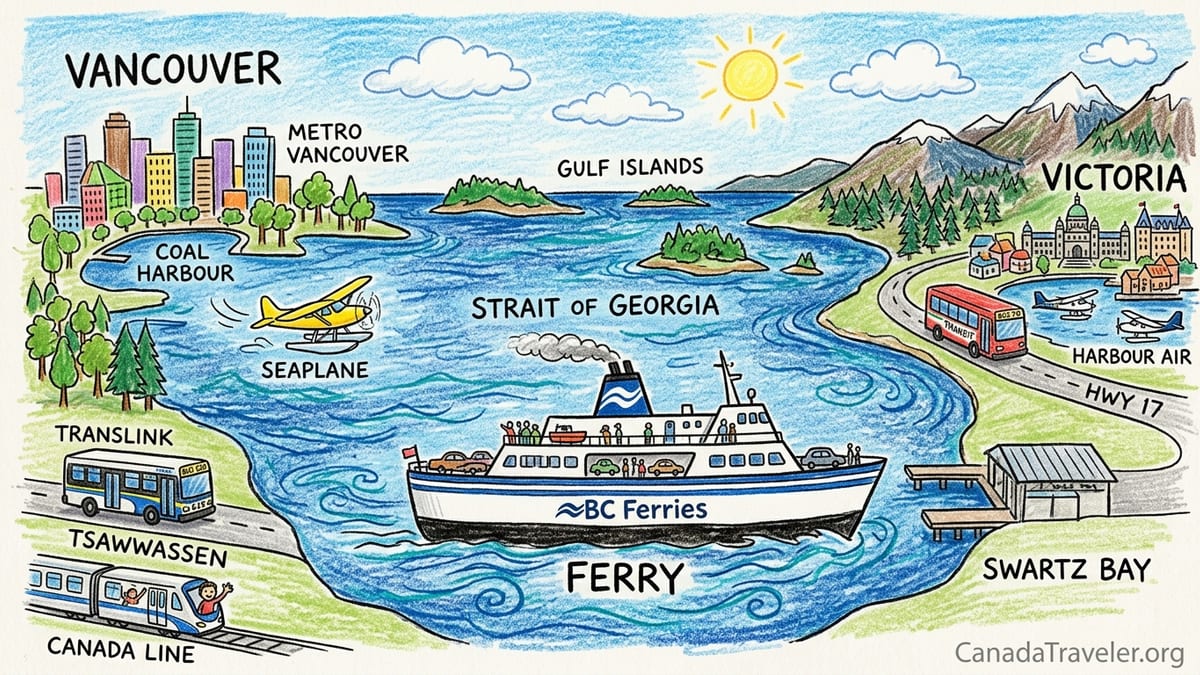
Vancouver and Victoria sit only about 100 kilometers apart as the crow flies, but the Strait of Georgia and the Gulf Islands make this a multi stage journey. Most travelers combine city transit or a coach bus with a ferry crossing between Tsawwassen, on the south side of Metro Vancouver, and Swartz Bay, 32 kilometers north of downtown Victoria. The ferry route, known within BC Ferries as Route 1, is the main artery between the two metropolitan areas and runs many times per day in most seasons, with a scheduled crossing time of about 1 hour 35 minutes.
On the Vancouver side, Tsawwassen ferry terminal is located on a causeway west of the suburb of Delta. It is not connected directly by rail, so you either drive, take a public bus from the Canada Line’s Bridgeport Station, or ride a dedicated coach such as BC Ferries Connector from downtown Vancouver or Vancouver International Airport. On the Vancouver Island side, Swartz Bay sits at the northern tip of the Saanich Peninsula, with BC Transit buses and multiple coach options connecting to downtown Victoria.
Alongside the ferry, two other options link the cities. Seaplanes such as Harbour Air connect Vancouver Harbour Flight Centre in Coal Harbour with Victoria’s Inner Harbour in around 35 minutes of air time. Conventional airlines run short flights from Vancouver International Airport to Victoria International Airport near Sidney, usually around 25 to 30 minutes in the air, followed by an additional ground transfer into Victoria. Each option has different implications for timing, convenience and cost that are worth understanding before you book.
In practice, many visitors are surprised that the total door to door time for all three options can be closer than the raw schedules suggest. Lines for vehicle check in at the ferry, security queues at the airport, or a tight connection off a late arriving seaplane can all change your real world experience. Planning with realistic buffers and a clear sense of each step will keep the trip smooth rather than stressful.
Getting from Central Vancouver to Tsawwassen Without a Car
If you are starting near downtown Vancouver and traveling without a car, the most common route to Tsawwassen is via SkyTrain and bus. From downtown, you ride the Canada Line south to Bridgeport Station in Richmond, then transfer to bus 620, which runs from Bridgeport directly to Tsawwassen ferry terminal. Many visitors do exactly this: for example, someone staying near Vancouver City Centre Station might spend about 12 minutes on the Canada Line and 45 to 55 minutes on the 620 bus, depending on traffic near the George Massey Tunnel and along Highway 17.
For airport arrivals, the logic is similar. From the YVR terminal you take the Canada Line to Bridgeport and then the 620 to Tsawwassen. Travelers with heavy luggage should build in some extra margin to get from baggage claim through customs and onto the train, because the 620 can be busy during summer weekends and school holidays. It is realistic to plan 30 to 45 minutes from stepping off your plane at YVR to boarding a Canada Line train, then another hour or more door to terminal, especially if you are unfamiliar with the system or arriving at a peak time.
A second car free option is booking the BC Ferries Connector, a coach service operated by Wilson’s that links downtown Vancouver, Pacific Central Station and Vancouver International Airport to Swartz Bay and downtown Victoria. With this option you store your luggage under the bus, ride the coach directly to Tsawwassen, stay on while the bus drives onto the ferry car deck, then reboard after the crossing for the final leg into Victoria. For many first time visitors, particularly those nervous about making transfers with bags and kids, this one ticket coach plus ferry package can feel more straightforward than juggling separate bus and transit tickets.
As of 2026, public transit between Vancouver and Tsawwassen involves TransLink fares, including a small airport surcharge if you board at YVR, while the Connector and similar coaches set their own pricing and schedules. In peak summer, coaches can sell out, so booking several days in advance is wise if you have a fixed travel day or need guaranteed seats for a family group.
Driving to the Ferry, Reservations and Check In
For travelers with a rental car or their own vehicle, driving to Tsawwassen is usually simple, but managing reservations and check in times matters. From downtown Vancouver, a typical drive to Tsawwassen outside rush hour is about 45 to 60 minutes via Highway 99 and Highway 17. From YVR, the drive is slightly shorter, often 35 to 45 minutes, assuming no unusual congestion at the tunnel or along the causeway. If you are leaving on a Friday evening or during a long weekend, these times can stretch significantly as locals escape the city.
BC Ferries strongly encourages vehicle reservations on the Tsawwassen to Swartz Bay route, especially between late spring and early fall and on holiday weekends. Drivers with reservations are assigned a specific sailing and are asked to arrive within a check in window, which is typically 30 to 60 minutes before departure. Arrive too late and the reservation may not be honored, with staff directing you into the standby lanes instead. Arrive very early and you may be held in a different area until the correct check in window opens, which surprises some first time drivers who assume they can simply line up hours ahead and sleep in the vehicle.
The real world experience on a busy August Saturday is instructive. A family from Seattle might drive up to Tsawwassen with an 11:00 departure reserved. They hit mild border delays and arrive at the terminal at 9:20, almost 100 minutes early. Staff ask them to wait in a holding lane until 10:00 when check in for their sailing officially opens. Another car, with no reservation, arrives at 10:45 and joins the standby queue, only to discover that multiple sailings are already close to full. The reserved vehicle boards easily while the standby driver may face a wait of several hours for a spot.
Foot passengers can also reserve on the Vancouver to Victoria route, though space for walk on travelers is rarely an issue compared to vehicles. For most of the year, a sensible guideline is to arrive 45 minutes before departure if you need to buy a ticket at the terminal, or 30 minutes if you booked online and only need to check in. During peak summer weekends or around Christmas, it is prudent to add at least another 15 to 30 minutes, particularly if you are connecting from public transit and cannot afford to miss a specific sailing.
On Board Tsawwassen to Swartz Bay and Onward to Downtown Victoria
Once through ticketing and the waiting areas, boarding the ferry itself is straightforward. Foot passengers walk up a covered ramp and filter into the main passenger decks, while vehicles drive aboard according to staff directions. On the major vessels assigned to Route 1, crossing time is scheduled at around 1 hour 35 minutes. In calm conditions the timing is consistent, though loading or unloading delays can occasionally push the total closer to two hours.
On board, travelers typically use the time for a meal, coffee break or simply watching the Gulf Islands slide by. Ferries on this route usually offer cafeteria style dining, a coffee bar, lounges, outdoor decks and play areas for children. A realistic scenario for a morning crossing might look like this: a couple boards the 9:00 sailing as foot passengers, finds a window table in the cafeteria for breakfast, then spends the final 40 minutes on the outside decks taking photos. By the time the announcement comes to return to vehicles and prepare to dock at Swartz Bay, the 95 minutes have passed quickly and they are mentally ready for the next leg of the journey.
Swartz Bay is a busy terminal that serves both the main Tsawwassen route and several Gulf Islands. Foot passengers disembark via walkways into a central terminal building, where they can follow well marked signs to BC Transit buses bound for Victoria and Sidney. Drivers roll off onto a short access road that quickly spits traffic into Highway 17, the Pat Bay Highway, south toward Victoria or north toward Sidney and the airport. There are washrooms, a small cafe and outdoor seating if you need a short break before continuing.
The most direct public bus from Swartz Bay to downtown Victoria is Route 70, an express service that generally takes about an hour to reach the city center. A traveler stepping off a midday sailing might wait 10 to 20 minutes for the next bus, spend 55 to 65 minutes in transit, then walk a few blocks from the final stop to a downtown hotel. In total, the post ferry portion from dock to lobby can often be as short as 75 minutes, but planning for 90 minutes allows for minor delays and the time it takes to navigate an unfamiliar bus system.
Door to Door Timing and Luggage: What to Really Expect
When considering Vancouver to Victoria travel, the biggest mistake many visitors make is to only compare the ferry crossing time to the flight duration. In reality, the choice should be about door to door time from your accommodation in central Vancouver to your accommodation in central Victoria, plus the stress factor of each mode.
For a car free traveler based near Vancouver City Centre Station and staying near Victoria’s Inner Harbour, a typical ferry itinerary might look like this. You leave your hotel at 8:00, catch the Canada Line at 8:10, arrive at Bridgeport at 8:22, and board the 8:35 departure of bus 620. You arrive at Tsawwassen around 9:25, buy your ticket and walk aboard the 10:00 ferry. The vessel docks at Swartz Bay about 11:35, you catch the 11:55 Route 70 bus, and reach downtown Victoria around 12:55. Door to door, that is just under five hours in a reasonably well coordinated but not rushed sequence.
By contrast, a seaplane passenger might walk from a downtown Vancouver hotel to the harbour terminal in 10 minutes, check in 45 minutes before a 10:00 flight, spend about 35 minutes in the air and then stroll to a Victoria Inner Harbour hotel in 10 minutes. Even accounting for a slight delay and some buffer, this trip can be comfortably under three hours door to door. A conventional flight from Vancouver International Airport to Victoria International Airport will usually sit somewhere in between. You may spend 25 minutes on the Canada Line to the airport, 60 to 90 minutes navigating check in and security, 30 minutes flying, then 35 to 45 minutes on a shuttle or bus into Victoria, often bringing the total close to four hours.
Luggage handling also differs meaningfully between options. On the ferry, foot passengers move their own bags, rolling suitcases up gangways and into lounges where they must keep them with them or stash them under seats. This can be mildly inconvenient with large suitcases or multiple children in tow, but it avoids weight limits and checked bag fees. On the BC Ferries Connector or similar coaches, large bags go in the underfloor compartments and you keep only a day pack on your lap. Seaplanes, by contrast, are strict about weight, both for safety and performance. A family of four with heavy checked style bags may find that the luggage allowances on a Harbour Air flight require them to travel lighter or pay extra for additional weight.
Comparing Ferry, Seaplane and Commercial Flights for Different Trips
For most visitors, the Tsawwassen to Swartz Bay ferry remains the default choice. It is usually the most economical, offers frequent departures in most seasons, and provides scenic value that many consider part of the British Columbia experience. Families with cars, road trippers continuing around Vancouver Island to places like Nanaimo, Tofino or Campbell River, and budget conscious travelers typically find the ferry best matches their needs. Having your own vehicle on the Island opens up beaches, hiking trails and small towns that are difficult to reach by bus.
For day trippers between downtown cores, however, seaplanes are hard to beat. A business traveler needing to attend a 10:00 meeting in Victoria and return to Vancouver in the evening can fly Harbour Air from Coal Harbour to the Inner Harbour in about 35 minutes, walk to the office, then reverse the route after work. Attempting the same schedule by ferry would likely require leaving Vancouver before 7:00 and returning close to midnight, with significant time spent on buses and in terminals. Visitors on a short itinerary, such as a three day city break, sometimes combine a seaplane one way and the ferry the other to balance time savings and cost.
Commercial flights via Vancouver and Victoria’s land based airports sit in a middle ground. They can be attractive if you are already at YVR due to an international arrival or connecting flight, or if you find a competitively priced ticket bundled into a larger itinerary. For example, a traveler flying from Toronto to Vancouver might book a through fare that continues to Victoria the same afternoon. In that case, it can be simpler to remain within the airport system instead of collecting baggage, switching to local transit and riding to Tsawwassen.
Travelers continuing around Vancouver Island should also think about their onward route. Someone planning to drive from Victoria to Tofino, for instance, might choose to take their car on the ferry, spend a night in Victoria, then drive north toward Nanaimo and across the Island the next day. Another traveler planning to focus only on Victoria without a car could sensibly fly in by seaplane, stay within walking distance of the Inner Harbour and Beacon Hill Park, then depart by ferry using buses to experience both modes without the cost of a rental car.
Best Choices for Families, Day Trips and Longer Island Itineraries
For families with young children, the ferry often strikes the best balance of flexibility and comfort. Parents can walk restless kids around the decks, let them burn energy in play areas and manage meal times more flexibly than on a short but cramped flight. On a summer midday sailing, it is common to see families claim a corner of the lounge as a base camp, with coloring books and snacks spread across a table near a window. Having a car on the ferry also allows you to pack strollers, coolers and sports gear without the constraints of airline baggage rules.
Day trips call for tougher trade offs. If you want a full day in Victoria with minimal overnight costs, seaplanes or very early ferries are usually the only realistic options. For a ferry based day trip, you might leave downtown Vancouver at 6:30, catch a morning sailing around 8:00 or 9:00, arrive in downtown Victoria late morning and then depart in the early evening, arriving back in Vancouver close to midnight. You technically see both cities in one day, but much of your time is spent in transit. By contrast, a seaplane passenger on a 9:00 departure could enjoy coffee in downtown Vancouver, land in Victoria before 10:00, spend a full day wandering the Inner Harbour, the Royal BC Museum and Beacon Hill Park, then catch a late afternoon or early evening flight back.
Overnight visitors with flexible schedules can often mix modes to their advantage. For instance, a couple spending four nights on Vancouver Island might sail over on an afternoon ferry, rent a car in Victoria to explore the Saanich Peninsula and Cowichan Valley, then drop the car and return to Vancouver by seaplane for a memorable finish. Similarly, backpackers on a tight budget might commit fully to transit and ferries, taking advantage of hostels near central bus routes in both cities and keeping costs low by walking and using local buses.
Those planning extended Island road trips should weigh whether to start their vehicle journey from Victoria or from another ferry terminal such as Nanaimo. While this guide focuses on Tsawwassen to Swartz Bay, ferry crossings from Horseshoe Bay or Tsawwassen to Nanaimo may sometimes make more sense if your primary destinations are on central or north Vancouver Island. In that case, however, the convenience of downtown to downtown seaplanes is replaced by the need for more driving on the Mainland before you even reach the ferry.
The Takeaway
Travel between Vancouver and Victoria is rarely only about the hour and a half on board a ferry or the half hour in the air. It is a chain of small steps that starts at your hotel door and ends when you roll your suitcase into your destination lobby. The Tsawwassen to Swartz Bay ferry, supported by SkyTrain, local buses and coach services, remains the most versatile and budget friendly choice, especially for families, road trippers and travelers planning to explore beyond Victoria itself.
Seaplanes offer a premium, time saving alternative, particularly for downtown to downtown day trips and short visits focused on the cores of both cities. Conventional flights via Vancouver and Victoria airports fill an important niche for those already moving through the airport system or connecting from other regions of Canada and beyond. Each option has clear strengths and trade offs, and there is no single right answer for every traveler.
If you value flexibility, scenery and the ability to carry generous luggage at a lower cost, plan for the ferry and give yourself realistic buffers between each stage of the trip. If time is your scarcest resource, consider investing in a seaplane ticket and compressing the journey to under three hours door to door. With thoughtful planning around reservations, check in windows and transit connections, the crossing between Vancouver and Victoria can feel less like a chore and more like a memorable part of your Pacific Northwest adventure.
FAQ
Q1. How long does it really take to travel from downtown Vancouver to downtown Victoria by ferry?
In normal conditions, a realistic door to door estimate is about four and a half to five and a half hours. That usually breaks down as roughly 30 minutes on the Canada Line from central Vancouver to Bridgeport, 45 to 55 minutes on bus 620 to Tsawwassen, 30 to 45 minutes for ticketing and boarding, 1 hour 35 minutes for the ferry crossing, and 75 to 90 minutes from Swartz Bay to downtown Victoria by bus and walking. Using a coach like BC Ferries Connector can shave some transfer time but the overall range is similar.
Q2. Do I need a reservation for the Tsawwassen to Swartz Bay ferry?
Vehicle reservations are strongly recommended, especially in summer, on long weekends and during school holidays, because standby waits for cars can stretch to several sailings. Foot passengers rarely need reservations and are almost never turned away for capacity reasons, but booking in advance can still simplify check in and give peace of mind on very busy days.
Q3. How early should I arrive at the ferry terminal with a car?
Plan to arrive at Tsawwassen 45 to 60 minutes before your reserved departure time with a vehicle, following the check in window instructions on your reservation. If you show up too late, staff may not honor your booking and you could be moved into the standby lane. Arriving very early does not necessarily guarantee earlier boarding, because terminals organize traffic according to reservations, sailing times and lane assignments rather than first come first served.
Q4. What is the best way to get from Swartz Bay to downtown Victoria without a car?
The most straightforward option is BC Transit Route 70, an express bus that usually takes around an hour from the ferry terminal to downtown Victoria. After walking off the ferry, you follow the signs to the bus bays, pay your fare on board and ride south into the city. When you arrive downtown, most major hotels and attractions around the Inner Harbour are within a short walk of the final stops.
Q5. How does seaplane travel compare with the ferry for a day trip?
For a same day return between the two downtowns, seaplanes are significantly faster but more expensive. A typical seaplane trip involves about 45 minutes of pre flight check in, 30 to 35 minutes of flying and a 5 to 10 minute walk on each end, often resulting in a total time under three hours door to door. The ferry based equivalent, with SkyTrain and buses on both sides, generally takes close to five hours each way, which severely limits how much time you can spend in the destination city during a single day.
Q6. Are there luggage limits on the ferry, seaplanes and coaches?
On the ferry as a foot passenger, you carry your own bags and there are usually no strict checked baggage limits beyond what you can practically manage. On seaplanes, strict weight limits apply for both passengers and luggage, so travelers with heavy or multiple bags may need to pay for additional allowance or pack lighter. On coach services like BC Ferries Connector, large suitcases typically go in underfloor compartments and smaller items stay with you, offering a middle ground with more capacity than a seaplane but more structure than ordinary transit.
Q7. Is it better to drive onto the ferry or leave the car behind and walk on?
It depends on your plans on Vancouver Island. If you intend to explore beyond Victoria, visit remote beaches, wineries or hiking areas, or you are traveling with children and a lot of gear, taking a car on the ferry can be worth the reservation fees and fuel costs. If your trip is focused mainly on downtown Victoria and nearby neighborhoods that are well served by buses and walkable streets, walking on and using transit, taxis or rideshares in Victoria can save money and parking stress.
Q8. What happens if my flight into Vancouver is delayed and I miss my planned ferry?
If you are connecting from an incoming flight at YVR to the ferry by public transit, build generous buffers into your plan, ideally at least three hours between scheduled landing and desired ferry departure. If a delay causes you to miss your targeted sailing, you can usually take the next available one as a foot passenger, purchasing a new ticket if necessary. If you have a vehicle reservation, contact BC Ferries as soon as possible, but be aware that last minute changes on peak days may mean you lose your reserved spot and travel on standby.
Q9. Are commercial flights between Vancouver International Airport and Victoria International Airport worth considering?
Yes, especially if you are already transiting through YVR or arriving on a long haul flight. The air time between YVR and Victoria International is usually around 25 to 30 minutes, and if your ticket is booked as a through itinerary from another city, your luggage typically transfers automatically. After landing on Vancouver Island, you still need about 35 to 45 minutes by shuttle, bus or taxi to reach downtown Victoria, so the total trip can be comparable to the ferry, but it may feel simpler when you are already inside the airport system.
Q10. Which option is best for travelers continuing around Vancouver Island after visiting Victoria?
For extended Island road trips, bringing or renting a car and using the ferry usually makes the most sense. You can sail into Swartz Bay, spend time in Victoria, then drive north toward destinations like Nanaimo, Parksville, the Comox Valley or the Pacific Rim region around Tofino and Ucluelet. Seaplanes work well for point to point city visits but are less practical if you need a vehicle for several days. If your main destinations are on central or northern Vancouver Island and you are driving from the Mainland, you may also consider ferries to Nanaimo instead of Swartz Bay to reduce overall driving distance on the Island.