


Few journeys in Canada feel as epic yet accessible as BC Ferries’ Inside Passage sailing between Port Hardy and Prince Rupert. Linking the tip of Vancouver Island with the northern coastal city of Prince Rupert, this long, mostly daylight voyage threads through fjords, forested islands and remote inlets that most travelers only glimpse from cruise ships. For independent road trippers, it is a working lifeline, a shortcut through roadless wilderness and a highlight of any Vancouver Island to Northern British Columbia itinerary.
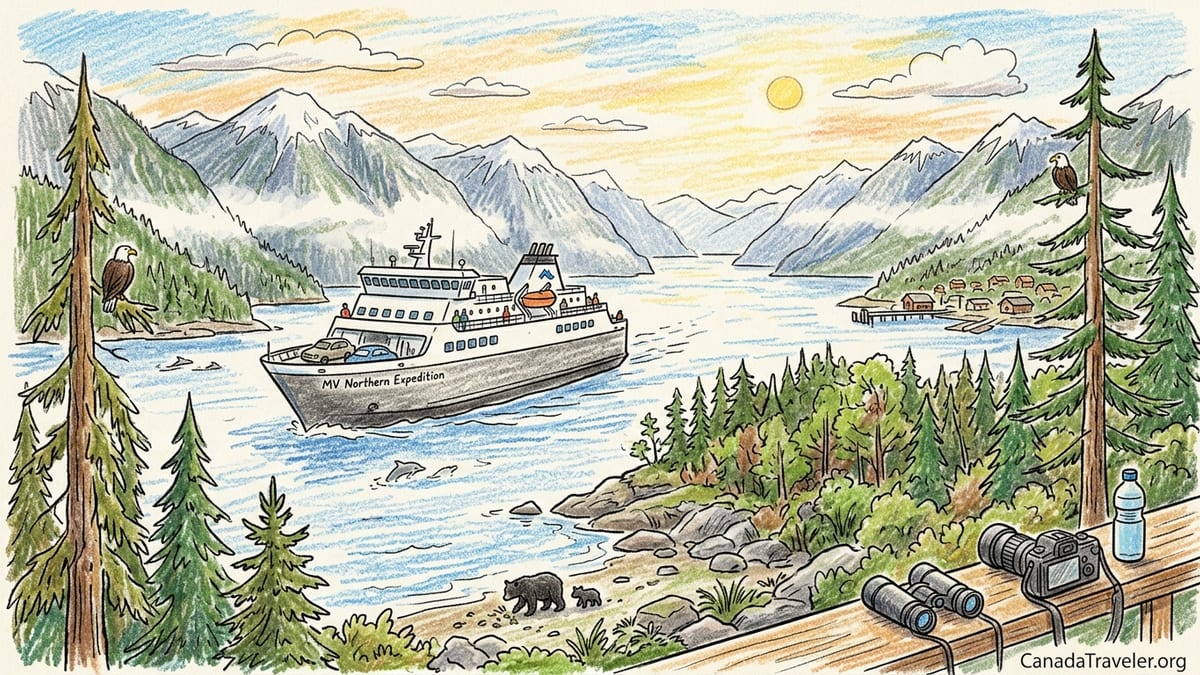
Understanding the Inside Passage Route
The Inside Passage sailing is Route 10 in the BC Ferries network, running between Port Hardy’s Bear Cove terminal on northern Vancouver Island and Prince Rupert on Kaien Island. The distance is roughly 500 kilometers, and the journey typically takes about 15 to 16 hours, scheduled so that most of the voyage occurs in daylight during the summer season. In practice, that means early-morning departures and late-evening arrivals, with long stretches of time to watch the coast glide by through large picture windows or from open outer decks.
The ship assigned to this route is usually the MV Northern Expedition, a purpose-built vessel for the Inside Passage with cabins, a full-service restaurant, self-serve cafeteria, and a reserved-seating lounge. Schedules vary year to year, but sailings generally operate several times a week from mid-June into early fall, with more limited service in shoulder periods. Travelers planning a road trip from Vancouver Island to Haida Gwaii or the Yukon often structure their entire itinerary around the dates this ferry is running.
This route is not a hop-on, hop-off coastal cruise. When sailing non-stop, the ferry departs Port Hardy in the early morning and runs directly to Prince Rupert, occasionally making brief intermediate stops in central coast communities on some schedules. Even when there are stops, passengers must remain on board unless specifically advised otherwise, and vehicles stay parked on the car deck until final arrival. Treat it as a long-haul, point-to-point journey that doubles as an all-day scenic excursion.
Because the ferry is part of British Columbia’s highway system, you will see everything from local residents heading to medical appointments to long-distance truckers bringing supplies north. That mix gives the sailing a different feel than a cruise ship: less formal, more utilitarian, but still with big-ship comforts such as private cabins, hot meals, lounges and panoramic viewing areas.
Port Hardy and Prince Rupert Terminals: What to Expect
On Vancouver Island, the Inside Passage departs from Bear Cove, a small terminal about a 10 to 15 minute drive northeast of Port Hardy’s town center. Unlike the large terminals near Vancouver, Bear Cove is a compact facility with limited services. There is vehicle staging, a terminal building with basic washrooms and seating, and pay parking, but there are no big shopping areas or extensive restaurants. Most travelers fuel up and buy snacks in Port Hardy the night before, then arrive at the terminal early with a full tank and provisions for the day.
Port Hardy itself is where you will want to handle any last-minute errands. The town has supermarkets, gas stations, liquor stores, outdoor outfitters and several motels and lodges. Many travelers choose to sleep in Port Hardy the night before sailing, especially when departures are around 7:30 in the morning and vehicle check-in opens much earlier. In peak summer, accommodation can book out on ferry days, so it is worth reserving a room at a local hotel or campground once you secure your ferry ticket.
At the northern end of the route, the Prince Rupert terminal sits a short drive from downtown along Highway 16. The facility is larger than Bear Cove and is shared with other northern routes, including ferries to Haida Gwaii. You will find check-in booths for vehicles, a terminal building, pay parking and taxi access. Still, amenities remain modest compared with southern BC terminals, so do not count on full-service restaurants inside; instead, plan to eat in town before boarding or after disembarking.
Prince Rupert’s compact downtown is only a 10 to 15 minute drive from the terminal. Hotels such as locally run inns and recognizable chain properties cluster near the waterfront, along with pubs, cafes and supermarkets. For early-morning departures or late-night arrivals, taxis typically wait at the terminal to meet the ferry, but in peak season it is wise to pre-book a cab or confirm your hotel’s shuttle options if you are traveling without a vehicle.
Reservations, Vehicles and Sailing Logistics
Because this is a long, less frequent route, vehicle reservations are strongly recommended and, for summer sailings, practically essential. Space for cars, campervans and RVs can sell out weeks or even months in advance for popular dates such as July weekends or around BC Day. When you book on the ferry operator’s website or by phone, you pay for the full fare for both vehicle and passengers up front, including any cabin or reserved seating upgrades, rather than a small reservation fee at the time of booking.
Standard passenger cars are charged up to a certain length, with additional per-foot charges for vehicles longer than that, such as motorhomes towing a small car or trucks hauling trailers. A typical mid-size car with two adults might pay in the mid to high hundreds of Canadian dollars for the full sailing in peak season, while a large RV with a family can easily exceed that. Exact prices change periodically, so treat any example figures as rough guidance rather than fixed amounts. For budget planning, travelers often assume that the Inside Passage will be one of the most expensive single travel days of a Northern BC road trip, comparable to a domestic flight for a couple.
Check-in for reserved vehicles typically begins about two hours before departure, with cut-off times that are enforced. Long-distance travelers in motorhomes often arrive even earlier in case of lineups or to sort luggage and day bags. Foot passengers also need to check in early with government-issued photo ID. Once vehicles are loaded, access to the car deck is restricted during the voyage, so anything you need for the day such as medications, warm layers, binoculars or camera gear should be packed into a carry-on bag and brought upstairs before departure.
Occasionally, there is limited space left for drive-up vehicles without reservations, but relying on this during summer is risky. Travelers in campervans sometimes report being turned away on prime dates or waiting multiple days in Port Hardy or Prince Rupert for a space to open up. If your schedule is tight or you are connecting to another ferry or flight, treat a reservation as mandatory rather than optional.
Onboard Experience: Cabins, Premium Seating and Food
Once on board the Northern Expedition, you will find a layout designed for a full day at sea. Private cabins are located on upper decks and come in various configurations, typically with two or four berths, a small desk, and an ensuite bathroom with shower. Although you will likely spend much of the journey on deck or in public lounges during daylight hours, many travelers value a cabin as a quiet retreat for naps, for children to rest, or simply to have a private space to store bags and change clothes. For families, a four-berth cabin can be particularly useful, even if you only use it intermittently.
In addition to cabins, the ship offers premium reserved seating in the Aurora Lounge at the bow. This forward-facing lounge features reclining leather seats with footrests and floor-to-ceiling windows offering a wide, almost wraparound view of the coastline. Entry is by paid reservation, usually added at the time of booking or at check-in if space allows. Travelers who want guaranteed window seats and a quieter atmosphere without paying for a full cabin often choose the lounge, especially in summer when outer decks can be busy during scenic sections.
For meals, the ferry typically has a full-service restaurant, often referred to as the Vista Restaurant, and a more casual cafeteria or café such as the Canoe Cafe. At breakfast, you can expect items like eggs, bacon, toast and coffee; for lunch and dinner, menus usually feature burgers, salads, sandwiches, hot entrees, desserts and a selection of beer and wine. Prices are in line with casual restaurant dining in coastal BC, so plan your budget accordingly. There are also grab-and-go options such as pastries, packaged snacks and coffee for those who prefer to graze.
The public lounges offer plenty of seating with large windows, and outdoor decks are accessible for most of the voyage, weather permitting. Seating is first-come, first-served outside of reserved lounges, so if you want a particular vantage point such as a port-side window seat for an upcoming narrow channel, it can pay to scout locations early in the day. Free Wi-Fi, if available, is usually limited and not designed for streaming, so consider downloading audiobooks, podcasts or offline maps before boarding to pass the quieter stretches.
Scenery, Wildlife and Seasickness
The primary reason many travelers choose the Inside Passage is the scenery. The route threads between densely forested islands and steep-sided mainland fjords, with small lighthouses, remote logging camps and occasional fishing villages breaking up the wilderness. On clear days you may see snow-streaked peaks in the distance, waterfalls cascading into the sea and low morning mist lifting off sheltered bays. Narrow channels, where mountains press close to each side of the vessel, are among the highlights, and the captain will often make route choices that maximize safety while still showcasing the most dramatic landscapes available under the day’s conditions.
Wildlife sightings are common but never guaranteed. Passengers regularly report seeing harbor porpoises and dolphins riding the bow wave, bald eagles perched in shoreline trees and, in late spring and summer, humpback whales or orcas surfacing at a distance. Closer to shore, you might spot black bears on beaches at low tide or sea lions hauled out on rocky islets. Bringing binoculars significantly improves your chances of enjoying these moments, and having a camera with a moderate zoom lens helps capture distant splashes without needing professional gear.
Although the term “Inside Passage” suggests sheltered waters, conditions can still be choppy, especially when the ship crosses more exposed gaps between island groups or when strong winds funnel down channels. Many travelers who are fine on short ferries such as the two-hour sailings near Vancouver still choose to bring motion sickness medication for this all-day voyage. Over-the-counter remedies, ginger candies, acupressure wristbands and staying well hydrated can all help. If you are prone to seasickness, securing a cabin allows you to lie down in a quiet space away from visual motion, which some passengers find easier than remaining in a busy lounge.
Layers are important even in midsummer. Decks can be windy and cool, while indoor areas vary from comfortably warm to slightly chilly depending on air conditioning and where the sun is striking the ship. A typical outfit might include a base layer, fleece or light insulated jacket, waterproof shell and comfortable walking shoes with non-slip soles. Having a hat and gloves can make early-morning or late-evening time on deck far more pleasant when you are intent on spotting distant whales against a cool horizon.
Luggage, Day Bags and Practical Tips
Because access to the vehicle deck is generally closed during the sailing, packing an effective day bag is critical. Before you leave your car, assemble everything you will want for the full day: passports or ID, medications, chargers, camera equipment, binoculars, warm layers, snacks and any personal comfort items. Many repeat travelers use a soft-sided duffel or hiking daypack that is easy to carry up stairs and through interior corridors. If you have booked a cabin, you can still minimize clutter by consolidating items into one or two main bags that stay with you in the room.
For foot passengers traveling without a vehicle, treat the ferry almost like a long-distance train or international flight. Rolling suitcases can be stored in your cabin if you have one, or kept near seating areas where you can keep an eye on them. Lockable zippers or small cable locks can provide peace of mind, but theft reports on this route are rare and the atmosphere is generally relaxed. Still, it is sensible to keep valuables such as wallets, electronics and travel documents on your person or in a small daypack at all times.
Food and drink policy can vary, but many travelers bring a small supply of snacks, fruit and refillable water bottles to supplement purchased meals. With a journey lasting more than half a day, this not only cuts costs but also ensures you have suitable options if you have dietary restrictions or simply prefer to eat at off-peak times rather than joining cafeteria lines during the lunch and dinner rush. If you rely on coffee or tea, consider carrying a travel mug, as onboard cups can be small and refills add up.
Finally, plan for limited connectivity. Mobile signal is patchy along much of the route, and any onboard Wi-Fi is usually basic and shared among many passengers. Travelers who bring offline entertainment such as downloaded series, reading on an e-reader, or travel journaling supplies often find the hours pass quickly. That said, many passengers end up leaving books unread, spending far more time than expected scanning the water for whales or simply watching the ever-changing coastline from the deck rails.
Fitting the Ferry into a Vancouver Island to Northern BC Road Trip
For many visitors, the Inside Passage ferry is a central link in a broader loop that connects Vancouver Island with Northern British Columbia and sometimes onward to the Yukon or Alaska. A common pattern begins in Vancouver, with travelers taking a shorter ferry to Nanaimo or Victoria, then driving up Vancouver Island over several days. They might stop in places like Campbell River for coastal hiking, Telegraph Cove for whale watching and grizzly bear tours, and Port McNeill for small-town harbors before reaching Port Hardy.
After sailing to Prince Rupert, road trippers often continue east along Highway 16 beside the Skeena River, one of the most scenic driving sections in the province. Towns like Terrace and Smithers provide bases for hiking, fishing and exploring Indigenous culture, while Prince George serves as a major junction. From there, routes fork north toward the Alaska Highway, northeastern BC and the Yukon, or south through the Cariboo region toward Williams Lake and back to the Lower Mainland. By combining the Inside Passage ferry with this inland drive, travelers create a varied loop that contrasts coastal fjords with interior mountains and ranchlands.
For those specifically interested in the Great Bear Rainforest, the ferry provides essential coastal access. While most of the 64,000-square-kilometre region is roadless wilderness, many small communities and remote lodges rely on marine transportation. Some travelers use the Inside Passage to reach departure points for bear-viewing trips or kayak expeditions, then connect onward via smaller boats or floatplanes. Others simply appreciate that by traveling one direction by sea and the other by land, they gain two very different perspectives on the same vast landscape.
If your time is limited, you can still integrate the ferry into a shorter itinerary. For example, you might spend four or five days driving from Victoria to Port Hardy with stops in Comox Valley and Port McNeill, take the Inside Passage north, then fly back to Vancouver from Prince Rupert after a night or two exploring its waterfront and nearby trails. This approach retains the highlight of the ferry journey while reducing days behind the wheel.
Connections to Haida Gwaii and the Great Bear Rainforest
Prince Rupert serves as the primary marine link to Haida Gwaii, the remote archipelago formerly known as the Queen Charlotte Islands. A separate BC Ferries route typically runs year-round between Prince Rupert and Skidegate Landing on Graham Island, with a crossing time of around seven hours. Schedules are planned so that, on some days in peak season, you can connect between the Inside Passage arrival and a Haida Gwaii departure either the same day or with an overnight in Prince Rupert. Given the length of both sailings, many travelers prefer to spend at least one night in town before continuing.
On Haida Gwaii, Highway 16 continues from the Skidegate terminal north toward Tlell, Port Clements and Masset, while a short secondary ferry links Skidegate with Sandspit on Moresby Island. Visitors head to Haida Gwaii for a mix of Haida cultural experiences, remote beaches, temperate rainforest hiking and multi-day trips into protected areas such as Gwaii Haanas. Using the Inside Passage to reach Prince Rupert and then continuing to Haida Gwaii by sea creates a continuous coastal route that feels worlds away from more conventional fly-in vacations.
The Great Bear Rainforest, stretching along the central and northern BC coast, is another region where the Inside Passage plays a supporting role. While the main ferry does not tour every inlet within this vast protected area, its route passes through or near sections of the broader Great Bear ecosystem. Travelers often combine the Port Hardy to Prince Rupert ferry with separate arrangements for bear-viewing or ecotourism lodges based in communities such as Klemtu, Bella Bella or remote island locations reached by small boat or floatplane from Prince Rupert.
In practical terms, that means planning your Inside Passage sailing dates around fixed start and end times for guided trips deeper into the rainforest. For example, you might sail north from Port Hardy, overnight in Prince Rupert, then catch a floatplane to a bear-viewing lodge on a specified departure day. After several days watching grizzlies or spirit bears fish for salmon, you return to Prince Rupert and either drive inland or sail south. Coordination between ferry schedules, small-plane operators and lodge bookings is key, so it is wise to confirm all moving parts well ahead of time.
Ferry vs Flying or Driving Inland
Choosing between the Inside Passage ferry, flying, or driving inland across British Columbia depends on your priorities of time, budget and experience. Flying between Vancouver and Prince Rupert is undeniably fastest, with direct flights taking roughly two hours. This works well for travelers short on time, those heading straight to Haida Gwaii, or visitors who might be nervous about long sea crossings. However, flights bypass both the Vancouver Island road trip and the maritime aspect of the journey, replacing coastal fjords with views from 30,000 feet.
Driving the inland route along Highway 97 and Highway 16 offers a different sort of adventure. From Vancouver, you can head north through the Fraser Canyon to Prince George, then west to Prince Rupert. This road trip reveals ranchlands, lakes and interior mountain ranges rather than island-dotted channels. Towns such as Quesnel, Prince George, Burns Lake and Smithers provide classic roadside motels, diners and regional museums. Some travelers choose to drive one direction and then put their vehicle on the ferry in the other, effectively creating a loop and reducing the number of repeated miles.
The Inside Passage ferry, by contrast, compresses what would be days of driving into a single long but restful travel day. You are not behind the wheel, fuel costs are irrelevant for the hours at sea, and instead of focusing on passing trucks and highway curves, you can sit in a lounge chair and watch for whales. For many, the ticket price is justified as both transportation and a scenic day cruise. The trade-offs are the need to book well ahead, the risk of occasional schedule adjustments due to weather or operational issues, and the challenge of being committed to a fixed sailing day.
In practice, many travelers find that the richest itineraries blend all three modes: driving across Vancouver Island to reach Port Hardy, sailing the Inside Passage between Port Hardy and Prince Rupert, and then either flying or driving inland from Prince Rupert depending on time. For example, a visitor might start in Vancouver, spend a week working their way up the Island, take the ferry north, explore Prince Rupert and Haida Gwaii by car and foot, then fly back to Vancouver at the end, leaving the vehicle rental return in Prince Rupert. Balancing cost, time and experience in this way allows the Inside Passage to become the centerpiece rather than the only highlight of the journey.
The Takeaway
The Inside Passage ferry between Port Hardy and Prince Rupert is more than a long-distance link in British Columbia’s transport network. It is a rare opportunity for independent travelers to experience a coastal route otherwise dominated by cruise ships and working vessels. With cabins for rest, premium lounges for front-row views, and public decks that put you eye-level with steep forested slopes and distant whales, the journey turns what could be a simple transfer into a full day of immersion in coastal wilderness.
Successful trips come down to planning. Booking vehicle space and any cabins well ahead, building your road-trip itinerary around limited sailing dates, packing an efficient day bag and preparing for variable weather all reduce stress on departure day. Thinking of the ferry as a hybrid between a scenic cruise and a long-haul train ride helps set expectations: you will share the ship with locals and freight, there are no formal entertainment programs, yet the passing landscape provides more than enough to fill your time.
By connecting Vancouver Island with Northern BC, Haida Gwaii and the broader Great Bear Rainforest, the Inside Passage sailing anchors some of the most memorable itineraries in western Canada. Whether you use it as a once-in-a-lifetime shortcut through remote fjords, a repeating link in an annual northern road trip, or the prelude to a wilderness bear-viewing expedition, it offers a perspective on the coast that few other journeys can match.
FAQ
Q1. How long is the Port Hardy to Prince Rupert Inside Passage ferry?
The sailing usually takes about 15 to 16 hours, with schedules designed so most of the journey occurs in daylight during the main summer season.
Q2. Do I really need a vehicle reservation for this route?
In peak summer, vehicle reservations are highly recommended and often essential, especially for RVs and campervans, as sailings on popular dates can sell out well in advance.
Q3. Are cabins worth the extra cost on the Inside Passage ferry?
Cabins add cost but provide privacy, a place to nap, store gear and escape crowds, which many families, older travelers and those prone to seasickness find worthwhile.
Q4. What kind of food is available on board?
The ship typically offers a full-service restaurant and a cafeteria or café serving hot meals, snacks, desserts and beverages, with prices similar to casual coastal BC restaurants.
Q5. How bad is seasickness on the Inside Passage route?
Much of the route is in sheltered waters, but some sections can be choppy. Many travelers bring motion sickness medication and find that fresh air and rest in a cabin help.
Q6. Can I stay in my vehicle during the sailing?
No, passengers are not allowed to remain on the vehicle deck while the ship is underway. You must bring everything you need for the day up to the passenger decks before departure.
Q7. Is the Inside Passage ferry suitable for children?
Yes, many families travel this route. Cabins, open decks, wildlife viewing and casual dining options make it manageable, though parents should plan activities for long quiet stretches.
Q8. How does the ferry connect with Haida Gwaii?
From Prince Rupert, a separate ferry route runs to Skidegate on Haida Gwaii. Travelers often sail the Inside Passage, spend a night in Prince Rupert, then continue on to the islands.
Q9. What is the best time of year to sail for scenery and wildlife?
Late spring through early fall generally offers the best combination of daylight, relatively mild weather and chances to see whales, dolphins and coastal birdlife.
Q10. How does taking the ferry compare to flying or driving inland?
Flying is fastest and driving inland offers different landscapes, but the ferry combines transportation with a full-day scenic experience through remote coastal fjords that roads do not reach.