


Camping in the Canadian Rockies is one of North America’s great road trips, but it is no longer a casual, show-up-and-see-what-happens experience. For Banff, Jasper and their neighboring parks, the 2026 season is built around reservation launch dates, wildfire-related capacity limits and strict rules designed to protect bears and people alike. This guide walks you through how to actually secure a campsite or backcountry permit, what to expect on the ground, and how to choose the right campground for Banff, Lake Louise, the Icefields Parkway and Jasper sightseeing.
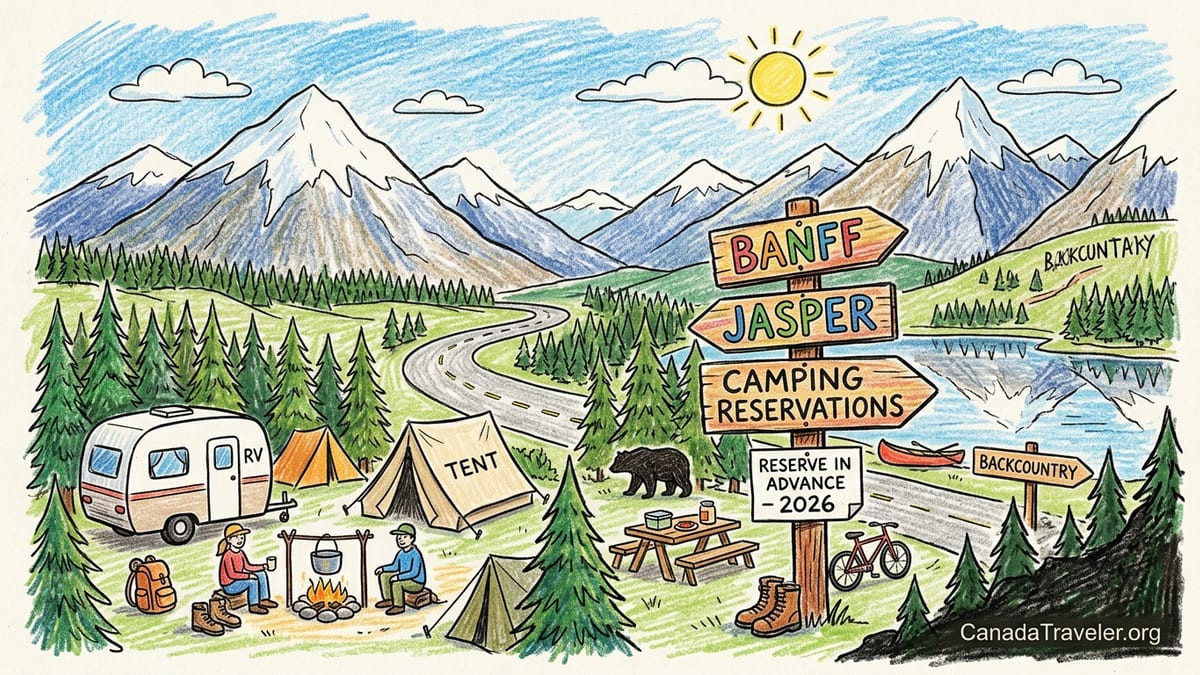
How Camping Works in Banff and Jasper in 2026
Parks Canada now expects most visitors to reserve campsites in advance for Banff and Jasper, especially from late June to early September. In January and February 2026, tens of thousands of nights across Tunnel Mountain, Lake Louise, Wapiti, Whistlers and other frontcountry campgrounds were released at set launch times, and many summer weekends booked out within minutes. Walk-in or same-day options still exist, but they are not reliable for peak periods.
For the 2026 season, Banff’s main frontcountry camping reservations, including Tunnel Mountain and the Lake Louise area, opened in late January, followed by additional inventory in February as Parks Canada adjusted capacity. Jasper’s frontcountry reservations launched slightly earlier, with the main release in late January at 8 am Mountain Time. Some Jasper capacity is still reduced because of wildfire damage and ongoing area closures, which means popular sites like Wapiti and Whistlers can feel harder to book than equivalent campgrounds around Banff.
On top of frontcountry reservations, backcountry camping in Banff, Yoho, Kootenay and Jasper uses the same online system, with its own January launch date for designated backcountry campgrounds. Lake O’Hara in Yoho operates on a separate random draw-style system, with applications typically accepted in March for the coming summer. Because all these products compete for similar dates and school holidays, many experienced visitors treat the January reservation window almost like buying concert tickets.
The critical point for 2026 and beyond: you should not arrive in Banff or Jasper in July or August assuming you will find a campsite. Wapiti and Tunnel Mountain often display “Campground full – all campers without reservations report to overflow” notices by afternoon, and even overflow lots along the Icefields Parkway can fill before dark on long weekends. Reservations are now the baseline, not the backup.
Reservation Basics: Frontcountry, RV Services and Backcountry Permits
Parks Canada’s reservation system allows you to filter by park, dates, party size and equipment type, then choose from individual sites. When booking a frontcountry campground like Tunnel Mountain Village II or Lake Louise Trailer, you will be asked to specify whether you bring a tent, trailer, fifth wheel or motorhome, and the length of your rig. This matters: older campgrounds have pads that cannot safely accommodate long RVs, while some tent-only loops exclude trailers entirely.
Most of Banff’s and Jasper’s larger campgrounds offer a mix of serviced and unserviced sites. Serviced sites typically include 15 or 30 amp electrical hookups, sometimes combined with water and sewer in “full hookup” spots, which appeal to RV travelers with air conditioning and large fridges. For example, Tunnel Mountain Trailer Court in Banff is almost entirely full-hookup RV territory, while Tunnel Mountain Village II mixes powered and unserviced sites, and Two Jack Main offers more traditional, unserviced, forested tent camping. In Jasper, Whistlers is the flagship modern campground with large, pull-through sites, power and upgraded facilities, while Wapiti offers a mix of powered and unserviced loops along the Athabasca River.
Backcountry permits are a separate booking within the same reservation platform. Instead of choosing a single campsite, you select a multi-night itinerary along a route such as the Skyline Trail in Jasper or the Egypt Lake area in Banff, then pick specific backcountry campgrounds for each night. A nightly backcountry permit fee applies on top of your park entry. Party sizes are capped, tent pads are limited, and food storage infrastructure (such as bear hangs or lockers) is provided at most official backcountry sites. Walk-in backcountry permits are increasingly rare on popular trails after the January release; most desirable long weekends in July and August book out quickly.
For visitors unable to secure a prime campground in the first wave, it is still worth checking the system regularly in the months before your trip. Cancellations are common when people’s vacation plans change, and new availability sometimes appears a few weeks out. Just do not rely on “something will open up” during the middle of a long weekend in late July.
Fire Rules, Food Storage and Camping in Bear Country
The Rockies are grizzly and black bear country, and both Banff and Jasper enforce strict rules on food storage and campsite cleanliness. Anything that smells like food or garbage must be locked inside a hard-sided vehicle or in campground storage lockers when unattended. Leaving a cooler, stove, dishes, pet food or even scented toiletries outside can earn a warning or a fine, but more importantly it can habituate bears to human food, which often leads to the animal being destroyed.
Frontcountry campgrounds such as Two Jack Lakeside, Johnston Canyon, Lake Louise and Whistlers are patrolled regularly by Parks Canada staff. You may see rangers inspecting sites in the evening, checking that coolers are put away and that dishwater is disposed of properly. In busy bear seasons, entire campgrounds or loops can be temporarily restricted to “hard-sided camping only,” meaning tents are not allowed and only RVs or vans with fixed walls and windows can stay. Track recent bulletins before arrival, as these restrictions sometimes change mid-season.
Campfires are generally permitted at designated fire pits when conditions allow, but 2026 has already shown how quickly that can change. Banff, for example, implemented a fire ban in late July due to high fire danger, immediately affecting all frontcountry and backcountry campfires. When a fire ban is in place, you cannot use wood-burning campfires even in metal rings; instead, you may be limited to gas stoves or propane fire pits with shut-off valves. When fire bans are not in effect, you must purchase a nightly fire permit as part of your reservation if you want to burn wood, which covers both the right to have a fire and often includes a set amount of firewood stocked at central wood piles.
In the backcountry, bear safety becomes even more practical. Designated sites usually have food storage cables or lockers, but hikers are responsible for using them correctly and for cooking and eating away from their tent. Trails like the Skyline in Jasper and the Sunshine to Mount Assiniboine routes traverse classic grizzly habitat, and it is common to see bear-warning signs at trailheads. Carrying bear spray on your belt or pack strap is standard practice, hiking in groups is strongly recommended, and some trails may face temporary closures when bears are actively feeding.
Choosing Campgrounds for Banff Town, Lake Louise and the Icefields Parkway
For sightseeing around the town of Banff, Tunnel Mountain Village I and II are the workhorse campgrounds. They sit a short drive or Roam Transit ride from downtown, with loops that suit both tents and RVs. Village II and the Trailer Court emphasize serviced sites with power and full hookups, making them popular with large motorhomes. Village I and nearby Two Jack Main feel more like traditional camping, with more trees, fewer services and better chances for dark night skies. If you plan to spend your days walking Banff Avenue, riding the Banff Gondola and soaking in the Upper Hot Springs, a Tunnel Mountain base keeps driving to a minimum.
Lake Louise is a very different experience. The Lake Louise tent and trailer campgrounds form a large complex alongside the Bow River, ringed by an electric fence to reduce bear conflicts. This is the most central base for visiting both Lake Louise and Moraine Lake, and for day trips along the Icefields Parkway and into Yoho National Park. Many tent campers find the ambience less secluded than at Two Jack or Johnston Canyon, thanks to the nearby railway line and sheer size of the campground, but in exchange you can reach the Lake Louise lakeshore, Moraine Lake shuttles and the Icefields Parkway in minutes.
Along the Icefields Parkway between Lake Louise and Jasper, a string of smaller, mostly unserviced campgrounds provide classic mountain overnights. Sites like Waterfowl Lakes, Rampart Creek and Mosquito Creek in Banff, and Honeymoon Lake, Wabasso and Kerkeslin in Jasper, prioritize tents and smaller RVs, and all sit outside reliable cell coverage. These campgrounds are superb bases for exploring the Parkway’s highlights, such as Peyto Lake, the Columbia Icefield Discovery Centre, Parker Ridge and Sunwapta Falls. Because they offer fewer services and lower capacity than townsite campgrounds, they can feel more peaceful, but they also fill quickly in high season and may have rolling reservation windows or limited reservable dates.
Jasper townsite campers generally choose between Whistlers and Wapiti. After a major rebuild, Whistlers offers modern washrooms, large pads and numerous powered sites, making it the top pick for families and RV travelers who want comfort while being a few minutes’ drive from Jasper’s restaurants and shops. Wapiti, running along the Athabasca River, mixes serviced and unserviced loops and often operates at reduced capacity in the wake of recent wildfires and infrastructure work. First-come, first-served winter camping is sometimes available at Wapiti in the shoulder season, but summer 2026 is heavily reservation-driven.
How Camping Differs in Yoho, Kootenay and Nearby Provincial Parks
While Banff and Jasper dominate most itineraries, Yoho and Kootenay National Parks offer a noticeably different camping feel. They are smaller, quieter and, at least for now, somewhat easier to book, though peak weekends can still sell out. Yoho’s primary frontcountry campgrounds, such as Kicking Horse near the town of Field, serve visitors who want quick access to Emerald Lake, Takakkaw Falls and the Spiral Tunnels viewpoint while staying within a short drive of Lake Louise. Sites tend to be more rustic and fewer in number than the big complexes in Banff.
Kootenay National Park’s campgrounds, including McLeod Meadows and Redstreak near Radium Hot Springs, line Highway 93 South and feel more like classic forest or riverside stops on a long road trip. Redstreak, perched above the village of Radium, offers some serviced sites, showers and easy access to the hot springs, making it attractive for families driving between Calgary and the Okanagan. McLeod Meadows, lower in the valley, focuses on unserviced camping by the Kootenay River. These parks share entry passes with Banff and Yoho, so you do not pay extra park admission when you cross the borders between them.
Nearby provincial parks in both Alberta and British Columbia add another layer. Alberta Parks campgrounds in the Bow Valley and Kananaskis regions, and BC Parks sites around Golden, Revelstoke or the Columbia Valley, use separate reservation systems from Parks Canada and often open their booking calendars on different dates. Prices, maximum stay lengths and cancellation policies differ slightly, and some provincial parks still maintain more first-come, first-served inventory than the big national parks. Savvy travelers sometimes combine a national park base with a few nights in a provincial park to stretch availability and budget.
In practical terms, camping in Yoho, Kootenay and nearby provincial parks feels a bit more relaxed than in Banff or Jasper, but the underlying rule is the same: do not count on last-minute peak-summer availability. Even quieter parks can see every site taken on a sunny August Friday, forcing those without reservations to drive long distances in search of a bed or settle for expensive last-minute motels.
Tent vs RV Sites, Opening Seasons and Shoulder-Season Strategies
Deciding between tent and RV camping in the Canadian Rockies is partly about comfort and partly about flexibility. Tents and small campervans fit into almost all frontcountry campgrounds, including smaller Parkway sites such as Mosquito Creek or Kerkeslin, which may be off-limits to very large motorhomes. RVs, on the other hand, gain access to full-hookup loops at Tunnel Mountain Trailer, Whistlers and Lake Louise Trailer, with on-board heating for cold nights and more resilience during rain or smoke events. Families often split the difference with rented 22 to 25 foot motorhomes that can still maneuver into most national park campgrounds.
Operating seasons vary by campground but generally run from May or early June through late September or early October. For example, many Banff-area campgrounds open in May, with some staying open into October, while Icefields Parkway campgrounds at higher elevations have shorter seasons, often from June to early September. In Jasper, Whistlers and Wapiti usually come online in May or June and run through early fall, with reduced winter operations in Wapiti for hardy tenters and RVs. Shoulder-season camping in May, early June or late September brings colder nights and a higher chance of snow, but also thinner crowds and more open reservations.
One practical shoulder-season strategy is to combine a few nights in a fully serviced RV site near Banff or Jasper with a night or two in more rustic Parkway campgrounds when weather and road conditions look favorable. You might, for example, book Tunnel Mountain Village II for a long weekend in early June, then add a night at Rampart Creek or Honeymoon Lake as a side trip if forecasts are mild. Because demand is lower, it is sometimes possible to secure shoulder-season sites with less lead time, though weekends still benefit from advance planning.
No matter the season, check for active fire bans and travel advisories before you depart. A mid-summer fire ban can change your cooking plans and evening routine overnight, while wildfire-related road closures in Jasper or along Highway 93 can add hours of detours. Keeping plans flexible for one or two nights at the end of your trip can be useful if you need to pivot from Jasper to Yoho, or from Lake Louise to Kootenay, because of smoke or closures.
The Takeaway
Camping in the Canadian Rockies in 2026 rewards those who plan early and stay flexible. Reservation launch days for Banff and Jasper now function as unofficial holidays for Western Canadian campers, with laptops open, alarms set for 7:55 am and wish lists ready. If you care about specific dates, campgrounds or hookups, you should join them, especially if you are eyeing July or August around Lake Louise, the Icefields Parkway or Jasper townsite.
At the same time, the region still offers room for spontaneity, particularly in shoulder seasons and in smaller parks like Yoho and Kootenay or nearby provincial campgrounds. Combining reserved nights at big hubs such as Tunnel Mountain, Lake Louise, Whistlers or Wapiti with a few more rustic nights on the Parkway can deliver both comfort and classic mountain solitude. Layer in bear-smart camping habits, respect for fire rules and a realistic understanding of how full campsites get in peak season, and you can still experience the Rockies as a string of starlit nights, cold rivers and quiet forest mornings rather than a stressful search for somewhere, anywhere, to park for the night.
FAQ
Q1. Do I really need a reservation to camp in Banff or Jasper in summer 2026?
Yes. From late June through early September, most serviced and many unserviced campgrounds in Banff and Jasper book out in advance, especially on weekends and around Lake Louise, the Icefields Parkway and Jasper townsite. Arriving without a reservation in peak summer often means relying on overflow lots or driving long distances to find a vacancy.
Q2. When did 2026 camping reservations open for Banff and Jasper?
For the 2026 season, Jasper’s frontcountry camping reservations launched in January, while Banff’s main frontcountry and Lake Louise area reservations followed in late January, with additional inventory released into February. Backcountry reservations for Banff, Yoho and Kootenay also opened in January, and special products like Lake O’Hara in Yoho used a separate application window in March.
Q3. What is the difference between serviced and unserviced campsites?
Serviced campsites provide some combination of electrical, water and sewer hookups, designed primarily for RVs and trailers. Unserviced sites do not offer hookups and suit tents, campervans and smaller trailers. For example, Tunnel Mountain Trailer Court in Banff offers full-hookup RV sites, while Two Jack Main and many Icefields Parkway campgrounds provide unserviced, more rustic sites.
Q4. Can I camp in a tent at all campgrounds in Banff and Jasper?
No. Some loops in large campgrounds are restricted to RVs or hard-sided units, and temporary bear-related restrictions can limit certain areas to hard-sided camping only. In general, tent campers have great options at places like Two Jack Main, Two Jack Lakeside, Johnston Canyon, Waterfowl Lakes, Whistlers’ tent loops and many smaller Parkway campgrounds, but you should always check site details when reserving.
Q5. How do backcountry camping permits work in these parks?
Backcountry camping uses a permit system tied to specific designated campgrounds and dates. You plan an itinerary, reserve tent pads at each backcountry site along your route and pay a nightly permit fee per person. Popular routes such as Jasper’s Skyline Trail or Banff’s Egypt Lake area often book out soon after the January reservation launch.
Q6. What should I know about bears and food storage?
All food, garbage, toiletries and anything with a strong smell must be stored in a vehicle or provided bear-proof lockers when unattended. Leaving coolers or dishes outside is prohibited and can attract bears, sometimes leading to fines and, more seriously, to bears becoming food-conditioned and ultimately destroyed. In the backcountry, you must use bear hangs or lockers and cook away from your tent.
Q7. Are campfires allowed, and what happens during a fire ban?
Campfires are usually allowed in designated fire pits if you purchase a nightly fire permit and follow local rules. During periods of high fire danger, Parks Canada may impose a fire ban, which prohibits wood-burning fires even in campground rings. Under a fire ban, you are typically limited to gas stoves or approved propane fire devices, so many travelers bring a gas stove as their primary cooking method.
Q8. Which campgrounds are best for visiting Lake Louise and the Icefields Parkway?
For Lake Louise itself, the Lake Louise tent and trailer campgrounds offer the closest base, protected by an electric fence and minutes from shuttle departures. For exploring the Icefields Parkway, a mix of Lake Louise campgrounds and smaller Parkway sites like Waterfowl Lakes, Mosquito Creek, Rampart Creek, Honeymoon Lake and Wabasso works well, allowing you to break up the drive between Banff and Jasper.
Q9. How does camping in Yoho and Kootenay differ from Banff and Jasper?
Yoho and Kootenay are quieter and have smaller, more rustic campgrounds, such as Kicking Horse in Yoho and Redstreak or McLeod Meadows in Kootenay. They share park passes with Banff and Jasper but often feel less crowded, especially midweek. Reservations are still recommended in peak season, but competition for sites is usually less intense than around Banff townsite or Jasper.
Q10. What are good strategies if I missed the main reservation launch?
If you missed the January and February launches, check the reservation system frequently for cancellations, target shoulder-season dates in May, early June or late September and consider alternative bases in Yoho, Kootenay or nearby provincial parks. Combining a few nights in a high-demand campground like Tunnel Mountain, Lake Louise, Whistlers or Wapiti with more flexible nights in smaller Parkway or provincial park campgrounds can still deliver an excellent Canadian Rockies trip.