


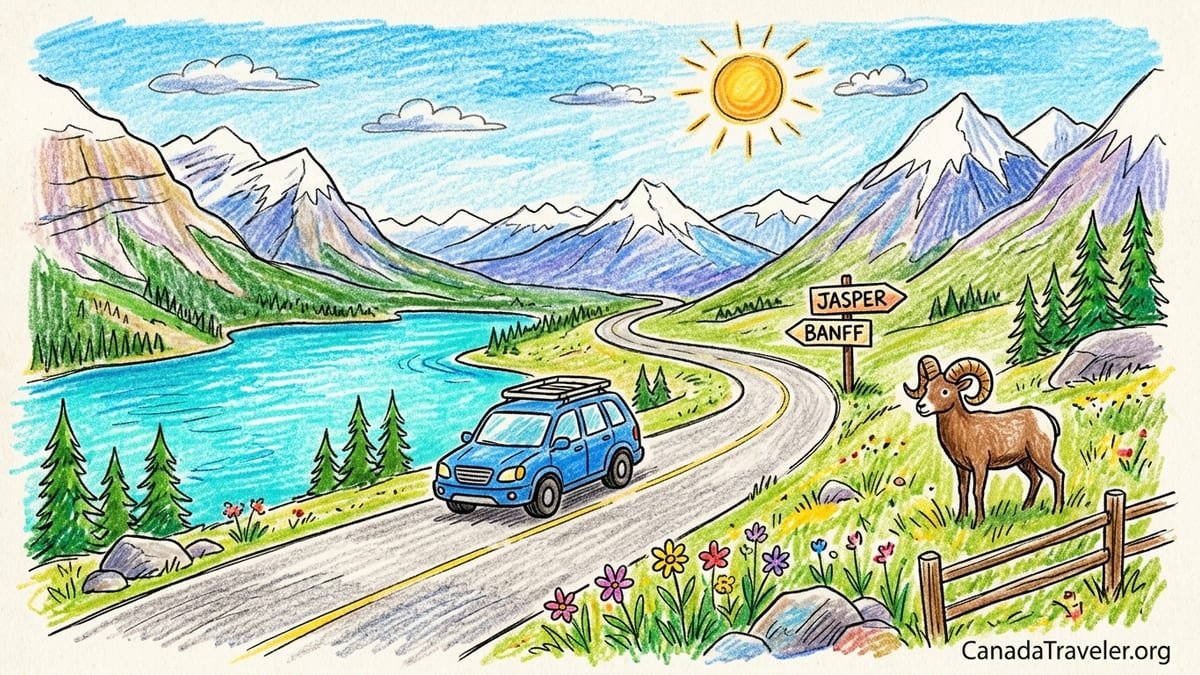
The classic Canadian Rockies road trip links Calgary, Banff, Lake Louise, Jasper and Yoho National Park along some of the most beautiful highways in North America. This guide focuses on the routes travelers actually drive, with practical details on airports, rental cars, fuel, parking, wildlife, winter tires, road closures and connectivity. Use it as a realistic planner, not a bucket-list checklist, and you will spend more time enjoying the mountains and less time fighting logistics.
How Long You Need and the Core Routes Travelers Actually Drive
Most independent travelers build their Rockies trip around one main spine: Calgary to Banff, on to Lake Louise, then up the Icefields Parkway to Jasper. Some return to Calgary the same way, while others continue east to Edmonton. A typical first-time itinerary might be 7 to 10 days, with 2 to 3 nights in Banff or Canmore, 1 to 2 nights near Lake Louise or Field for Yoho, and 2 to 3 nights in Jasper. With less than a week you can still have a satisfying loop Calgary–Banff–Lake Louise–Icefields Parkway–Jasper–Edmonton, but you will be moving most days.
Driving distances are manageable but the scenery slows you down. The town of Banff is about 130 kilometers west of Calgary, usually a 1.5-hour drive without traffic. Lake Louise village is another 45 to 60 minutes beyond Banff. The Icefields Parkway from Lake Louise to Jasper runs for roughly 230 kilometers and can easily take 4 to 6 hours or more with photo stops and short walks. Treat these drives as full or half-day experiences rather than quick transfers.
One-way itineraries are common. A popular pattern is to fly into Calgary, spend several nights in Banff or Canmore, then move to the Lake Louise or Yoho area, continue north to Jasper via the Icefields Parkway, and finally depart from Edmonton. Others prefer a simple return trip, flying in and out of Calgary and backtracking along the parkway. Both approaches work; the better choice depends on flight prices, rental-car fees and how much time you have.
If you are tempted to “do it all” by adding side trips to Kootenay, Kananaskis, the Columbia Valley and more in a single week, remember that each new park adds driving hours and packing days. It is usually better to focus on Banff, Lake Louise, Jasper and perhaps Yoho as an extension rather than trying to tick off every Rocky Mountain park in one enormous loop.
Calgary vs Edmonton Airports and One-Way vs Loop Trips
For most Rockies road trips, Calgary International Airport is the obvious gateway. It is Alberta’s busiest airport and sits around a 90-minute drive from Banff on fast divided highway. Many major North American and European carriers run nonstops into Calgary, and rental car inventory is usually high, which helps if you need an SUV or larger vehicle in summer. For a classic loop, you can arrive and depart from Calgary, visiting Banff, Lake Louise and Jasper before returning south via the Icefields Parkway.
Edmonton International Airport is another option, especially if you find cheaper flights or are combining the Rockies with time in northern Alberta. Edmonton is roughly 4 hours’ drive from Jasper. A common one-way pattern is Calgary to Banff and Lake Louise, up the Icefields Parkway to Jasper, then east to Edmonton to fly out. This avoids backtracking but may add a one-way rental surcharge. Some renters find the fee modest compared with the value of not repeating the same highway; others prefer to save money by returning the car to Calgary.
When comparing airports, look at more than airfare. Factor in rental-car availability, child-seat rentals, pickup and drop-off hours, and potential weather delays. For example, flying into Calgary on a late winter evening and then expecting to drive to Banff in heavy snow after dark can be stressful. You might instead sleep near the airport and start fresh in daylight. In summer, landing early in Calgary often allows you to pick up a car, grab groceries, and still arrive in Banff by early afternoon.
One-way vs loop decisions also affect your daily rhythm. A Calgary round trip gives you the chance to see the Icefields Parkway in both directions, which can be worthwhile because the scenery looks different northbound and southbound. A Calgary–Edmonton one-way lets you keep moving forward, but you will likely only travel the parkway once, so plan plenty of time on that day for stops at Bow Lake, Peyto Lake overlook, Columbia Icefield, Sunwapta Falls and Athabasca Falls.
Rental Cars, Fuel, Parking and Practical Driving Logistics
Almost all visitors self-drive in the Rockies. At Calgary or Edmonton airport, major brands like Enterprise, Avis, Hertz, National, Budget and Alamo offer compact cars, sedans and SUVs. A typical midsize SUV in summer might cost anywhere from a modest daily rate in shoulder season to a significantly higher amount during July and August, when inventory is tight. Booking several months in advance usually yields better choices, especially if you need automatic transmission and snow-capable tires for shoulder-season travel.
For most of late spring through early autumn, a regular car is fine on paved highways such as the Trans-Canada, Highway 1A and the Icefields Parkway. In winter and early spring, a vehicle with good ground clearance and proper winter tires is a safer choice. Rental companies in Alberta generally equip cars with all-season or winter tires in the cold season, but do not assume; confirm explicitly that your vehicle will meet legal winter tire requirements for the period you will drive the Icefields Parkway.
Fuel planning is simple if you pay attention. Gas stations are frequent between Calgary and Banff, and there are stations in Banff, Canmore, Lake Louise village and Jasper. The long gap is between Lake Louise and Jasper on the Icefields Parkway, where you should not expect frequent services. In high season there is fuel at the Saskatchewan River Crossing area and often at or near the Columbia Icefield visitor complex, but prices are higher than in the towns and hours can be limited. Many travelers top up in Lake Louise before heading north and again in Jasper before heading south.
Parking is an everyday consideration. In Banff, popular trailheads and lake areas such as Lake Minnewanka, Johnston Canyon and Lake Louise fill early on peak days. Parks Canada and local operators increasingly use shuttles and parking reservations to manage congestion. As a driver, that means planning your day around early starts or accepting shuttle use for iconic spots like Moraine Lake. In towns like Banff and Jasper, you will find a mix of free time-limited street parking and pay lots. Hotels with underground parking can be a relief in winter, when clearing snow from street-parked cars becomes part of your morning routine.
The Icefields Parkway: Lake Louise to Jasper in Detail
The Icefields Parkway, officially Alberta Highway 93 North, is the highlight of many Rockies road trips. The 230-kilometer stretch between Lake Louise and Jasper threads past glaciers, turquoise lakes and broad river valleys, with frequent pullouts and trailheads. It is a two-lane mountain highway with no towns in between, only a few services at places like Saskatchewan River Crossing and the Columbia Icefield area. Treat it less like a commute and more like an all-day scenic drive with a picnic and layers of clothing ready.
Most travelers drive the parkway in a single day, leaving Lake Louise around mid-morning and reaching Jasper in the late afternoon or early evening. A realistic schedule might include short walks at Bow Lake, the Peyto Lake viewpoint, a stop at the Columbia Icefield visitor complex or one of the icefield viewpoints, and quick visits to Sunwapta Falls and Athabasca Falls closer to Jasper. With this many stops, it is common for the 3-hour pure driving time to stretch to 6 or 7 hours. Families with young children often break the journey with longer lunches at picnic areas so that kids get time out of the car.
Some travelers choose to overnight along the parkway in campgrounds or simple lodging near the Columbia Icefield, which can make sunrise and sunset photography easier and allows slower pacing. If you do this, remember that cell coverage along the Icefields Parkway is essentially nonexistent outside a small area near the Columbia Icefield, and that there are no large supermarkets or pharmacies. You need to bring food, water, basic medicines and warm clothing rather than relying on picking things up along the way.
Weather along the parkway is highly changeable. Even in July, you may leave Lake Louise in mild sunshine and encounter cool, windy conditions and sleet near the Columbia Icefield. On shoulder-season days in May or October, snow squalls can briefly limit visibility and create slushy or icy patches on shaded curves. Build extra time into your schedule, keep your fuel tank comfortably above half, and avoid committing to nonrefundable evening activities on the day you drive the parkway.
Banff, Canmore, Lake Louise and Yoho: How to Structure Stops
Calgary to Banff is the natural first leg. Many travelers either stay in Banff town itself or in the nearby community of Canmore. Canmore sits just outside the national park boundary and often has more apartment-style rentals, supermarkets and a slightly quieter feel. Banff, inside the park, puts you closer to the main sights and shuttles but can be more expensive and busier in high season. A common pattern is to spend 3 or 4 nights in one base, making day trips to Lake Minnewanka, Sunshine Meadows, the Banff Gondola on Sulphur Mountain, and short hikes like Tunnel Mountain.
From Banff or Canmore, many road trippers move to Lake Louise village for a night or two to be close to the big lakes and to reduce early-morning driving. Lake Louise itself and nearby Moraine Lake see intense demand at sunrise and sunset in summer, so staying within a short drive makes sunrise canoeing or early hikes more realistic. Travelers on tighter budgets sometimes stay in the nearby hamlet of Field, just across the provincial border in Yoho National Park, and drive 20 to 30 minutes back and forth to Lake Louise area trails.
Yoho National Park is usually treated as an extension from Lake Louise rather than a separate long stay. The main Yoho valley road and the Emerald Lake and Takakkaw Falls areas can be explored in one or two days of out-and-back drives from Field or Lake Louise. Road access to Takakkaw Falls typically closes in late fall and reopens in late spring, so shoulder-season visitors need to check current conditions before counting on that stop. During peak summer weekends, parking at Emerald Lake and the Natural Bridge fills quickly, so early morning or late afternoon visits help avoid frustration.
If you have more than a week, consider adding a night or two in Kananaskis Country south of Canmore. This provincial-park region offers quieter trailheads and a more local feel than Banff town, though services are fewer. Roads like Highway 40 and Spray Lakes Road provide dramatic scenery within an hour of Canmore, but you should always check for seasonal wildlife closures and be prepared for gravel sections and slower speeds.
Weather, Seasons, Winter Tires and Road Closures
Mountain weather has a mind of its own. In July and August you can expect mild to warm days in the valleys and cool nights, but sudden thunderstorms, hail and brief cold snaps are possible. Shoulder seasons in May, June, September and October can be spectacular, with fewer crowds and golden larch forests, but they also bring a real risk of snow at higher elevations. It is entirely possible to see snow flurries on the Icefields Parkway in late May or early October while the sun shines in Calgary.
From early November through March, the Rockies operate on winter terms. Ice and packed snow are common on roads, daylight is short, and temperatures can drop well below freezing. Alberta regulations require that vehicles traveling the Icefields Parkway between early November and the end of March carry winter-rated tires or chains, defined by symbols such as the three-peak mountain snowflake or M+S markings. Law enforcement and parks staff may turn around vehicles without proper tires during storms, and insurance coverage can be compromised if you ignore regulations.
Road closures are a fact of life in the mountains. Rockfall, avalanches, wildlife incidents and severe weather can temporarily close portions of Highway 1, Highway 93 and access roads like the Yoho valley road. In winter, portions of the Icefields Parkway may close overnight or for longer stretches until crews can safely clear them. Travelers should get in the habit of checking provincial road-condition services before setting out each day, particularly if crossing passes like Bow Summit or heading into more remote areas.
Because conditions shift quickly, it is wise to keep your itinerary slightly flexible. For example, if a storm is forecast for the day you plan to drive Lake Louise to Jasper, you might invert your schedule by spending an extra night in Banff and making the long drive a day earlier or later. Booking fully prepaid, nonchangeable accommodations on every single night can backfire if a closure forces a detour or delay.
Wildlife on the Roads, Mobile Coverage and Staying Safe
Wildlife sightings are one of the joys of a Rockies road trip, but they also demand careful driving. Elk, deer, bighorn sheep and mountain goats frequently appear on or near highways, especially at dawn and dusk. In some areas you may see cars pulled over with people photographing a roadside bear. While it can be tempting to join them, stopping abruptly or crowding animals is dangerous and discouraged. It is safer to continue to the next proper pullout, turn around if legal, and only stop where your car is fully off the travel lane.
Speed limits on park highways are lower than many visitors expect, often around 90 kilometers per hour or less, with reduced zones near junctions, wildlife crossings and viewpoints. Fines for speeding in national parks are significant, and more importantly, higher speed greatly increases the risk of serious wildlife collisions. At night, especially in shoulder seasons, you should slow down and use high beams when appropriate, since animals can be hard to see until they are close.
Mobile coverage is good in Calgary, Canmore, Banff town, Lake Louise village and Jasper, but drops off quickly between these communities. Along the Icefields Parkway and parts of Yoho and Kootenay, there may be no cellular service at all for long stretches. That reality affects how you navigate and handle emergencies. Download offline maps before you leave town, carry a paper map from a visitor center or fuel station, and do not rely on ride-hailing or food-delivery apps once you are in the parks.
For emergencies inside the national parks, you can usually dial 911 when you have a signal, but you should not assume that help can be contacted instantly from every trailhead or roadside pulloff. Some travelers rent a satellite messenger or satellite phone, especially in winter or if they plan day hikes far from town. At the very least, tell someone your daily route, keep extra warm clothing, water and snacks in the car, and avoid driving with less than a quarter-tank of fuel in remote sections.
Putting Route Variations Together Without Overloading Your Trip
There is no single perfect Rockies road trip, but there are patterns that work particularly well. For a 7-day one-way itinerary, a realistic plan might be: arrive Calgary, overnight in Calgary or Canmore; 2 nights in Banff; 1 night near Lake Louise or Field for Yoho; 2 nights in Jasper; then drive to Edmonton for a final night near the airport. This gives you time for at least one flexible weather day and avoids repeating the Icefields Parkway. It works especially well if flight prices to Calgary and from Edmonton are similar.
For a 7- to 10-day round trip from Calgary, you might spend 3 nights in Banff or Canmore, 2 nights in Lake Louise or Field, 2 or 3 nights in Jasper, then drive back to Banff or Canmore for a final night before returning to Calgary. The advantage is seeing the Icefields Parkway twice, once in each direction, and having more flexibility if weather or closures affect the highway on one of the days. You also avoid one-way rental fees, which can be meaningful for longer rentals or larger vehicles.
If you want to include Kananaskis, consider trimming your town nights rather than overextending your driving. For example, a 9-day loop might look like: night 1 in Kananaskis, nights 2 and 3 in Banff, night 4 in Lake Louise, nights 5 and 6 in Jasper, night 7 in Lake Louise or Field again, and nights 8 and 9 in Calgary for urban exploring and a relaxed departure. This way, you experience both a quieter provincial-park feel and the national-park hubs without driving every day.
The main planning error first-time visitors make is scattering one-night stays across too many towns: a night in Calgary, a night in Canmore, a night in Banff, a night at Lake Louise, a night in Field, and so on. Each move costs packing time and check-in logistics. It is often better to choose a few hubs and use them as bases for day trips. With Banff or Canmore, Lake Louise or Field, and Jasper as your anchors, you can see a great deal of the Rockies while still enjoying unhurried mornings and evenings.
The Takeaway
A Canadian Rockies road trip is less about ticking off every possible valley and more about choosing a realistic route and pace. Focus first on the spine that most travelers use: Calgary, Banff or Canmore, Lake Louise, the Icefields Parkway and Jasper, with Yoho and Kananaskis as thoughtful extensions rather than mandatory detours. Decide early whether you prefer a simple Calgary loop or a Calgary–Edmonton one-way, and check how that choice affects flight costs and rental-car options.
Once your broad route is set, pay attention to seasonal details that shape the experience: winter tire rules, likely weather, wildlife on the roads, expected mobile dead zones and the limited services along the Icefields Parkway. Carry offline maps, build flexibility into your schedule, and resist the temptation to drive every day. With a bit of planning and realistic expectations, the highways between Calgary, Banff, Jasper and Yoho become less of a logistical puzzle and more of the scenic backdrop to a memorable, self-directed journey.
FAQ
Q1. Is it better to start a Canadian Rockies road trip in Calgary or Edmonton?
Calgary suits most travelers because it is closer to Banff and Lake Louise, which are usually first priorities. Edmonton can work well for one-way trips that end or begin near Jasper, especially if flights are cheaper or you have plans in northern Alberta.
Q2. How many days do I need for Calgary, Banff, Lake Louise and Jasper?
A comfortable minimum is about 7 days, which allows 2 to 3 nights in Banff or Canmore, 1 to 2 nights near Lake Louise or Yoho, and 2 to 3 nights in Jasper. With 10 days you can add a night in Kananaskis or extra time in your favorite base.
Q3. Do I need a 4x4 or SUV to drive the Icefields Parkway?
In summer and early autumn, a regular car with good tires is fine on the paved parkway. In winter and early spring, an SUV with proper winter tires or chains provides more security, but the critical factor is having legally compliant winter-rated tires rather than four-wheel drive alone.
Q4. Are there gas stations between Lake Louise and Jasper?
Services on the Icefields Parkway are limited. You will generally find fuel in Lake Louise and Jasper, and seasonally at Saskatchewan River Crossing and near the Columbia Icefield complex. It is wise to fill up before leaving either town so you are not dependent on a single remote station.
Q5. Will I have mobile phone service on the Icefields Parkway?
Expect long stretches with little or no mobile coverage along the Icefields Parkway and parts of Yoho and Kootenay. You will have good service in Calgary, Canmore, Banff, Lake Louise village and Jasper. Download offline maps and carry a paper map as backup, especially in winter or shoulder seasons.
Q6. When are winter tires legally required in the Canadian Rockies?
On the Icefields Parkway, winter tires or chains are generally mandatory from early November through late March, and may be required any time the road is snow or ice covered. Exact dates and requirements can change, so you should check current provincial and Parks Canada guidance before your trip.
Q7. What is the best time of year for a self-drive Rockies trip?
Late June through early September offers the most reliable weather, long daylight and fully open facilities, but also the biggest crowds and highest prices. May and October can be beautiful and quieter, though some roads, campgrounds and lake-access areas may be closed or operating on reduced schedules, and early snow is possible.
Q8. How do I avoid parking problems at Lake Louise and Moraine Lake?
Parking lots at Lake Louise and, historically, at Moraine Lake fill very early in peak season. The most practical strategies are to use official shuttle systems where required, visit outside the busiest midday hours, and consider staying in Lake Louise village or nearby Field to shorten pre-dawn drives.
Q9. Is it safe to drive with wildlife on the roads?
It is safe if you drive cautiously. Obey speed limits, be especially alert at dawn and dusk, and avoid stopping in travel lanes to watch animals. Use pullouts where you can get fully off the road, and never feed or approach wildlife, even if other visitors are doing so.
Q10. Can I visit Banff, Jasper and Yoho in one short trip?
You can physically reach all three in as little as 5 or 6 days, but it will feel rushed with many hotel changes. For a first visit, most travelers are happier focusing on Banff or Canmore, Lake Louise and Jasper, then adding Yoho as a day-trip extension rather than trying to give each park several separate nights.