


Picking the wrong base in the Canadian Rockies can quietly steal hours from every day of your trip. The distances between Banff, Canmore, Lake Louise, Jasper, Golden and Kananaskis look manageable on a map, but once you factor in traffic, wildlife slowdowns and irresistible roadside viewpoints, a “quick” drive can turn into a two-hour commute. This guide focuses on how each base actually works in real life, so you can decide whether to stay in one place or split your time between Banff or Lake Louise and Jasper for a smoother, less stressful Rockies itinerary.
Understanding Distance, Driving Time and Park Access
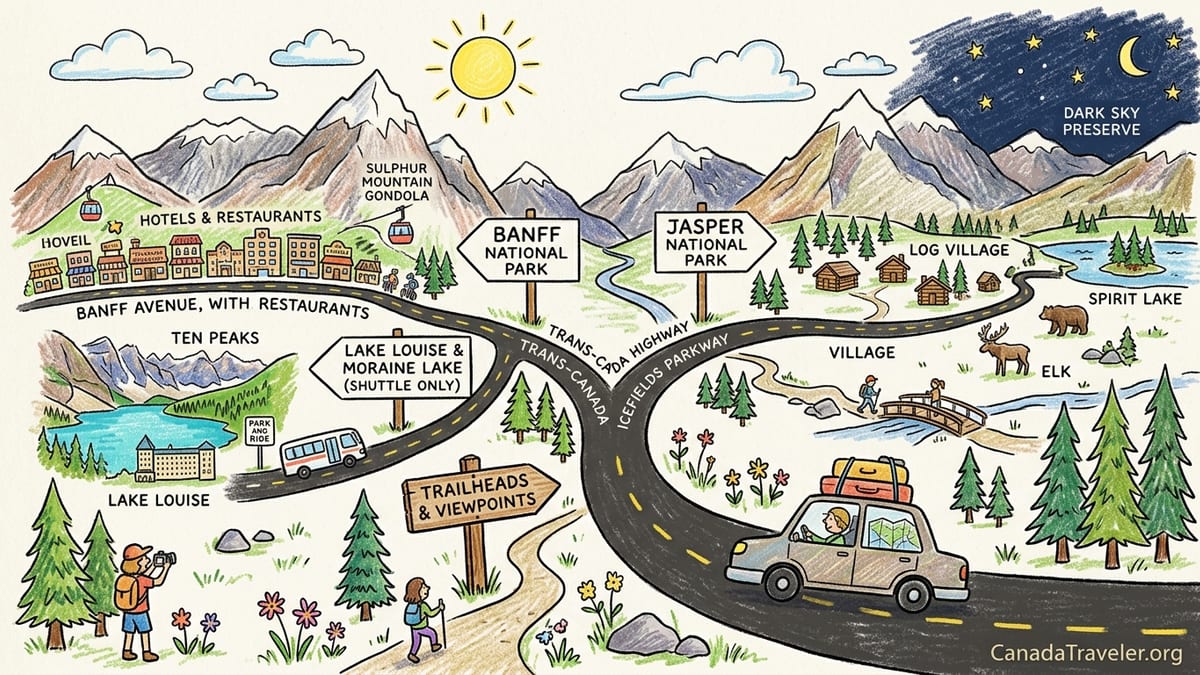
The Canadian Rockies are linear. The Trans-Canada Highway and the Icefields Parkway run like a spine through the mountains rather than in a loop, which matters when you are choosing where to sleep. Banff town is about 90 minutes west of Calgary International Airport in normal traffic. From Banff it is roughly 40 minutes to Lake Louise, another 40 minutes to the Alberta–British Columbia border near Yoho National Park, and about 3 hours along the Icefields Parkway to Jasper if you drove without stopping, which almost nobody does.
Those numbers matter because popular sights are spread out. Iconic lakes such as Moraine Lake and Lake Louise sit closer to the Lake Louise village area than to Banff. Signature Jasper spots such as Maligne Lake or Pyramid Lake are another 45 minutes or more beyond Jasper town if you include stops. If you stay in Canmore to save money, you add about 25 to 35 minutes of driving each way to reach central Banff, more in peak summer when traffic is heavy at the park gates. Over a four or five day trip, that can mean an extra five or six hours in the car.
Road conditions and parking rules add another layer. In recent years, Moraine Lake access has moved to shuttle- and tour-only in peak season, which means early shuttle departures from Lake Louise or the Lake Louise Ski Resort park-and-ride. If you base yourself in Banff or Canmore, catching a 6:30 a.m. shuttle departure can mean a pre-dawn alarm and an hour of driving before you even join the line. Likewise, if you stay in Banff or Lake Louise and insist on day-tripping to Jasper and back, you are looking at 6 to 8 hours behind the wheel in a single day once sightseeing stops are included.
Park passes are required for every day you spend in Banff, Yoho, Kootenay or Jasper national parks, no matter where you sleep. Staying in Canmore, Golden or Kananaskis does not exempt you from the pass if you drive into the parks. The practical takeaway is simple: pick a base that aligns with most of your planned hikes and viewpoints so you are driving to trailheads, not chasing them from the highway all week.
Banff: Lively Hub With Premium Prices
Banff town is the closest thing the Rockies have to a small city. Banff Avenue is lined with hotels, restaurants, bars and gear shops, and the surrounding valley delivers instant mountain drama. Visitors who want the classic Rockies experience with minimal logistics often base entirely in Banff for three to five nights and use it as a hub for Lake Minnewanka, Sulphur Mountain, Sunshine Village, and day trips toward Lake Louise and Yoho.
Hotel rates in Banff, particularly between late June and early September, are among the highest in the region. Standard hotel rooms under the 250 Canadian dollar mark per night in peak season are rare, and many centrally located properties run far higher. Historic resorts such as the Fairmont Banff Springs or modern suites hotels along Banff Avenue command premium rates but offer on-site restaurants, lounges, spas and easy access to local shuttles. Travelers on tighter budgets often look at older motels a few blocks off the main strip or shared hostels on the edge of town to stay closer to the action without committing to resort prices.
Banff’s restaurant and nightlife scene is unmatched in the Rockies. You can find everything from casual pizza and burgers to higher-end tasting menus and cocktail bars. Banff Avenue and Bear Street stay lively into the night, especially on weekends. For some travelers that buzz is a highlight. For others, especially those seeking a quiet mountain evening after long hikes, the noise and foot traffic can feel more resort town than wilderness village.
Parking in Banff is manageable but not effortless. Paid town parking has become more common, and popular trailheads near Banff, such as Johnston Canyon, can fill early on summer mornings, pushing late arrivals to remote lots and shuttle buses. The advantage of staying in town is that many local shuttle routes start or stop there, reducing the need to hunt for parking at ultra-busy spots. If your priority is convenience and amenities and you are willing to pay for them, a Banff base makes sense for a first visit, especially for shorter trips focused mainly on Banff National Park south of Lake Louise.
Canmore: Better Value and Everyday Comforts
Canmore sits just outside the eastern gate of Banff National Park. It looks and feels more like a real mountain town than a resort bubble, with year-round residents, schools and local services. For many visitors, particularly those staying 5 to 10 nights or traveling with families, Canmore’s combination of lower prices, larger condos and quieter evenings is compelling even though it requires extra driving time into the park.
Accommodation options in Canmore skew toward condo-style hotels and vacation rentals. It is common to find one- or two-bedroom suites with kitchenettes and laundry for prices similar to or slightly lower than a basic hotel room in Banff. For example, a two-bedroom condo with kitchen and parking in high summer may run somewhere in the mid-200s to low-300s per night in Canadian dollars, while a comparable space in Banff would often push higher. That difference adds up quickly on a week-long stay, especially for families or groups who appreciate the ability to cook some meals.
Canmore’s dining scene is strong for its size, with locally focused cafes, bakeries and a growing number of craft breweries and relaxed restaurants. Nightlife is far more subdued than Banff. You will find busy patios on warm evenings and occasional live music, but few venues that run into the early hours. For many travelers that quieter atmosphere is a plus, and the views of the surrounding peaks from town are no less impressive than those from Banff’s streets.
The major trade-off with Canmore is time. The drive to Banff town is typically around half an hour in good conditions, but morning traffic through the park gates and construction can add to that. If you are chasing sunrise at Lake Louise or catching the earliest shuttle to Moraine Lake from the Lake Louise staging area, staying in Canmore means a very early start, often well before 4:30 or 5 a.m. on high-summer dates. As a base for trips that mix park days with rest days, remote work or non-park activities, Canmore works beautifully. As a launchpad for daily dawn-to-dusk sightseeing in Banff and Lake Louise, the time cost may become frustrating.
Lake Louise: Best for Iconic Lakes and High-Elevation Hiking
The Lake Louise area is small, expensive and incredibly strategic. A handful of hotels and lodges cluster near the highway junction and the lakes themselves, meaning you can be standing on the Lake Louise lakeshore or boarding a Moraine Lake shuttle in minutes instead of an hour or more. For hikers targeting high-elevation trails such as the Plain of Six Glaciers, Lake Agnes, or the Paradise Valley, or for those wanting to be close to the Lake Louise Ski Resort in winter, this location is hard to beat.
Accommodation in Lake Louise is limited and commands some of the highest rates in the Rockies. At the top end are grand lakeside properties that can easily run well into the high hundreds per night in summer, particularly for lake-view rooms. More modest hotels and hostels near the village and highway offer somewhat lower prices but still tend to cost more than similar-quality rooms in Canmore or Golden. Budget-focused visitors often compromise by staying two nights in Lake Louise to secure easy access to the famous lakes, then shifting to a more affordable base for the remainder of their trip.
Dining options in Lake Louise are far fewer than in Banff. Most restaurants are attached to hotels or lodges, with a mix of casual and upscale menus that understandably price in their remote location and limited competition. Nightlife is minimal. After dinner, most visitors retreat to hotel lounges, stroll the lakeshore or simply rest for early starts the next day. For travelers seeking solitude and dawn photography sessions on the lakes, this quiet rhythm is a feature, not a bug.
Parking pressure here is intense. Lake Louise lakeshore lots frequently fill early in the morning in peak season, and Moraine Lake has moved to a model that relies on shuttles, tours or approved commercial transport rather than private vehicles. Basing in Lake Louise significantly reduces the time and stress involved in reaching those shuttles and sunrise viewpoints. For trips heavily focused on the postcard lakes and nearby hikes, mixing at least two nights in Lake Louise with time in Banff or Jasper often produces the most pleasant overall experience.
Jasper: Quieter Wilderness and Long Drives
Jasper town sits at the northern end of the Icefields Parkway, surrounded by Jasper National Park’s peaks and lakes. Compared with Banff, Jasper feels more low-key and lived-in, with fewer large hotels and more small motels, cabins and family-run lodges. Travelers who prioritize wildlife viewing, long hikes, dark-sky stargazing and a slower pace often prefer Jasper as their primary base, even if they still pass through Banff on the way.
Driving the Icefields Parkway between Lake Louise and Jasper is a highlight of almost every longer Rockies trip. The route takes about 3 hours point-to-point in ideal conditions, but many travelers spend 6 to 8 hours stopping at places such as Bow Lake, Peyto Lake viewpoints, the Columbia Icefield area, Sunwapta Falls and Athabasca Falls. That reality is why trying to “do Jasper in a day” from Banff or Lake Louise rarely makes sense. A return day trip can push beyond 8 hours of driving before you add trail time or glacier tours, which leaves many visitors exhausted and frustrated.
Accommodation in Jasper covers a wide range, from in-town motels and small hotels to cabin-style lodges along the Athabasca River or at lakes such as Patricia, Pyramid or Lac Beauvert. Prices are still high by many travelers’ standards and can climb into the mid or high-200s per night and beyond in summer for standard rooms, but they are often slightly lower than Banff’s top-tier rates. Cabins or chalets a short drive from town can deliver more space and a stronger sense of wilderness at similar price points to compact hotel rooms near Banff Avenue.
Restaurants in Jasper are generally smaller and more casual than in Banff. Expect independent cafes, diners, pubs and a few higher-end options rather than a strip of cocktail bars. Nightlife is limited, but many visitors spend their evenings along the river, on lakeside docks or at campgrounds instead. For those who prefer stars over streetlights, Jasper’s status as a dark-sky preserve is a major plus. The main trade-off is distance: if your primary wish list revolves around Lake Louise, Moraine Lake and Banff’s gondolas, Jasper alone is too far. If you have at least six or seven nights, splitting your time between the Banff–Lake Louise corridor and Jasper lets you enjoy each region without wasting days in the car.
Golden and Kananaskis: Smart Alternatives in the Right Itinerary
Golden, in British Columbia, and the Kananaskis region in Alberta do not sit inside the core national park corridor, but both are increasingly popular bases for travelers seeking better value, less crowded hiking and a different perspective on the same mountain ranges. They are not ideal substitutes for a first-time, parks-focused visit, but they can work well when combined with a shorter stay in Banff, Lake Louise or Jasper.
Golden lies to the west of Lake Louise, in the Rocky Mountain Trench near the confluence of the Columbia and Kicking Horse rivers. From Golden, it is roughly 45 minutes to an hour to Lake Louise, depending on traffic and construction, which makes it a reasonable base for Yoho National Park highlights such as Emerald Lake, Takakkaw Falls and the Kicking Horse River canyon. Accommodation in Golden ranges from motels around the highway to chalets along the Kicking Horse Mountain Resort access road and small inns in town. Prices are often noticeably lower than in Banff or Lake Louise for similar or larger rooms, and many properties include free parking without the town-centre congestion you find in Banff.
Kananaskis Country, southeast of Canmore, is a region of provincial parks and recreation areas with fewer crowds and no need for a federal park pass. Several resort-style hotels and lodges cluster near the main valley and along access roads to ski areas. These properties often appeal to visitors who want spa facilities, fine dining and mountain scenery without Banff’s busier streets. Hiking in Kananaskis tends to feel wilder and less busy, though parking lots at popular trailheads can still fill early on summer weekends. If your plan is to combine a couple of Banff and Lake Louise days with quieter hikes and resort downtime, splitting nights between Banff or Canmore and a Kananaskis lodge can work very well.
The main caution with both Golden and Kananaskis is simple geography. Using either town as your sole base for a short trip that aims to cover Banff, Lake Louise, Moraine Lake and Jasper will mean repeated long drives. For instance, a visitor staying in Golden who wants to hike near Banff one day and join a Columbia Icefield tour the next may face two consecutive mornings of two or more hours of driving each way. Over a week this adds up, so these alternatives are best if you plan to focus your activities in their immediate surroundings, with only occasional forays into the busier parks.
How to Choose: One Base or Split Between Banff/Lake Louise and Jasper
The choice between one base and a split stay comes down to time, interests and tolerance for driving. If you have three or four nights total and your must-see list focuses on Lake Louise, Moraine Lake, Banff town and short scenic hikes, staying entirely in Banff or splitting between Banff and Lake Louise for a night or two is usually the simplest solution. You minimise packing and unpacking, save the Icefields Parkway for a future trip and keep most daily drives under an hour round-trip outside of special outings.
Once you reach six or seven nights, a split stay begins to make clear sense. A common pattern is three nights in Banff or Canmore, two nights in Lake Louise and two or three nights in Jasper, with the Icefields Parkway drive effectively becoming a full-day sightseeing transfer between bases. This approach turns what would otherwise be repetitive long-haul day trips into scenic travel days. You check out of one hotel in the morning, explore waterfalls, short trails and viewpoints en route, then check into your next base in late afternoon without backtracking.
Families with younger children or travelers who dislike frequent check-ins might instead choose just two bases. For example, four nights in Canmore followed by three in Jasper delivers both affordability and variety, with a single big driving day along the Icefields Parkway in the middle. Conversely, couples visiting for a special occasion might prioritize views and convenience by booking two or three nights at a lakeside hotel in Lake Louise and several more in Banff or Jasper, accepting higher nightly rates in exchange for being able to walk to sunrise views or evening restaurants.
What does not work as well in practice is using a single base in Canmore, Golden or Kananaskis to day-trip everywhere from Banff to Jasper in a short timeframe. Over and over, visitors who attempt this report feeling rushed, tired and pressed for daylight, especially if they are also trying to squeeze in sunrise and sunset photography. When distances are measured in hours rather than minutes, choosing at least two strategic bases often transforms the same itinerary from a series of road sprints into a relaxed mountain holiday.
The Takeaway
Where you stay in the Canadian Rockies will shape every day of your trip more than almost any other choice you make. Banff offers the fullest menu of hotels, restaurants and nightlife at the highest prices and with the most visitors. Canmore softens the cost and crowds at the price of extra drive time. Lake Louise places you at the doorstep of the region’s most famous lakes but limits your restaurant and nightlife choices. Jasper rewards those willing to venture farther with quieter trails, darker skies and a more local feel. Golden and Kananaskis, used carefully, can add value and variety but rarely replace the national park hubs for first-time visitors.
Before you book, list your non-negotiables: particular hikes, iconic lakes, wildlife viewing, stargazing, spa time, lively dinners or quiet cabins. Then match them to the practical realities of each base: average nightly budget, desired driving time, available parking and park access. For many travelers, a split stay between the Banff–Lake Louise corridor and Jasper delivers the best of both worlds. For shorter trips, one or two well-chosen bases close to your main priorities will keep the focus where it belongs: on mountain air, glacier-fed lakes and time spent outside rather than in the car.
FAQ
Q1. If I only have three nights in the Rockies, should I try to visit both Banff and Jasper?
With only three nights, it is usually better to focus on Banff and the Lake Louise area. Trying to include Jasper adds at least one long day of driving along the Icefields Parkway and leaves little time to explore either region on foot.
Q2. Is Canmore too far from Banff to use as a base?
Canmore is about 25 to 35 minutes by car from Banff in normal conditions, so it works well as a base if you are comfortable with that daily drive. For early-morning starts to Lake Louise or Moraine Lake, it can feel far, so consider at least one or two nights closer to those lakes if sunrise views are important.
Q3. How many nights should I spend in Jasper?
For travelers driving the Icefields Parkway and wanting to experience Jasper’s lakes and hikes, two to three nights is a good minimum. That allows time for the road-trip transfer day, one full day around Jasper’s lakes and canyons, and perhaps a second day for a longer hike or wildlife viewing.
Q4. Is Golden a good alternative to Lake Louise?
Golden can be a smart alternative if you primarily want to explore Yoho National Park and are comfortable driving 45 minutes to an hour to reach Lake Louise. It offers better-value accommodation and easier parking, but it is not ideal as your only base if you also plan to spend multiple days in Banff and Jasper.
Q5. Are hotels really that expensive inside the parks?
In peak summer, nightly rates in Banff, Lake Louise and Jasper are often significantly higher than in Canmore, Golden or nearby towns. Finding standard rooms under roughly 250 Canadian dollars per night right downtown can be difficult, and resort or lakeside properties frequently cost much more. Booking early and mixing park stays with nights in more affordable bases helps manage costs.
Q6. Do I need a car, or can I rely on shuttles and tours?
You can visit many classic sights using shuttles and tours from Banff or Lake Louise, but having a car provides more flexibility for early starts, sunset stops and quieter trailheads. In Jasper and around Golden, public transport is limited, so a car is strongly recommended if you want to explore independently.
Q7. When does it make sense to split between Banff or Lake Louise and Jasper?
Once your trip reaches six or seven nights, splitting between the Banff–Lake Louise corridor and Jasper usually delivers a better experience than staying in one place. You can turn the Icefields Parkway into a full-day scenic transfer rather than a rushed out-and-back drive and reduce daily driving to more manageable distances.
Q8. Is Kananaskis a good substitute for Banff?
Kananaskis offers beautiful scenery, strong hiking and often quieter trails, but it is not a full substitute for Banff if you want the famous lakes, gondolas and town atmosphere. It works best as a complement, perhaps two or three nights at a Kananaskis lodge combined with several nights in Banff or Canmore.
Q9. How early do I need to start to see sunrise at Lake Louise or Moraine Lake?
In mid-summer, sunrise at these lakes can be very early, and parking or shuttle departures fill fast. Staying in Lake Louise or nearby cuts pre-dawn travel to minutes, whereas starting from Banff or Canmore may require leaving well before 4:30 or 5 a.m. on busy days.
Q10. What is the best base for travelers who care more about restaurants and nightlife than hiking?
Banff town is the best match for visitors who prioritise a wide range of restaurants, bars and evening activities. You can still access scenic viewpoints and short walks during the day, then return to a lively main street at night, something the smaller and quieter bases cannot replicate to the same degree.