


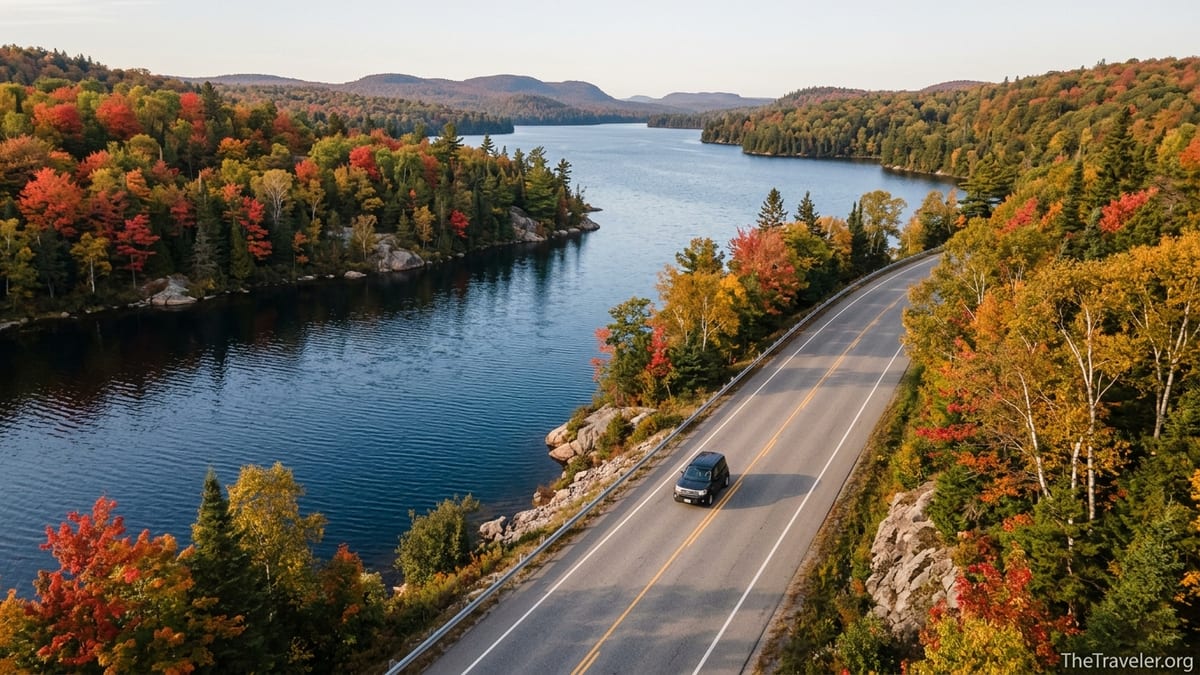
Few trips feel as perfectly matched to a season as an autumn road trip through Eastern Canada. Between late September and mid October, forests in Ontario and Quebec ignite in shades of red, orange and gold, wrapped around clear lakes, river valleys and historic cities. With a bit of planning, you can time a route that hits classic foliage corridors like Algonquin Provincial Park, the Laurentians and the Eastern Townships, then decide whether to push on toward the famed Cabot Trail in Nova Scotia. This guide walks you through when to go, how to structure an Ontario to Quebec fall loop, where to stay, and what to consider before extending toward Atlantic Canada.
When to Go: Understanding Peak Fall Foliage in Eastern Canada
In Eastern Canada the color change moves from north to south and from higher to lower elevations over several weeks. In a typical year, the first strong reds begin showing in late September in northern and higher elevation areas such as Algonquin Provincial Park in Ontario and Parc national de la Jacques Cartier near Quebec City. Historical park data for Algonquin shows the average peak of maple color tends to fall in the last week of September, with good viewing often lingering into the first days of October, although weather patterns can shift this by about a week earlier or later in any given year.
Further south, regions such as the Laurentians, Charlevoix and the Eastern Townships in Quebec often peak between roughly September 25 and October 20, with earlier color in the higher Laurentian mountains and slightly later, more drawn out color in the gentler Eastern Townships. Recent foliage planning guides for Eastern Canada self drive itineraries suggest Quebec City and Jacques Cartier Park are usually at or near peak from around late September into early October, while the Eastern Townships and lower Laurentian foothills often look their best in the second week of October and occasionally into the third, especially in years with a slow, cool fall.
Ontario’s southern and more urban areas change later. Around Ottawa and the upper stretches of the Ottawa Valley, travelers commonly find good color in early to mid October. Across Eastern Ontario destinations such as the Rideau Lakes or the Thousand Islands area near Kingston, regional foliage roundups often point to mid October as a typical peak window, with some color hanging on into the third week of October. If your primary goal is classic maple color around cities and lakes rather than the earliest show in the highlands, dates around the Canadian Thanksgiving long weekend, which usually falls in the second week of October, are a good planning anchor.
If you are considering adding Atlantic Canada to your loop, it is helpful to know that peak color in Nova Scotia’s Cape Breton Highlands usually hits in the first half of October, especially around the highlands that frame the Cabot Trail. Provincial and regional tourism guides describe a six week foliage season from mid September to late October, with the most intense color along the Cabot Trail often appearing from late September to roughly the Canadian Thanksgiving period. This means an Ontario and Quebec loop and a Cabot Trail side trip can both be timed for broadly the same two to three week window if you are willing to cover some longer distances.
Core Route: Building an Ontario and Quebec Fall Foliage Loop
For most travelers flying into Eastern Canada, Toronto or Montreal are the easiest starting points. A classic one to two week foliage loop begins in Toronto, runs northeast through cottage country toward Algonquin Provincial Park, then bends southeast to Ottawa, east to Montreal and the Laurentians, and finishes in Quebec City and the nearby valleys before looping back or flying home from there. Commercial self drive itineraries marketed for fall colors often frame this as an eight to ten day trip linking Toronto, Algonquin, Kingston and the Thousand Islands, Montreal, the Laurentians and Quebec City, balancing city time with lake and forest days.
A practical ten day version might look like this. Days one and two: explore Toronto’s neighborhoods and waterfront parks, where trees in places like High Park and the Don Valley usually start turning by late September into early October. Day three: drive roughly three hours north to Huntsville or Dwight on the edge of Algonquin Provincial Park, a distance of about 280 kilometers from downtown Toronto depending on route, using the town as a base to explore Highway 60, the major corridor that cuts east-west through Algonquin’s lakes and lookouts. Day four: spend another day hiking short trails or renting a canoe on one of the quieter lakes off the park road.
From Algonquin, many itineraries swing southeast toward Ottawa and the St Lawrence corridor. Day five could involve a four to five hour drive to Ottawa, Canada’s capital, where the slopes around the Ottawa River and nearby Gatineau Park in Quebec offer wide valley views and roadside lookouts in early to mid October. Gatineau Park is frequently cited in Ontario foliage guides as a must visit spot that complements Algonquin, and being only about 20 minutes from downtown Ottawa it fits easily into a one or two night stay. Day six and seven can then carry you down to Montreal in about two hours of driving, perhaps routing via the Thousand Islands region near Kingston for a cruise among tree lined islands if time allows.
Linking Montreal and Quebec City is straightforward, with under three hours of highway between them. Many commercial Eastern Canada road trip itineraries pair two nights in Montreal with two or three in Quebec City, giving time for side trips to the Laurentian mountains to the north or the agricultural landscapes and small towns along the St Lawrence River. A rental car makes it easy to drive north from Montreal to resort villages like Mont Tremblant, a roughly 1.5 to 2 hour drive depending on traffic, or to follow quieter back roads through the wine country and orchards of the Eastern Townships southeast of the city. East of Quebec City, day trips toward Charlevoix or to provincial parks like Jacques Cartier can fill out a three night stay with a mix of hiking, river valley viewpoints and historic old town walks back in the city after dark.
Ontario Highlights: Algonquin, Ottawa Valley and Eastern Ontario
Algonquin Provincial Park remains the single most famous fall foliage destination in Ontario, and for many travelers it is the visual centerpiece of an Eastern Canada fall road trip. The Highway 60 corridor, a roughly 56 kilometer section cutting through the south end of the park, concentrates many of the best short hikes and viewpoints. Popular stops like the Lookout Trail, a three kilometer loop, offer sweeping views over hardwood ridges that typically burn bright red and orange in late September. Canoe rentals at outfitters near access points such as Canoe Lake give visitors a chance to see the color mirrored in still water, although cooler nights and occasional frost mean that earlier autumn weeks often feel more comfortable for paddling.
Around the park, small communities such as Huntsville, Dwight and Whitney provide accommodation that can be broadly grouped into lakeside resorts, rustic lodges and cabin rentals, and budget friendly motels. In high season, typical nightly rates for simple motels can rise into the mid range, while lakeside resorts and higher end lodges frequently price in the upper band of what you might expect in rural Ontario, particularly on Canadian Thanksgiving weekend. Bookings often open months in advance and sell out quickly once foliage forecasts and social media photos begin circulating in late summer, so reserving lodging by midsummer is wise if you are aiming for the last week of September or the first week of October.
Beyond Algonquin, the Ottawa Valley and Eastern Ontario offer quieter but rewarding foliage drives. East of Algonquin, back roads around Barry’s Bay and the Madawaska Valley combine rolling farmland with forested hills that show off mixed hardwood color in early October. Farther south, Eastern Ontario travel guides highlight routes around the Rideau Canal and Rideau Lakes region as pleasant mid October drives, with village main streets, stone lockstations and farm stands selling apples and pumpkins set against yellow and orange maple stands. Near Kingston and Gananoque, many Thousand Islands boat tours continue operating into October, allowing visitors to see tree covered islands from the water while crowds are smaller than in midsummer.
In and around Ottawa itself, Gatineau Park on the Quebec side of the river acts as a natural extension of an Ontario trip. Overlooks like Champlain Lookout can get busy on peak weekends, but they deliver a classic Eastern Canada scene: river valleys framed by bands of orange and red forest stretching to the horizon. Because the park is so close to the capital, you can base yourself in an urban hotel near Parliament Hill and treat the foliage drives and hikes as half day side trips, returning to restaurants and museums in the evening. This balance of outdoor color and city comforts is one of the main reasons many first time visitors choose to include Ottawa on an Ontario and Quebec fall route.
Quebec Highlights: Laurentians, Eastern Townships and Quebec City Region
Quebec’s combination of mountain landscapes and historic river cities makes it exceptionally well suited to an autumn road trip. North of Montreal, the Laurentian mountains rise as a chain of rounded hills dotted with lakes and ski villages. Towns like Saint Sauveur and Mont Tremblant transform in late September and early October as surrounding forests change color. Mont Tremblant in particular is a popular base, with gondola rides offering easy access to summit viewpoints and short hiking trails that look down over a patchwork of lakes and forests. Travel planners often note that some of the earliest and most intense color near Montreal appears here, so if your dates are in very late September this is a good first stop.
Southeast of Montreal, the Eastern Townships offer a gentler but equally rewarding landscape of vineyards, orchards and low wooded hills. Regional fall foliage resources describe the Townships as having a hardwood mix that produces saturated oranges and reds, with peak displays commonly occurring through much of October. Small towns such as Sutton, Magog and Bromont mix cafes, inns and local markets with easy access to nature. Ski hills like Mont Orford and Mont Sutton often operate chairlifts for sightseeing on autumn weekends, and some also publish live summit webcams to help travelers judge color progression. For many visitors the Townships feel more pastoral and less crowded than the Laurentians, making them a good choice for slower paced drives that combine foliage viewing with wine tasting or cider sampling.
Around Quebec City, foliage highlights center on river gorges and dramatic viewpoints. Parc national de la Jacques Cartier, about a 30 minute drive north of the city, is one of the province’s signature autumn destinations. The deep glacial valley, carved by the Jacques Cartier River, is flanked by forested cliffs that turn strong shades of yellow and orange, and hiking trails such as the popular Les Loups route climb to panoramic lookouts over the river corridor. Guides to the park note that weekends from late September through Thanksgiving see particularly heavy visitation because of the foliage, so midweek visits or early starts can make a noticeable difference in crowd levels.
East along the St Lawrence, the Charlevoix region and the stretch of coast toward Tadoussac offer a different feel again, with fjord like inlets, small villages and viewpoints above the river. While this area is slightly beyond a tight one week loop, travelers with ten to twelve days often add one or two nights somewhere between Baie Saint Paul and La Malbaie to combine fall color with coastal scenery and, in some cases, whale watching excursions that still run into October. Roads in this region are winding and hilly in places but generally in good condition, and traffic levels, while higher on holiday weekends, are usually manageable compared with major city highways.
National and Provincial Parks: Scenic Drives, Trails and Practicalities
National and provincial parks are the backbone of an Eastern Canada foliage route. In Ontario, Algonquin Provincial Park requires a daily vehicle permit, and capacity for popular day use corridors such as Highway 60 can feel limited on peak weekends, with parking areas at trailheads filling by mid morning. Ontario Parks encourages travelers to check day use reservation systems and capacity information before arrival, especially for busy fall Saturdays and the Thanksgiving long weekend. Campgrounds like Mew Lake stay open into October, though nighttime temperatures can drop close to freezing, so late season campers need appropriate gear.
In Quebec, provincial parks branded as parc national, such as Parc national de la Jacques Cartier or Mont Tremblant, charge per person or per vehicle day use fees and sometimes operate shuttle systems or controlled parking in the busiest periods. For example, Jacques Cartier park is known to experience heavier traffic on September and early October weekends because of its reputation for fall color, and access points or popular trailhead parking can back up at peak times. Buying tickets in advance where possible, arriving early in the morning and using park shuttles when offered all help reduce stress and prevent time lost in queues.
Beyond the parks, many of the most memorable autumn views are from ordinary provincial highways and regional roads. The drive along Quebec’s Autoroute 73 and 175 corridor north of Quebec City into the Laurentians, the old road routes through Sutton and Dunham in the Eastern Townships, and the curves of Highway 60 through Algonquin all combine everyday infrastructure with standout scenery. Local tourism boards and regional travel sites often publish suggested “color routes” with turn by turn descriptions, highlighting side roads where photographers frequently gather, such as popular lookouts near Creemore in rural Ontario, which travelers have described as magnets for fall stock photographers.
Practicalities to keep in mind across all these areas include shorter daylight hours, cooler temperatures and the potential for rain fronts. Typical daytime highs in many of these regions in early October can range from single digits Celsius to the mid teens, with overnight lows closer to freezing in higher elevations. That means packing layers, waterproof outerwear and warm hats and gloves, even if your primary plans focus on short walks from the car. It also means planning your day to prioritize outdoor activities and longer drives during the limited daylight, leaving city restaurants, museums or lodge fireplaces for the darker evening hours.
Accommodation, Car Rental and Peak Season Planning
Because fall foliage season is short, demand condenses into a few key weeks, and that affects accommodation and car rental availability. In cities like Toronto, Montreal, Ottawa and Quebec City, hotel availability in late September and early to mid October is generally good, but major events, conferences and holiday weekends can push prices up and reduce choice. In smaller resort towns and near parks the squeeze is much more noticeable. Lodges near Algonquin Provincial Park, inns in the Laurentians and Eastern Townships, and rural B&Bs along popular routes often report strongest demand for Friday and Saturday nights from the last week of September through the Thanksgiving weekend.
Travelers aiming for waterfront resorts or sought after properties in villages such as Mont Tremblant, Magog or Baie Saint Paul will usually do best by booking several months ahead, especially if their dates are inflexible. Those planning closer to departure may find more options by mixing property types, for instance spending peak weekend nights in larger regional centers such as North Bay, Sherbrooke or Trois Rivieres, and reserving more atmospheric but limited lodging in small towns on midweek dates when demand is lower. Vacation rental platforms can also help fill gaps, but in some rural townships short term rental regulations are evolving, so checking local rules and booking with reputable operators is important.
Car rental is another area where advance planning pays. In recent years some travelers have reported higher rental rates or limited vehicle classes in peak travel windows across Canada, especially at airports with strong demand from international visitors. Booking a car as soon as flights are confirmed can lock in a broader choice of vehicles for a fall road trip. For routes that include both major cities and rural mountain roads, a mid size car with decent fuel efficiency and enough trunk space for luggage and outdoor gear is usually adequate. An all wheel drive vehicle can offer extra confidence in wet or early season snowy conditions in the highlands, although main roads are normally well maintained in early October.
Logistically, it often makes sense to pick up and drop off the car in the same city to avoid one way fees, particularly on an Ontario and Quebec only loop. However, for longer trips that add Atlantic Canada, dropping the car in a different province may be worth the surcharge if it saves multiple days of driving. In all cases, travelers should factor fuel costs, tolls on certain Quebec bridges and highways, daily park fees and parking charges in city centers into their overall budget so that the cost of the road trip reflects more than just nightly accommodation and headline rental rates.
Should You Extend Toward Atlantic Canada and the Cabot Trail
Many travelers considering an Eastern Canada fall road trip ask whether it is worth extending beyond Ontario and Quebec to Atlantic Canada, particularly to drive the Cabot Trail in Nova Scotia. The Cabot Trail is a roughly 300 kilometer loop around the northern part of Cape Breton Island that passes through Cape Breton Highlands National Park and clings to cliffs high above the Gulf of Saint Lawrence. Regional tourism boards and national travel media frequently rank it among the most spectacular scenic drives in the country, especially in autumn when the highland forests turn color and the ocean contrasts with red and gold hillsides.
From a timing perspective, the Cabot Trail’s foliage window broadly overlaps with that of the Laurentians and Charlevoix. Nova Scotia foliage guides updated for 2026 describe peak color in the Cape Breton Highlands arriving in the first two weeks of October, with fall color season stretching from mid September through late October across the province. On years when the color change is slightly earlier, peak can edge toward late September, while later years sometimes hold strong color well into the Canadian Thanksgiving period. The region’s Celtic inspired fall festivals and harvest events typically cluster in this same window, making early October the sweet spot for both scenery and local culture.
The trade off is distance and travel time. Reaching Cape Breton Island from Quebec City by road involves roughly 1,200 kilometers of driving and at least two long days on the highway, not counting stops. From Montreal, the drive is even longer. For travelers with only ten days in total, this detour can squeeze time in Ontario and Quebec to just a couple of days each, which may feel rushed if this is a first visit to Canada. Those with two weeks or more can consider a one way or loop itinerary, for example Toronto to Quebec City via Algonquin and Montreal, then onward through New Brunswick to Cape Breton and ending in Halifax, flying home from there.
Costs and seasonal operations are another consideration. While Cape Breton’s fall tourism season remains active into October, some smaller operators, accommodations and restaurants begin reducing hours or closing after key festivals in mid October, treating that moment as the end of the primary tourist season. Guidebooks and local residents note that while a late October visit can still be beautiful, travelers may find a narrower range of dining options and organized tours. Weather is also more volatile along the Atlantic coast at this time of year, with stronger winds, cooler temperatures and a higher chance of storms compared with interior Ontario and Quebec, so flexible scheduling and buffer days become more important.
For travelers whose main priority is to sample Canadian fall color for the first time and who want to keep driving days moderate, focusing on a rich Ontario and Quebec loop is often the more practical choice. On the other hand, if you have previously visited the major cities or if rugged coastal scenery appeals as much as foliage, building in an extension to the Cabot Trail and Cape Breton Highlands can elevate the journey into a broader Eastern Canada odyssey. In that case, consider trimming city time in favor of more nights in Cape Breton, accepting that much of the extra mileage will be on highways through New Brunswick and rural Nova Scotia rather than on twisting mountain byways.
The Takeaway
An Eastern Canada fall road trip through Ontario and Quebec offers a rare combination of vibrant foliage, accessible national and provincial parks, and historic cities with strong food and cultural scenes. By understanding how the color change progresses from north to south and higher to lower elevations, you can choose dates that maximize your chances of hitting peak in key areas such as Algonquin Provincial Park, the Laurentians, the Eastern Townships and Parc national de la Jacques Cartier, while still leaving time to enjoy Toronto, Ottawa, Montreal and Quebec City without feeling rushed.
Planning ahead for accommodation near parks, reserving rental cars early and building some flexibility into your day to day route will help you navigate peak season crowds and changing weather. Concrete choices such as spending two nights near Algonquin for back to back park days, anchoring a long weekend in the Laurentians or Eastern Townships, and setting aside at least two full days in Quebec City with a side trip into the surrounding valleys can turn a simple drive into a layered, memorable journey. Layered clothing, conservative driving times and a willingness to pause at unplanned viewpoints round out the practical side of the trip.
Deciding whether to extend toward Atlantic Canada and the Cabot Trail ultimately comes down to time, budget and personal travel style. The Cabot Trail stands as one of the most dramatic autumn drives in Canada, but reaching it from Ontario and Quebec requires several additional days and an appetite for long highway stretches. For many visitors, especially on a first visit or a ten day schedule, concentrating on Ontario and Quebec delivers more depth with less logistical strain. Others will gladly trade a few city museums for days of cliff hugging ocean views on Cape Breton Island. Either way, Eastern Canada in fall rewards those who slow down, look up and let the season set the pace.
FAQ
Q1. When is the best time to plan an Ontario and Quebec fall foliage road trip?
The most reliable window is from late September to around the Canadian Thanksgiving weekend in mid October, with earlier peaks in northern and higher elevation areas like Algonquin and slightly later color in southern and lowland regions.
Q2. How many days do I need for a good Ontario and Quebec fall loop?
A compact but satisfying loop can be done in 8 to 10 days, while 12 to 14 days allows a more relaxed pace with extra nights in parks such as Algonquin, the Laurentians, the Eastern Townships and the Quebec City region.
Q3. Is it better to start in Toronto or Montreal for this kind of trip?
Both work well, but starting in Toronto is convenient if you want to include Algonquin and Eastern Ontario first, while starting in Montreal suits travelers focusing more on the Laurentians, Eastern Townships and Quebec City.
Q4. Do I need to reserve park permits in advance for Algonquin and Quebec provincial parks?
For popular fall weekends and holidays it is strongly recommended to secure day use permits or parking reservations where required ahead of time, as park authorities often limit capacity and trailhead parking fills quickly on peak foliage days.
Q5. What type of car is best for an Eastern Canada fall road trip?
A comfortable mid size car is sufficient for most routes, but an all wheel drive vehicle can offer extra reassurance on wet or cooler days in higher elevations, and a model with good fuel efficiency helps keep costs manageable over long distances.
Q6. How busy are the roads and viewpoints during peak foliage season?
Main highways generally flow well, but access roads to top viewpoints in places like Algonquin, Gatineau Park, the Laurentians and Jacques Cartier Park can be crowded on sunny weekends, especially around the Thanksgiving holiday period.
Q7. Can I rely on public transport instead of renting a car?
Major cities such as Toronto, Ottawa, Montreal and Quebec City are well connected by trains and buses, but most of the best foliage drives and trailheads are not served by frequent public transport, so a rental car is the most practical option.
Q8. What should I pack for weather in late September and early October?
Pack layers including a warm fleece or sweater, a waterproof shell, hat and gloves, along with sturdy walking shoes, since daytime temperatures can be cool and nights near freezing in higher areas even when days are sunny.
Q9. Is it worth extending the trip to drive the Cabot Trail in Nova Scotia?
It can be very rewarding if you have at least 12 to 14 days and enjoy longer highway days, as the Cabot Trail offers outstanding coastal and mountain scenery, but it does add significant distance and some extra cost.
Q10. Are late October dates still good for an Eastern Canada fall road trip?
By late October many higher elevation and northern areas are past peak, but lower elevation and coastal regions can retain color, and city parks still show autumn foliage, though you should expect more muted displays and cooler, less predictable weather.