


Planning a first trip to Eastern Canada usually starts with the same short list: Toronto, Montreal and Quebec City. The challenge is deciding how many nights to spend in each city, whether to add side trips like Niagara Falls or Ottawa, and whether to travel by train or rental car. This guide breaks down realistic 7, 10 and 14-day itineraries, using current travel times and real hotel and ticket examples to help you build a route that fits your budget and travel style.
How Long You Really Need in Each City
For a classic Eastern Canada loop, a practical rule of thumb is at least two full days in each major city, plus extra nights for travel days and side trips. In real terms, that usually means 2 to 4 nights in Toronto, 2 to 3 nights in Montreal and 2 to 3 nights in Quebec City, depending on your pace. Travelers who like museums, food and neighborhoods tend to be happiest with three nights in each stop so they are not rushing between check-ins and check-outs.
Toronto is Canada’s largest city and can easily fill three or four nights if you want to balance downtown highlights with a day trip to Niagara Falls. Many international visitors arrive at Toronto Pearson Airport, spend two nights downtown near Union Station or the Entertainment District, then decide whether to allocate a third or fourth night based on whether they will visit the falls. A two-night stay works for a quick CN Tower visit, St. Lawrence Market and Harbourfront, while three nights makes a same-day Niagara excursion more comfortable.
Montreal rewards at least two nights, but three nights allows time for neighborhoods beyond Old Montreal. With two nights you can walk the cobblestone streets of Old Montreal, see the Notre-Dame Basilica light show, and spend a half day on Mount Royal or at the Jean-Talon Market. A third night lets you slow down with dinners on Rue Saint-Denis or in Mile End, something many travelers regret skipping if they only make a brief stop between trains.
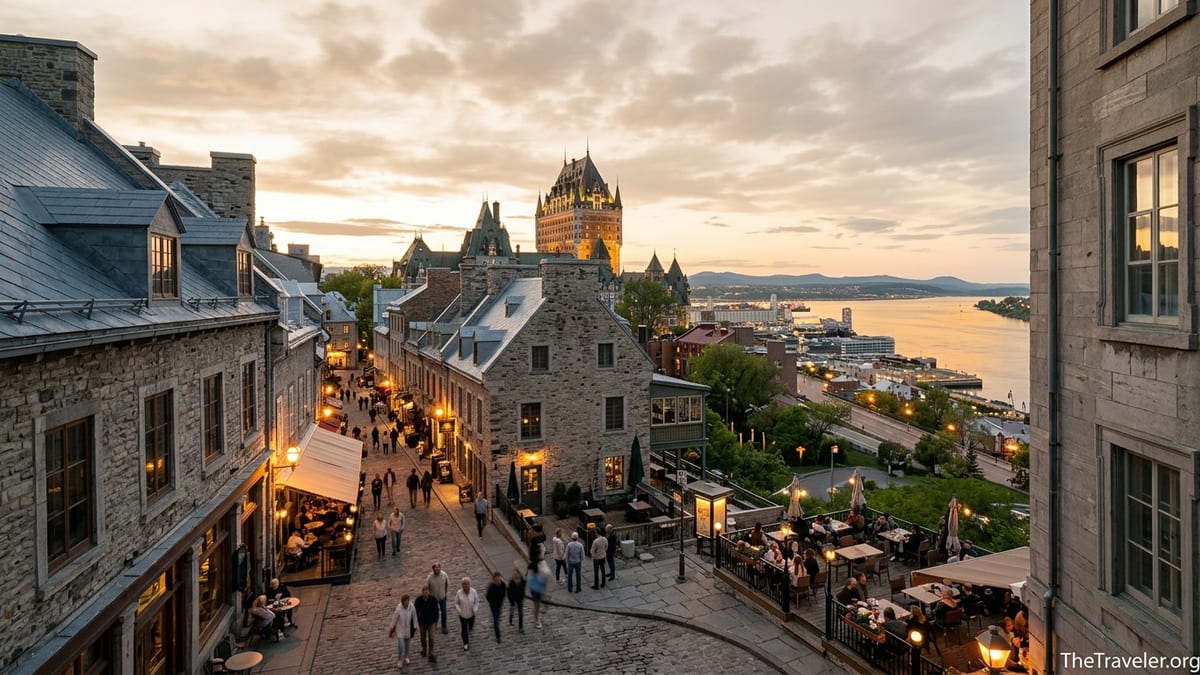
Quebec City is more compact but arguably the most atmospheric stop. Two nights inside or just outside the city walls give you one full day to explore the Upper and Lower Town, the Plains of Abraham and the Dufferin Terrace. Adding a third night opens room for a half-day trip to Montmorency Falls or Île d’Orléans. Many visitors who spend only one night in Quebec City say they wish they had scheduled an extra evening simply to wander after dark when day trippers have gone and the streets are quieter.
Train Versus Car: What Works Best on This Route
Between Toronto, Montreal and Quebec City, you can travel entirely by train or by rental car, and both options have clear trade-offs. VIA Rail’s corridor trains link Toronto to Montreal in roughly five hours and Montreal to Quebec City in about three to three and a half hours on most departures. Typical economy fares vary by day and how far ahead you book, but it is common to see prices in the range of 80 to 150 Canadian dollars per person between major city pairs when booked a few weeks out, with occasional sales making it cheaper.
For many first-time visitors focused on the cities, trains are the simplest option. You can step from a hotel near Toronto’s Union Station, ride directly into downtown Montreal’s Gare Centrale, and continue into Quebec City’s Gare du Palais, all without worrying about parking, winter driving conditions or one-way drop fees. Families or pairs can bring snacks and use onboard Wi-Fi, and they avoid navigating Montreal rush-hour traffic or Quebec City’s narrow streets. This can be a relief if you are arriving jet-lagged or traveling in early spring or late autumn when weather can be unpredictable.
Renting a car can make sense if you value flexibility or are adding rural detours such as Prince Edward County’s wineries or small towns along the St. Lawrence River. Driving from Toronto to Montreal typically takes about six hours without major stops, while Montreal to Quebec City is usually around three hours on Highway 20 or 40. A midsize rental car from a recognized brand such as Enterprise or Hertz often starts in the range of 60 to 100 Canadian dollars per day before insurance and fuel, though prices can spike in peak summer. You will also need to budget for daily parking, which can run from about 25 to 40 dollars per night at downtown hotels in Toronto and Montreal.
A hybrid approach works well for many: rely on trains between the big cities, and rent a car only for specific days, such as a one-day loop from Toronto to Niagara-on-the-Lake or a day trip from Quebec City to Charlevoix. In practice, this might look like three nights in Toronto with one guided Niagara tour instead of driving, train to Montreal for three nights, then train onward to Quebec City for two or three nights before flying home. This structure avoids one-way rental surcharges and keeps most of your city days car free.
7-Day Itinerary: Toronto, Montreal & Quebec City Highlights
With seven days, you will need to move at a steady pace, but you can still see all three cities by prioritizing train travel and keeping side trips limited. A straightforward plan is 2 nights in Toronto, 2 nights in Montreal and 2 nights in Quebec City, with the remaining day absorbed by travel. This works best for travelers who are comfortable with early trains and who prefer to focus on core sights rather than extensive museum visits.
For example, arrive in Toronto on Day 1 and stay near Union Station at a midrange downtown property such as the Fairmont Royal York or a contemporary hotel in the Entertainment District. Spend your first afternoon walking to the CN Tower, the harbourfront and nearby sports venues. On Day 2, use the morning for St. Lawrence Market and the Distillery District, then an afternoon neighborhood visit to Kensington Market or Queen Street West. If Niagara Falls is a priority, you can reserve a full-day guided tour with early departure and late evening return, but understand that this will compress your time in the city itself.
On Day 3, take a mid-morning VIA Rail train from Toronto to Montreal and aim to arrive in time for an early evening stroll and dinner in Old Montreal. Book a hotel within walking distance of Gare Centrale or the Old Port, such as a boutique property in a historic stone building or a chain hotel at Square Victoria. Day 4 can then be devoted to Old Montreal, the waterfront and the Notre-Dame Basilica, with time in the afternoon to ride up Mount Royal for the classic skyline viewpoint. On Day 5, continue by train to Quebec City, ideally choosing an early afternoon departure to reach the walled city by evening.
Spend Days 6 and 7 inside Quebec City’s historic core, basing yourself near the Château Frontenac or in the Saint-Jean-Baptiste district. One day can be focused on walking the Upper Town, visiting the Plains of Abraham and the Citadelle, while the second day covers the Lower Town around Place Royale and perhaps a short ride out to Montmorency Falls if time allows. On your final day, schedule a late-afternoon departure so that you still have a few unstructured hours for last walks along the Dufferin Terrace or café stops before heading to the airport or train station.
10-Day Itinerary: Adding Niagara Falls or Ottawa
With 10 days, most travelers can comfortably add either Niagara Falls from Toronto or Ottawa between Montreal and Quebec City. A common pattern is 3 nights in Toronto, 3 nights in Montreal and 3 nights in Quebec City, with a spare day used for travel or a side trip. This extra time reduces the feeling of constant motion and opens room for slower meals and unplanned wandering.
If Niagara Falls is on your wish list, dedicating one full day is realistic from a Toronto base. Niagara Falls is roughly 130 kilometers from downtown Toronto, and driving normally takes around 1.5 hours in light traffic, though weekend congestion can stretch travel closer to two hours each way. Many visitors opt for an organized day tour including round-trip coach transport, a Niagara City Cruises boat ticket and stops at attractions such as the Whirlpool Rapids and a winery in Niagara-on-the-Lake. These tours typically depart around 8 a.m. and return by early evening, allowing you to see Horseshoe Falls up close without managing transit connections yourself.
An alternative is to use GO Transit commuter services, which at many times of year offer direct train or combined train and bus routes from Toronto’s Union Station to Niagara Falls. Travel time can be about two hours each way by train when seasonal direct services run, or longer when combined with bus segments. For a family of four traveling on a weekend, GO often sells flat-fare day passes that cap the total cost, while weekday travel is priced per distance. Once in Niagara Falls, the local WEGO bus system links the station to the main hotel and attraction area around Clifton Hill and the falls viewing area, which limits the need for taxis.
If you are more interested in Canadian history and museums, consider adding Ottawa between Montreal and Quebec City. The train from Montreal to Ottawa takes roughly two hours, and Ottawa to Quebec City typically involves a change of train in Montreal for a total journey of around six hours. Spending one or two nights in Ottawa allows time to walk Parliament Hill, the Rideau Canal and the ByWard Market. Staying near the canal or in the downtown core puts you within easy walking distance of the National Gallery of Canada and the Canadian Museum of History across the river in Gatineau, although museum fans could easily devote a full extra day just to these institutions.
14-Day Itinerary: Slower Travel and Extra Bases
A 14-day trip lets you combine both Niagara Falls and Ottawa without feeling rushed, while also adding slower days in each city. A balanced layout might be 4 nights in Toronto, 3 nights in Montreal, 2 nights in Ottawa and 3 nights in Quebec City, with side trips layered in. Another option for those who prefer fewer hotel changes is to extend stays in Toronto and Quebec City and keep Ottawa as a day trip from Montreal, though this makes for a longer travel day.
Consider starting with four nights in Toronto, giving you two full city days, one Niagara Falls day and one flexible day for neighborhoods or a local island visit. A typical pattern could be Day 2 for downtown and waterfront, Day 3 for a Niagara tour including the boat ride into the mist, and Day 4 for exploring areas such as the Beaches, Roncesvalles or the Toronto Islands by ferry. For accommodations, some travelers choose a higher-end base such as a luxury property on University Avenue for the entire Toronto stay, while others split between a business hotel near Union Station and a boutique property in a neighborhood like Yorkville.
From Toronto, travel by train to Montreal and spend three nights exploring beyond the historic center. With the extra time, you might stay in Plateau-Mont-Royal or Mile End, using the city’s metro system to move between cafés, parks and the riverfront. One full day can focus on Old Montreal and the Old Port, another on Mount Royal Park and nearby residential streets, and a third on markets and food. In summer, bringing or renting bicycles can make it easier to explore the Lachine Canal path and reach riverfront green spaces that are less crowded than the central tourist areas.
Next, add one or two nights in Ottawa to break the journey to Quebec City. Train schedules often allow a mid-morning departure from Montreal that gets you into Ottawa by lunchtime, leaving the afternoon free for a Parliament Hill walk and views along the Rideau Canal. Stay in a downtown hotel near the canal or ByWard Market so you can easily walk to restaurants and the main museums. Your onward travel day to Quebec City can then be spent on daytime trains, arriving in the evening ready for three slow days inside the walled city, with a full half day dedicated to an excursion like Montmorency Falls or a culinary tour on Île d’Orléans.
Choosing Hotel Bases and Neighborhoods
On a multi-city itinerary, picking the right hotel base in each city can save both time and money. In Toronto, staying within a 10 to 15 minute walk of Union Station simplifies both airport transfers and train departures to Montreal or Niagara Falls. Popular areas include the Financial District and Entertainment District, where midrange chain hotels and higher-end properties sit close together. Travelers who value nightlife and restaurants might choose a hotel near King Street West, while families may prefer the quieter Harbourfront area with easy access to parks and the ferry to the Toronto Islands.
In Montreal, first-time visitors often split between Old Montreal and the downtown core. A hotel in Old Montreal puts you within steps of the Old Port, Notre-Dame Basilica and cobbled lanes, which is ideal if you enjoy early morning or late evening walks when day visitor traffic is lower. However, prices in peak summer can run higher here. Staying just uphill in the central business district around Square Victoria or Peel Street usually lowers nightly rates and keeps you close to metro lines that connect quickly to the Plateau, Mile End and Jean-Talon Market.
Quebec City has a clear choice between staying inside the walls of Old Quebec or in nearby districts like Saint-Jean-Baptiste or Saint-Roch. Booking a small inn or hotel within Old Quebec lets you step out directly into the historic streets and see the Château Frontenac and Dufferin Terrace without a climb. This is especially pleasant in winter when snow transforms the cityscape and you may prefer shorter walks. On the other hand, neighborhoods just outside the walls often offer better value, with local restaurants and easier vehicle access if you are driving. Many travelers choose to spend at least one or two nights inside the walls for the experience, even if the rest of their stay uses a slightly more modern base.
In Ottawa, a hotel near the Rideau Canal or ByWard Market works well for short stays, putting you within walking distance of Parliament Hill, the National Gallery and canal-side paths. Larger chain hotels dominate this area, but boutique options and apartment-style suites are increasingly common. For Niagara Falls, those who decide to stay overnight may choose between high-rise hotels overlooking the falls, which typically charge a premium for view rooms, and more budget-friendly properties closer to Lundy’s Lane or Niagara Falls Boulevard that rely on WEGO buses or short drives to reach the main viewpoints.
Practical Tips for Booking and Moving Between Cities
When planning this route, it helps to work backwards from your fixed dates and international flights. If your flights are into and out of Toronto, consider starting there immediately rather than flying onward after arrival. Booking VIA Rail tickets a few weeks to a couple of months ahead usually gives you more departure choices and lower fares than last-minute purchases, especially in high summer and around Canadian public holidays. Many travelers choose mid-morning trains to avoid early alarm clocks and late-night arrivals, and reserve business or “quiet” cars when they value more space.
For rental cars, compare a few major providers and watch for one-way drop fees if you intend to pick up in one city and return in another. In many cases it is cheaper to complete a loop starting and ending in Toronto, or to use trains between cities and rent cars only for local day trips. If you are traveling in winter, factor in the possibility of snow and ice on highways, and look for rentals that include winter tires where required by provincial law or strongly recommended by local authorities. In city centers, confirm overnight parking costs with your hotel so that these do not become an unwelcome surprise at check-out.
Budget for city taxes and daily transportation costs. Public transit in Toronto, Montreal and Ottawa is generally reliable and cost-effective for visitors. For example, a single adult fare on local city transit typically falls in the range of a few Canadian dollars, with day passes available in some cities. In Montreal and Toronto, purchasing reloadable transit cards makes it easier to tap on and off buses, streetcars and subways without carrying coins. In Quebec City, most visitors rely more on walking within the historic core and occasional taxis or rideshares for longer distances or late-night returns.
Lastly, be realistic about pace. On paper it is possible to squeeze four cities and Niagara Falls into a seven-day trip, but many travelers appreciate building in at least one “nothing scheduled” afternoon in each base. A coffee on a quiet side street in Mile End, an unhurried sunset along the Toronto waterfront or a lingering breakfast overlooking the St. Lawrence River in Quebec City often become the most memorable parts of a journey that otherwise could feel like a sequence of scheduled checklists.
FAQ
Q1. Is 7 days enough for Toronto, Montreal and Quebec City?
Seven days is enough for a fast-paced trip that gives you a taste of each city, typically with about two nights in each and one day absorbed by train travel.
Q2. Should I travel between Toronto, Montreal and Quebec City by train or car?
Most first-time visitors find trains easier, as VIA Rail links the downtown cores and avoids parking and traffic. A rental car suits those planning rural detours or off-route stops.
Q3. How many nights should I spend in Toronto if I want to see Niagara Falls?
Plan at least three nights in Toronto if Niagara Falls is a priority. That gives you one full city day, one full Niagara day trip and time to adjust to any jet lag.
Q4. Can I visit Ottawa and Niagara Falls on the same trip without rushing?
Yes, but it is more comfortable with around 10 to 14 days. Many travelers add a day in Ottawa between Montreal and Quebec City and take a separate day trip to Niagara from Toronto.
Q5. Is Niagara Falls realistic as a day trip from Toronto?
Yes, a Niagara Falls day trip from Toronto is very common. Expect roughly 1.5 to 2 hours each way by car in light traffic, or about 2 hours or more with train and bus connections.
Q6. When is the best time of year to do this Eastern Canada itinerary?
Late spring, summer and early autumn offer the most reliable weather and festival options. Winter can be beautiful, especially in Quebec City, but requires more preparation for cold.
Q7. Are these cities walkable if I do not rent a car?
Yes. Central areas of Toronto, Montreal, Ottawa and Quebec City are walkable and supported by transit, so many visitors complete the entire route without driving.
Q8. How far in advance should I book trains and hotels?
Booking trains and hotels a few weeks to a couple of months ahead usually secures better prices and availability, especially for summer, long weekends and major festivals.
Q9. Is it better to start in Toronto or Montreal?
Most international flights arrive in Toronto, so many travelers start there, but the route works in either direction. Choose based on flight prices, schedules and your preferred finale.
Q10. Can I do this trip with children?
Yes. Families often appreciate train travel for space and movement, and all four cities offer child-friendly attractions such as aquariums, science centers, parks and riverfront paths.