


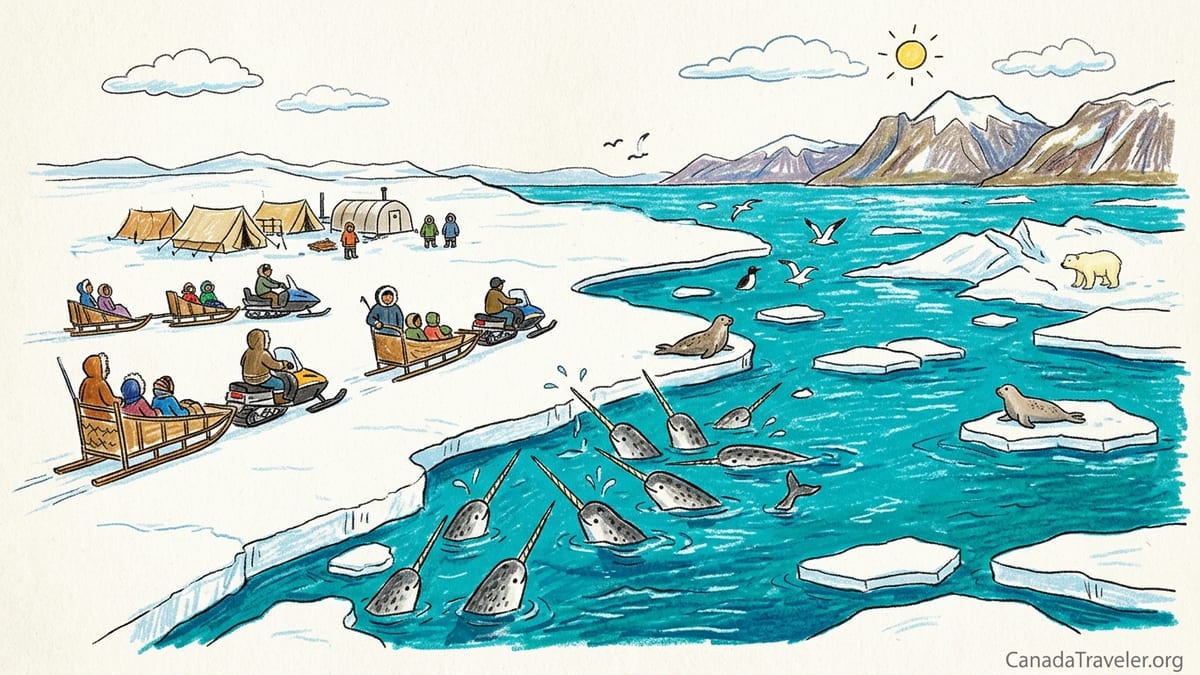
At the northern edge of Baffin Island in Nunavut, a shifting boundary separates solid sea ice from dark, moving water. Inuit call this sinaaq, the floe edge, and every spring it becomes one of the richest wildlife viewing stages on Earth. Narwhals surface through narrow leads, seals haul out on ice pans, polar bears patrol the margins and seabirds circle above. For travelers, carefully guided floe edge tours offer a rare chance to stand on land-fast sea ice and watch the Arctic wake up from winter.
What and Where Is the Floe Edge, the Arctic “Line of Life”?
In Nunavut, the floe edge is the seasonal boundary where land-fast sea ice anchored to the coast meets open water or drifting pack ice. Inuit refer to this place as sinaaq, sometimes called the “line of life,” because it concentrates both marine life and the people who depend on it. Along northern Baffin Island, especially near communities such as Pond Inlet, Arctic Bay and Clyde River, this edge can sit 30 to 80 kilometers offshore in late spring, forming a long white ribbon against a band of open, often turquoise water.
Physically, the floe edge exists because currents and winds keep parts of Baffin Bay and Lancaster Sound relatively ice free, while colder, more sheltered coastal waters remain locked in land-fast ice well into June. The contrast between solid ice and open water creates upwelling and mixing that bring nutrients to the surface. Those nutrients fuel blooms of phytoplankton, which in turn support dense schools of Arctic cod and other small fish. It is this productivity that ultimately draws whales, seals, polar bears and seabirds into the same narrow zone, often within view of a carefully placed floe edge camp.
For travelers, the key point is that the floe edge is not a fixed line on a map. It can advance or retreat by several kilometers in a single day under the influence of wind and tides. A floe edge that is safe and accessible in early June may be fractured or gone altogether by early July. That is why operators and local guides reassess ice conditions every season and sometimes every morning, moving camps or changing routes in response to shifting cracks and pressure ridges.
Why Narwhals, Whales, Seals and Bears Gather at the Sinaaq
Every spring, narwhals migrate north along the Baffin Island coast and into Lancaster Sound, tracking retreating sea ice and the open leads that form at the floe edge. Acoustic and tagging studies around Eclipse Sound indicate that narwhals are regularly present from roughly May through July as the sea ice breaks up, with particularly strong activity in June and early July. At that time, pods of dozens or even hundreds of animals may pass by in loose groups, surfacing to breathe and occasionally revealing their long tusks as they roll in the water.
Narwhals and belugas are drawn to the floe edge partly because this is where access to air and food coincide. They need leads and polynyas in order to breathe but also target Arctic cod and other fish that feed on the plankton blooms along the ice edge. Bowhead whales occasionally use these same productive waters, especially near larger inlets and sounds around the north of Baffin Island. The exact timing of whale movements varies year by year, but many guides consider mid June to mid July the most reliable window to see narwhals at the floe edge near Pond Inlet or Arctic Bay.
Seals and walruses take advantage of the sea ice itself. Ringed and bearded seals maintain breathing holes and haul-out spots on stable pans, often close to the open water where they can feed. Walruses may rest in groups on larger floes while diving for clams in the shallow sea floor near the edge. These concentrations of marine mammals in turn attract polar bears, which use cracks, pressure ridges and the irregular surface of the floe edge to stalk seals and occasionally scavenge whale carcasses. It is not unusual for a well-timed tour to see narwhals moving through the leads, seals on nearby ice and a distant polar bear picked out as a creamy dot against the snow.
Above all of this, seabirds exploit the same productivity. Thick-billed murres, kittiwakes, fulmars and guillemots gather where small fish rise toward the light. In the Pond Inlet area, some of these birds nest on nearby cliffs and commute daily to the ice edge to feed. For photographers, the mix of low-angle spring sun, blue water and circling birds can be as compelling as the chance of seeing a tusked narwhal.
Key Floe Edge Season: Why May to July Matters
The classic floe edge travel period on Baffin Island runs from roughly early May through early July. In May, the land-fast ice is still strong and snow covered, which makes long snowmobile journeys more comfortable and allows operators to tow heavy qamutik sleds with fuel, tents and kitchen gear. Daytime temperatures near Pond Inlet in May are often well below freezing, especially with windchill, yet the light is already close to continuous, delivering long days for wildlife watching and photography.
By early to mid June, the floe edge has usually moved closer to the community, the sun is higher and the first large pulses of narwhals tend to arrive in Eclipse Sound and Lancaster Sound. Many operators who specialize in narwhal watching schedule their main floe edge departures between about 25 May and 5 July to match this typical pattern. In a good year, travelers during this window may see narwhals on most days, though no responsible guide will promise sightings. Sea ice is still thick enough to support camps, yet the open water beyond can be wide and dark, providing strong visual contrast against the white ice in photographs.
By late June and into July, the character of the ice changes quickly. Snow cover melts, the surface becomes softer and puddled, and cracks widen into channels. The same warming that brings more comfortable air temperatures also destabilizes travel routes. This is why many over-ice base camp itineraries near Pond Inlet end by the first or second week of July in an average year. After that, narwhal trips pivot to boat-based itineraries using small vessels that weave among drifting floes rather than camps on solid sea ice.
Weather and long-term climate trends introduce variability, so travelers should approach any specific date range as approximate. In some recent years the safe travel window near certain Baffin Island communities has effectively narrowed to a core of two to three weeks. If seeing the floe edge specifically is a priority, it is wise to choose travel dates within the heart of the traditional season, for example around mid June, and to remain flexible about which day yields the best ice and wildlife conditions.
Pond Inlet vs Other Baffin Island Bases
Pond Inlet, or Mittimatalik, on northern Baffin Island is the best-known base for floe edge tours. The community sits at the entrance to Eclipse Sound with views toward Bylot Island and the distant mountains of Sirmilik National Park. From town, snowmobiles can reach the floe edge in several hours, depending on its exact position that season. Several specialized operators, often working in partnership with local Inuit guides and outfitters, run seasonal base camps east or north of Pond Inlet. These typically consist of heated, cabin-style tents or weatherport structures set on the ice, with a communal kitchen and insulated sleeping tents for guests.
Pond Inlet’s popularity stems from a combination of reliable narwhal migration routes, scenic mountains, and relatively well-developed local guiding capacity. Travelers can usually find packages that include return snowmobile and qamutik transfers to the floe edge, several nights in a heated base camp and all meals, sometimes bundled with flights from Ottawa or Iqaluit. As of 2026, week-long floe edge trips from Pond Inlet commonly fall in the approximate range of 7,000 to 12,000 Canadian dollars per person when including charter flights and camp accommodation, though shorter three to five day packages based out of town can be lower.
Other Baffin Island communities also offer strong floe edge opportunities. Arctic Bay, on the northwestern side of the island, is known for dramatic cliffs and a narrower inlet that can funnel narwhals and seals into relatively confined areas. Some travelers report exceptional narwhal encounters here in June, though flight access is more limited and tour availability can be smaller than in Pond Inlet. Clyde River, on the east coast, provides access to different sections of Baffin Bay, with guides who focus on both floe edge wildlife and glacier scenery. In each case, the basic pattern is similar: travel out by snowmobile and qamutik to a safe section of floe edge identified by local knowledge, spend long days scanning the water for whales and seals, and return to either a mobile camp or town-based lodging.
Choosing between these communities often comes down to flight logistics, budget and how specialized a wildlife experience you want. Pond Inlet tends to support the most structured, camp-based safaris and may be easier for first-time Arctic visitors who prefer more infrastructure. Arctic Bay and Clyde River can feel more off the beaten path and may suit travelers who prioritize remoteness and are comfortable with smaller-scale, more custom arrangements booked directly with local outfitters.
How Floe Edge Trips Work: Snowmobiles, Qamutik and Base Camps
Most spring floe edge tours on Baffin Island rely on snowmobiles towing qamutik, the traditional Inuit wooden sleds, to reach the sinaaq. A typical day might start in Pond Inlet with guests climbing into the qamutik, bundled in insulated suits provided by the operator. Local guides drive snowmobiles at the front and rear of the caravan, following known safe routes over the sea ice. The journey can take anywhere from two to six hours depending on where the floe edge lies that season. Along the way, guides watch constantly for fresh cracks, thin ice near tidal inlets and signs of pressure ridges.
For multi-day trips, outfitters establish heated base camps either directly on the sea ice or occasionally on stable landfast ice close to shore but within easy snowmobile reach of the active edge. These camps often include double-walled, canvas or synthetic tents mounted on wooden platforms, filled with thick mattresses, heavy-duty sleeping bags and small heaters powered by fuel or generators. There is usually a communal dining tent where hot meals are served, often mixing familiar comfort food with local country foods such as Arctic char or caribou, depending on availability and local regulations.
Day-to-day, guests travel from the base camp to a chosen viewing point along the floe edge, then spend several hours or most of the day scanning the water, listening for the characteristic exhalations of whales and watching the ice for seals or the distant shape of a bear. Some tours incorporate short hikes on nearby land, visits to seabird colonies or cultural activities with Inuit guides such as storytelling or tasting traditional foods. On calmer days, experienced operators may launch small boats or kayaks into the open water near the ice edge for a closer look, though this is heavily dependent on conditions and safety assessments.
Shorter, town-based day trips follow a similar pattern but return to lodge or guesthouse accommodation in the evening. This can be a good option for travelers who prefer not to sleep on sea ice or who want to combine floe edge excursions with time in the community, visiting local artists, co-ops and cultural centers before or after their wildlife days.
Clothing, Photography and Staying Safe on the Sea Ice
Conditions at the floe edge can feel deceptively harsh even under clear blue skies. The combination of wind, open water, low temperatures and long hours of standing still requires serious cold-weather clothing. Most operators provide heavy insulated one-piece suits and sometimes boots, but travelers should still bring a full layering system: moisture-wicking base layers, thick fleece or wool mid layers, windproof and waterproof outer shells, insulated mitts with liners, a warm hat that covers the ears and a balaclava or buff. Many visitors also appreciate chemical hand and foot warmers for use during long sessions behind a camera on the ice.
For photography, telephoto lenses in the 300 to 600 millimeter range are often ideal for whales and bears, while a wider lens captures the dramatic combination of sea ice, mountains and Arctic light. A full-frame DSLR or mirrorless camera with good high-ISO performance helps during low-contrast weather. Tripods or monopods can be challenging to use on uneven snow and ice, so some photographers prefer beanbags or simply brace cameras against the qamutik. Importantly, electronics drain quickly in cold temperatures, so extra batteries kept close to the body are essential.
Safety on the floe edge hinges on constant local knowledge and conservative decision making. Sea ice can look solid from a distance but conceal thin spots where currents erode it from below. Wind shifts can push pack ice against the edge, closing leads and sometimes pressuring the land-fast ice itself. Experienced guides track weather forecasts, tides and subtle signs like new cracks or water seeping through snow. Parks authorities and local governments in Nunavut emphasize that some areas are prone to early thinning due to strong currents and should only be crossed by people who know the ice intimately.
Guests contribute to safety by following guide instructions without exception. That often means staying behind marked lines near the edge, avoiding overhanging cornices of ice and keeping noise and sudden movements to a minimum near wildlife. Travel insurance that covers medical evacuation is strongly recommended, since communities such as Pond Inlet are remote and serious incidents require air transport. Even with these precautions, incidents are rare on professionally guided trips, largely because operators build substantial safety margins into their itineraries.
Costs, Logistics and Setting Realistic Wildlife Expectations
Traveling to the floe edge is logistically complex and reflects that in its costs. Most international visitors reach Nunavut via Ottawa or Montreal, flying to Iqaluit and then onward to communities like Pond Inlet or Arctic Bay on regional airlines. Return airfares within Nunavut can easily add several thousand Canadian dollars per person, which is why some tour packages bundle these flights. In addition to air travel, travelers pay for guiding, snowmobile and qamutik use, fuel, camp infrastructure, food and the wages of multiple staff working in remote conditions.
As a rough guide, specialized floe edge tours of four to five days from Baffin Island communities commonly fall in the approximate range of 3,500 to 6,000 Canadian dollars per person, including guiding, camping equipment, meals and transport on the ice but excluding flights to Nunavut. Longer itineraries that include charter flights from southern Canada or added cultural activities can push total trip budgets into the low five figures per traveler. While this makes floe edge travel a significant investment, it is worth remembering that you are effectively chartering a small expedition with safety-critical infrastructure in one of the most remote regions on Earth.
In terms of wildlife, expectations should be ambitious but grounded. Even at prime locations near Pond Inlet or Arctic Bay, narwhal sightings are never guaranteed. Some guests may see multiple pods over several days, while others might only glimpse distant blows in foggy conditions. Ice dynamics, wind patterns, hunting activity and sheer chance all play roles. Seals and seabirds are typically more reliable, and many groups do encounter polar bears, though often at long range. Good operators frame wildlife as a possibility rather than a promise, emphasizing the overall Arctic experience: vast landscapes, 24 hour light, silence and the cultural insights shared by Inuit guides.
Travelers who arrive prepared for the full spectrum of conditions, including days of low visibility or heavy wind, are more likely to appreciate the trip even if marquee species prove elusive. Choosing a slightly longer itinerary, for example five or six days on the ice rather than two or three, increases the odds of at least one clear, wildlife-rich day. Asking prospective operators detailed questions about their seasonal track record, guide experience and maximum group sizes can also help set appropriate expectations.
Why You Must Travel With Experienced Local Guides
Attempting independent travel to the floe edge on land-fast sea ice is extremely risky and strongly discouraged. The hazards are not always obvious to visitors, even those with cold-weather trekking or polar cruise experience. Sea ice can conceal tide cracks that open and close with the lunar cycle, areas of thin ice above strong currents and unstable overhangs formed by repeated fracturing. A safe route one week can be impassable the next. Local Inuit guides grow up reading this constantly changing surface, combining generational knowledge with modern tools such as GPS and satellite imagery.
Professional guides in Nunavut also understand wildlife behavior and legal frameworks. Approaching polar bears or whales too closely is dangerous and can contravene regulations or traditional practices. Local operators know how far to stay from bears, when to reposition guests if an animal is moving through and how to interpret signs of stress in whales or seals. They also coordinate with community organizations and, where relevant, national park authorities to ensure that tour activity aligns with conservation goals and community needs.
From a practical perspective, guides organize critical logistics that would be impossible for most independent travelers. They source snowmobiles and qamutiks suitable for the conditions, arrange fuel caches or carrying capacity, provide insulated clothing, erect and maintain heated camps and plan contingency routes. They also serve as translators and cultural interpreters in communities where Inuktitut is widely spoken and where social norms around privacy, land use and wildlife harvest differ from southern Canada.
Finally, traveling with local guides directs economic benefits to the communities whose knowledge makes floe edge tourism possible. Many outfits are owned or staffed by Inuit hunters and trappers who combine traditional skills with tourism training. Choosing licensed, community-connected operators supports that expertise and helps ensure that floe edge travel remains sustainable in the face of changing ice patterns and increasing global interest in the Arctic.
FAQ
Q1. When is the best time of year to visit the floe edge near Pond Inlet?
The most reliable period is usually from late May through late June, with some seasons extending into early July, when sea ice is still strong and narwhals are migrating.
Q2. How many days should I plan for a floe edge tour?
Allow at least four to five days on the ice or in camp to account for weather delays and to improve your chances of good wildlife viewing and photography conditions.
Q3. Are narwhal sightings guaranteed on floe edge tours?
No. Even at prime locations and times, narwhal sightings depend on ice conditions, weather and animal movements, so reputable operators never promise guaranteed encounters.
Q4. How cold is it at the floe edge in May and June?
Temperatures commonly range from about minus 15 to minus 5 degrees Celsius in May, warming toward around freezing in June, but windchill can make it feel significantly colder.
Q5. Do tour operators provide cold weather clothing and boots?
Most specialized floe edge operators supply insulated suits and sometimes boots, but you should still bring quality base layers, mid layers, socks, hats and gloves of your own.
Q6. How do I get to Pond Inlet or Arctic Bay from southern Canada?
Travelers typically fly from Ottawa or Montreal to Iqaluit, then connect on regional flights to communities such as Pond Inlet, Arctic Bay or Clyde River, often arranged by the tour operator.
Q7. Is it safe to bring children on a floe edge tour?
Some operators accept older children and teenagers who can handle cold, long days and follow safety instructions closely, but families should discuss suitability directly with the guide company.
Q8. What level of physical fitness is required for floe edge trips?
Most time is spent riding in qamutik sleds and standing or sitting at the ice edge, so extreme fitness is not needed, but you should be comfortable in cold conditions for many hours.
Q9. Can I visit the floe edge without joining a guided tour?
Independent travel on the sea ice is strongly discouraged for safety reasons; visitors should always hire experienced local guides with appropriate equipment and local knowledge.
Q10. Are there options for boat-based narwhal viewing if I travel later in summer?
Yes. After the sea ice breaks up, some communities offer small boat tours in July and August to search for narwhals and other marine wildlife among drifting floes and open water.