


The Icefields Parkway between Lake Louise and Jasper is often described as one of the most beautiful drives on earth, but it is also one of the most misunderstood. Many travelers still treat Highway 93N as a simple three-hour transfer between two resorts. In reality it is a 232-kilometre wilderness corridor where fuel, food and phone service quickly fade while glacier-fed lakes, hanging icefields and wildlife appear around almost every bend. This guide explains how long you should really allow, where to stop, how to prepare and why the Parkway itself deserves to be the highlight of your Rockies itinerary.
Understanding the Icefields Parkway Route
The Icefields Parkway runs for approximately 232 kilometres between the village of Lake Louise and the town of Jasper, threading through Banff and Jasper National Parks along the spine of the Canadian Rockies. The road loosely follows the Bow, Mistaya, North Saskatchewan, Sunwapta and Athabasca river valleys, with mountain walls and glaciers in view for much of the way. Elevation varies from around 1,400 metres near Jasper to just over 2,000 metres at Bow Summit before dropping and climbing again toward Sunwapta Pass near the Columbia Icefield. Those changes in altitude, combined with the continental divide weather patterns, explain why conditions can shift from dry pavement to heavy snow within a single day, even in shoulder seasons.
Driving times are frequently underestimated. In ideal summer conditions, without stops, most drivers cover Lake Louise to Jasper in about three to three and a half hours. With realistic sightseeing stops, short walks and photo breaks, it is wiser to plan on six to nine hours for the full stretch. A common real-world pattern in July and August is a 7:30 a.m. departure from Lake Louise, a coffee stop at Bow Lake, Peyto Lake by mid-morning, a late lunch around the Columbia Icefield and an early evening arrival in Jasper. In winter, Parks Canada encourages travelers to complete the journey entirely in daylight, which usually means starting after road crews have worked in the morning and arriving before mid-afternoon during the shortest days.
The Parkway feels different from a standard highway because it is. It is a special-use corridor managed as part of the national parks system, with limited development and no commercial billboards, traffic lights or towns along the way. Aside from a seasonal service cluster at Saskatchewan River Crossing and the Columbia Icefield area, there are no urban centres between the endpoints. That remoteness is a large part of the appeal, but it also means you must approach the day with more planning than an ordinary drive.
How Long to Allow and Why a Full Day Makes Sense
For most travelers, the safest assumption is that the Icefields Parkway will consume a full day, even if the odometer suggests a short hop. In peak summer, traffic moves slowly behind motorhomes and tour buses, and every scenic pullout tempts you to stop. A driving plan that looks efficient on paper often stretches well into the evening as travelers add one more waterfall stop or decide to walk a short trail. If you want to visit flagship sites such as Peyto Lake, the Columbia Icefield and Athabasca Falls, and still arrive in Jasper before dark, blocking out at least eight hours gives you room to slow down.
A practical one-day summer itinerary from Lake Louise might look like this in real time. Depart around 8 a.m. after fueling up and buying lunch supplies. Reach Bow Lake in roughly 35 minutes and linger for 20 minutes along the shoreline. Continue to Bow Summit and Peyto Lake, allowing an hour or more for the walk to the viewpoint and photos. Stop again at Saskatchewan River Crossing for a washroom break and perhaps a snack from the small convenience store. Spend two to three hours in the Columbia Icefield area exploring the Athabasca Glacier forefield or joining a pre-booked glacier experience. Add shorter pauses at Sunwapta Falls and Athabasca Falls closer to Jasper. The clock will generally show early evening by the time you check into accommodation in town.
Trying to combine the entire Icefields Parkway drive with additional side trips on the same day often leads to rushed, stressful travel. For example, attempting to leave Calgary after breakfast, visit Lake Louise, drive the Parkway with multiple stops and still reach Jasper before dark leaves little margin for weather, construction or crowds at viewpoints. Splitting the journey with an overnight at the Columbia Icefield area, Saskatchewan River Crossing or a frontcountry campground along the route can transform a long haul into a relaxed two-day experience with early-morning and late-evening light at the lakes and glaciers.
Key Scenic Stops: Bow Lake, Peyto Lake and Saskatchewan River Crossing
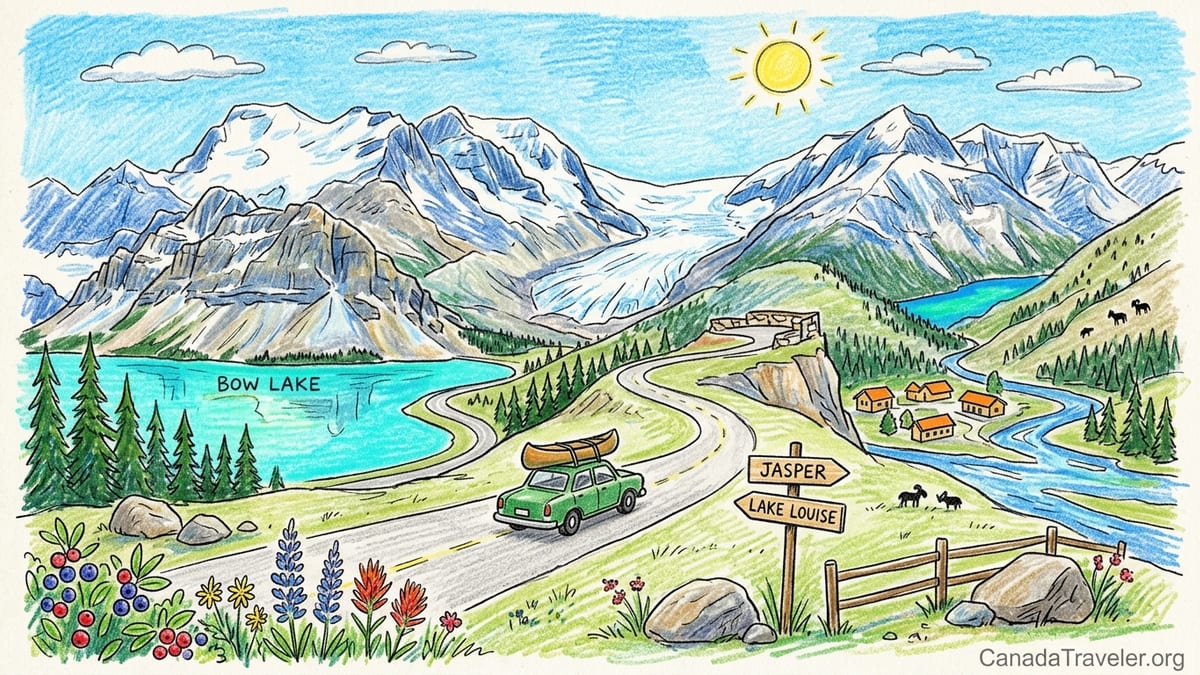
Heading north from Lake Louise, Bow Lake is often the first place where travelers feel the character of the Icefields Parkway. The lake lies directly beside the highway, roughly 40 minutes from Lake Louise, backed by Crowfoot Mountain and glaciers that feed the vivid turquoise water. In summer, the shoreline near the parking area becomes a popular place to stretch legs, photograph reflections and watch the light change on the ice. A simple but effective strategy is to bring a thermos of coffee or tea from Lake Louise and plan your first real pause here rather than at a roadside pullout.
A short drive beyond Bow Lake brings you to Bow Summit and the access road to Peyto Lake, one of the most photographed views in the Canadian Rockies. From the upper parking area in the main visitor season, the walk to the viewpoint is an uphill paved path of roughly 10 to 15 minutes for most people, longer at higher elevations if you are not acclimatized. Travelers often underestimate the time they will spend at the viewpoint. On a clear July morning, it is easy to linger for 45 minutes or more watching clouds sweep across the surrounding peaks and waiting for other visitors to clear from the railings for photographs.
Saskatchewan River Crossing, reached after the road descends through a sequence of bends and valley views, marks roughly the midpoint of the Lake Louise to Jasper journey. It is the only significant service cluster between Lake Louise and Jasper in the main summer season. A seasonal gas station, small motel, simple restaurant and convenience store operate here, typically from spring into early autumn. Many drivers treat it only as a fuel and washroom stop, but the confluence of the North Saskatchewan, Mistaya and Howse rivers visible from nearby viewpoints makes it a worthwhile scenic pause in its own right. If you arrive around lunchtime, this is a logical place to refuel both car and passengers before continuing toward the higher passes.
Columbia Icefield, Sunwapta Falls and Athabasca Falls
The Columbia Icefield area, roughly two hours north of Lake Louise without stops, is the geographic and emotional centre of many Icefields Parkway itineraries. Here the Athabasca Glacier, one of the icefield’s outlet glaciers, descends within walking distance of the road. A visitor centre operates seasonally on the slopes above the highway, offering interpretive displays, washrooms, a cafeteria-style restaurant and access to paid glacier experiences and an elevated glass-floored viewing platform over the adjacent valley. Many travelers book a glacier tour time slot in advance and plan their driving day around that fixed appointment, giving shape to their schedule and ensuring a long enough break in the middle of the route.
Even without joining a paid tour, the Athabasca Glacier forefield offers a powerful free experience. A short, steep walk from the lower parking area leads to viewpoints where you can see the glacier’s crevasses, moraines and interpretive signs marking where the ice reached in previous decades. The walk is on uneven ground at high elevation and can be windy and cold even in July, so sturdy footwear, a windproof jacket and layers are important. It is not safe to venture onto the glacier itself without appropriate equipment and a qualified guide because of hidden crevasses and unstable snow bridges.
Continuing north from the Columbia Icefield, the Parkway descends toward the Sunwapta and Athabasca river valleys. Sunwapta Falls sits a short drive off the main highway, with a parking lot only a quick walk from a dramatic canyon where the river funnels through a narrow gap in the rock. Travelers with more time can follow a longer trail to the lower falls area, but even a 20-minute stop gives you a strong impression of the river’s power. Farther along, Athabasca Falls offers another high-value stop close to the road. Here, a very wide river squeezes through a relatively narrow slot, creating a roar that you can hear from the parking area. Well-built viewing platforms and fences make it easy to see the falls from different angles, but staying behind the barriers is critical, as the rock can be wet and slippery.
Fuel, Food, Mobile Coverage and Park Passes
Services along the Icefields Parkway are deliberately limited. Travelers should think of Jasper and Lake Louise as the last full-service hubs, with only seasonal, reduced options in the middle section. Before leaving either endpoint, it is wise to fill your fuel tank completely, top up windshield washer fluid and purchase water and snacks. During the main visitor season, a gas station operates at Saskatchewan River Crossing, and there are seasonal services around the Columbia Icefield Centre, but their opening dates, hours and prices can vary. In winter, Parks Canada states clearly that there are no services at all between Lake Louise and Jasper, which means drivers must be self-sufficient for the entire 232 kilometres.
Food choices reflect this pattern. In summer, you might pick up bakery items and coffee in Lake Louise village, add extra groceries for a picnic from a supermarket in Banff or Jasper, and then rely on your own supplies supplemented by simple meals from the Saskatchewan River Crossing restaurant or the cafeteria-style dining at the Columbia Icefield Centre. Prices at these mid-route facilities tend to be higher than in town, so budget-conscious travelers often bring sandwiches, fruit and snacks in a cooler and use viewpoints or picnic sites such as Bow Lake, Waterfowl Lakes or Honeymoon Lake as lunch spots.
Mobile phone coverage is limited across most of the Parkway. You can rely on a signal in Lake Louise and Jasper, and Parks Canada notes that coverage may be available at Saskatchewan River Crossing and around the Columbia Icefield in the main season, but large stretches of the highway have no service at all. That reality makes advance planning important. Download offline maps to your phone before leaving town, share your intended route and approximate arrival time with someone you trust and avoid depending on navigation apps for last-minute changes. Traditional paper maps picked up from a parks visitor centre remain useful here.
Every vehicle traveling the Icefields Parkway must have a valid Parks Canada pass because the entire route lies inside Banff and Jasper National Parks. You can buy a daily pass or an annual Discovery Pass, depending on how long you plan to stay in the park system. Passes are sold at entry gates, park visitor centres and online, and you must display the pass on your dashboard or hang it from the rear-view mirror while driving and parking. Fines for being in the parks without a valid pass can be significant, and buying in advance also speeds your departure if there is a queue at the gate.
Weather, Seasons and Winter Driving Reality
Weather on the Icefields Parkway is highly variable. In July and August, you may drive from warm sunshine in Banff to sleet or cold wind at the Columbia Icefield within a few hours simply because of the altitude change. Temperature differences of 10 degrees Celsius or more between townsites and high passes are common. In shoulder seasons such as May, early June, September and October, snow on higher sections of the highway is a real possibility. Road shoulders and pullouts can remain icy even when the main lanes appear clear, and lingering snowbanks may limit parking space at popular viewpoints.
In winter, Parks Canada repeatedly emphasizes that the Icefields Parkway is no ordinary road. The highway remains open year-round in most seasons, but winter maintenance follows a different schedule than major transport routes, and avalanche control work or heavy snowfall can temporarily close the road with little warning. If the Parkway is closed, the detour between Lake Louise and Jasper involves driving around the mountains via the foothills, adding several hours of travel time. Travelers planning a winter drive should check the official road report and weather forecasts before committing to the route and build flexibility into their itinerary.
Winter driving on the Parkway demands preparation and experience. Alberta law and Parks Canada guidance have, at various times, required or strongly recommended winter tires or chains for vehicles on mountain highways during the cold season. In practice, renters in Calgary or Edmonton are often offered SUVs or sedans with winter-rated tires; confirm this when you book, not at pickup time. A basic winter car kit should include warm clothing, blankets, high-energy snacks, drinking water, a small shovel, booster cables and candles or a simple emergency light source. Drivers should avoid using cruise control on snowy or icy pavement, maintain lower speeds than they might on a clear city freeway and start later in the morning so that daylight and plowing operations are both in their favor.
Because daylight is short in midwinter, Parks Canada suggests starting early enough to reach your destination with ample margin for stops and delays, but not so early that you drive long distances in the dark on potentially icy roads. A realistic plan in January might involve leaving Lake Louise around 10 a.m., pausing only briefly at viewpoints, eating lunch in the car and reaching Jasper in mid-afternoon before temperatures fall sharply. If the forecast calls for heavy snow or strong winds, the safest decision is often to postpone the drive or reroute via lower-elevation highways rather than assuming you can simply push through.
Accommodation Strategy and Where to Break the Trip
Travelers who view the Icefields Parkway as an attraction rather than a transfer often choose to spend one or even two nights along the route. Doing so unlocks experiences that are difficult to access when you are racing a same-day schedule between Lake Louise and Jasper. Sunrise reflections at Bow Lake, a quiet evening walk near Waterfowl Lakes, or late golden-light views of the Columbia Icefield are far more comfortable if your bed for the night is within a short drive. In high summer, frontcountry campgrounds along the Parkway can provide that flexibility at a lower cost than resort towns.
On the Banff National Park side, campgrounds such as Mosquito Creek, Waterfowl Lakes and Rampart Creek sit close to the highway and typically offer basic facilities. North of the Columbia Icefield, options such as Wilcox Creek or Honeymoon Lake play a similar role. These campgrounds often open seasonally and may require reservations during July and August. For travelers who prefer indoor accommodation, there are limited lodges and hostels scattered along the route, including options near Saskatchewan River Crossing and in the Columbia Icefield area, usually operating only in the main visitor season. Booking these rooms well in advance is wise, as they serve a niche but popular market of visitors seeking a quieter overnight halfway between Banff and Jasper.
Mixing an overnight along the Parkway with stays in both Banff or Lake Louise and Jasper can create a natural three-part Rockies itinerary. One example would be two nights in Banff to adjust to the altitudes and explore nearby hikes, one night in Lake Louise to focus on the famous lakes and nearby trails, one night along the Parkway near the Columbia Icefield and then two or more nights in Jasper to enjoy that town’s quieter, more wildlife-rich surroundings. Within that structure, your Icefields Parkway driving day turns into a series of short hops rather than a single long push, and you can respond more easily to unexpected weather or road conditions by adjusting stops.
In winter, overnight options along the Parkway are more limited, and many travelers choose to drive the full distance in one day, then base themselves in Jasper or Banff for several nights instead of staying mid-route. If you are determined to break the trip in winter, confirm opening months, heating and access details directly with any accommodation provider well ahead of time, as conditions in the high passes can affect utility services and parking arrangements.
Why the Parkway Is the Destination, Not Just the Road
Thinking of the Icefields Parkway as merely the link between two postcard-famous towns undersells its character. This is a place where the highway itself functions as a long, linear viewpoint. Glaciers such as Crowfoot and Bow spill off the Wapta Icefield toward turquoise lakes. Wildlife sightings, from bighorn sheep on roadside cliffs to elk in river meadows and the occasional black bear foraging along the verge, are common. The way the road reveals its scenery slowly, with each bend showing a new valley or hanging glacier, is best appreciated at a moderate pace with frequent pauses.
Parks Canada explicitly encourages travelers to plan their stops according to the time they actually have, rather than attempting to check off every viewpoint in a single pass. That advice reflects decades of experience with visitors who underestimate driving times, overestimate their energy levels at altitude or fail to account for variable weather. A realistic approach is to choose a few anchor stops that match your interests, whether they are short waterfalls walks, lake viewpoints, glacier experiences or trailheads, and then allow extra time for spontaneous pullouts along the way. For many visitors, simply sitting for a while at a roadside picnic table listening to distant waterfalls and watching cloud shadows move across the peaks becomes a core memory.
The Parkway’s remoteness is part of what makes it special. Once you leave Lake Louise or Jasper you enter a corridor with limited artificial light, minimal development and long stretches without buildings. At night, on clear evenings away from the full moon, stars can appear with a brightness that surprises visitors used to urban skies. Even in full daylight, the absence of billboards and heavy commercial traffic creates a feeling of immersion in the landscape that is rare on modern highways. Treating the drive as an experience in its own right, and preparing accordingly, allows you to enjoy both the signature stops and the quiet intervals between them.
FAQ
Q1. How long does it really take to drive from Lake Louise to Jasper on the Icefields Parkway?
Most travelers should plan on six to nine hours in summer, including time for major stops such as Bow Lake, Peyto Lake, the Columbia Icefield, Sunwapta Falls and Athabasca Falls.
Q2. Where can I buy fuel along the Icefields Parkway?
Year-round fuel is available in Lake Louise and Jasper. In the main visitor season a gas station normally operates at Saskatchewan River Crossing, but in winter there are no services between the endpoints.
Q3. Is there mobile phone coverage along the route?
Expect reliable coverage only near Lake Louise and Jasper. Limited signal may be available at Saskatchewan River Crossing and the Columbia Icefield area in season, but most of the drive has no service.
Q4. Do I need a national park pass to drive the Icefields Parkway?
Yes. The entire highway lies within Banff and Jasper National Parks, so every vehicle must display a valid Parks Canada pass, either a daily permit or an annual Discovery Pass.
Q5. Is it safe to drive the Icefields Parkway in winter?
It can be safe for drivers with winter experience who have proper tires, check conditions in advance and are prepared for sudden weather changes, but storms and avalanche work can close the road.
Q6. What are the must-see stops if I have only one day?
If time is tight, many visitors focus on Bow Lake, Peyto Lake, the Columbia Icefield and Athabasca Falls, adding Saskatchewan River Crossing or Sunwapta Falls if daylight and energy allow.
Q7. Can I do a round trip from Banff or Lake Louise to Jasper and back in one day?
It is physically possible in long summer daylight, but it makes for a very long, rushed day. Most travelers are happier driving one way and staying at least one night in Jasper.
Q8. Are there places to eat along the Icefields Parkway?
Yes, but options are limited. Seasonal restaurants and cafes operate at Saskatchewan River Crossing and at the Columbia Icefield Centre. Many visitors bring their own picnic food from Banff, Lake Louise or Jasper.
Q9. Do I need to book Columbia Icefield or glacier tours in advance?
Advance booking is strongly recommended in peak summer, especially for mid-day tour times. Many people plan their whole driving schedule around a pre-booked glacier experience.
Q10. Is camping available along the Icefields Parkway?
Several frontcountry campgrounds lie close to the highway and usually operate in the main summer season. Reservations are recommended in July and August, and most campgrounds close for winter.