

Canada’s Pacific coast can be confusing to plan. Many “West Coast” tours actually focus on the Rocky Mountains, brushing past the ocean before heading inland. If your dream is ferries across the Salish Sea, remote inlets on Vancouver Island and small boats searching for whales and bears, you need to read the fine print. This guide compares organized and semi-independent tours that genuinely follow the Pacific coastline, and shows how they stack up against renting a car and doing the same routes yourself.
What Counts as a True West Coast Canada Tour
On brochures and booking sites, “West Coast Canada” is often used as a catch-all label for anything that starts or ends in Vancouver. Many classic itineraries spend one or two nights in the city, then race inland to Banff and Jasper for a week in the Rockies. If your priority is coastal scenery and marine wildlife, those trips will feel misleading. A genuine Pacific coast itinerary spends most of its time either along the Strait of Georgia and Juan de Fuca Strait, on Vancouver Island itself, or moving north along the Inside Passage and island-dotted channels toward Port Hardy or Prince Rupert.
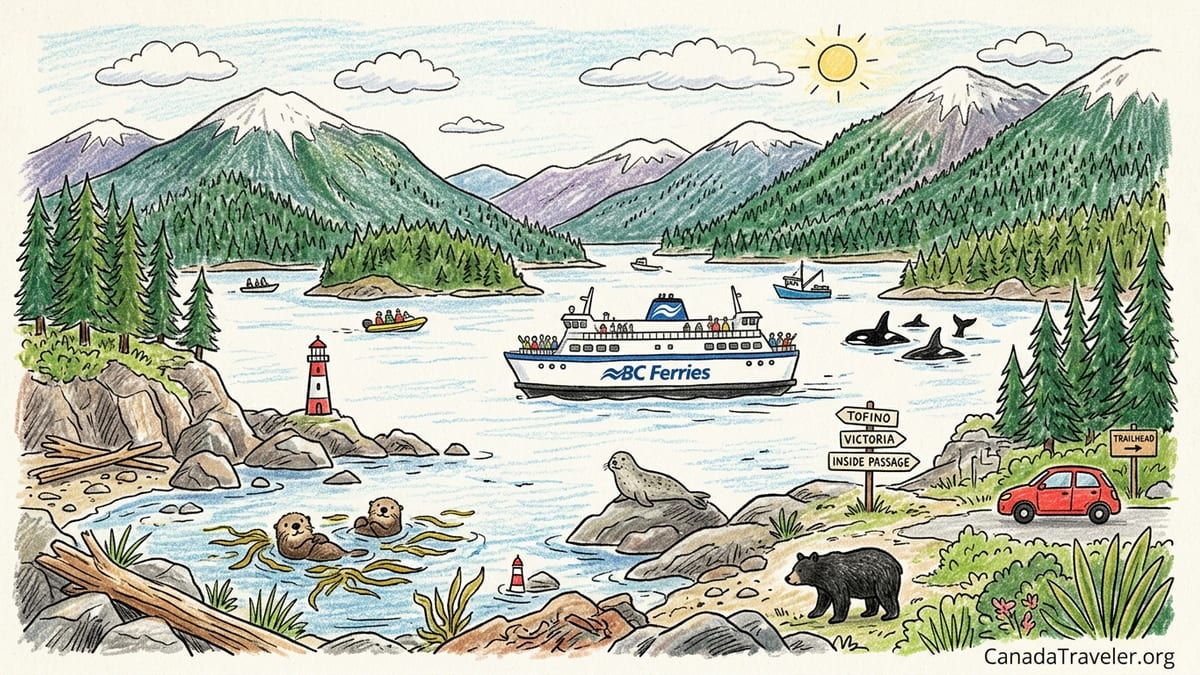
Look for concrete clues in the day-by-day outline. Itineraries that include multiple ferry crossings with BC Ferries between Vancouver and Victoria or Nanaimo, or that feature smaller communities such as Tofino, Ucluelet, Campbell River, Port Hardy or Telegraph Cove, are typically coastal in focus. Some longer circuits add an Inside Passage sailing between Port Hardy and Prince Rupert, or small-ship cruises with companies such as Maple Leaf Adventures that remain within British Columbia’s fjords and channels rather than heading directly to Alaska. These are strong indicators that you will actually travel the Pacific shoreline rather than simply fly over it.
By contrast, tours that devote three or more nights to Jasper, Banff or Lake Louise, or highlight the Icefields Parkway, the Athabasca Glacier or the Rocky Mountaineer train without any extended time on Vancouver Island, are Rockies-heavy products. They can still be superb trips, but they are not true West Coast itineraries. When “West Coast” appears in the name yet the only coastal element is a single night in Vancouver before you board a cruise ship, you are effectively booking a Rockies plus cruise combo, not a land-based exploration of Canada’s Pacific coast.
Before you book, cross-check the map and timing. A seven-to-ten-day itinerary that includes Victoria, Tofino and Campbell River, plus two or more ferry crossings and at least one full day on the water for whale or bear watching, is almost certainly coast-focused. Anything shorter that tries to include both the Rockies and Vancouver Island is likely to rush the shoreline and treat it as a transit corridor rather than a destination.
Vancouver and Whistler: City, Mountains and Semi-Independent Freedom
Vancouver-and-Whistler packages are the easiest way to sample both urban and alpine sides of the coast in under a week. A typical guided short break might include two nights in downtown Vancouver and two in Whistler, with coach transport along the Sea to Sky Highway. Small-group operators and local companies often keep groups under 24 passengers and use minibuses rather than large coaches, which allows more flexibility for photo stops at Shannon Falls or the Sea to Sky Gondola viewpoint.
Commercial examples range from day trips that leave Vancouver in the morning, stop briefly in Squamish and spend four to five hours in Whistler Village, to more immersive three- or four-day tours with hotel stays and included excursions such as gondola tickets or bike rentals. Prices for guided day trips from Vancouver to Whistler generally start around the low hundreds of dollars per person, depending on season and inclusions. Accommodation on overnight packages is usually in mid-range hotels in central Whistler, with breakfasts included and other meals at your own expense. This structure gives you several hours each day to explore independently while your main transport is still taken care of.
For semi-independent travelers, a common alternative is to rent a car in Vancouver, drive the Sea to Sky Highway and assemble your own Whistler stay. A compact rental might cost roughly the price of one guided day trip spread across three or four days, especially if split between two people. Parking in Whistler is not free, but self-drivers gain the ability to stop at trailheads for hikes such as the Stawamus Chief or to detour to small lakes around Pemberton. The trade-off is that you need to book your own accommodation, compare gondola and activity prices and keep an eye on driving conditions, particularly in winter when snow tires and potential storms become factors.
For most visitors primarily interested in Canada’s Pacific coast, Vancouver-and-Whistler packages make sense as either a short introduction or as a bolt-on before or after more coastal touring on Vancouver Island. They are not, by themselves, enough to claim you have really experienced the West Coast, because they include no ferries and very limited time on the ocean. However, if you combine them with at least several days on Vancouver Island or an Inside Passage segment, they become a strong foundation for a wider coastal circuit.
Vancouver Island Tours: Ferries, Small Towns and Coastal Culture
Vancouver Island is the heart of land-based travel on Canada’s Pacific coast. Reaching it requires a ferry crossing of roughly 90 minutes to 2 hours through the Salish Sea, usually between Vancouver’s Tsawwassen terminal and Swartz Bay near Victoria or between Horseshoe Bay and Nanaimo. Most guided tours include ferry tickets and manage vehicle logistics for you, which reduces stress when sailings are busy in summer. On the water, passengers typically have open-air decks for coastal views and a cafeteria or lounge for the crossing.
Guided Vancouver Island itineraries range from two-day Victoria city breaks to ten-day loops of the entire island. A common mid-length product spends three nights on the island, splitting time between Victoria and either Tofino or Ucluelet on the wild west coast. Group sizes vary: some operators keep numbers to a maximum of 12 to 18 guests using minibuses, while larger coach tours can reach 40 passengers. Accommodation is usually in three- to four-star hotels or lodges located near the waterfront in Victoria and on or near the beach in Tofino, often with breakfast included. Meals in Tofino and Ucluelet tend to be independent, giving you the freedom to dine at local seafood restaurants or casual cafes.
Real-world examples include multi-day “Vancouver Island Highlights” tours combining Victoria, Cathedral Grove’s giant Douglas firs and coastal time in Tofino with optional whale watching or surfing lessons. These packages often bundle in the ferry, ground transport and a limited set of excursions, such as a visit to Butchart Gardens outside Victoria or a guided walk in Pacific Rim National Park Reserve. Prices for week-long small-group island tours typically land in the low to mid thousands of dollars per person, depending on season, room category and whether wildlife excursions are included.
Semi-independent approaches are popular because Vancouver Island is easy to explore with a car. Renting a vehicle in Vancouver or Victoria allows you to piece together your own circuit: perhaps two nights in Victoria, two in Tofino, a night in Campbell River and a final night around Parksville or Nanaimo. Ferry fares for cars and passengers are clearly published, and most coastal communities have a range of family-run motels, chain hotels and cabin-style lodges. The trade-off is that you must time your driving to ferry schedules, book accommodation well in advance for July and August and cope with long summer queues at popular viewpoints and trailheads.
Active and Hiking-Focused West Coast Itineraries
For travelers who want to spend more time on trails than on tour buses, active and hiking-focused itineraries on the West Coast can be compelling. Some adventure travel companies offer guided small-group tours that combine Vancouver Island’s coastal paths with sections of inland forest and occasional beach camping. These might include day hikes in Pacific Rim National Park Reserve near Tofino, coastal trails near Sooke on southern Vancouver Island or easier walking routes in Strathcona Provincial Park inland from Campbell River. Group sizes in this segment are usually small, often between 8 and 14 guests, to keep things manageable on narrow trails and at shared campsites.
At the more adventurous end of the spectrum, specialized outfitters guide backpacking expeditions on the West Coast Trail, a demanding multi-day hike along the island’s southwest edge. These trips are tightly regulated, with limited daily permits and strict rules on safety and environmental impact. Guided versions typically include pre-booked trail permits, transport to and from trailheads and shared outdoor equipment such as group cooking gear. Meals are generally included and carried in by the group, and accommodation is in tents at designated beach or forest campsites. Travelers still need to be fit and comfortable with muddy terrain, ladders, cable cars and tidal planning.
Active tours usually build in more structured days and fewer free hours compared with standard coach itineraries, because hiking routes and safety briefings dictate the schedule. However, independent time can still be found in evenings at base towns like Ucluelet or Port Renfrew, where you can explore small harbors, local breweries or short additional walks on your own. Self-planned hikers who are confident in their logistics can use rental cars and public information from BC Parks to design similar routes, but they must personally secure permits, monitor weather and manage transportation at both ends of one-way trails.
When comparing guided hiking tours to independent trekking, consider that professional guides bring local knowledge of tides, wildlife habits and trail conditions that difficult coastal routes demand. The cost per person for these guided trips is higher than a basic road tour, largely because of small groups, included meals, specialized gear and permit fees. Yet for many, the reassurance of not having to self-rescue if conditions deteriorate, and the ability to focus on scenery rather than navigation, make the premium worthwhile.
Wildlife-Focused Tours: Whales, Bears and Coastal Ecosystems
Wildlife is one of the primary reasons travelers choose Canada’s Pacific coast over inland alternatives. Dedicated wildlife tours, often based in communities such as Tofino, Ucluelet, Campbell River, Port Hardy and Telegraph Cove, focus on encounters with whales, sea otters, seals, sea lions and coastal bears. Operators typically run half-day boat trips in small vessels, either rigid-hull inflatables or covered boats with outdoor viewing decks. Group sizes may range from 12 to about 40 passengers, with smaller boats offering more intimate experiences and larger ones providing a steadier ride.
Real-world examples include whale watching outfits in Nanaimo and Victoria that operate multiple departures during peak season, and bear-watching tours from Tofino that glide along sheltered inlets at low tide to watch black bears turning rocks in search of crabs. Further north, Indigenous-led companies based near Port Hardy and in the Broughton Archipelago offer combined whale and grizzly bear viewing, incorporating cultural interpretation alongside wildlife sightings. These tours usually run full-day schedules, with small groups and knowledgeable guides who explain both ecological dynamics and Indigenous history of the region.
Standalone wildlife tours can be booked as independent day trips while you travel on your own, or they can be bundled into broader coastal itineraries. Many multi-day Vancouver Island tours list wildlife experiences as optional add-ons, letting you choose between, for example, a bear watching excursion in Clayoquot Sound or a half-day whale watching trip. In these cases, the base package cost does not include the wildlife component, but group discounts or preferred scheduling may be arranged through the tour operator. Fully inclusive wildlife itineraries, particularly those heading into the Great Bear Rainforest on small ships, typically include all meals, all excursions and guiding and come at a higher price point, reflective of the remote setting and specialized crews.
Planning independently, you can mix and match wildlife tours according to your interests and budget. Booking a whale watching trip directly in Victoria, a black bear cruise in Tofino and a grizzly day tour from Campbell River lets you spread costs across your journey. However, popular departures in September and during holiday periods sell out quickly, so advance reservations are essential. You must also be responsible for reaching departure docks on time, often very early in the morning, which can be difficult without your own vehicle or when relying on infrequent local buses.
Longer Coastal Circuits and the Inside Passage
For travelers with 10 to 14 days or more, longer coastal circuits provide a deeper immersion into Canada’s Pacific edge. One common structure is a loop that starts in Vancouver, crosses to Vancouver Island, travels the length of the island by road from Victoria to Port Hardy and then boards a ferry or small ship along the Inside Passage toward northern British Columbia. From there, some tours connect to a train route inland, while others return south along the coast or link with Alaska-bound cruises.
Guided versions of these routes can be found in the portfolios of Canadian and international tour companies. Many keep groups small, often under 24 guests, and use mid-sized ships or chartered ferries combined with a touring coach or minibus on land. Ferries and small ships may range from BC Ferries’ large Inside Passage vessels to expedition-style boats that pull into small inlets and anchor near remote islands. Accommodation on such circuits is a mix of comfortable hotels in larger towns like Victoria or Nanaimo, simpler lodges in smaller communities along the island and ship cabins of varying categories on the longer sea segments. Most of these tours include some breakfasts and several dinners, particularly on sailing days, while leaving lunches flexible.
One example of this style of itinerary follows the length of Vancouver Island before boarding an Inside Passage ferry to Prince Rupert, then continuing inland by train to Jasper. While the inland train component shifts the focus away from the coast, the fact that the entire island and the Inside Passage segment are included means the Pacific shoreline is genuinely central to the experience. Another small-ship operator offers coastal expeditions through the Inside Passage and nearby archipelagos with no inland Rockies component at all, concentrating entirely on fjords, islands, wildlife and Indigenous coastal communities.
Independent travelers can re-create similar circuits by combining BC Ferries routes, rental cars and regional flights. For example, you might drive from Victoria to Port Hardy over several days, stopping in Campbell River and Port McNeill, then sail the Inside Passage north before hopping a train or flight onward. Doing this without an organized tour often reduces per-person costs if you travel as a couple or family and select modest accommodation. However, you must be comfortable navigating ferry booking systems, coping with early-morning check-ins and planning around limited sailing days on some of the more remote routes.
In the longer-circuit category, the distinction between true coastal itineraries and Rockies-heavy journeys is particularly important. Some products advertise an “Inside Passage and Rockies” combination that dedicates only a single day to coastal waters while devoting most nights to mountain towns. Others spend an entire week in coastal channels and on Vancouver Island before making a shorter inland hop. Reading carefully and prioritizing itineraries that emphasize ferries, coastal communities and wildlife excursions will ensure your trip aligns with the Pacific-coast focus you are seeking.
Guided vs Semi-Independent vs Fully Independent: What Really Changes
When comparing guided tours, semi-independent packages and a fully independent self-drive, the most meaningful differences come down to control, complexity and cost per person. A classic guided coach or small-group tour bundles accommodation, main transport, some excursions and occasionally some meals into a single purchase. You give up some flexibility in return for the simplicity of having logistics handled. Semi-independent packages, such as those that include city-center hotels, ferry tickets and a rental car or rail segment, sit in the middle. Independent travel requires the most planning but gives you the greatest freedom to choose pacing and specific activities.
On a guided small-group coastal tour, daily structure is usually clear: breakfast together, a morning drive or excursion, a midday arrival at a new town or trail, and a few hours of independent time before an optional group dinner. You might have two or three evenings entirely free in places like Victoria and Tofino, plus pockets of free time in smaller communities for self-guided walks. A larger coach tour tends to be more regimented due to the challenge of moving many people at once, but still allows independent dining and some unscheduled hours most days. Transport is typically in one dedicated vehicle for the whole itinerary, with ferries and boats arranged for the group.
Semi-independent products might deliver a rental car at your Vancouver hotel, bundle in reserved ferry crossings and provide pre-booked hotels in each destination but leave daily sightseeing entirely to you. You drive yourself, choose whether to book a wildlife tour or simply walk the shoreline, and decide where to eat. This style suits travelers who like the reassurance of confirmed beds and timed ferries but do not want to be tied to a group timetable. Meal inclusions are usually limited to breakfasts where hotels provide them; lunches and dinners are almost always on your own.
Fully independent travelers typically rent a car and assemble all components themselves. They can choose budget motels in Nanaimo, cabins in Ucluelet, homestays near Campbell River or higher-end lodges in Tofino, according to budget. They also have complete control over group size, which might be just a couple or a family of four. Transport, meal planning and excursion booking are entirely self-managed. The upside is flexibility: if you hear about a fantastic bear-watching company in town or find that the weather is better in one area of the island, you can shift your plans more easily, provided availability allows.
In terms of cost, guided tours often look expensive at first glance but can be competitive once you factor in high-season hotel rates in popular coastal towns, ferry fares for vehicles and the cumulative prices of separate wildlife tours. Independent travel can be cheaper if you are willing to travel shoulder-season, book early and select modest accommodation, but it can also be more expensive if you favor short-notice changes and higher-end properties. Your tolerance for planning and uncertainty is as important as your budget when choosing the right style.
How to Choose the Right West Coast Experience for You
With so many permutations of cities, islands, wildlife hotspots and inland add-ons, it is helpful to think in terms of priorities and travel style. If your primary interest is experiencing whales, bears and wild coastal landscapes with minimal stress, a small-group Vancouver Island or Inside Passage tour that includes several dedicated wildlife days is likely the best match. Look for itineraries with multiple nights in key towns such as Tofino, Ucluelet, Campbell River or Port Hardy and at least two boat-based wildlife excursions.
If you value culture and food as highly as scenery, consider combining a semi-independent Vancouver and Victoria stay with a guided loop to the island’s west coast. This gives you time in walkable neighborhoods, access to museums and galleries and the freedom to explore local restaurants while still benefiting from organized transport through rural areas where public options are limited. Vancouver-and-Whistler extensions fit well on either side of this core, particularly in winter or early spring when mountains and city are at their most contrasting.
Travelers who enjoy driving in new countries and want maximum flexibility might use the guided and semi-independent products mainly as research tools. By examining sample itineraries, you can design your own route with similar pacing and overnight stops, then adjust it to your interests. You might add more time in lesser-visited spots like Port Alice or Sointula, swap out a popular whale watching harbor for a quieter one or include extra nights in one place to simply walk beaches and watch stormy Pacific weather roll in.
Whichever option you choose, the key to a satisfying West Coast Canada trip is to ensure the Pacific itself is at the center of your plan, not a side note. That means time on ferries, nights in coastal communities, and at least a couple of days spent close to the water aboard small boats or on foot. If an itinerary seems more excited about glaciers and high mountain passes than about tidal flats and sea lions, it may be a wonderful journey, but it is not the coastal experience you are seeking.
The Takeaway
West Coast Canada is more than a marketing phrase. For travelers drawn to Pacific beaches, storm-carved headlands and the possibility of watching whales breach against a mountain backdrop, it describes a specific band of islands, inlets and shoreline communities that deserve unhurried exploration. Vancouver and Whistler provide a polished gateway, but the true coastal narrative unfolds on Vancouver Island, in smaller towns along the Strait of Georgia and up through the intricate waterways of the Inside Passage.
Guided and semi-independent tours remove much of the logistical friction from this region, bundling ferries, accommodations and key excursions into coherent journeys. Small-group Vancouver Island loops and Inside Passage expeditions are particularly effective at balancing structure with free time, giving you both the security of an organized trip and space to explore on your own. They suit travelers who want to maximize their chances of seeing wildlife and iconic scenery without having to master ferry timetables or coastal road networks.
Renting a car and arranging a similar route independently appeals to those who enjoy planning, value flexibility and are comfortable navigating in a foreign country. It can be cost-effective and rewarding, especially outside peak season, but requires more advance work and a higher tolerance for last-minute changes due to weather or availability. Many visitors find that a hybrid approach works best: a mix of self-planned days in major cities and short guided segments in remote or wildlife-focused areas.
Ultimately, the best West Coast Canada itinerary is the one where your time roughly matches your interests: hours spent on ferries and small boats if the ocean is your priority, days on trails if you favor hiking, and evenings in small coastal towns if your perfect trip includes lingering over local seafood as the sun sets over the Strait. By reading itineraries carefully and matching the style of tour to your preferences for structure and independence, you can be confident that your journey along Canada’s Pacific coast will be exactly what you imagined.
FAQ
Q1. How many days do I need for a meaningful West Coast Canada trip?
For a coastal-focused itinerary that includes Vancouver, Victoria and at least one additional Vancouver Island destination such as Tofino or Campbell River, plan a minimum of 7 to 10 days. With 12 to 14 days, you can comfortably add Whistler or an Inside Passage segment without feeling rushed.
Q2. Is it better to book a guided Vancouver Island tour or drive myself?
If you dislike planning and want ferries, hotels and some wildlife tours bundled together, a guided or semi-independent package is easier. If you enjoy driving, want flexibility to stop wherever interests you and are comfortable booking ferries and accommodation, self-driving can be more flexible and sometimes cheaper.
Q3. Do West Coast Canada tours usually include meals?
Most coastal coach and small-group tours include daily breakfast and some dinners, especially on boat or ferry segments. Lunches and many dinners are often left independent so you can try local restaurants in places like Victoria and Tofino.
Q4. What size are groups on typical West Coast Canada tours?
Coach tours can have 30 to 40 passengers, while small-group and adventure-oriented itineraries often limit numbers to about 12 to 24. Wildlife day tours in small boats may carry roughly a dozen to a few dozen guests, depending on the vessel.
Q5. How much independent time will I have on a guided coastal tour?
Most itineraries offer several hours of free time on most days, especially in larger towns. You can often explore city centers, waterfronts or short trails independently, though long hiking days or boat-based wildlife trips will naturally be more structured.
Q6. Are ferries included in West Coast Canada tour prices?
On guided and semi-independent itineraries that feature Vancouver Island or the Inside Passage, standard passenger and vehicle ferry fares are usually included in the tour price. Independently, you must purchase ferry tickets yourself as part of your trip budget.
Q7. When is the best time to visit for whale and bear watching?
Wildlife viewing seasons vary by location, but late spring through early autumn generally offers good chances of seeing whales and coastal bears. Many operators consider late summer and early fall particularly reliable, especially during salmon runs.
Q8. How can I tell if a tour really focuses on the Pacific coast?
Check the day-by-day itinerary for multiple ferry crossings, several nights on Vancouver Island and visits to coastal communities such as Tofino, Ucluelet, Campbell River or Port Hardy. If most nights are in inland mountain towns, the tour is Rockies-heavy rather than coastal.
Q9. Is renting a car in Vancouver necessary for coastal travel?
A rental car is very useful for exploring Vancouver Island and smaller coastal towns, but not strictly essential in Vancouver and Victoria where public transport and walking work well. Many travelers combine a car-free city stay with a rental only for the island portion.
Q10. Can I combine a coastal tour with a Rockies trip in one vacation?
Yes, many visitors do both regions on a single trip, often by starting with Vancouver and Vancouver Island before heading inland by train, coach or rental car. Just be aware that trying to see both in under 10 days will limit how deeply you experience each area.