


I arrived at Hopewell Rocks with the iconic postcard in my head: flowerpot sea stacks rising from a bare red ocean floor, a few tiny people for scale and endless space to wander. The real experience in 2026 turned out to be much messier. The problem was not the rocks themselves, which are genuinely extraordinary, but the sharp gap between the dream sold in photographs and the tight, unforgiving reality of tides, timing, rules and crowds on the ground.
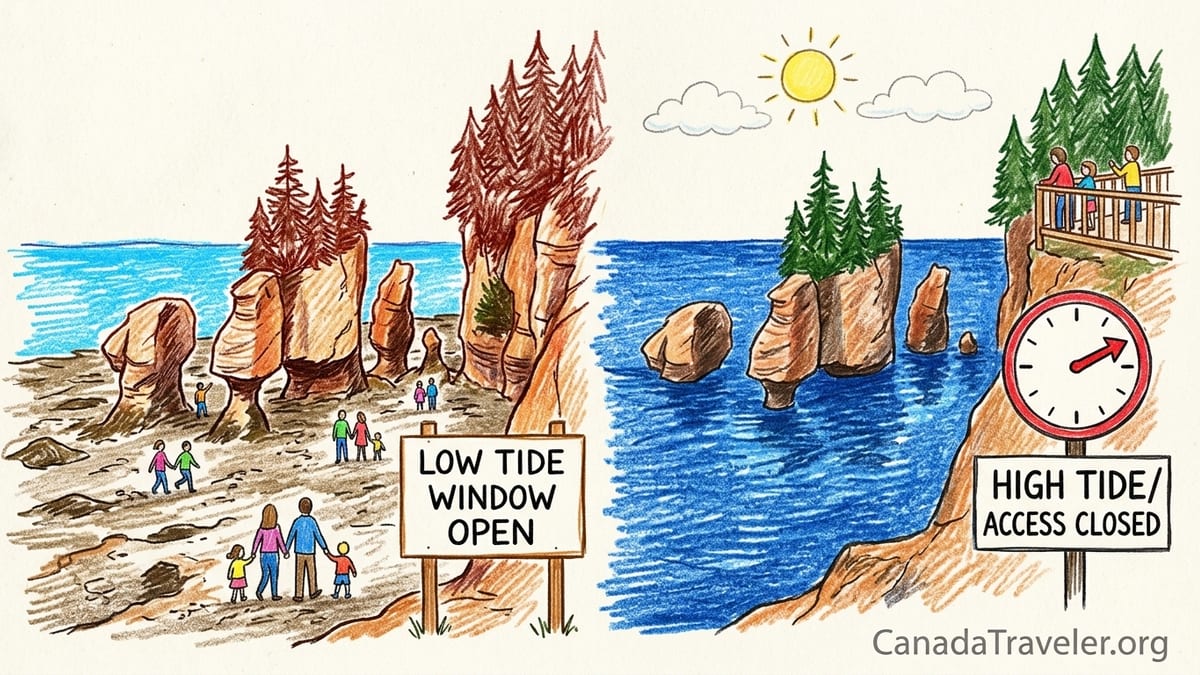
The Promise Versus the Reality
Like many visitors, I did my basic homework before driving down Route 114 toward Hopewell Cape. I knew the Bay of Fundy has some of the highest tides in the world and that you can “walk on the ocean floor” at low tide. What I did not fully grasp until I was standing in the parking lot was how brutally the timing dominates everything. Those famous low-tide photographs represent a window of only a few hours, twice a day. Miss that window and you do not stroll among the flowerpot formations at all. You stand at a fenced lookout, squinting down at brown water and slick cliff walls, wondering what you did wrong.
On brochures and tourism campaigns, Hopewell Rocks is presented as a flexible highlight on any Maritime road trip. In practice it behaves more like a scheduled performance with a non-negotiable start time that shifts every single day. Families rolling in from Moncton after a late breakfast, tour buses caught behind roadworks and cruise passengers on rigid shore excursions all collide with a tide table that refuses to budge. When visitors discover that their “once in a lifetime” stop is in the wrong part of the six-hour tidal cycle, frustration is understandable.
The rocks themselves are incredible. That is precisely why the disconnect stings. The marketing suggests that a ticket and a sunny forecast are enough. On my visit, the Bay of Fundy’s physics, the park’s limited season and the practical challenges underfoot made it very clear that they are not.
The Six-Hour Tidal Whiplash No One Warned Me About
The single biggest factor that makes Hopewell Rocks feel overrated is not crowds or price. It is timing. The tide in the Bay of Fundy rises and falls roughly every six hours, with about six hours and a bit separating low tide from high tide. Local operators and New Brunswick tourism material repeat the same rule of thumb: walking safely on the ocean floor is possible only from about three hours before low tide to about three hours after. Outside that window, the access points are closed off and staff start moving people back toward the stairs as the water races in.
That six-hour swing sounds generous until you start plotting it against real-world itineraries. On the day I visited, the first low tide window fell around mid-morning, which was perfect for early risers but almost impossible for anyone driving in from further afield that same day. The second low tide arrived after the park’s closing time, which meant that half the day’s tidal cycle simply could not be experienced legally. If your one available driving day to Hopewell Rocks happens to line up with low tide at dawn and again late at night, you have a problem that better planning cannot solve.
I watched one family arrive at the Main Deck lookout in the early afternoon, when the tide was already climbing. They had kids in flip-flops and hoodies, cameras ready, and you could see the confusion bloom as they stared at a churning brown bay instead of an empty red seabed. A staff member explained, politely but firmly, that ocean floor access was already closed for safety. Their admission still allowed them to walk the cliffside trails and peer down at the formations from above, but the experience they had driven hours for was gone for that day.
Even travelers who understand the theory of “check the tide table” often do not realize how tightly that rule boxes them in. If low tide is at 1:30 p.m., you really need to be on the stairs down by about 11:00 a.m. to get decent time on the floor before they start clearing people out. If your road trip schedule or your tour bus does not bend around that specific number, the rocks will not bend around you.
Parking, Admission and the Two-Day Ticket Question
Hopewell Rocks is no longer a casual roadside stop where you pull over, scramble down and leave a donation. It is a provincial park with gate staff, paved parking lots, food concessions and posted regulations. As of the 2026 season, the official daily entrance fee set under New Brunswick’s Parks Act for an adult between 19 and 64 years is 18.15 Canadian dollars before tax, and a family ticket is 45.37 Canadian dollars before tax. These rates apply from April 1, 2026, through March 31, 2027, and provincial sales tax adds another 15 percent on top of the posted prices.
Your ticket is valid for two consecutive calendar days within the operating season, a perk heavily promoted in the FAQ and visitor materials. On paper this sounds like a perfect solution to the tide problem. In practice it only helps if your travel plans already include two separate visits or an overnight nearby. Many long-distance road trippers do not have that luxury. I spoke to a couple from Ontario who had looped their entire Maritime itinerary around a single afternoon stop. They paid the full adult rate, saw only mid-tide from the viewpoints, and left feeling that the second day printed on their tickets was nothing more than an unused promise.
Even for travelers who do stay locally, the two-day arrangement has fine print that matters. It does not extend the park’s daily operating hours or bend them around the tides. If the only low tide during your stay falls outside those hours, the second day on your ticket cannot conjure up safe access to the ocean floor. The ticket buys you admission, not water-level magic. It solves the desire to see both low and high tides on different days only when nature and the clock happen to line up.
Parking itself is straightforward but not free if you count your time. On busy summer days, I watched vehicles circle for spaces and families trek from overflow areas at the top of the hill. Unlike spontaneous roadside attractions such as the St. Martins Sea Caves or many Bay of Fundy pullouts, Hopewell demands a queue at the gate, a structured arrival, and the quiet hope that traffic and weather have not eaten into your precious tide window.
Seasonal Closure and Why Off-Hours Access Is Prohibited
Another reality that undercuts the Instagram fantasy is how short and rigid the official season is. For 2026, publicly available planning resources for Hopewell Rocks list the operating season as ending on October 25. The precise opening date varies slightly by year, but in general the park is open only from late spring through to mid or late October. Outside those dates the site is officially closed. The official FAQ makes the reasoning blunt: access to the park outside operational days and times is strictly prohibited because of the powerful tides, the risk of rockfall from the cliffs, harsh off-season weather and the absence of safety and interpretive staff.
In practical terms, this means two things. First, if your Maritime road trip falls in late October or during shoulder seasons, the iconic walk among the flowerpots is simply not available as a legal, supported activity. Second, even inside the season, the daily operating hours can still clash with favorable low tides. Tide times are posted on provincial sites in Atlantic Time with clear notes that walking the ocean floor is only possible during the low-tide window. Staff do not remain on duty around the clock, and the stairs are not designed to function as emergency escape routes under floodlight at midnight.
It is true that some locals and determined photographers report hopping gates or walking in from outside the main entrance during the off-season, effectively accepting the risk themselves. It is also true that the park’s warnings are based on real incidents, including sudden rock collapses like the partial failure of Elephant Rock several years ago. Once you have stood on that damp, uneven ocean floor and looked back up at the cracked strata above, the logic of closing the area when no one is watching becomes very difficult to argue with.
For out-of-province visitors, the key point is that “closed” at Hopewell Rocks does not mean “reduced services.” It means the official access points are shut and you are not supposed to be down at the base of the cliffs at all, regardless of how perfect the low tide might be on your phone’s tide app.
Steps, Ramps and the Misleading Idea of Easy Access
The trail network at Hopewell Rocks is often presented as friendly and accessible, and parts of it are. The walk from the visitor centre along a wooded, sloping path to the first viewpoints is gentle and straightforward. The real test begins the moment you attempt to reach the ocean floor itself. The main route down is the so-called Main Deck staircase, a wooden structure that drops 99 steps to the base and requires you to climb 101 steps back up when the siren sounds and the tide begins to chase you inland again.
On my visit, those steps were clogged at peak times with visitors pausing to catch their breath, tourists stopping mid-flight for selfies, and families coaxing small children up each riser. The 99-step descent looks manageable when you are still fresh. The 101-step climb back to the top after an hour on slippery mud and stones feels like a test of cardio fitness you did not sign up for. There are landings to pause, but they fill up quickly on busy days, and there is a real sense of one-way traffic pressure whenever the water starts to turn.
There is a second primary access point at North Beach, a long ramped path promoted as a stair-free alternative. Tourism material and the park’s own descriptions often highlight this as a more accessible option, and it is gentler in terms of gradient. Yet the ramp only solves the problem of getting down from the clifftop. It does not flatten the ocean floor itself. At the bottom you still step onto a mix of mud, scattered stones, slick seaweed and puddled salt water that pose real challenges for visitors with mobility issues, small children or anyone wearing the wrong shoes.
A third, less-publicized route, via the Demoiselle area, adds variety but not simplicity. Regardless of which access you choose, none of them turn the tidal flats into a boardwalk. When visitors arrive expecting something closer to a beach promenade, the reality can feel unwelcoming.
Mud, Footwear and the Myth of the Perfect Photograph
Here is the part the postcards do not tell you. The ocean floor at Hopewell Rocks is not a clean red carpet. It is a tidal zone. That means thick clay-like mud in some sections, lumpy gravel in others, and veils of seaweed draped over rocks that look dry but behave like soap-slick tiles. I watched more than one person step confidently off a firmer patch, plant a sneaker onto dark green weed and skate sideways with a startled yelp. Staff warn people constantly to watch their footing, and it is advice worth taking seriously.
Footwear is an entire subplot. The park recommends sturdy shoes or rubber boots. What I saw in reality were white trainers, flat sandals, ballet flats and lightweight hiking shoes slowly staining red-brown. Children splashed in shallow tide pools and emerged with mud streaked to their knees. A couple from Europe tried to skirt the dirtiest sections to keep their city shoes clean, which meant they saw only a fraction of the formations before retreating to the stairs. If you want the classic shot framed between pillars of rock, you will likely earn it with muddy ankles.
Crowds add another layer of friction. In promotional imagery, the sea stacks stand solitary against a vast sky. In real life, at peak summer low tides, the gap between those stacks can feel like a pedestrian street market without the stalls. People cluster around the most famous formations, queue to duck into caves and tuck themselves against walls for group photos. Taking a photograph without strangers in it becomes an exercise in patience, timing and careful cropping. On my visit, one photographer with a tripod waited almost fifteen minutes before a short lull let him capture a relatively empty scene.
The density of visitors is not the park’s fault. Hopewell Rocks is promoted provincially and nationally, cruise buses converge from Saint John and Moncton, and social media has turned the site into a checklist destination. Yet the combination of narrow access points, fast-changing tides and a confined shoreline means it is extremely difficult to ever feel alone with the landscape unless you catch an off-peak, cloudy shoulder-season low tide. Once again, timing is destiny.
Kayaking, Extra Costs and What Your Ticket Does Not Include
There is one way to experience Hopewell Rocks at high tide that comes closer to the dreamlike posters: by kayak. Outfitters based near the park launch guided trips when the Bay of Fundy waters climb back up around the flowerpot formations, allowing paddlers to weave between rock pillars that were bare mud a few hours earlier. It is a remarkable way to understand the full vertical range of the tide and see the cliffs from water level.
What is less obvious to many visitors browsing brochures is that this kayaking experience is completely separate from the standard park admission. Your 18.15 dollar adult ticket or 45.37 dollar family ticket does not cover kayak rentals or guided tours. Those are commercial services with their own booking systems, schedules keyed to specific high-tide times and additional per-person costs that can easily match or exceed your entry fee. High-tide kayaking also sells out on peak days, particularly when the timing lines up with cruise schedules or long weekends.
This matters because many travelers assume that the two-day ticket structure will automatically allow them to see both low tide on foot and high tide from the water without extra logistical strain. In reality, coordinating a walk on the ocean floor, a return visit to see the formations surrounded by water from viewpoints and a high-tide kayak session involves threading three separate needles: the low-tide window, the park’s operating hours and the outfitter’s available departures. Call it a trifecta of constraint. For families with young children or anyone on a pre-packaged tour, achieving all three can feel impossible.
When you compare this to unscheduled coastal stops elsewhere in the region, the difference is stark. Along the Fundy Trail Parkway, for example, you can pull off at viewpoints or walk onto Long Beach without making an appointment with the moon. At Hopewell, that celestial appointment is the entire show.
Comparing Hopewell Rocks With St. Martins and Long Beach
None of this means the Bay of Fundy is overrated as a destination. Far from it. What it does mean is that some travelers may find better value and more flexibility at other tidal sites compared to the tightly managed machine of Hopewell Rocks. About a two-hour drive west, near the village of St. Martins, sandstone sea caves curve into the cliffs beside a working harbor. At low tide you can walk out across pebbled flats, weave among shallow channels, and enter cave mouths that are swamped again at high water. The tides there are serious, but you view them against the everyday backdrop of fishing boats and small inns. There is no gatehouse charging a dedicated entry fee just to stand on the beach.
Further south along the coast, the Fundy Trail Parkway offers pullouts, viewpoints and access to Long Beach, where exposed tidal flats stretch far away at low tide. You pay a general parkway entrance fee, then explore at your own pace. On my stops there, the experience felt horizontal and open-ended instead of vertical and compressed. If the tide was not ideal at one spot, I could drive fifteen minutes down the road and find a different angle or activity that did not depend on a specific water level.
What Hopewell offers that these places do not is the sheer sculptural drama of the flowerpot sea stacks, carved into playful shapes that lend themselves to names like “Lover’s Arch” or “Mother-in-Law.” You genuinely will not find those forms duplicated at St. Martins or Long Beach. The question is whether that extra drama justifies the additional constraints, costs and crowding, especially if your schedule allows you to experience only one part of the tide cycle.
For travelers who want a more relaxed Fundy encounter, the trade-off may not be worth it. You can still watch the water rise and fall metres up a wharf wall in Alma, wander a near-empty beach near St. Martins or sit above the flats along the Fundy Trail and palpably feel the sea breathing in and out. None of those ask you to synchronize your day to the minute.
Five Real Drawbacks That Visitors Should Take Seriously
After walking the trails, climbing the stairs and squinting at the tide table on my phone, I would highlight at least five concrete drawbacks that many visitors underestimate. First, the dependence on very specific low-tide windows means that a sizable portion of travelers arrive at the wrong time and cannot do the thing they paid and planned for: walking among the formations. No amount of scenic viewpoints from above replaces that feeling when you are standing at the base of a sea stack and looking up.
Second, the brief operating season ending on October 25 in 2026 cuts off late-autumn and winter visitors entirely. Even shoulder season travelers in October must adapt to shorter daylight, cooler temperatures and a higher probability that at least one of the day’s ideal low-tide windows will fall outside opening hours. Third, the physical access is harder than many people expect. Those 99 steps down and 101 back up are real, and the ramped North Beach alternative still delivers you onto uneven, slippery ground. For anyone with bad knees, heart issues or a fear of crowded staircases, this can be a serious limitation.
Fourth, the combination of mud, stones and seaweed makes the ocean floor itself an obstacle course. Sturdy footwear and a tolerance for getting filthy are not optional if you want to explore more than a token distance from the bottom of the stairs. That is a significant adjustment if your mental image was a gentle sandy beach with a few photogenic rocks. Fifth, the crowds at peak times and in peak season degrade both safety and serenity. Narrow stairs, sirens warning of incoming tides, ATV-riding staff urging stragglers back and thick clusters of people around the most famous formations do not add up to the contemplative nature experience many visitors expect from the glossy marketing.
None of these drawbacks erase the geological wonder of the place, but they fundamentally change the experience. They also raise the uncomfortable question at the heart of this investigation: is Hopewell Rocks overrated, or simply misunderstood? In my view, it is oversold as an easy highlight. With full information and realistic expectations, it can still be a powerful encounter. Without those, it can feel like an expensive disappointment pinned to the wrong tide chart.
The Takeaway
So when does Hopewell Rocks truly deserve its reputation? For a start, you need a day when one low tide happens squarely inside operating hours with enough buffer on either side. You need to arrive on site at least two hours before the published low-tide time, wearing footwear that you do not mind sacrificing to red mud. Ideally you either stay nearby or use that two-day ticket to visit the site once at low tide on foot and once at or near high tide from the clifftop viewpoints. If kayaking is on your wish list, you also need to book a separate high-tide tour that meshes with both the tide and your admission window.
The key is to ignore opening hours as your primary planning tool and instead start with real tide predictions. Use a Bay of Fundy tide table keyed specifically to Hopewell Cape in Atlantic Time and anchor your schedule to low tide, not noon or “after breakfast.” Once you have identified a suitable low-tide window, then and only then do you layer in driving times from Moncton, Saint John or Halifax, your hotel checkout and your other stops in the region. If you cannot make any low-tide window work during your travel dates, it may be wiser to shift your expectations or prioritize other Fundy experiences such as the St. Martins Sea Caves or Long Beach on the Fundy Trail.
Hopewell Rocks is not a casual detour. It is an appointment with gravity, the moon and a very rigid timetable, all compressed into trails, stairs, ramps and a muddy, unforgettable strip of ocean floor. If you walk into that appointment fully informed, the place can still amaze you. If you arrive expecting the postcards to match any random afternoon, you may leave wondering how such a monumental natural wonder can feel so unforgiving.
FAQ
Q1. Is Hopewell Rocks really overrated, or is it still worth visiting?
It is worth visiting if you plan obsessively around the tide, accept the mud and crowds, and understand that walking the ocean floor is only possible in a narrow low-tide window.
Q2. How close to low tide should I arrive to walk among the flowerpot rocks?
Aim to be on the stairs down about two to three hours before the posted low-tide time so you have room to explore before staff start clearing people out.
Q3. Can I visit Hopewell Rocks outside official operating dates or in the evening after closing?
No. Access outside operational days and hours is officially prohibited because of powerful tides, risk of rockfall, harsh weather and the lack of safety staff on site.
Q4. How much does it cost to visit Hopewell Rocks in 2026?
For the April 1, 2026 to March 31, 2027 period, daily admission is set at 18.15 Canadian dollars before tax for adults and 45.37 Canadian dollars before tax for families.
Q5. Does the two-day ticket guarantee I will see both high and low tide?
No. The ticket is valid for two consecutive days, but it does not change the tide times or park hours. You still need tide predictions that fall within operating hours.
Q6. How hard are the stairs and ramps to the ocean floor in practice?
The Main Deck staircase has 99 steps down and 101 back up, and it feels strenuous when crowded. The North Beach ramp avoids stairs but still leads to uneven, slippery tidal flats.
Q7. What kind of footwear should I bring for walking on the ocean floor?
Wear sturdy shoes or rubber boots that you do not mind covering in red mud. Avoid flip-flops, flat sandals and white trainers if you want to explore more than a token distance.
Q8. Is high-tide kayaking included in the park admission price?
No. High-tide kayak tours are operated by separate outfitters, with their own per-person fees and tide-based schedules, and are not covered by your standard entry ticket.
Q9. How does Hopewell Rocks compare with places like St. Martins Sea Caves or Long Beach?
Hopewell offers more dramatic sea stacks but far stricter timing and crowds. St. Martins and Long Beach provide more flexible, lower-pressure Fundy tidal experiences with fewer constraints.
Q10. What is the single most important planning tip for visiting Hopewell Rocks?
Start with an accurate tide table for Hopewell Cape, pick a day and time with low tide inside operating hours, and build your entire visit schedule around that specific low-tide window.