


I drove to Peggy’s Cove with a head full of Tourism Nova Scotia images: a lone white lighthouse on silent granite, a handful of fishing boats in a misty harbour, and the kind of stillness you associate with a village that folds up after dark. By the time I turned back toward Halifax later that day, I was asking a very different question than when I left: once you have taken the postcard lighthouse photo, how much real substance is actually left at one of Nova Scotia’s most heavily promoted stops?
The Drive from Halifax: Expectations Meet the Lighthouse Route
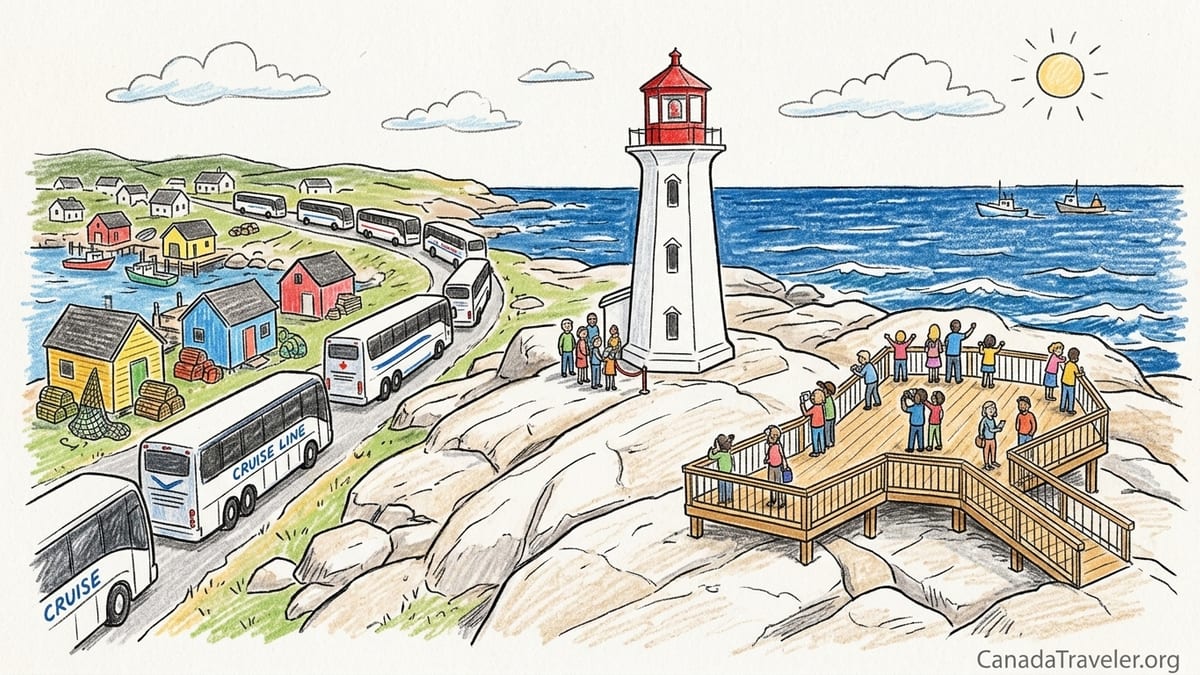
From downtown Halifax to Peggy’s Cove, the drive looks almost tailor-made to build anticipation. You leave the city on Highway 333, often called part of the Lighthouse Route, and within 20 minutes you are passing rocky coves and small communities like Goodwood and Shad Bay. Official visitor information usually frames Peggy’s Cove as “less than an hour’s drive” from the city, and that is accurate if traffic is smooth and you do not stop. What tends to be glossed over is that on a sunny July or August day, especially when a cruise ship is in port, that final stretch can feel like a slow-moving queue of cars, tour coaches, and rental SUVs all funnelling toward a village of barely a few dozen year-round residents.
As a travel writer I went in with genuine excitement. Every Halifax brochure and hotel concierge still treats Peggy’s Cove as the default day trip, often ranking it ahead of Lunenburg or the Annapolis Valley. The narrative is consistent: rugged granite, a classic 1914 lighthouse, a tiny working harbour, and a sense that this is “the real Nova Scotia.” I left just after 9 a.m., deliberately aiming to arrive before the period Tourism Nova Scotia describes as generally busiest, roughly 11 a.m. to 3 p.m., when crowds and parking pressure peak. By choosing the “right” time, I hoped to see the village at something closer to its calm, postcard self.
The closer you get, the more the marketing collides with reality. Directional signs shift from “Halifax” and “Lunenburg” to a single goal: Peggy’s Cove. Buses marked with cruise line logos rumble past. Pull-offs that once felt like hidden viewpoints are now packed with cars angling for an early lighthouse glimpse. It is not the traffic of an untouched fishing village; it is the traffic of a branded attraction at the end of a small coastal road.
This is the first hint of the central tension at Peggy’s Cove. The scenery on the way in is undeniably beautiful. But the approach already feels curated around a single image and a single stop, rather than an organic village people happen to pass through on their way to somewhere else.
Parking, First Impressions and the New Viewing Platform
The main parking area sits slightly above the village and the lighthouse, and it has been expanded in recent years as part of a multimillion-dollar infrastructure project that included a large, accessible viewing deck, new washrooms, and improved walkways. The improvements were designed to address very real safety and crowding issues, and they succeed in some important ways. On my visit, even as vehicles stacked up along the access road by late morning, there was a clear system, staff guiding traffic at peak times, and a relatively safe way for people with limited mobility to experience the view without scrambling across uneven rock.
Parking itself was free when I visited, although some private lots around businesses charged their own fees. That feels like an important detail, because some organized excursions sell Peggy’s Cove as a major investment, with half-day coach tours from Halifax often priced around 90 to 120 Canadian dollars per person and some private car or van tours climbing several hundred dollars for a family. Independent travelers who drive themselves and bring their own snacks are not facing those kinds of costs, but they do face the non-monetary price of time spent in queues and crowds once they step out of the car.
From the parking lot, my first impression was not of a village but of an attraction. On one side, a modern building housing washrooms and a visitor area. On another, a busy restaurant with a large deck and a line for chowder before 10:30 a.m. A steady stream of coach passengers flowed along the marked pathway toward the viewing platform, many following a guide with a raised sign. Speakers on one bus were already narrating the history of the 1868 lighthouse while people were still finding their footing on the granite.
Then you walk onto the new accessible viewing deck, and the narrative becomes more complicated. The structure itself is thoughtfully designed, with gentle ramps, sturdy railings, and clear sightlines to both the lighthouse and the Atlantic. It makes Peggy’s Cove accessible to visitors using wheelchairs, strollers, canes, or simply nervous about uneven rock. That is an unquestionable win for safety and inclusivity, and it deserves credit. The trade-off is visual and emotional: you are not alone on a wild headland; you are on a busy platform, shoulder to shoulder with dozens of other visitors, all prioritizing the same selfie angle.
The Lighthouse: Icon, Photo Backdrop and Bottleneck
Peggy’s Point Lighthouse is, objectively, photogenic. The white tower with its red top stands on a sweep of pale granite, the ocean behind it usually some moody shade of blue or grey. It is not hard to see why tourism authorities use this image on everything from airport billboards to provincial travel guides. The question is what happens when hundreds of people arrive within the same midday window, all intent on getting that exact picture.
By late morning, a queue had formed for the classic “lighthouse with person in foreground” photo spot, the informal platform on the rocks near the base of the tower. This was not an official line with ropes, just a social agreement: each small group waited, stepped into the frame, took several versions of the same shot, and then shuffled away. Behind them, more visitors clambered on the rocks, some venturing dangerously close to the dark, wet areas that local authorities warn about relentlessly. Loudspeaker announcements and weathered signs were explicit: stay on the dry, light-coloured granite; do not step on the darker wet rocks; rogue waves can sweep you off even on apparently calm days.
The safety messaging here is intense because it has to be. Local campaigns and warning websites emphasize that the dark, glistening rock marks the reach of previous waves, often lined with seaweed that is as slick as ice. Rescue operations are difficult in the heavy Atlantic swell, and several past accidents have turned fatal. Walking the site, the difference between the dry, pale granite and the darker, damp rock is visually obvious if you know to look for it. The problem is many visitors are focused almost entirely on their phone screens and the lighthouse composition, not the conditions under their feet or the water’s reach. I watched more than one person back up toward the edge without glancing behind them.
Emotionally, the lighthouse visit left me with a sense of compression. In theory, you are on a broad granite landscape, free to wander and absorb the coast. In practice, large sections are functionally off-limits for safety, and the safe, central areas are thick with people posing, calling to friends, and comparing shots. The physical view is still powerful, but the psychic space that brochures promise, that sense of quiet contemplation at land’s edge, is largely gone during the busy mid-day window.
Walking the Village: Fishing Heritage vs Tourist Facade
Leaving the rocks and dipping into the village, you finally encounter the fishing past that fills so many captions. There are weathered wooden sheds along the cove, lobster traps stacked on wharves, and a handful of small boats still working the surrounding waters. It would be inaccurate and unfair to say that Peggy’s Cove no longer has any authentic fishing activity. It does, particularly outside the peak visitor hours, and for residents the ocean remains both a livelihood and a constant presence.
Yet when you walk the main loop in the late morning or afternoon, what dominates is tourism. Souvenir shops cluster along the road, selling everything from locally made crafts to mass-produced trinkets branded with lighthouses and lobsters. Some shops have thoughtful displays of Nova Scotian art and photography, including work inspired by the cove’s granite landscape. Others lean heavily on inexpensive imports that could be found in almost any coastal gift shop in North America. It is a mixed ecosystem, with some businesses clearly rooted in community history and others created primarily to serve the tour-bus flow.
The restaurant and café options follow a similar pattern. A bowl of seafood chowder commonly starts around 18 to 22 Canadian dollars, a lobster roll can push toward 30 dollars, and even a simple fish-and-chips plate can feel surprisingly high once you add tax and tip. For some, it is a fair price to pay for a meal with an iconic view. For budget-conscious travelers or families, it can feel like captive-audience pricing, especially when you compare it to similar dishes in Halifax or in less publicized coastal villages where the same ocean is just as present and the portions sometimes larger.
The fishing-village character is still there in flashes: a resident painting a dory, kids riding bikes between houses, laundry flapping on a line. But these details can be hard to notice through the constant flow of pedestrians on the narrow roadside. Tour groups pause for explanations, visitors spill off curbs to get around them, and cars inch past. It is a lot of human activity compressed into a very small space, and it shifts the feel from “living village that welcomes visitors” toward “village-sized outdoor museum.”
How Much Is Left After the Photo? Real Limitations and Disappointments
This brings us to the core question: once the obligatory lighthouse photos are taken, how much substantial sightseeing remains at Peggy’s Cove, especially if you are visiting in that busy 11 a.m. to 3 p.m. slot? For me, the answer was: not as much as the marketing suggests, and the gaps are worth addressing head-on.
The first limitation is the narrowness of the experience. The vast majority of visitors follow essentially the same loop: parking lot, viewing deck, scramble onto the safe granite around the lighthouse, then back through the village past a string of shops and eateries. There are a few interpretive panels about geology and history, but there is no large, in-depth visitor center to unpack how this glacially carved granite landscape formed, how the fishing economy rose and shifted, or how the community wrestles with heavy tourism today. The story is present, but in fragments.
The second disappointment is the level of crowding relative to the small physical footprint. Even at 10:30 in the morning on a clear summer weekday, I found myself repeatedly stepping aside to let large tour groups pass on the village road and timing my movements on the rocks so I did not end up in someone else’s photograph. Tourism guidance acknowledges that 11 a.m. to 3 p.m. is the worst of it, and local advice strongly suggests arriving early morning or later in the evening. That recommendation is sound, but also an admission: at standard sightseeing hours, the place is saturated.
The third issue is the prevalence of generic souvenir shopping at the expense of deeper engagement. Again, there are exceptions with local crafts and serious artwork, but a substantial portion of retail space is devoted to keychains, magnets and mass-produced decor. If your idea of a memorable maritime stop includes talking to working fishers, learning about lobster seasons, or engaging with coastal conservation, you have to look harder than you should at a destination this famous.
Fourth, the cost-to-experience ratio can feel off if you rely on organized excursions. Half-day group tours from Halifax that package a brief city drive with an hour or two at Peggy’s Cove are often priced near the three-figure mark per person. Cruise-line shore excursions can be even higher. For that investment, many participants are effectively paying to stand in crowded viewpoints and navigate the same narrow loop, with limited freedom to linger on quieter corners or detour to lesser-known spots nearby. Independent visitors in their own vehicle face fuel and time costs, but they retain more control to adjust around the crowds.
Finally, there is the emotional mismatch between the promised tranquility and the on-the-ground atmosphere. Official guides still describe “stepping back in time” and a “tranquil atmosphere,” yet on a peak-season afternoon the soundscape is more likely to include idling bus engines, shouted instructions, and overlapping languages from dozens of separate groups. For travelers seeking contemplation at the ocean’s edge, that gap can be sharply disappointing.
Safety on the Rocks: Rogue Waves, Dark Granite and Real Risk
Of all the realities that promotional material softens, safety is the one that matters most. Local authorities and tourism agencies have spent years trying to correct the romantic notion that the rocks at Peggy’s Cove are just a natural playground. The message is now blunt: the North Atlantic here is cold, powerful and indifferent to visitor expectations, and the rock surface closest to the water is not simply “a bit slippery.” It is a zone where a single misstep or rogue wave can have life-threatening consequences.
The crucial distinction is between the pale, dry granite higher on the headland and the darker, often shiny rock closer to the waterline. The dark sections indicate where waves have recently washed, leaving a film of moisture and often seaweed or algae that cling tenaciously to the stone. Local safety campaigns urge visitors never to step onto these darker patches and never to turn their backs on the ocean near the edge. Rescue personnel and long-time residents routinely recount incidents where people were swept into the surf on days that looked deceptively calm from the parking lot.
Walking across the site, I saw the full range of behavior. Some families kept children well back, pointed out the colour difference on the rocks, and read every safety sign. Others ventured downstep by step, cameras held high, joking about getting “just a little closer” for that dramatic shot. It is easy to see how the casual attitude takes hold: there is no railing cutting off the entire shore, plenty of people are standing within worrying distance of the edge, and dozens walk away dry. The problem is that the risk is not linear. It is not one more step, one more second; it is one unexpected surge.
In this context, the new accessible viewing deck deserves serious praise. It offers a way to feel the waves, wind and horizon without walking the rock at all. For visitors with mobility challenges, small children, or any hesitation about footing, this deck turns Peggy’s Cove from a maybe into a genuine option. It also functions as a pressure valve, absorbing many who might otherwise venture into more hazardous zones. The frustrating reality is that not everyone uses it that way; some treat it as a warm-up before going further out onto surfaces they do not fully understand.
If there is a criticism to be made, it is not of the deck or the warnings but of how tour operators sometimes frame the stop. When Peggy’s Cove is sold primarily as a quick “lighthouse and rocks” photo session en route to somewhere else, safety can feel like a legal disclaimer instead of a central theme. In truth, anyone bringing a group here should lead with safety: explain the dark versus light rock, insist on staying well back from the edges, and remind participants that no image is worth a fall into that water.
Independent Visit vs Organized Excursion: Who Wins?
For many travelers, the first question is not whether Peggy’s Cove is worth seeing at all, but how. Do you rent a car and drive yourself, or join one of the many guided tours departing Halifax hotels and cruise terminals? After weighing both options on the ground, the trade-offs are clearer than glossy brochures admit.
Self-driving is straightforward. The main route is direct, the signage is clear, and in a standard rental car the round trip fuel cost is relatively modest, especially if you combine Peggy’s Cove with other coastal stops. You can leave Halifax early, beating some of the coach traffic, linger if the fog rolls in beautifully, or bail out quickly if the parking lot is heaving and the wind is brutal. You can also detour to less promoted communities along the way, such as Prospect or Terence Bay, to compare how different a Nova Scotian fishing village feels when the tour buses do not arrive every morning.
Organized excursions trade that flexibility for convenience. A typical half-day coach tour bundles hotel pickup, narrated drive, an hour or so of free time at the cove, and a return trip for a fixed price. From a cruise ship, that convenience is multiplied: the coach leaves from the pier, returns in time for departure, and removes any navigation worries. However, you are also locked into group schedules, often arriving squarely within the 11 a.m. to 3 p.m. window when the rocks and paths are most congested.
Then there are private tours and taxis that market Peggy’s Cove as a premium experience. Some Halifax hotels work with car services that offer three-hour round trips in a sedan or SUV for close to 200 Canadian dollars or more per vehicle, not including tips or meals. These tours can be pleasant and unhurried, especially for small groups or those with mobility considerations, but their pricing should not be mistaken for the default cost of visiting. Many independent travelers drive themselves for the price of a one-day car rental and fuel, or carpool with friends, and enjoy the same views.
From an investigative standpoint, what struck me most was how similar the on-site experience looked regardless of how people arrived. Whether they had paid a high per-person tour rate or split gas four ways in a rental car, everyone ended up in the same queues on the granite and the same narrow lanes between gift shops. The real upgrade is not money spent on transport, but time spent planning around crowds and considering alternative coastal stops for the rest of the day.
Beyond Peggy’s Cove: Blue Rocks, Prospect, Terence Bay and Lunenburg
To understand whether Peggy’s Cove is overrated, it helps to step back and compare it with other seaside communities within a reasonable drive. I left the cove feeling squeezed and curious, so I deliberately sought out places that locals often mention in the same breath but tourism campaigns rarely lead with: Blue Rocks near Lunenburg, Prospect, and Terence Bay.
Blue Rocks lies just beyond the UNESCO-listed town of Lunenburg, itself a major draw. It is also a traditional fishing community, but its slate ledges and clustered shacks feel dramatically quieter. When I parked there on a similar summer day, there were a handful of cars, a few kayakers launching with a local outfitter, and painters set up on easels along the shore. There were no coach buses, no formal viewing platforms, and very few souvenir shops. The village offered almost nothing in the way of organized attractions, but a great deal in terms of unstructured atmosphere: the creak of wharf timbers, the smell of bait, and the sense of being in a community that happens to welcome visitors rather than pivoting around them.
Prospect, reached by another side road off the same general coastal highway that serves Peggy’s Cove, provided a similar sense of balance. The small church, the modest wharf, and the open granite barrens felt closer to how I had imagined a Nova Scotia fishing village before I looked at any tourist brochure. Locals walked dogs, a couple of kayaks slipped through the chop, and there was space to hear the wind. There were no lines for photographs and no obvious loop of souvenir stops.
Terence Bay, with its own lighthouse and a sobering memorial to the wreck of the SS Atlantic, added a deeper historical layer. Standing there, looking at the same Atlantic but over a much quieter shoreline, I found more of the reflective, almost austere beauty that Peggy’s Cove once symbolized. Lunenburg itself, although far from undiscovered, spreads its visitors across a larger grid of streets, museums, galleries, and working waterfront so that the pressure rarely hits one single rock outcrop or lane the way it does at Peggy’s Cove.
These comparisons matter because they reveal that Peggy’s Cove is not the only place where you can feel wind off the Atlantic, walk on granite, and watch fishing boats at rest. It is, however, the place that has been promoted most aggressively, funneling a disproportionate share of visitors into a very tight space. When you know that Blue Rocks, Prospect, Terence Bay and the greater Lunenburg coastline exist, the question shifts from “Is Peggy’s Cove worth seeing at all?” to “Is it worth seeing at the cost of skipping quieter, equally beautiful alternatives?”
The Takeaway
So, is Peggy’s Cove overrated? In the narrow sense that it delivers a dramatic, photogenic lighthouse on a remarkable slab of coastal granite, the answer is no. The physical setting really is striking, and the new accessible viewing deck has made that view available to more people, more safely, than ever before. For a first-time visitor to Nova Scotia who wants the iconic shot, a short, well-timed stop can still feel meaningful.
But if we define “overrated” as the gap between reputation and overall experience, especially during peak hours, the answer tilts toward yes. The heavy midday crowds, limited walking routes, concentration of generic tourist retail, and persistent safety risks on the rocks combine to create something closer to an outdoor theme set than the peaceful fishing village image that still anchors provincial marketing. Once the lighthouse photo is captured, many visitors find they are left with a fairly shallow menu of additional things to do on site.
For travelers who are sensitive to crowds, hoping for long quiet walks, or traveling on a tight budget, Peggy’s Cove may be best treated as a quick stop rather than the centrepiece of a day. Arrive early, ideally before 9 or 10 a.m., or come in the late afternoon and stay for sunset if weather and schedule allow. Walk the village respectfully, support the businesses that feel genuinely local, and then move on to less promoted coves and communities where the rhythm of daily life has not been reorganized around tour buses.
Those who might be happier elsewhere include photographers who crave solitude more than iconic subjects, families worried about managing small children near hazardous rocks, and travelers who prize depth of cultural experience over ticking off bucket-list sights. For them, Blue Rocks, Prospect, Terence Bay and the wider Lunenburg coastline offer richer dividends per hour spent, even if their names never appear on an airport billboard. Peggy’s Cove remains a powerful symbol, but as a lived experience it is no longer the quiet, self-contained world the postcards promise.
FAQ
Q1. Is Peggy’s Cove still a real fishing village or just a tourist stop?
It remains a small, lived-in community with working boats and residents, but tourism dominates the main loop near the lighthouse, shops and restaurants.
Q2. How busy does Peggy’s Cove get between 11 a.m. and 3 p.m.?
On clear days in summer or when cruise ships are in Halifax, parking areas, rocks and village lanes can feel very crowded, with photo queues forming around the lighthouse.
Q3. Is it safe to walk on the rocks around the lighthouse?
It is reasonably safe if you stay on the dry, light-coloured granite well back from the edge, but dark, wet rocks near the water are extremely slippery and hazardous.
Q4. What is the purpose of the new viewing platform at Peggy’s Cove?
It provides an accessible, safer vantage point for people of all mobility levels to see the lighthouse and coastline without scrambling over uneven or dangerous rock.
Q5. Are food and souvenirs at Peggy’s Cove expensive?
Restaurant prices and many souvenir items are relatively high compared with less famous coastal communities, especially for seafood dishes and branded trinkets aimed at day-trippers.
Q6. Is it better to visit Peggy’s Cove independently or on an organized tour?
Independent travel offers more flexibility and lower costs, while organized tours simplify transport but often arrive during the most crowded midday period.
Q7. How does Peggy’s Cove compare with places like Blue Rocks or Prospect?
Those communities are generally quieter, less commercialized and feel more like everyday coastal villages, though they lack Peggy’s Cove’s famous lighthouse landmark.
Q8. Can children visit Peggy’s Cove safely?
Yes, but adults must supervise closely, keep children off dark wet rocks near the water and consider using the viewing deck instead of roaming far onto the granite.
Q9. How long should I plan to spend at Peggy’s Cove?
Many visitors find that one to two hours is enough for the lighthouse, village walk and photographs, especially if they also plan stops at other coastal sites the same day.
Q10. Who is most likely to feel that Peggy’s Cove is overrated?
Travelers who dislike crowds, prefer in-depth cultural experiences or seek quiet coastal walks often feel underwhelmed and may prefer less publicized villages nearby.