


Some travel experiences photograph better than they feel in real life. Tidal bore rafting on Nova Scotia’s Shubenacadie River might be one of them. In glossy tourism shots, you see rafts punching through chocolate-brown walls of water, grinning families in matching life jackets, and Bay of Fundy superlatives about the “world’s highest tides.” On a warm August afternoon, clutching my online booking confirmation and a dry change of clothes, I set out to discover whether this muddy, violent encounter with the Fundy tide is really an essential Nova Scotia experience or a niche adventure being oversold to average visitors.
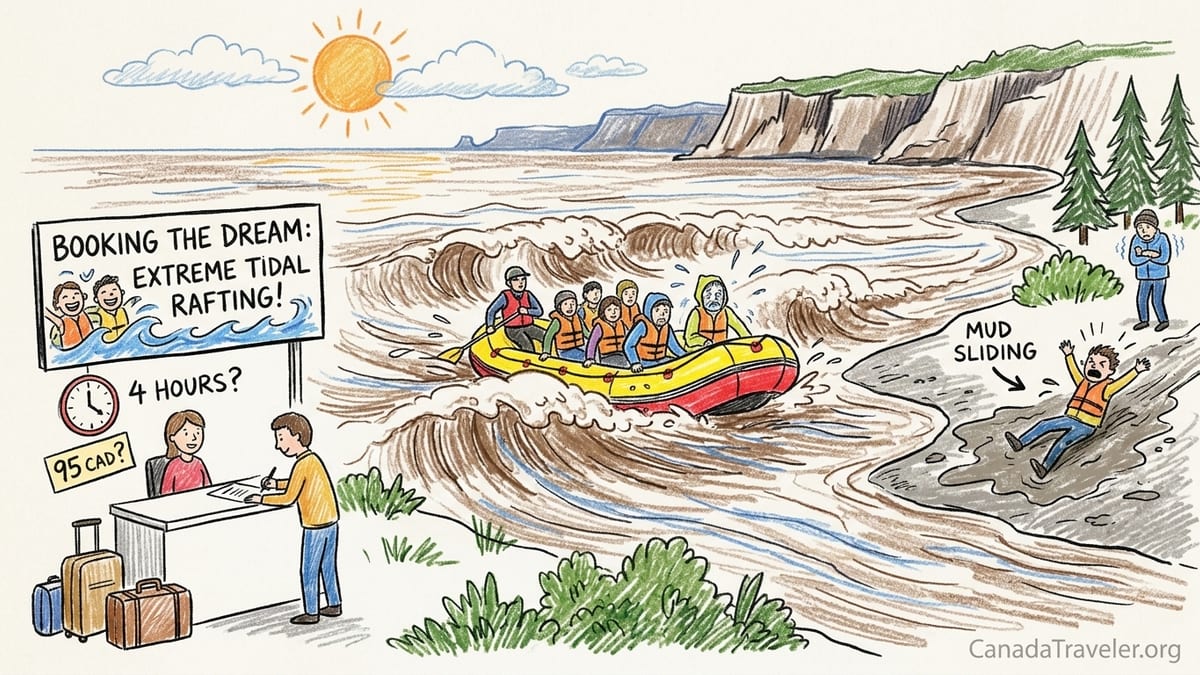
Booking the Dream: Expectations vs Reality at the Check-in Desk
I booked with Shubie River Wranglers, one of several licensed operators on the Shubenacadie River alongside competitors like River Runners, Fundy Tidal Bore Adventures, and Shubenacadie River Adventure Tours. Their Tourism Nova Scotia listing still advertises adults at 70 dollars for a two-hour tour and 95 dollars for a four-hour option, with lower child and group rates. In practice, when I checked recent customer reports and their current booking system, many departures were listed closer to 75 dollars for two hours and just over 100 dollars for four, especially in peak season, once taxes or card fees were factored in. So the 70 and 95 dollar figures are a useful baseline, but most visitors should expect to pay around 75 to 105 dollars per adult seat for 2026 departures.
At the check-in office, the sell is slick and confident. Wranglers divide trips into regular, high, and extreme tides, but the brochure language would make almost any slot sound unmissable. A wall of photos shows rafts nearly swallowed by brown waves, with paddlers barely visible behind flying spray. It is easy to assume that this is what you will get, no matter which tide you happen to have free in your holiday calendar. My booking confirmation mentioned a “2-hour B tour,” which I learned would start on waves and end with mud sliding, in contrast to their “A” version that begins with mud and finishes in the rapids.
Before we even touched the water, I noticed the first gap between marketing and reality: time. The website called it a two-hour adventure, but we were asked to arrive at least 45 minutes early to sign waivers, gear up, and listen to a safety briefing. After the river segment, there would be transport back to base, optional showers, and the familiar chaos of peeling off wet gear and wrangling kids. I started my stopwatch when I parked the car and stopped it when I finally sat down in dry clothes again. Total commitment: just shy of four hours for the “two-hour” tour. On a four-hour river trip, you are realistically looking at up to five hours out of your day.
Yet while the time creep felt like minor marketing optimism, much bigger questions emerged around the one thing operators cannot control: the tide itself.
Understanding the Tidal Bore: A Violent River in Reverse
The brochures lean heavily on superlatives about the Bay of Fundy, home to some of the world’s highest tides, with a range that can exceed 15 meters in parts of the bay. On the Shubenacadie River, these tides do something more dramatic than simply rise and fall. For a brief window around high tide, an incoming wall of seawater blasts into the river mouth, reverses the normal downstream flow, and builds into a series of standing waves that the rafting operators ride up and down.
On the gravel bar where we launched, our guide traced the process in the wet sand. The river was flowing steadily seaward, brown and deceptively calm. Somewhere out in the Fundy basin, the flood tide was racing landward. When it reached the narrow choke point at the river mouth, that energy would surge upstream as a foaming front, known as the tidal bore. In the narrow, shallow curves of the Shubenacadie, the incoming tide piles into underwater bars and river bends, rearing up into troughs and peaks. In a good set, those brown waves can top two meters, with crashing faces and chaotic cross-currents that feel nothing like conventional whitewater on a mountain river.
What the ads generally omit is how changeable this phenomenon is. Guides and operators talk quietly among themselves about “tide size” in feet, pegged to daily tidal range predictions. Fundy Tidal Bore Adventures, for example, sorts their schedule into medium, high, and extreme tides, with anything over roughly 24 feet of tidal range described as extreme. On those dates, the flood punches in faster and harder, and the river can rise well over six meters during the trip. Lower-range tides still form waves, but they may be closer to a bouncy boat ride than the brown chaos you see on Instagram.
In practice, this means no two departures are alike. Moon phase, recent rainfall, wind, and sandbar shifts all change how the bore stands up. One family’s “most intense adventure of our lives” can be another group’s “gentle rollercoaster” just 24 hours later. For travelers looking for predictable thrills, that variability is a central problem.
Why Tide Selection Makes or Breaks Your Trip
When I first looked at dates, my instinct was simply to fit a rafting slot between a morning visit to Burntcoat Head Park and an evening drive back to Halifax. That is how most travelers plan. They pick a day that matches their road trip, click on whatever time the booking calendar shows as available, and trust that the professionals would not schedule a departure if it were not going to be good.
Talking to staff and reading operator explanations made me rethink that casual attitude. Shubie River Wranglers publishes a detailed tide schedule that marks which days offer their four-hour marathon rides and which ones are limited to shorter experiences. Shubenacadie River Adventure Tours works with a full and half-trip model, explicitly tied to tide intensity, and mentions a “Qualifier” level for smaller tides that is framed as better for those who want scenery and milder action. Fundy Tidal Bore Adventures lists tide categories for each day and openly brands the biggest tides as the most thrilling option, while acknowledging a minimum age of around nine years for those departures.
The message, between the lines, is stark. A midweek medium tide in early season will not deliver the same adrenaline as a Saturday extreme tide during a big moon. Operators will still use the same promotional footage for both, and the price difference is marginal, but your actual experience will change dramatically. High and extreme tides can produce punishing hits and deep troughs where you brace your feet and hang on while the raft seems to fall away beneath you. On smaller tides, you may still get soaked, but the waves wash over the bow rather than folding the entire boat into a muddy vortex.
This breaks the illusion that “a tidal bore trip is a tidal bore trip.” It is not. It is more like skiing: booking a random weekend without checking snow conditions and terrain will not ruin your day, but it may leave you wondering what all the hype was about. If you are going to pay over 300 dollars for a family of four, it is worth aligning your date with either the biggest tides if you want maximum chaos or the smaller “Qualifier” days if you value scenery and a gentler outing.
Curiously, few operators push this point during booking, perhaps because drawing attention to lower-intensity days might make some departures harder to sell. That lack of clear expectation-setting is, in my view, one of the biggest weaknesses in how the experience is marketed.
Comparing Operators: Duration, Style, and the Hidden Hours
On paper, the major Shubenacadie operators look surprisingly similar. Shubie River Wranglers, Fundy Tidal Bore Adventures, and Shubenacadie River Adventure Tours all run fleets of sturdy, high-horsepower Zodiac-style boats, with around six to eight guests per raft plus a guide. They provide life jackets and usually waterproof jackets or full rain suits. Prices in 2026 cluster tightly between about 70 and 110 dollars per adult, with child discounts that bring kids under 12 down by roughly 10 dollars per seat.
Look closer, though, and the trip style diverges. Fundy Tidal Bore Adventures offers both two-hour and four-hour experiences, with the longer trip marketed as roughly 20 kilometers of river time that mixes wave riding, mud sliding, and calmer stretches. Shubie River Wranglers arranges its schedule into A and B variants. Two-hour A mixes an upstream run to meet the bore with a surfing run back to base, with time set aside for mud play. Two-hour B focuses more on waves first, then mud near the end. Their four-hour version attempts to do everything: start on a nearly empty riverbed, chase the bore in, surf multiple wave sets, and ride the now full river back to the launch.
Shubenacadie River Adventure Tours, which operates under the Shubenacadie Tidal Bore Rafting Resort umbrella, traditionally frames its outings as full tours or half tours. A full tour runs close to three hours on the water, with the “Watermark A and B” half trips around one and a half hours each, again with tidal intensity and passenger appetite driving which option is offered on a given day. River Runners, a long-established player, also focuses on two-hour slots from near Maitland, emphasizing the high and extreme tide days as their signature product.
The obvious difference is duration, but the subtler factor is how operators divide that time between waiting, moving, and hitting waves. On my two-hour B trip, we spent roughly 30 minutes motoring to the main wave zone, 40 minutes actively running back and forth across multiple wave sets, 20 minutes doing controlled mud slides on the exposed banks, and about 30 minutes making our way back as the river broadened and slowed. The rest of the time was consumed by gearing up, boarding, and getting organized. Friends who took a four-hour trip with another operator described a slower start with more river wildlife spotting and commentary, a similarly intense core of wave-riding, and a longer, calmer return through now fully flooded channels.
In other words, you are not necessarily buying twice as much chaos with a four-hour ticket. You are buying a more varied half-day on the river, which may or may not be what you want if your main goal is to be slammed by the biggest waves and then retreat to a hot shower as quickly as possible.
Safety Briefing, Gear, and Physical Demands: Who Can Actually Handle This?
At the launch, Wranglers staff issued heavy-duty rain jackets and life vests over our existing clothes. Other operators sometimes provide full rain suits and neoprene booties, and a few lists mention wetsuits for colder shoulder-season departures. Footwear is a sticking point. You are told firmly to wear old sneakers or secure sandals, and to avoid flip-flops that will instantly be claimed by the river. Even if you think you are prepared, you will almost certainly underestimate how soaked everything will be. Within 10 minutes of reaching the first standing waves, muddy river water was slamming into the raft so hard it pushed my life jacket up under my chin and turned the inside of my rain jacket into its own miniature bathtub.
The safety briefing covered the basics: how to sit with feet braced under the inflated thwart, when to hold the side lines instead of your camera, what to do if someone falls in, and how to lean into waves to reduce the risk of being pitched backward. The guide also outlined medical considerations in broad terms, warning those with back problems, heart issues, or late-term pregnancies that this was not an appropriate excursion. In that sense, the messaging was clear. What remained less discussed was what that actually feels like at full intensity.
When the first serious wave hit us, the impact felt like driving a compact car into a deep pothole at highway speed. The inflatable raft absorbed the worst of it, but my lower spine still registered the jolt. Over the next 30 minutes, we punched through wave after wave, alternately climbing brown liquid walls and dropping diagonally into frothing troughs. Hands cramped around the safety rope. Knees jammed into rubber tubes. A teenage passenger across from me caught a wave full in the chest and coughed hard as muddy water filled his nose and mouth. He was fine, and the guide checked carefully, but the point was made: you do not dabble in this. You commit.
Age and size rules reflect that reality. Most operators publish a minimum age of six years for standard tides, with stricter limits for high and extreme days. Fundy Tidal Bore Adventures explicitly recommends a minimum age of nine for their biggest tides, which matches what I saw on the river. Younger, smaller children were visibly struggling to keep their footing and hold on when the raft lurched. Weight and mobility are discreetly referenced in waiver forms rather than public marketing. If you cannot get in and out of a low, moving inflatable without help, or if you have significant knee or balance issues, the practical demands of this experience may overwhelm the fun.
To be clear, the trips I observed were professionally run. Guides carried radios, scanned the water constantly, and prepped guests well. There is no evidence to suggest that reputable Shubenacadie operators are cavalier about safety. But the very nature of slamming a small vessel into muddy standing waves at speed means that even a well-managed trip can feel violent. Travelers who equate “family-friendly” with “gentle” may find themselves deeply out of their comfort zone.
Mud, Cold, and Facilities: The Unromantic Aftermath
Promotional shots lean hard into the novelty of Fundy mud. In real life, it is both a playground and a logistical headache. After the wave segment, our guide nosed the raft into a sloping bank of gray-brown clay and invited anyone keen to climb up and slide down. The mud was silky and shockingly deep, swallowing ankles and occasionally a whole calf. Children shrieked with delight. Adults hesitated, picturing rental cars and fragile phone charging ports. A few of us stayed in the boat, already cold enough without smearing a fresh layer of sticky clay over every surface.
Back at the base, the romance fully evaporated. The changing facilities were serviceable but basic: a set of gendered rooms with benches, hooks, and plastic curtains. With a boatload of soaked guests arriving at once, it felt cramped. Long queues formed for a limited number of showers, and hot water was not a guarantee on a busy mid-summer day. There was nowhere truly dry to sort gear without stepping in another puddle. Every car I saw leaving the lot looked like it had transported a small flood.
Weather compounds the discomfort. On warm, still days, the chill is tolerable and even refreshing. On overcast or windy days, repeated dousings in cold, sediment-rich water can leave you shivering before the halfway point. Operators run May to October, and while some supply extra thermal layers early or late in the season, others simply recommend guests bring more clothing. That puts a lot of responsibility on visitors to anticipate conditions they may not fully grasp.
Cancellation policies vary. Some operators are fairly strict once you are inside a 48-hour window, charging full fare unless conditions are unsafe by their judgment. That means you may feel financially pressured to go ahead with a marginal weather forecast or a lower-intensity tide that no longer seems worth it. In an era when many travelers expect flexible refund options, the rigidity felt out of step with the chaotic nature of the product.
Is It Worth the Money Compared with Simply Watching the Tide?
It is easy to justify the cost of tidal bore rafting in isolation. Seventy to one hundred dollars for two to four hours of guided adventure, including gear and a unique natural spectacle, is not wildly out of line with other high-adrenaline activities. The question becomes more complicated when you compare the experience to cheaper, calmer ways of meeting the Bay of Fundy.
Along the same shore, you can visit the Fundy Discovery Site near Truro and watch the bore roll past for free, with interpretive signs and a safe vantage point. Further down the coast, Burntcoat Head Park lets you walk on the ocean floor at low tide and then watch the water race back in, all for a modest parking or donation fee. The vertical difference between low and high at Burntcoat, often showcased with staircase markers on the headland, is arguably more visually striking than anything you see from the bottom of a muddy raft.
There is also the simple joy of standing on a riverbank or viewpoint and watching the Shubenacadie reverse direction without being soaked to the bone. Families with younger children, older travelers, and those with mobility or cardiac concerns might find that a thoughtfully timed visit to Burntcoat Head or Hopewell Rocks in neighboring New Brunswick delivers a deeper appreciation of the tidal miracle without the physical price tag.
Seen in that context, tidal bore rafting starts to look like a premium add-on for a specific traveler profile rather than a must-do hallmark of a Bay of Fundy trip. If your budget is tight, dedicating several hundred dollars and half a day to this one activity may crowd out other experiences that showcase the region’s culture, food, and landscapes with less stress on your body.
The Takeaway
After four hours of anticipation, impact, and cleanup, I sat in my car, heater on full, trying to decide whether the experience was worth recommending to most readers. The honest answer is that tidal bore rafting on the Shubenacadie River is spectacular, unpredictable, and fundamentally intense. It is also messy, time-consuming, and more physically punishing than marketing language about “family fun” might suggest.
There are clear drawbacks. First, the experience you get is heavily dependent on tide range and river conditions, yet booking systems rarely force you to engage with that reality. Second, the physical demands can be high: repeated jolts, cold immersion, and the need to brace and hold on constantly. Third, the “two-hour” label is misleading for trip planning. You should budget three to five hours door to door, which can complicate road-trip itineraries. Fourth, facilities and post-trip comfort are functional rather than luxurious, despite the premium pricing for families. Fifth, cancellation and refund policies often give operators more flexibility than guests, leaving you committed even if conditions change in ways that blunt the thrill.
Who will love it? Adrenaline seekers who genuinely enjoy rough water, do not mind being cold and filthy, and accept that nature can underperform on a given day are prime candidates. Active families with older children, especially those comfortable in kayaks or on roller coasters, may also find it a highlight of their Nova Scotia trip, provided they choose departures on bigger tides and bring realistic expectations about mud and discomfort.
Who should think twice or avoid it entirely? Travelers with significant back, neck, heart, or balance issues; anyone who dislikes cold or confined spaces; parents of very young or anxious children; and visitors who are already uneasy around water will likely find the stress outweighs the wonder. Those on tight schedules or budgets may also get better overall value by timing a visit to Burntcoat Head or the Fundy Discovery Site instead and appreciating the Bay of Fundy’s drama with feet planted firmly on solid ground.
If you arrive informed, choose your tide carefully, and embrace the mud as part of the bargain, Shubenacadie tidal bore rafting can be extraordinary. But it is not, and should not be sold as, a universal crowd-pleaser. This is an adventure that suits a specific slice of travelers. For everyone else, there are quieter, drier, and more forgiving ways to watch rivers run backwards.
FAQ
Q1. How long does a “two-hour” tidal bore rafting trip really take door to door?
For most operators, you should expect at least three to four hours from arrival to leaving the parking lot, once you include check-in, gearing up, the river run itself, transport back, and changing out of wet clothing.
Q2. How much does tidal bore rafting on the Shubenacadie River cost in 2026?
Adult prices typically run from about 70 to 110 Canadian dollars per seat depending on operator and length, with Shubie River Wranglers still advertising around 70 dollars for two hours and 95 dollars for four, and others like Fundy Tidal Bore Adventures listing similar two and four-hour options with child discounts.
Q3. Do all departures give the same level of waves and excitement?
No. Tide height and river conditions make a major difference. Medium tides can produce a fun but moderate ride, while high and extreme tides around big moon phases create larger, more aggressive standing waves and a more intense experience.
Q4. What is the minimum age for children on these trips?
Most operators set a minimum age around six years for standard tides, with stricter recommendations on the biggest tides. For example, some trips suggest at least nine years old on extreme tide departures because of the force of the waves.
Q5. How physically demanding is tidal bore rafting compared with regular whitewater rafting?
While you are not paddling constantly, the repeated impacts and sudden drops can be surprisingly hard on backs, knees, and grip strength. Many people find it rougher and more jarring than they expected from family-oriented marketing.
Q6. Will I get completely soaked and covered in mud?
Yes. Expect mud-laden water to hit you from head to toe during wave sections, and additional mess if you participate in mud sliding on the riverbanks. You should bring full spare clothing, including underwear and footwear, and protect car seats afterwards.
Q7. Are the trips safe?
Licensed operators use sturdy boats, carry safety gear, and provide briefings, and the activity has a solid track record with reputable companies. However, the environment is inherently powerful and unpredictable, so a basic level of fitness, comfort in water, and respect for instructions is essential.
Q8. What should I wear and bring for a tidal bore rafting trip?
Wear old, secure shoes, synthetic or wool layers that stay warm when wet, and avoid cotton. Bring a full change of clothes, a towel, a plastic bag for wet items, and consider a waterproof case if you plan to carry a phone.
Q9. Is tidal bore rafting a better way to see the Bay of Fundy than visiting places like Burntcoat Head?
It is a more immersive and adrenaline-focused way to feel the tide’s power, but parks like Burntcoat Head offer calmer, cheaper experiences where you can see dramatic tidal ranges and walk on the ocean floor without the physical strain and cost of rafting.
Q10. How far in advance should I book, and can I cancel if the weather looks bad?
In July and August, booking at least a week ahead is wise, especially for high or extreme tide slots. Many operators have strict cancellation windows of 24 to 48 hours, so you may not receive a refund if you choose to back out because of marginal weather or a change of heart.