


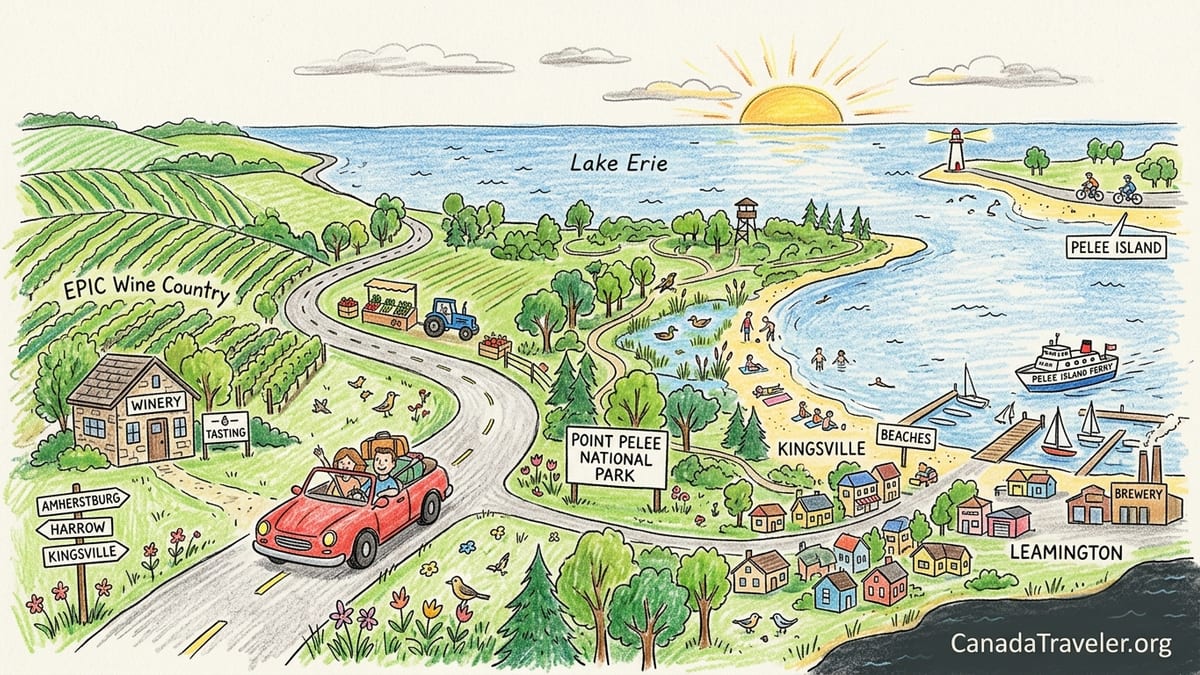
Southern Ontario’s Lake Erie North Shore is one of those rare places where you can drive from historic waterfront towns to vineyards, wide sandy beaches, a world-class birding hotspot and an island in the middle of the lake, all in a single trip. Built around Amherstburg, Essex County wine country, Kingsville, Leamington, Point Pelee and Pelee Island, this flexible road trip connects wine tasting, cycling, birdwatching and easy beach time along Canada’s southernmost shores.
Why the Lake Erie North Shore Belongs on Your Road Trip List
Stretching from Amherstburg on the Detroit River to Leamington on Lake Erie, this corner of Essex County sits below the 42nd parallel, at roughly the same latitude as northern California and the French Riviera. That mild climate, moderated by the lake, is what makes the Essex Pelee Island Coast wine region possible and also gives Point Pelee its unusually rich birdlife and long summer season. You can comfortably plan outdoor-focused travel here from about May through October, with peak beach and patio weather in July and August and prime bird migration in May and again in late September.
The drive itself is compact. Windsor to Amherstburg is roughly 30 minutes, Amherstburg to Kingsville about 40 minutes along County Road 20, and another 20 minutes brings you to Leamington. Ferries to Pelee Island run from both Kingsville and Leamington, so you can build an island stay into the middle or end of your loop without long highway days. Even if you only have a long weekend, you can sample waterfront towns, two or three wineries, Point Pelee National Park and at least a night on Pelee Island.
Destination marketing for the area now leans into this exact pattern: start in the historic riverfront town of Amherstburg, follow the coastal wine route past farm stands and vineyards, spend time in Kingsville and Leamington as bases for Point Pelee, and add Pelee Island for beaches and an unplugged, slow-down finale. The route works equally well for couples focused on wine and food, birders chasing warblers and shorebirds, and families mixing beaches with easy bike rides.
Planning Your Route: Weekend Dash or Slower Coastal Escape
If you have three days, a typical pattern is Friday night in Amherstburg or Windsor, Saturday winery hopping between Amherstburg, Harrow and Kingsville, Sunday at Point Pelee and the Leamington waterfront, then home. A four-day version adds at least one night on Pelee Island. With five to seven days, you can slow down, stay two nights in wine country, two around Point Pelee and two on the island, with built-in time for cycling, marsh paddling and lingering on patios.
Driving is by far the easiest way to cover the region. Distances are short, but wineries and trailheads are spread out along country roads where public transit is minimal or absent. Many visitors fly into Windsor or Detroit, pick up a rental car and then loop along County Road 20 and inland concession roads between Amherstburg, Harrow, Colchester and Kingsville. Taxi services and rideshares exist in the towns, but for winery days most people either designate a driver or book a local tour company to handle transportation.
Cyclists can absolutely incorporate riding, but the area is best treated as a hub-and-spoke destination rather than a point-to-point bikepacking route. For example, you might park in Kingsville, ride a relaxed loop to two wineries and the lakefront and then return to the same inn that afternoon. On Pelee Island, quiet roads, low traffic and a near-flat profile make it one of the most approachable places in Ontario to do a 30-kilometre circuit without worrying about hills or heavy vehicles.
Amherstburg and the Western Gateway
Amherstburg makes a fitting starting point, especially if you are arriving via Windsor or Detroit. The town sits near the mouth of the Detroit River, and its riverfront core has a compact, walkable feel. King’s Navy Yard Park runs along the water with historic cannons, manicured gardens and views across to Michigan, while Fort Malden National Historic Site adds a dose of War of 1812 history. Many visitors spend their first evening strolling the park, grabbing ice cream or a drink on a patio and watching freighters slide past at sunset.
As an overnight stop, Amherstburg offers small inns and B&Bs within walking distance of the riverfront. Prices are generally lower than in Niagara or Muskoka; a clean, mid-range room in town often runs in the moderate bracket rather than luxury. From here you are roughly 20 to 30 minutes by car from several EPIC wineries near Harrow and Colchester, and about an hour from Leamington, so it works well as a gentle on-ramp to the rest of the trip if you arrive later in the day.
For food and drink, look for casual pubs and bistros clustered around the historic downtown. This is not the place for big-city nightlife, but that is part of the appeal. After a day of travel, most road trippers are happy to keep things simple: a local craft beer or Ontario wine with dinner, a walk by the water and an early night so they can hit the wine route or national park refreshed the next morning.
EPIC Wine Country: Vineyards Between Amherstburg, Harrow and Kingsville
The heart of the Essex Pelee Island Coast wine region lies between Amherstburg, Harrow, Colchester and Kingsville, and you quickly see why this area is marketed as one of Canada’s sunniest winegrowing regions. Many vineyards sit within sight or a short drive of Lake Erie, taking advantage of the long growing season and moderated temperatures. Signature grapes here often include Cabernet Franc, Chardonnay, Riesling and hybrid varieties suited to warm summers and cold winters, alongside increasingly popular sparkling wines and rosés.
Realistically you can visit two or three wineries in a relaxed day without feeling rushed. Places such as Sprucewood Shores Estate Winery, Colchester Ridge Estate Winery and North 42 Degrees Estate Winery are representative of the local scene, combining tasting bars with patios or lawns where you can linger over a glass. Many offer snack boards, wood-fired pizzas or bistro-style lunches, so you do not have to leave the wine route for a midday meal. A shared tasting flight is typically priced in a reasonable range per person, often waived with a bottle purchase, making it easy to sample widely without committing to full glasses at each stop.
A number of operators based in the region run half-day and full-day wine tours that include transportation, tastings at several wineries and sometimes a sit-down lunch. These are especially worth considering if no one in your group wants to act as designated driver. It is also increasingly common to find tasting passports that bundle sample pours at multiple wineries for a fixed price, encouraging exploration across the region over a weekend. Expect more of a relaxed, agricultural vibe than the polished tourism infrastructure of Niagara; gravel driveways and working vineyards are part of the charm.
Compared with larger Ontario wine regions, EPIC wine country still feels pleasantly undiscovered. Weekends in July and August can be busy, particularly on sunny afternoons, but even then you are more likely to encounter groups of friends chatting on patios than tightly scheduled tour buses. For many travellers, that lower-key atmosphere is exactly why they choose the Lake Erie North Shore as their go-to wine escape.
Kingsville and Leamington: Lakeside Towns, Beaches and Breweries
Continuing east, Kingsville and Leamington serve as the main service hubs for Point Pelee and the Pelee Island ferries. Kingsville has leaned into its identity as a small-town food and drink destination, with craft breweries, coffee shops and restaurants dotted around its walkable centre. You can easily spend a full afternoon here between a local brewery taproom, a stroll down to the lakeshore and a stop at one of the nearby wineries just outside town.
Leamington, traditionally known for greenhouse agriculture, has been steadily improving its waterfront, with a marina, promenade and sandy municipal beach. In summer, you will see families hunting for beach glass, people launching kayaks and paddleboards and anglers lining the docks. This is also where many visitors base themselves for Point Pelee, since the national park entrance is roughly a 15-minute drive away. Accommodation runs from chain hotels near the highway to lakeside motels and cottage rentals; booking ahead for weekends in July, August and during the May birding festival is strongly advised.
On the beer front, the region offers small-town breweries producing approachable styles suited to post-hike or post-beach refreshment. Taprooms typically serve tasting paddles and pints in the mid-range price bracket, often with snacks or partnerships with local food trucks. You will not find the sheer density of breweries seen in larger cities, but the ones that do exist often lean heavily into local ingredients and a community atmosphere, making them pleasant evening stops after days spent outdoors.
Both Kingsville and Leamington have grocery stores, pharmacies and outdoor shops, so they are logical places to stock up before heading to Pelee Island or settling into a cottage near Point Pelee. Think of them as your resupply and restaurant hubs between vineyard country and the wild tip of the peninsula.
Point Pelee National Park: Tip of Canada, Trails and Birdlife
Point Pelee National Park is the geographic and ecological anchor of this road trip. Jutting nearly 15 kilometres into Lake Erie, the point is one of the most important bird migration hotspots in North America. In May, during the Festival of Birds, it is not unusual for visiting birders to see dozens of warbler species in a single day along the forest boardwalks and woodland trails. In autumn, hawk and monarch butterfly migrations draw a different wave of nature enthusiasts. Even if you are not a dedicated birder, the combination of marsh boardwalks, sandy beaches and forest paths is compelling.
The park has over a dozen kilometres of walking and cycling routes, including the Centennial Hike and Bike Trail that threads through forest and savanna, and the Marsh Boardwalk, where a tower and series of lookouts overlook cattail wetlands. Rental canoes and kayaks are often available in season for paddling through the marsh channels, a highlight for many visitors. In summer, supervised swimming areas on the Lake Erie side provide classic beach experiences, but currents near the very tip can be dangerous, so swimming there is strongly discouraged and sometimes prohibited.
For cyclists, Point Pelee is best treated as a half-day ride. You can park near the entrance, ride the paved multi-use trail down to the visitor centre, then either cycle or hop on the shuttle closer to the southern tip. Many visitors choose to walk the final stretch along the beach or boardwalk to the actual point, where you stand at the southernmost point of mainland Canada with lake waves curling in from both sides. Lightweight hybrid or gravel bikes are ideal, but many casual riders simply use city bikes or rentals suitable for paved paths.
Park entry fees are comparable to other national parks in Canada and can be paid at the gate or in advance. In busy periods, particularly May birding weekends and prime summer Saturdays, it is worth arriving early to secure parking close to your chosen trailheads. There is no camping within the park itself, so most visitors stay in nearby Leamington, Kingsville or at cottage rentals along the shore and drive in for day visits.
Pelee Island: Slowing Down on Lake Erie
Pelee Island, Canada’s southernmost inhabited point, adds an island chapter to the trip that feels markedly different from the mainland. The pace is slower, the road network is simple and traffic is light. Many visitors leave their car parked at their mainland accommodation and travel as foot passengers or with bicycles, but bringing a vehicle can be helpful if you plan to stay several days, carry camping or photography gear or explore less central corners of the island at your own pace.
The island’s main draw is its relaxed, back-to-basics feel: long stretches of shoreline, gravel lanes, small pockets of forest and wetlands and a scattering of vineyards and farmsteads. Signature natural sites often mentioned by birders include Fish Point and Lighthouse Point nature reserves, both renowned for migration watching in spring and fall. In summer, sandy beaches and shallow lake water make for laid-back swimming and picnicking, though water conditions can vary, so checking local advisories on arrival is wise.
Cycling is one of the best ways to experience the island. A full loop of the main road network is roughly 30 kilometres, manageable in half a day at a leisurely pace with photo stops. Rentals are usually available on the island in peak season, but bikes are limited and demand spikes on holiday weekends, so bringing your own can be a safer bet if cycling is central to your plan. The mostly flat terrain makes it easy going even for casual riders and families, but summer sun can be intense, so packing water and sun protection is important.
Accommodation on Pelee Island ranges from simple cottages and B&Bs to small inns. There is strong seasonal variation, with some operations closing outside late spring to early fall, so checking dates carefully when you book is essential. Nightly rates tend to be comparable to other rural Ontario island or cottage destinations, with weekend and holiday surcharges. Because the island’s capacity is limited, it is smart to secure accommodation before you book ferry tickets rather than assuming you can arrive and find something last-minute.
Pelee Island Ferry Logistics and When to Have a Car
Ferry service to Pelee Island is operated by Ontario’s provincial ferry company, with seasonal schedules typically running from spring into late fall and varying between Leamington and Kingsville as mainland departure points. In recent years, sailings have been divided between the two ports, with Leamington generally hosting more early and late season departures and Kingsville seeing frequent summer service. Crossing times are usually in the range of 90 minutes, but can vary by vessel and schedule, so always confirm for your specific dates.
Vehicle space on the ferries is limited, and summer weekends, long weekends and peak birding periods book up quickly. It is common advice among locals to reserve a car space weeks or even months ahead if you know your travel dates. Foot passenger and bicycle spots are usually more flexible, though even these can fill on the heaviest travel days. Fares are set per passenger and per vehicle, with bicycles typically incurring only a modest additional fee. Check-in times before sailing are strictly enforced, so plan to arrive well in advance to avoid missing your departure.
Deciding whether to bring a car to Pelee Island depends on your travel style. If you are staying one or two nights near the main settlement, do not mind walking or cycling and prefer to keep costs down, leaving the car on the mainland can work well, especially in combination with a centrally located inn or B&B. If you are booking a cottage farther from the dock, travelling with children or planning to carry coolers and gear, the convenience of having your vehicle at hand usually outweighs the extra ferry fare and reservation logistics.
On the mainland portions of the trip, however, a car is almost always useful. While you could base in Kingsville or Leamington and arrange occasional taxis to nearby wineries, service can be patchy in rural stretches, especially in the evenings. Having your own wheels gives you flexibility to detour to roadside farm markets, small conservation areas like Holiday Beach, or quiet public shore access points that are not on any bus route.
Where to Stay: Mainland Bases and Island Overnights
Most travellers break their nights into a combination of mainland and island stays. A common pattern is to spend one night in Amherstburg or Windsor at the start, two nights between Kingsville and Leamington, and one or two nights on Pelee Island. That structure gives you time for a full day of wine touring, a full day devoted to Point Pelee and at least a full day on the island without racing from place to place.
On the mainland, accommodation runs the gamut from chain hotels at highway interchanges to historic inns in town centres and standalone cottage rentals along the Lake Erie shore. Couples often favour smaller boutique inns integrated with restaurants or breweries, while families may prefer rental cottages with kitchen facilities and direct beach access. Prices vary by season, but compared with major resort regions in Ontario, nightly rates here tend to be moderate, especially outside holiday weekends and peak birding dates.
On Pelee Island, planning ahead is critical. The limited number of rooms, combined with the fixed ferry capacity, means that summer weekends and festival periods can sell out. Some returning visitors choose to travel midweek, when the island is quieter and more options are available. There is usually at least one small grocery store and a handful of seasonal eateries on the island, but selection is narrower than on the mainland, so many people bring a cooler with staples and treat dining out as an occasional treat rather than assuming restaurant meals for every sitting.
Regardless of where you stay, aim to book accommodations and ferry crossings in tandem. It is not uncommon for would-be visitors to secure a desirable cottage only to discover that their preferred ferry sailings are already at capacity for vehicles. Lining up both pieces early removes the most significant logistical stress from an otherwise easygoing road trip.
Beaches, Cycling and Birdwatching Highlights
Beaches are a thread running throughout this itinerary. Amherstburg’s waterfront is more about river views and grassy parks than sand, but as you move east the Lake Erie shoreline offers several sandy public beaches suitable for swimming on calm days. Leamington’s main beach and nearby municipal sites give families easy access with playgrounds and washrooms, while within Point Pelee National Park you will find multiple beach access points along the western shore. Conditions vary with wind and water levels, so locals often check the beach situation day by day rather than relying on a single spot.
For cycling, Point Pelee’s flat, paved multi-use paths and Pelee Island’s quiet roads stand out as the most beginner-friendly options. Confident riders can also use the country roads between Harrow, Colchester and Kingsville to link wineries and farm stands, but should be prepared for stretches with no shoulder and a mix of local and agricultural traffic. Bringing a front light and high-visibility clothing is wise even for daytime rides, as weather can shift quickly near the lake and fog or low light can roll in.
Birdwatchers will find almost too many choices for a single trip. Point Pelee’s reputation rests on its migrant songbirds and warblers in May and diverse species throughout the shoulder seasons. Nearby, conservation areas such as Hillman Marsh and Holiday Beach offer additional shorebird and raptor viewing from towers and dikes, often with fewer crowds than the national park. On Pelee Island, modest forest patches and shoreline points can produce memorable mornings during migration, with warblers flitting at eye level along quiet trails.
Even non-birders often come away surprised by how central wildlife feels here. Turtles basking on logs in the marsh, monarch butterflies drifting across the beaches in late summer and flocks of swallows swirling around observation towers lend an almost cinematic quality to simple hikes. Packing binoculars, even an inexpensive pair, dramatically increases what you notice on boardwalks and lakefront walks.
The Takeaway
A Lake Erie North Shore road trip built around Amherstburg, Essex County wine country, Kingsville, Leamington, Point Pelee and Pelee Island delivers a distinctive mix of experiences in a compact footprint. You can taste wine at relaxed, farm-based vineyards, walk to the southern tip of mainland Canada, cycle quiet island roads and finish your days with sunsets over Lake Erie without ever driving more than a couple of hours between major stops.
For a short break, a three-day weekend anchored on wine touring and a full day at Point Pelee makes sense. With more time, folding in Pelee Island and slowing your pace turns the itinerary into a true coastal escape, with enough room to linger on beaches, follow bird migration and explore side roads and conservation areas. A car is a practical necessity on the mainland and often worth bringing to the island, but cyclists and walkers can structure parts of the trip around two wheels or two feet once they arrive at their chosen bases.
Ultimately, what sets this route apart is how accessible it feels. From major urban centres in Ontario and the U.S. Midwest, you can be walking a marsh boardwalk, sampling local Cabernet Franc or watching a Lake Erie sunset within a few hours of leaving home. If you are looking for an Ontario road trip that pairs wine country ease with serious nature credentials and the novelty of an island in the middle of the lake, the southern shores of Lake Erie deserve a spot near the top of your list.
FAQ
Q1. How many days do I need for this Lake Erie North Shore road trip?
Most travellers are happy with three to five days. Three days allows for Amherstburg, a day of wineries and a full day at Point Pelee. Adding two more days lets you include at least one or two nights on Pelee Island for a slower, more relaxed escape.
Q2. Do I really need a car, or can I rely on transit and taxis?
A car makes this itinerary much easier. Public transit between towns is limited and does not serve wineries or trailheads well. Taxis and rideshares exist around Kingsville and Leamington but are not reliable in rural stretches. Once you reach a base like Pelee Island or Point Pelee you can walk or cycle, but for moving between regions, driving is strongly recommended.
Q3. When is the best time to visit for birdwatching at Point Pelee and Pelee Island?
Peak spring migration usually occurs in May, when Point Pelee’s Festival of Birds takes place and warblers and songbirds are most concentrated. Autumn migration from roughly late August through October brings raptors and monarch butterflies. Outside these windows, you will still see birds, but the density and diversity are highest in shoulder seasons.
Q4. Can I swim safely at the beaches along this route?
Swimming is common at Leamington’s municipal beach and at designated beach areas inside Point Pelee National Park when conditions are calm. The very tip of Point Pelee can have strong currents and is not recommended for swimming. On Pelee Island, some shoreline areas are suitable for wading and swimming, but conditions vary with wind and water levels, so always follow local advice and posted signs.
Q5. How far in advance should I book the Pelee Island ferry?
For vehicles, it is safest to book several weeks or even a couple of months ahead for summer weekends and holiday periods. Foot passengers and cyclists generally have more flexibility, but popular sailings can still fill. As a rule of thumb, book the ferry once your accommodation is confirmed, and avoid leaving reservations to the last minute.
Q6. Is it better to stay on the mainland or on Pelee Island?
Both have advantages. Mainland bases like Kingsville and Leamington offer more accommodation and restaurant choice and easier access to wineries and Point Pelee. Pelee Island provides a quieter, more remote feel and is ideal if you want to disconnect and focus on cycling, beaches and birding. Many travellers split their time between both for variety.
Q7. Can I visit wineries and still enjoy the trip if I am not a serious wine drinker?
Yes. Many EPIC wineries emphasize setting as much as wine, with patios, food menus and lake or vineyard views that appeal even if you only sample a glass or two. Non-drinkers often enjoy the farm landscapes, local food and relaxed social atmosphere, and many venues have non-alcoholic options alongside their wine lists.
Q8. Is cycling safe along the Lake Erie North Shore and on Pelee Island?
Point Pelee’s paved multi-use paths and Pelee Island’s low-traffic roads are very approachable for casual cyclists. Rural roads between wineries are rideable for confident cyclists but may lack shoulders and carry agricultural traffic. Helmets, bright clothing and lights are sensible precautions. Families and newer riders often prefer to keep most of their cycling within the national park and on the island.
Q9. What should I budget for accommodation in this region?
Prices vary by season and style, but mid-range hotels and inns on the mainland are generally moderate compared with Ontario’s major resort areas, especially outside holiday weekends. Island stays can be slightly higher due to limited supply. Booking early and travelling midweek usually yields better value, and self-catering cottages can help keep food costs down.
Q10. Does this itinerary work in cooler months, or is it strictly a summer trip?
The full beaches-and-swimming experience is best from roughly late June through early September, but spring and fall have strong appeal, particularly for birders and cyclists. May and October can bring cooler temperatures and some closed seasonal operations, yet trails, boardwalks and many wineries remain open. Winter visits are quieter and more limited in scope, but a handful of wineries and outdoor areas still offer a very low-key getaway.