


Crossing Lake Huron on the MS Chi-Cheemaun between Tobermory and South Baymouth is one of Ontario’s classic summer journeys. For many travelers it is the highlight of a Lake Huron or Georgian Bay road trip, but it also requires a bit of planning. This guide walks you through the 2026 operating season, how to book tickets and bring a vehicle, what to expect at the terminal and on board, and how to decide whether it is worth taking your car to Manitoulin Island.
Chi-Cheemaun Overview and 2026 Operating Season
The MS Chi-Cheemaun is a large passenger and vehicle ferry that connects Tobermory, at the tip of Ontario’s Bruce Peninsula, with South Baymouth on Manitoulin Island across Lake Huron. Operated by the Owen Sound Transportation Company, it typically carries up to several hundred passengers and close to 150 vehicles on each sailing, offering a crossing time of just under two hours. The route forms the seasonal link in Highway 6 between the Bruce Peninsula and Manitoulin, and for many drivers it neatly replaces a long land detour via Sudbury.
For 2026, the Chi-Cheemaun is scheduled to operate from May 1 to October 18. Early in the season and in late fall, there are usually two sailings per day in each direction, one in the morning and one in the afternoon. In peak summer, typically from late June into early September, service increases to three departures daily in each direction, including an evening sailing that is popular with both locals and road trippers. Exact 2026 departure times will be published closer to the season, but travelers can expect a similar pattern to previous years, where morning sailings often leave around 8 or 9 am, mid-day sailings around mid-afternoon, and evening sailings in the early evening.
Because the ferry is seasonal, planning around the May 1 start and October 18 end is important. For example, someone driving from Toronto to Thunder Bay in late April cannot rely on the ferry and will need to route via Highway 69 and Sudbury instead. By contrast, a traveler planning a September cottage trip on Manitoulin can comfortably book the ferry in both directions, as long as they are traveling before the October closing date.
Weather is another factor to keep in mind. While cancellations are relatively rare in summer, strong winds and rough seas on Lake Huron can occasionally affect service, especially in shoulder-season months like May and October. It is wise to allow some flexibility in your itinerary on those edges of the season and to avoid planning critical flight connections immediately after a ferry arrival.
Reservations, Fares and Check-in Rules
Reservations have become effectively mandatory on the Chi-Cheemaun, especially for vehicles, but also for walk-on passengers during busy summer periods. The operator’s current policy is that all passengers, whether traveling with or without a vehicle, should hold reservations booked in advance, and that bookings must be made at least four hours before the desired departure time. Same-day, last-minute travel is sometimes possible on a standby basis, but it cannot be relied upon in July and August.
Vehicle fares are structured by length and height, with standard passenger vehicles under roughly 6 meters falling into a base category and longer or taller vehicles such as large campers, trailers or cargo vans incurring additional per-foot charges. Passenger fares are charged per person. While exact 2026 prices will be set closer to the season and can change from year to year, recent seasons have seen a typical one-way cost for a car and two adults in the approximate range of a few hundred Canadian dollars, which can be comparable to the fuel and time savings relative to driving the highway route around Georgian Bay. Seniors, children and occasionally special-promotion days around holidays like Canada Day may have discounted rates.
Check-in rules are strict. At present, reservation holders must check in at the terminal ticket booth at least one hour before sailing time or their reservation may be cancelled and their space given to standby traffic. This applies to both vehicles and walk-on passengers. In practice, that means that if you hold a reservation for a 3:40 pm sailing, you should aim to be physically at the ticket booth in Tobermory or South Baymouth by 2:30 pm at the latest. On peak travel days, such as Fridays in July, many experienced travelers arrive 90 minutes before departure to allow for queues at the booth and to avoid any risk of losing their spot.
If you arrive after the one-hour cutoff, your reservation is considered void and you are treated as a standby traveler. If space remains, you may still be loaded at the discretion of staff, but there is no guarantee. Travelers who misjudge traffic on Highway 6 or spend too long at a Tobermory café sometimes discover that being 15 or 20 minutes past the cutoff means waiting for the next sailing or, on the busiest days, not getting on at all. For this reason, it is wise to treat the check-in deadline as hard and build generous buffers into your schedule.
Vehicles, Bicycles and Foot Passengers
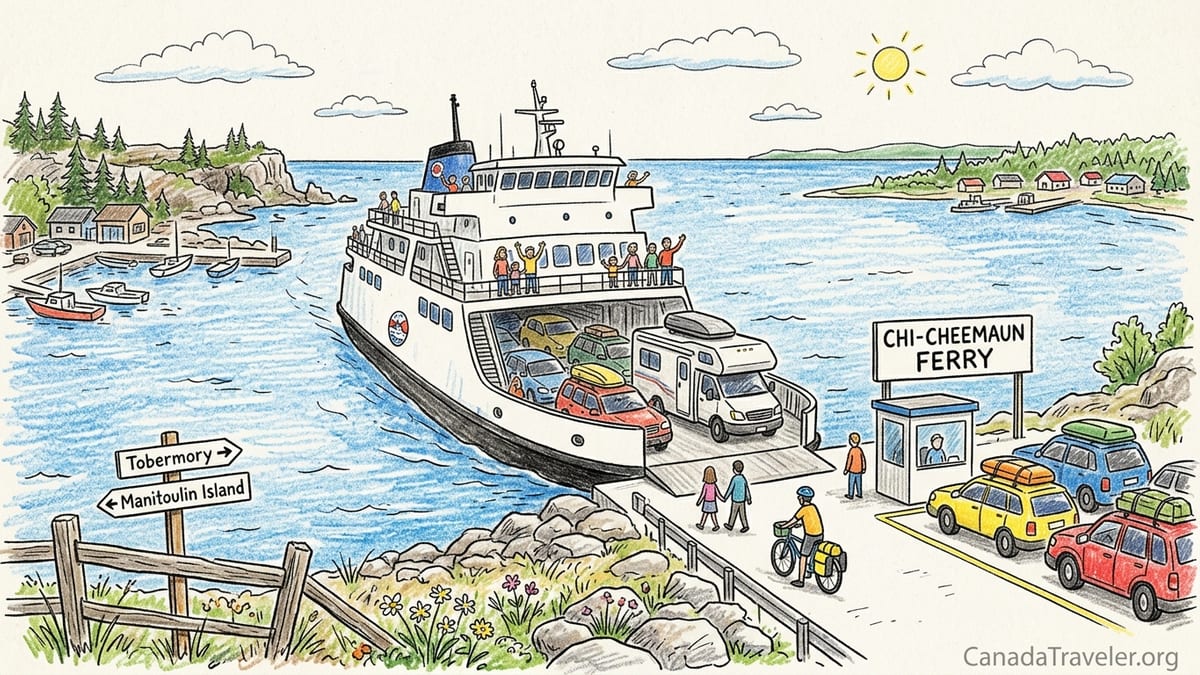
One of the main advantages of the Chi-Cheemaun is the ability to bring your vehicle across Lake Huron. On a typical summer sailing, the car deck will carry an eclectic mix of compact cars, SUVs with roof boxes, pickup trucks towing fishing boats, rental motorhomes, and occasionally tour buses. Standard passenger vehicles are loaded first into numbered lanes at check-in, then directed on board in sequence by deck crew. Drivers park on the car deck, put the vehicle in gear or park with the parking brake set, and are not allowed back down during the crossing except in emergencies.
Larger vehicles such as RVs, trailers and commercial trucks must be measured accurately at booking and check-in. A motorhome that is longer or taller than declared may incur surcharges and, in the worst case, may not fit into the sailing you intended. If you are renting an RV from a company in Toronto, for example, check the exact length including any rear bike racks or tow hitches before you reserve. Summer sailings often carry a high number of RVs headed for campgrounds on Manitoulin, so booking these units early is particularly important.
Bicycles are welcome on the ferry and are an excellent way to explore both Tobermory and Manitoulin Island. Cyclists pay a modest bike surcharge in addition to the passenger fare and typically line up in a separate lane at the terminal before being walked or ridden on board under crew direction. Many cycle tourists ride from Wiarton or Owen Sound up the Bruce Peninsula, overnight in Tobermory, then take the morning ferry to South Baymouth and continue toward Manitowaning, Little Current or beyond. On the Manitoulin side, relatively quiet highways and small roads make for scenic, if occasionally hilly, rides.
Foot passengers, or “walk-ons,” use dedicated passenger ramps in Tobermory and South Baymouth, where elevator and wheelchair access is available. Walk-ons must also reserve and check in at least one hour prior to departure. In practice, there is often more leeway for walk-on travelers on off-peak sailings, especially in spring and fall, but in July and August the ship can reach its passenger capacity, and late-arriving walk-ons may be turned away if the vessel is full. For those staying in Tobermory without a car, parking at their accommodation and walking to the terminal is a common and stress-free option.
Parking, Terminals and What Happens If You Are Late
Both Tobermory and South Baymouth terminals have pay parking lots operated by the ferry company. As of the most recent information, daily parking fees are charged seven days a week during the sailing season. This is particularly relevant for travelers who plan to leave a vehicle behind and walk or cycle on to Manitoulin, or for those making a day trip without bringing their car. For example, a family staying at a cottage near Lion’s Head might drive to Tobermory in the morning, park in the terminal lot, walk on for a mid-day sailing, spend the afternoon exploring Manitoulin by shuttle or pre-arranged tour, then return on the evening ferry and drive back to their cottage.
The Tobermory terminal sits directly at the head of Little Tub Harbour, a short walk from the village’s restaurants, boat tour docks and waterfront inns. This makes it very easy to check in early, secure your reservation, then leave your car in line and explore on foot. Many travelers check in 90 minutes ahead of time, park in their assigned lane, then stroll to a harbor-front café for coffee or pick up snacks for the crossing. However, you must be back at your vehicle when boarding begins, as announcements may be limited and loading proceeds quickly once the ramp opens.
In South Baymouth, the terminal area is more compact but still offers a few shops and eateries within walking distance. Many Manitoulin visitors time their southbound crossing after spending their last morning at a nearby beach or hiking spot such as Providence Bay or Misery Bay Provincial Park. Traffic on Highway 6 can be sparse, but it is still prudent to leave extra time in case of construction or wildlife on the road, especially at dawn and dusk.
If you are late for check-in, staff will generally move your vehicle from the reserved lane into a standby lane. At that point, loading priority is given to on-time reservation holders, and any remaining space is filled with standby vehicles in the order of arrival, subject to deck layout constraints. On extremely busy weekends, it is possible for all standby lanes to be left behind if the sailing fills entirely with reserved traffic. Travelers who missed a mid-day sailing have reported waits of several hours or the need to overnight in Tobermory or on Manitoulin and try again the next day, especially during long weekends. The safest strategy is to plan your approach as if you were catching a flight and to avoid last-minute arrivals at the terminal.
Onboard Experience: Seating, Food and Crossing Duration
The crossing between Tobermory and South Baymouth typically takes just under two hours, depending on conditions. Once on board, passengers leave their vehicles and head up to the main passenger decks, where a mix of indoor lounges and outdoor viewing areas are available. Seating is first-come, first-served, with large windows offering views of Georgian Bay, the open waters of Lake Huron and the rugged shorelines of the Bruce Peninsula and Manitoulin Island.
Food service on the Chi-Cheemaun usually includes a cafeteria-style restaurant serving hot meals, snacks and drinks, as well as a licensed lounge where alcoholic beverages are available during certain sailings. Menus can change from season to season, but travelers can generally expect casual fare such as burgers, fish and chips, chili, salads, sandwiches and baked goods, along with coffee, tea and soft drinks. On evening sailings, particularly in peak summer, there may be special offerings like themed dinners or live music as part of the ship’s programming, especially around anniversary years for the vessel.
Families with children will find plenty of seating areas where kids can watch the scenery or play quiet games, and the open decks are popular spots for taking photos and spotting lighthouses and islands. Even in July, the wind over Lake Huron can be cool, so packing a light jacket is advisable. On calm days, passengers often gather at the bow or stern to watch the ferry depart the harbor and pass by Flowerpot Island and other landmarks near Tobermory.
Because passengers cannot access vehicles during the voyage, it is important to bring everything you need upstairs with you when you leave the car deck. That might include medication, a book, headphones, a camera, a sweater and any valuables you do not wish to leave in the vehicle. Some travelers also bring picnic-style snacks to supplement or replace onboard dining, though outside alcohol is not permitted.
Using the Ferry as Part of a Lake Huron or Georgian Bay Road Trip
The Chi-Cheemaun is perfectly positioned for multi-day road trips that combine the Bruce Peninsula, Manitoulin Island and the North Shore of Lake Huron. A classic itinerary for visitors driving from southern Ontario starts in Toronto, Kitchener or London, heads north through Owen Sound and Wiarton, and spends one or two nights in Tobermory exploring Bruce Peninsula National Park and Fathom Five National Marine Park. From there, travelers take a morning ferry to South Baymouth, drive across Manitoulin, and continue via the swing bridge at Little Current toward Espanola and Sudbury.
For example, a five-day circuit from Toronto might look like this in practice: Day one, drive to Tobermory with stops at Wiarton and Lion’s Head, overnight in a harbor-front inn. Day two, hike the Grotto or take a glass-bottom boat tour, then catch the evening ferry to South Baymouth and overnight in a Manitoulin lakeside cabin. Day three, explore Kagawong’s Bridal Veil Falls and the Ojibwe Cultural Foundation in M’Chigeeng, then overnight near Gore Bay. Day four, drive to Sudbury via Little Current and Espanola, visiting Science North, then continue south along Highway 69 to Parry Sound. Day five, follow the shoreline of Georgian Bay back toward the Muskoka region and Toronto.
Some travelers treat the ferry as a one-way leg in a longer loop and return via the land route around Georgian Bay instead of taking the ship both ways. Others use the ferry in both directions, perhaps sailing northbound on a quiet Wednesday morning in June and southbound on a Sunday evening in September. Because the ferry removes hundreds of kilometers of highway driving, it can significantly reduce travel fatigue, especially for families with small children who would otherwise face very long days in the car.
Cyclists and motorcyclists also make heavy use of the ferry in their touring routes. A popular multi-day bike trip includes cycling the Bruce Peninsula, taking the ferry to Manitoulin, then riding a loop through communities such as Mindemoya and Manitowaning before heading north to the North Channel. Motorcyclists often combine the twisty roads of the Bruce with quiet island highways and the scenic stretch between Espanola and Sault Ste. Marie, using the Chi-Cheemaun as a centerpiece of their loop.
Is It Worth Taking a Car to Manitoulin Island?
Whether it is worth taking a car on the Chi-Cheemaun depends on your itinerary, budget and travel style. In general, bringing a vehicle provides the greatest flexibility on Manitoulin Island, where public transportation is limited and attractions are spread out across a large rural landscape. Iconic sights such as Cup and Saucer Trail, Providence Bay Beach, Misery Bay Provincial Park and the small towns of Gore Bay, Kagawong and Little Current are separated by significant driving distances, and taxis or ad hoc shuttle services can be expensive and sporadic.
For a couple planning a two or three-night stay on Manitoulin, driving their own car onto the ferry usually makes sense. The cost of the vehicle fare is offset by the ability to choose from a wide range of accommodations, including cabins and campgrounds that are not on organized tour routes, and by the convenience of setting their own schedule. For example, a family of four staying at a lakeside cottage near Mindemoya will almost certainly benefit from having their own vehicle to reach grocery stores, beaches and hiking trails.
However, there are scenarios where leaving the car behind can be reasonable. Travelers on a tight budget who only want to do a same-day visit to Manitoulin might park in Tobermory, walk on the ferry and join a pre-arranged bus tour that picks up foot passengers at South Baymouth, visiting a curated selection of attractions before returning for the evening sailing. Solo travelers who are comfortable planning around limited local transport and who enjoy slow travel might also opt to base themselves in a single village on the island and explore nearby areas on foot or by bicycle, using local taxis occasionally for longer hops.
Another consideration is the comparative cost and time of driving the long way around versus using the ferry. A driver going from Kitchener to Sault Ste. Marie without the ferry will likely route through Sudbury, adding several hundred kilometers and many hours of highway time. By contrast, using the Chi-Cheemaun can break the journey into manageable legs with a scenic two-hour interlude on the lake, which many travelers find well worth the fare.
Peak vs Off-Peak Sailings and When to Travel
Demand on the Tobermory to South Baymouth route varies sharply between peak and off-peak periods. Peak travel dates cluster around summer weekends from late June through the Labour Day weekend in early September, as well as long weekends such as Victoria Day in May and Thanksgiving in October. Mid-day and evening sailings on Fridays heading northbound and Sundays heading southbound are particularly busy, as are sailings around major holiday events and special promotions.
On these peak sailings, reservations often sell out weeks in advance, especially for longer vehicles and RVs. Terminals can be crowded, lines at the ticket booth are longer and standby chances are slim. For example, a traveler who shows up without a reservation for the 1:30 pm ferry on a sunny Saturday in July may find that all vehicle spaces are taken until the evening or even the next day. Families on summer holidays or visitors with fixed check-in times at cottages or campgrounds should book as early as possible once the reservation system opens for the season.
Off-peak sailings, such as weekday mornings in May or late September, are much quieter. In these periods, you may find spacious lounges, plenty of room on deck and more flexible options if you need to change your reservation. Travelers with flexible schedules can take advantage of this by planning shoulder-season trips. A midweek June crossing can combine pleasant weather with lower crowds, making it a favorite for retirees, photographers and road trippers who prefer a calmer pace.
The introduction of three departures daily in each direction during peak season in 2026 offers more choice, but does not eliminate the need to plan ahead. Evening sailings can be appealing for those who want a full day on either side of the lake, but they also tend to fill quickly with locals and regular travelers who know their advantages. If you prefer a quieter, more relaxed experience, consider very early morning or shoulder-season sailings, and treat the busiest midday departures in July and August as times when it is essential to have a confirmed reservation and arrive well ahead of check-in cutoffs.
FAQ
Q1. How long is the ferry crossing between Tobermory and South Baymouth?
The MS Chi-Cheemaun crossing typically takes just under two hours, though actual duration can vary slightly with weather and traffic conditions.
Q2. What are the 2026 operating dates for the Chi-Cheemaun?
For the 2026 season, the ferry is scheduled to operate from May 1 through October 18, with more frequent sailings during the summer peak.
Q3. Do I really need a reservation, or can I just show up?
Reservations are strongly recommended for all travelers and effectively essential for vehicles, especially during peak summer and long weekends when many sailings sell out.
Q4. How early should I arrive at the terminal before my sailing?
You should check in at least one hour before departure, and in busy summer periods many travelers plan to be at the ticket booth 90 minutes ahead to avoid losing their reservation.
Q5. Can I bring my RV or trailer on the Chi-Cheemaun?
Yes, RVs and trailers are accepted, but you must provide accurate length and height when booking, and spaces for long vehicles often sell out first on popular sailings.
Q6. Is it worth taking a car over to Manitoulin Island?
For most multi-day visits it is worthwhile, as a car gives you flexibility to reach beaches, hiking trails and small towns spread across the island’s large rural area.
Q7. What happens if I miss the check-in cutoff time?
If you arrive after the check-in deadline your reservation may be cancelled and you will be treated as standby, loaded only if space remains on that sailing.
Q8. Are there food and drinks available on board the ferry?
Yes, the ship usually offers a cafeteria with hot meals and snacks plus a lounge area; many travelers also bring light snacks and water with them.
Q9. Can I stay in my car during the crossing?
No, passengers must leave their vehicles and go up to the passenger decks for the duration of the voyage, returning only after the ship has docked and unloading begins.
Q10. Is the Chi-Cheemaun suitable for cyclists and foot passengers?
Absolutely, cyclists can roll their bikes on with a small surcharge, and walk-on passengers use accessible ramps at both terminals, making car-free travel feasible for some itineraries.