


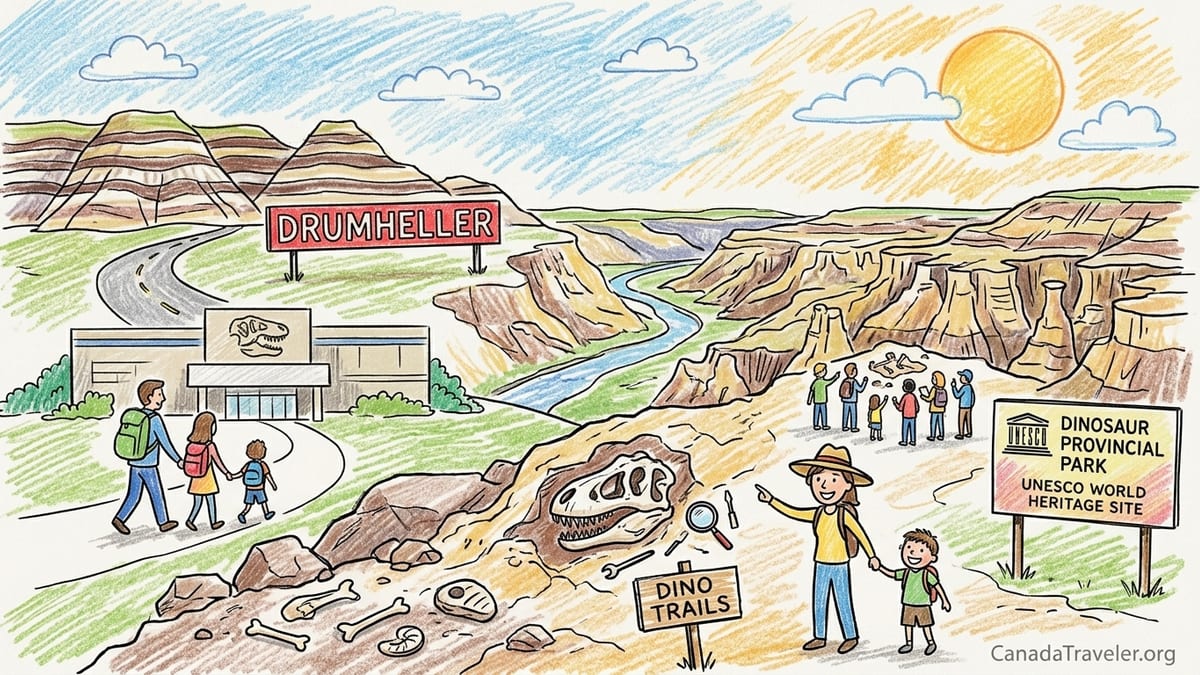
Across eastern Alberta, rolling prairie suddenly breaks open into a maze of coulees, hoodoos and canyons carved from soft rock. This is the Canadian Badlands, one of the richest Late Cretaceous fossil regions on Earth and an unforgettable place for a three to five day road trip built around dinosaurs, geology and Indigenous history. Rather than rushing Drumheller as a single day trip, this itinerary uses it as a base before continuing deeper into Dinosaur Provincial Park and on to the sacred hoodoos and rock art of Writing-on-Stone / Áísínai’pi.
How Ancient Seas Created Today’s Fossil-Rich Badlands
To understand why the Alberta Badlands are so rich in dinosaur fossils, it helps to picture the region 75 million years ago. In the Late Cretaceous, a warm, shallow body of water called the Western Interior Seaway split North America from the Arctic Ocean to the Gulf of Mexico. Eastern Alberta lay along the western shoreline of this inland sea, in a low-lying coastal plain criss-crossed by rivers, floodplains and swamps. Dinosaurs, turtles, crocodiles and primitive mammals lived in these wetlands while fish and marine reptiles swam offshore.
Over millions of years, rivers feeding the seaway dropped layer upon layer of sand, silt and mud. Plant material and the remains of animals were quickly buried in these sediments, especially during floods and river channel changes. That rapid burial, combined with mineral-rich groundwater, helped preserve bones and even impressions of skin and plants. These Late Cretaceous sediments compacted into the sandstone, mudstone and shale that now form the bedrock beneath Drumheller and Dinosaur Provincial Park.
Only much later did the modern Badlands appear. After the last ice age, meltwater from retreating glaciers cut deeply into the soft rock of the Red Deer River and its tributaries. Erosion peeled back the surface, carving coulees and canyons and exposing the fossil-bearing layers beneath. Today when you stand at viewpoints like Horseshoe Canyon outside Drumheller or at the rim of Dinosaur Provincial Park, you are looking into a cross-section of ancient river channels, floodplains and coastal environments, with dinosaur bones still weathering from the slopes.
This combination of rich Cretaceous sediments and rapid modern erosion explains why paleontologists have collected tens of thousands of fossils in the region and why visitors can see everything from articulated skeletons in the Royal Tyrrell Museum to isolated bone fragments underfoot on guided hikes in Dinosaur Provincial Park. It is a landscape where deep time feels remarkably close at hand.
Drumheller as Base Camp: Getting There and Getting Oriented
Most travelers approach the Badlands from Calgary, which makes Drumheller a practical first base. The drive is roughly 135 kilometres and usually takes about an hour and a half in a standard rental car. For much of the journey you pass through gently rolling farmland before the road suddenly dips into the Red Deer River valley and the striped hillsides of Drumheller’s Badlands come into view.
Drumheller works well as a base for families and enthusiasts because it combines big-ticket attractions like the Royal Tyrrell Museum with short drives to canyons, hoodoos and historic mining sites. There is a range of motel-style accommodations, small hotels and family-run campgrounds in and around town, along with grocery stores, fuel and casual restaurants. For example, many families choose a mid-range chain hotel with a pool in central Drumheller for two nights, then switch to camping at Dinosaur Provincial Park to experience the Badlands after dark.
A standard rental car is sufficient for almost all of the main sights around Drumheller. Roads to Horseshoe Canyon, Horsethief Canyon, the Drumheller Hoodoos, Rosedale Suspension Bridge and Atlas Coal Mine are paved or well-graded. Gravel side roads do exist, especially near lesser-known viewpoints and river access points, but for this itinerary you can avoid anything that requires high clearance or four-wheel drive simply by sticking to signed tourist routes.
Summer in the Badlands is hot and dry, with daytime highs often climbing above 30 degrees Celsius in July and August and relatively little shade once you are off the valley bottom. Bring refillable water bottles and sun protection in the car, and aim to hike early or later in the day. In shoulder seasons like May, June and September, conditions are often more comfortable for walking, but occasional thunderstorms and muddy trails are possible. Having footwear that can handle dust, loose gravel and the odd muddy patch will make short canyon walks more pleasant.
The Royal Tyrrell Museum: World-Class Dinosaurs in the Heart of the Badlands
The Royal Tyrrell Museum of Palaeontology, located a short drive northwest of Drumheller in Midland Provincial Park, is the undisputed highlight for dinosaur-focused travelers. It is Canada’s only museum dedicated exclusively to paleontology and is widely considered one of the premier dinosaur museums in the world. Its galleries showcase impressive full skeletons, intricate fossil mounts and exhibits that connect directly to the surrounding landscape.
As of late 2026, regular admission is listed at about 25 Canadian dollars per adult and 55 Canadian dollars per family, which includes up to two adults and their children aged 7 to 17, for a maximum group size of eight. Children six and under require a ticket but are admitted free. These rates include tax and are scheduled to remain in effect through March 31, 2029, though visitors should always double-check closer to their travel dates in case of provincial changes.
From September 1 to mid May, the museum operates on reduced hours and is open from Tuesday to Sunday, typically between 10 a.m. and 5 p.m. It is closed on most Mondays during that period, with the exception of certain holiday Mondays. Between May 15 and August 31 it opens seven days a week, with extended summer hours often running from morning until 9 p.m. Timed entry tickets are standard, which helps spread out crowds in peak season. Booking a morning time slot can make for quieter galleries, especially if you are visiting with young children who are excited to explore before lunchtime.
Inside, several galleries are especially memorable. A series of signature dinosaur halls feature towering skeletons of tyrannosaurs, ceratopsians and hadrosaurs recovered from Alberta and beyond. In some cases, these mounts are based on specimens found in nearby valleys, and interpretive panels explain exactly where in the Badlands the fossils were collected. Research-focused exhibits highlight how paleontologists reconstruct ecosystems from fossil evidence, using everything from microscopic pollen grains to bite marks on bones.
The fossil preparation lab is another highlight. Large windows allow visitors to watch technicians carefully remove rock from around fossils using air scribes and tiny tools. Families often find it fascinating to see a horn or vertebra slowly emerge from stone, sometimes over days or weeks of work. Interactive exhibits explain how CT scanning, 3D imaging and modern analytical techniques are used to study specimens that might otherwise remain locked inside blocks of rock.
Exploring Around Drumheller: Canyons, Hoodoos and Coal History
Beyond the museum, Drumheller offers a cluster of outdoor stops that bring the geology and human history of the valley to life. A logical way to structure a full day is to combine one or two canyon viewpoints with a hoodoo walk, a short suspension bridge visit and an afternoon at a historic coal mine.
Horseshoe Canyon, about 17 kilometres west of Drumheller on the main highway, is often the first dramatic view travelers encounter. From the parking area at the rim, you look down into a U-shaped canyon where banded layers of brown, beige and grey rock curve in a broad arc. Short trails descend onto the canyon floor, though footing can be steep and slippery when wet. Geology enthusiasts will appreciate how the exposed layers reveal a stack of river and floodplain deposits, while families typically enjoy a one hour wander among the buttes and gullies before climbing back to the viewpoint.
Northwest of Drumheller, Horsethief Canyon feels slightly wilder and less developed. From roadside pullouts, you see a maze of narrow coulees and knobby hills, with fewer marked trails and very limited shade. The name reflects the area’s past use as a hiding place for stolen livestock. Today it appeals to travelers who want to sit quietly on the rim and absorb the scale of the eroded landscape. It is a good place to point out drainage patterns and how small rivulets carve ever deeper channels into the soft rock.
South of town, the Drumheller Hoodoos, sometimes called the Hoodoos Trail, offer a compact chance to walk among the mushroom shaped rock pillars that have become an unofficial symbol of the Badlands. Protective boardwalks and fencing help limit erosion and visitor impact. The hoodoos are capped by harder stone that protects the softer pedestal underneath, illustrating in miniature how differential erosion shapes the landscape. A short stop of 30 to 60 minutes is realistic, especially on hot days when the dark rock radiates heat.
Nearby, the Rosedale Suspension Bridge crosses the Red Deer River at a former mining hamlet. This narrow pedestrian bridge, originally built for coal miners accessing work sites, now provides an airy crossing with views back toward the valley walls. It adds a touch of mild adventure for children without requiring technical skill. Further along the valley at the Atlas Coal Mine National Historic Site, guided tours take visitors through the story of Drumheller’s mining boom, including preserved tipples, machinery and in some cases underground workings. Together, these stops round out the picture of how geology underpinned both fossil preservation and coal formation in the region.
Dinosaur Provincial Park: Fossil Heartland and UNESCO World Heritage Site
From Drumheller, the drive to Dinosaur Provincial Park is roughly two hours, covering about 170 kilometres southeast through prairie farmland toward the Brooks region. The final approach is unforgettable: the flat fields suddenly break open where the Red Deer River’s tributaries have carved into the rock, revealing a labyrinth of hoodoos, buttes and canyons. The park is recognized as a UNESCO World Heritage Site because of its exceptional concentration of Late Cretaceous fossils and the integrity of its Badlands landscape.
It is crucial to note that Dinosaur Provincial Park is not where the Royal Tyrrell Museum building is located. Many first-time visitors assume they can see the museum galleries inside the park, but the museum sits near Drumheller. What connects them is the shared geology. Some of the most important specimens on display at the Royal Tyrrell, including several iconic dinosaur skeletons, were excavated from quarries in and around Dinosaur Provincial Park and other sites in the region.
The park is divided into a more accessible public zone and a restricted natural preserve where most fossil quarries lie. Public trails include a series of short interpretive walks, such as the Badlands Trail and the Coulee Viewpoint, where signs explain rock layers, fossil discoveries and modern plants and animals. A paved scenic loop road winds through part of the valley, with pullouts and viewpoints suitable for those who prefer to explore by car and short strolls.
To reach active or historically important fossil sites, you need to join an official guided program run through Alberta Parks. Options typically include a two hour bus tour that travels into restricted areas, family oriented fossil programs where kids learn to spot bits of bone and petrified wood, and longer guided hikes that might last half a day or more and venture deeper into the preserve. These tours usually operate from late spring through early fall and can sell out in peak season, so it is wise to book online in advance once your travel dates are fixed.
Throughout the park, strict rules protect fossils. In Alberta, vertebrate fossils are considered part of the province’s heritage resources. It is illegal to remove them without permission or to disturb potential sites. On guided tours, leaders often demonstrate how to recognize bone fragments and explain that even small surface finds must be left in place. This not only preserves scientific information but also ensures that future visitors can experience the excitement of spotting real fossils embedded in the rock.
Practicalities at Dinosaur Provincial Park: Heat, Camping and Access
Spending at least one night at Dinosaur Provincial Park lets you experience the Badlands at sunrise and sunset when colours soften and wildlife is more active. The main campground sits along the cottonwood lined river, with a mix of unserviced and serviced sites. In summer, reservations are recommended, especially for weekends. A small visitor centre offers exhibits on local geology and paleontology, a gift shop and basic information about trails and tours.
Summer conditions in the park can be more extreme than in Drumheller. Daytime highs often exceed 30 degrees Celsius and the clay rich soil and bare rock reflect heat, making it feel even hotter on exposed slopes. Shade is limited once you leave the river corridor, so a wide brimmed hat, light long sleeves, sunscreen and plenty of drinking water are important even for short hikes. A common pattern is to plan longer walks or guided hikes in the morning, spend the hottest hours along the river or in the visitor centre, and then head out again for evening photo opportunities.
Road access within the main public area is suitable for standard rental cars. The entrance road and scenic loop are paved or good gravel, and parking lots at trailheads and the visitor centre are well maintained. Some side tracks into picnic areas or viewpoints are unpaved, but they are generally manageable at low speeds in dry weather. Heavy rain can temporarily create muddy conditions and puddles, so checking with park staff about road status after storms is sensible if you plan to drive beyond the main loop.
The closest full-service fuel stops are outside the park in nearby communities such as Brooks, so arrive with at least half a tank and do not assume you can top up inside the park itself. Grocery options are also limited once you arrive, so many visitors stock up in Brooks, Drumheller or Calgary before heading in. Simple on-site offerings may include snacks, ice cream and drinks in high season, but not a full supermarket. A cooler with water and easy picnic meals gives you the flexibility to linger at viewpoints or stay through sunset without rushing back out.
For families, evenings in the campground can be a highlight, with children exploring short riverside paths and looking up at bright stars far from city lights. For geology enthusiasts, dusk is an ideal time to study the subtle colour differences between rock layers, and early mornings often bring fog patches swirling through the coulees, emphasizing the relief of the Badlands.
Extending the Journey to Writing-on-Stone / Áísínai’pi
Travelers with five days can extend the Badlands loop south to Writing-on-Stone Provincial Park, also known by its Blackfoot name Áísínai’pi. From Dinosaur Provincial Park, it is roughly a three and a half to four hour drive through the open prairie of southern Alberta, often via Brooks and then smaller communities toward the Milk River valley near the United States border. As you approach, sandstone outcrops and hoodoos begin to appear again, but here the focus shifts from dinosaurs to Indigenous cultural heritage.
Writing-on-Stone / Áísínai’pi is a UNESCO World Heritage Site recognized primarily for its extraordinary concentration of rock art and its ongoing spiritual significance to the Blackfoot Confederacy. The park protects thousands of petroglyphs and pictographs carved or painted into sandstone cliffs and hoodoos along the Milk River. Many of these images depict human figures, horses, shields and ceremonial scenes that reflect stories, visions and historical events. Archaeological evidence indicates that people have used this valley for at least several thousand years.
Although the landscape includes hoodoos similar in shape to those near Drumheller, Writing-on-Stone is not a dinosaur destination. Its significance is cultural and spiritual rather than paleontological. Visitors are asked to treat rock art areas as sacred places, staying on designated trails and not touching or tracing the images. Guided tours, often led by interpreters with knowledge of Blackfoot history and traditions, provide context that is difficult to gain from signs alone and are highly recommended if available during your visit.
The park offers a riverside campground, a visitor centre with exhibits on Blackfoot culture and local natural history, and several marked trails that weave among the hoodoos and along the riverbank. Summer temperatures can again be hot, with limited shade away from the trees near the Milk River, so the same precautions about water, sun protection and light clothing apply. Road access to the campground and main day-use areas is suitable for standard cars, though some portions may be gravel. As with Dinosaur Provincial Park, it is sensible to arrive with enough fuel and supplies for at least a day or two.
A Three to Five Day Alberta Badlands Itinerary
One effective way to structure this road trip is to think in layers. Start by using Drumheller as your introduction to the Badlands and dinosaur science, move on to Dinosaur Provincial Park to immerse yourself in the fossil rich landscape itself, and finish at Writing-on-Stone / Áísínai’pi to connect with the deeper human history of the region. This approach works for both families and dedicated geology or dinosaur travelers, with small adjustments.
On Day 1, travel from Calgary to Drumheller, check into your accommodation and visit the Royal Tyrrell Museum for an afternoon or evening session depending on your timed ticket. Allow at least three to four hours in the galleries, with younger children often hitting their limit at around the three hour mark. If you arrive earlier in the day, you might add a short walk in Midland Provincial Park or a quick stop at the world’s largest dinosaur structure in town for a fun photo.
Day 2 can be devoted to the outdoor attractions around Drumheller. A sample schedule might start at Horseshoe Canyon in the cool of the morning, continue to Horsethief Canyon for a late morning viewpoint stop, and then head down the valley to the Drumheller Hoodoos early in the afternoon. Plan a brief visit to the Rosedale Suspension Bridge, and then finish at the Atlas Coal Mine for a late afternoon guided tour. This structure lets you balance driving and walking, with options to shorten or lengthen stops depending on the interests and stamina of your group.
On Day 3, depart Drumheller for Dinosaur Provincial Park, arriving in time for an afternoon visitor centre visit and perhaps a short self-guided trail. Spend the night at the park campground or in nearby accommodations outside the valley. Day 4 can then focus on a booked guided program into the restricted fossil areas, combined with a leisurely drive along the scenic loop and relaxed time by the river. If you have only three full days, you could begin the drive back toward Calgary or other destinations in the late afternoon.
Travelers with five days can add Writing-on-Stone as a final destination. After your second day in Dinosaur Provincial Park, drive south to Writing-on-Stone and stay one or two nights. Spend a full day walking hoodoo trails, joining any available guided rock art tours and relaxing along the Milk River. On your last day, begin the journey back toward Calgary or Lethbridge, perhaps pausing at prairie viewpoints or small towns along the way. This extended version turns a museum-focused visit into a broader exploration of Alberta’s Badlands, linking ancient seas, dinosaurs and millennia of human presence.
Separate Versions for Families and Geology Enthusiasts
Families with school-age children will likely prioritize hands-on experiences, shorter walks and a manageable daily pace. In Drumheller, that might mean dedicating most of Day 1 to the Royal Tyrrell Museum, with frequent breaks in kid-friendly galleries and time at the outdoor playground near the entrance if available. Day 2 could include Horseshoe Canyon and the Drumheller Hoodoos, both of which allow children to scramble carefully among safe areas while learning basic geology through interpretive signs. The Rosedale Suspension Bridge adds a short burst of excitement, and the Atlas Coal Mine offers tactile experiences such as climbing stairs on the tipple and seeing old mining tools.
At Dinosaur Provincial Park, families might choose a shorter family fossil program or bus tour rather than a long hike. These programs often emphasize simple fossil identification, games and stories as much as scientific detail, which keeps children engaged. Camping by the river becomes an adventure in itself, from roasting marshmallows to listening for coyotes after dark. For Writing-on-Stone, families should be prepared to explain to children why it is important not to touch rock art and to frame guided tours as story sessions rather than long lectures. Breaking the day into a morning hike, a midday rest by the river and an evening hoodoo walk can help younger travelers enjoy the site.
Geology enthusiasts and dinosaur-focused adults may prefer to spend longer periods at each interpretive stop, reading panels in full and asking in-depth questions on guided tours. In Drumheller, that could translate into a full day inside the Royal Tyrrell Museum, including temporary exhibits and perhaps a behind-the-scenes program if available, followed by an evening photo session in nearby coulees. Day 2 might include careful observation of rock layers at Horseshoe and Horsethief Canyons, with time spent comparing sediment colours, cross-bedding and evidence of ancient river channels or soil horizons.
At Dinosaur Provincial Park, serious enthusiasts might book both a long guided hike into the preserve and a bus tour to maximize exposure to different fossil sites. Bringing a field notebook to sketch outcrop profiles or note the types of fossils seen can turn a casual visit into an informal study trip. Writing-on-Stone then provides an opportunity to consider how geology influences human use of the landscape, from the soft sandstone that allows for petroglyph carving to the sheltering coulees used for camps and ceremonies. For all visitors, regardless of focus, this road trip offers a rare chance to see how ancient seas, changing climates and human cultures have all left their marks on a single region.
The Takeaway
An Alberta Badlands road trip that links Drumheller, Dinosaur Provincial Park and Writing-on-Stone / Áísínai’pi rewards travelers who slow down. Instead of treating Drumheller as a rushed day excursion, using it as a base allows time to absorb the Royal Tyrrell Museum, walk among hoodoos and consider how coal mining and fossil hunting have both shaped the valley. Continuing on to Dinosaur Provincial Park deepens the experience by placing you inside the eroded heart of the Late Cretaceous landscape, among the very layers that have yielded so many famous dinosaur skeletons.
Extending the journey further south to Writing-on-Stone completes the picture. Here the emphasis shifts from dinosaurs to people, as Blackfoot rock art and stories anchor the landscape in thousands of years of human memory. Together, these three stops trace a continuous story from ancient seaways and dinosaurs, through the carving of the Badlands, to the cultures that continue to hold these places as home or as sacred. Whether you are traveling with children clutching toy tyrannosaurs, with a field notebook and hand lens, or simply with a curiosity about deep time, the Canadian Badlands offer a road trip that feels connected, instructive and unforgettable.
FAQ
Q1. Is the Royal Tyrrell Museum located inside Dinosaur Provincial Park?
The Royal Tyrrell Museum is near Drumheller in Midland Provincial Park, not inside Dinosaur Provincial Park. Some specimens on display there were excavated from Dinosaur Provincial Park and other Badlands sites, but the museum building and the park are about two hours’ drive apart.
Q2. How many days do I need for this Alberta Badlands itinerary?
Plan at least three full days to cover Drumheller and Dinosaur Provincial Park without rushing. To include Writing-on-Stone / Áísínai’pi, five days gives you time for travel between sites, guided tours and unhurried hikes, especially if you are traveling with children.
Q3. What are the current admission costs for the Royal Tyrrell Museum?
As of late 2026, regular admission is approximately 25 Canadian dollars per adult and 55 Canadian dollars per family, including tax. Children six and under require a ticket but are admitted free. Prices are set for the current provincial fee period but can change, so it is wise to confirm closer to your visit.
Q4. When is the Royal Tyrrell Museum closed on Mondays?
From September 1 to mid May, the Royal Tyrrell Museum is open Tuesday to Sunday and closed on most Mondays, except certain holiday Mondays. Between mid May and the end of August it is generally open seven days a week with longer summer hours.
Q5. Do I need a four-wheel-drive vehicle to visit these Badlands sites?
No, a standard rental car is sufficient for the main attractions in Drumheller, Dinosaur Provincial Park and Writing-on-Stone. Access roads and scenic loops are paved or good gravel. Drive slowly on unpaved sections and check conditions with park staff after heavy rain if you plan to explore beyond main parking areas.
Q6. Can I collect or take home fossils that I find?
In Alberta, vertebrate fossils are protected as part of the province’s heritage resources. It is illegal to remove or disturb them without proper authorization. In Dinosaur Provincial Park and other protected areas, any fossils you see on trails or guided tours must be left in place, and guides will explain how to report significant finds to staff.
Q7. How hot does it get in the Badlands during summer?
Summer daytime temperatures in Drumheller, Dinosaur Provincial Park and Writing-on-Stone often reach or exceed 30 degrees Celsius. The dark rock and limited shade can make it feel hotter on slopes and canyon floors. Plan hikes for morning or late afternoon, wear sun protection and carry more water than you think you will need.
Q8. Are the guided tours at Dinosaur Provincial Park worth booking in advance?
Yes. Guided bus tours and hikes into the restricted fossil areas are among the highlights of the park and often sell out in peak season. Booking online in advance once you know your travel dates helps ensure you can join the programs that best match your interests and fitness level.
Q9. Is this itinerary suitable for young children?
Yes, with some adjustments. Short walks at Horseshoe Canyon, the Drumheller Hoodoos and along the river in both Dinosaur Provincial Park and Writing-on-Stone work well for school-age children. The Royal Tyrrell Museum is very engaging for dinosaur-loving kids, though those under about six may tire more quickly. Building in rest time and avoiding the hottest hours of the day is important.
Q10. How should I divide my time between Drumheller, Dinosaur Provincial Park and Writing-on-Stone?
On a three-day trip, consider one and a half to two days in Drumheller and one to one and a half days in Dinosaur Provincial Park. On a five-day trip, add one or two nights at Writing-on-Stone. This balance gives enough time for the Royal Tyrrell Museum, canyon and hoodoo walks, at least one guided fossil tour and a meaningful visit to the Blackfoot rock art and hoodoos along the Milk River.