

The pavement east of Edmonton turned the color of pewter in late afternoon as I left the city on Highway 16, clouds stretched in high, thin bands and the air just cool enough to see my breath at stoplights. It was a weekday in October 2026, with the sun dropping earlier every night, and I had one plan for the evening: drive to Elk Island National Park to watch bison at dusk, then stay on at Astotin Lake in the Beaver Hills Dark Sky Preserve in the hope that the northern lights might show.
Getting from Edmonton to Elk Island for an Evening Visit
Elk Island National Park lies about 35 kilometres east of downtown Edmonton, directly along Highway 16, the Yellowhead Highway that cuts across the prairie. Leaving the city in late afternoon, the transition is quick. One moment you are passing big box stores in Sherwood Park, the next you are sharing the highway with long-haul trucks and grain trailers, farm fields opening on either side. The official park boundary is fenced, and highway signs begin to warn of wildlife, a reminder that from here on, every kilometre may hold a surprise on the roadside.
For an evening trip focused on wildlife and dark skies, timing matters. On this October day, I left central Edmonton just after 4:30 p.m., giving myself almost an hour to reach the main gate before the sun slid toward the horizon. Traffic eastbound was light, mostly commuters heading home to rural acreages and a steady stream of transport trucks. The sky was high and overcast, a kind of diffuse gray that Parks Canada staff often quietly celebrate, because cooler, cloud-filtered evenings can bring bison and elk out of the forest fringe toward the grasslands.
The turnoff for Elk Island is obvious. Large brown Parks Canada signs appear along Highway 16, pointing to the north and south entrances. For the classic bison viewing route and Astotin Lake access, you use the north entrance. Here, a short access lane leaves the highway, leading to the park gate and a booth where staff check admission. On my visit, regular national park fees were in effect: adults were being charged about ten dollars for a daily pass, with a family or group rate under twenty dollars for up to seven people in one vehicle, while youth seventeen and under entered free. Payment was quick with tap-enabled credit card, though you can also arrive with an annual pass if you visit often.
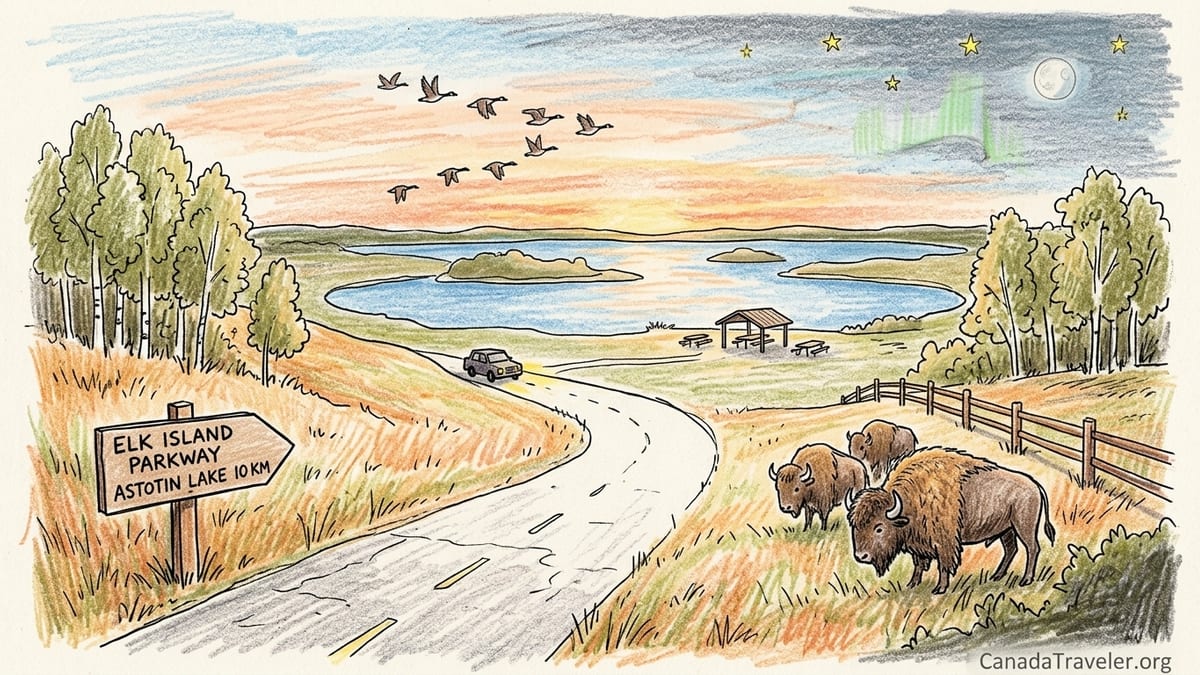
Once past the gate, the Elk Island Parkway runs north from Highway 16 through open meadows and aspen stands toward Astotin Lake. This paved parkway is part of a fenced, managed landscape, but it still feels remote. Posted limits drop well below highway speeds, and signs along the road repeat a message that becomes a theme of any evening here: slow down and expect wildlife at any time.
Bison Loop Road and the First Glimpse of Plains Bison
Almost immediately after leaving the gate, a right-hand turn leads to Bison Loop Road, a one-way paved loop specifically designed for vehicle-based wildlife viewing. It is one of Parks Canada’s most frequently recommended places to see bison in Elk Island, and most visitors make it their first stop, especially near dawn and dusk. I followed suit, turning off the parkway and rolling onto the narrow loop as the sun slipped into the lower third of the sky.
Bison Loop Road curves gently through mixed grassland and clumps of aspen and willow. On some visits, herds graze right beside the pavement, but this was not one of those evenings. I completed the first half of the loop watching only for birds, my headlights still off, scanning the tawny slopes and low spots with naked eyes. A red-tailed hawk lifted off a fence post, and a loose line of Canada geese traced south overhead. For several minutes, it seemed that the iconic animals on the signs might refuse to appear.
Halfway around, though, one uneven brown shape resolved into a bison lying in the grass, then several more beside it. A small group of plains bison was bedded roughly 150 to 200 metres from the road, just beyond a shallow dip that hid most of their bodies. Even at that distance they looked massive. One adult bull, horns thick and curved, lay facing away from the wind, his dark forequarters more woolly than his hips. A couple of younger animals shifted their weight, flicking tails and occasionally lifting their heads to chew. None approached the road. That is the reality of ethical viewing: sometimes your best sighting remains a dark silhouette resting far out in a field.
I stayed in the car, windows cracked. Parks Canada’s guidance is clear here. Visitors must keep at least one hundred metres away from bison unless safely inside a vehicle. Bison can run much faster than a human, and both plains and wood bison in Elk Island are powerful, unpredictable wild animals. The loop’s design encourages you to remain in your car, simply pulling into small paved bays to watch. Several other vehicles joined the quiet vigil, engines idling low, nobody stepping out. As the light cooled from gold to gray, the bison herd gradually stood up as a group and drifted deeper into the park, hoofs muffled by dry grass.
North of Highway 16: Plains Bison and Managed Wildness
Back on the Elk Island Parkway, I continued north deeper into the plains bison range. Elk Island is unusual in that it protects both subspecies of North American bison within a single fenced national park. The north side of Highway 16 is home to a large herd of plains bison, the classic “buffalo” of old prairie stories, descendants of animals reintroduced here more than a century ago as part of wide-ranging conservation efforts. Their back humps are rounded and high, with a pronounced shaggy cape over shoulders and chest, and heavy forequarters narrowing toward the hips.
Wildlife viewing in this northern section is a blend of luck and pattern recognition. Parks Canada suggests the best chances of seeing bison and other large mammals come at dawn or dusk or on cooler, overcast days, because heat often pushes animals into the forest shade by mid-afternoon. On this October evening, the temperature sat just above freezing, ideal for movement. Even so, the open meadows along the first kilometres of the parkway remained quiet. Instead I saw white-tailed deer ghosting along the edge of the trees and a lone coyote trotting along a distant fenceline.
Bison appeared again closer to the park operations area, where service roads and fenced pastures break up the forest edge. A mixed group of perhaps twenty animals grazed two fields away from the pavement, their forms partially blocked by a line of poplars. The closest stood roughly 120 metres from the road, near enough for detail through binoculars but still beyond the recommended buffer if anyone had been tempted to walk closer. Calves from the spring calving season, now several months old, stayed near cows, drifting in loose association as they fed. One animal occasionally rolled onto its side in the dirt, creating a low dust cloud that hung briefly in the cool air.
The sense here is of managed wildness. Elk Island is entirely enclosed by fence, and bison movements are constrained by the park boundary and by internal enclosures built to protect vegetation and maintain herd health. Yet in the moment, watching animals roll, graze and nudge one another across a wide grassland as the sky dims, the human infrastructure recedes. From the paved pullouts along the parkway, you are still simply a visitor on the fringe of a powerful herd, and the one-hundred-metre rule feels less like a restriction than a way to keep that feeling safely intact.
South of Highway 16: The Wood Bison You May or May Not See
Before committing to Astotin Lake for sunset, I doubled back toward Highway 16 to cross mentally, if not physically, into the world of wood bison. The parkway north of the highway belongs to plains bison, but Elk Island’s southern sector, reached through a separate entrance, holds wood bison in a large, mostly roadless enclosure. The distinction is more than geographic. Wood bison are a different subspecies, taller and longer-legged, with a more peaked hump that sits forward over the shoulders and a less pronounced shoulder cape compared with plains bison.
Most short evening visitors never see the wood bison at all, in part because vehicle access into their area is limited to a short spur road to the Wood Bison Trailhead and some peripheral views from Highway 16. That was my experience on this trip. From a legal pullout along the highway, looking south across a mix of low hills and wetlands, no animals were visible, though tracks and old wallows near the fence spoke to their presence. A decade ago, Parks Canada videos often showed wood bison feeding along ponds here, but they have many square kilometres of land to roam and can easily be out of sight on any given night.
That absence became part of the story. It is tempting to imagine that a national park is a kind of open-air zoo, with guaranteed encounters on every visit. Elk Island refuses that simplification. Both wood and plains bison may appear in large herds beside the road, or they may be silhouettes far out on the landscape, or they may remain entirely within forest and marsh. In autumn, rut and calving seasons are over, and herds sometimes disperse into smaller units.
Nonetheless, the knowledge that two distinct bison subspecies occupy the land on either side of Highway 16 enriches the drive. To the north, plains bison graze and wallow in terrain that echoes the Great Plains. To the south, wood bison, whose history in Canada includes brushes with extinction and decades of careful disease management, move through a mix of boreal wetland and upland. You may see one, both or neither on an evening visit, but the road through Elk Island crosses an invisible line between two conservation stories, and simply knowing that helps frame what you are looking for in the fading light.
Astotin Lake: Sunset, Birds and the Slow Arrival of Night
From Bison Loop Road, the Elk Island Parkway continues north to the Astotin Lake area, the social heart of the park and one of the designated viewing areas in the Beaver Hills Dark Sky Preserve. Here you find a lakeshore day-use area, picnic shelters, a small sand beach, the Astotin Lake Campground access and open views west across the water. I reached the parking lot about forty minutes before official sunset, with the cloud deck thinning into streaks that promised at least some color.
Astotin Lake is long and island-dotted, part of the rolling Beaver Hills landscape that has attracted travelers for more than a century. On this October evening, the campground was quiet, but the day-use area still held a handful of families finishing early suppers at the picnic tables. Children played near the swings while parents packed coolers back into cars, mindful of the temperature that was already edging toward single digits Celsius. Out on the lake, a raft of ducks paddled in loose formation, periodically diving, while a pair of grebes traced silver wakes through the orange reflection of the sky.
As the sun touched the tree line, the park subtly shifted. A V-shaped flock of geese arrived from the north, voices loud over the growing calm, circling once before settling into the open water. The aspen trees ringing the picnic area, stripped of many of their leaves by earlier frosts and wind, rattled dryly. Overhead, the flat gray of an hour earlier gave way to bands of peach and purple, the high clouds catching light long after the ground dimmed. It was the sort of sunset that pulls people instinctively to the shore. Several of us walked down to the narrow beach, standing with hands in pockets, watching the last direct sunlight fade behind the western bank of trees.
Birdlife around Astotin Lake does not stop at dark. As the color drained from the sky, a few late gulls swung low over the water, and the calls of unseen songbirds came briefly from the reeds. The real soundtrack, though, was the constant low conversation of geese and ducks settling in for the night. For travelers, especially those based in Edmonton who might have spent the morning at office desks or in classrooms, this migration of sound and light just forty minutes from the city feels like a major reset before the longer wait for stars.
Beaver Hills Dark Sky Preserve and the Reality of Aurora Hunting
Elk Island sits within the Beaver Hills Dark Sky Preserve, a designation created in partnership among Parks Canada, Alberta Parks, local municipalities and astronomy groups to recognize and protect the region’s relatively dark night skies. Compared with truly remote northern sites, some light from Edmonton is still visible low on the western horizon, but above that glow the sky can be surprisingly rich with stars. On clear nights, the Milky Way arcs over Astotin Lake, and planetary alignments and meteor showers draw amateur and professional astronomers alike.
On this particular October night, the sky was still partly cloudy. The forecast suggested clearing after midnight, well beyond the patience of most casual visitors. This is where expectations must be aligned. Normal stargazing and aurora chasing are related but distinct pursuits. Stargazing in a place like Elk Island means looking up at a predictable sky of constellations, planets and the soft smear of the Milky Way when conditions allow. Even with some haze, you may see major stars through breaks in the cloud, learn the shapes of Orion and Cassiopeia and watch satellites slide silently overhead.
Aurora hunting is another matter. The northern lights depend on solar activity and clear skies, and they are never guaranteed, no matter what a social media forecast or smartphone app may claim. Even on nights when geomagnetic predictions are favorable, displays near Edmonton can ebb and surge unpredictably, sometimes confined to a faint green band low in the northern sky, sometimes rising overhead in curtains of pink and white. On my visit, low cloud held stubbornly to the north. Several small groups near the parking lot consulted aurora apps on their phones, screens briefly bright in the darkness, but the horizon remained blank of color.
Yet the dark-sky experience was still rich. A break in the cloud revealed the Big Dipper and the W-shaped line of Cassiopeia, mirrored faintly in the lake. A bright planet, likely Jupiter at this time of year, hung over the eastern trees. The air temperature had dropped close to freezing, and the wind off the lake, gentle earlier, now carried an edge that seeped quickly through any gap in clothing. People who had arrived in thin hoodies or sneakers retreated first, car doors slamming softly, while those in insulated jackets, toques and winter boots lingered. The lesson for visitors is straightforward: even in early fall, come dressed as if for a winter evening walk, with multiple layers, gloves and something windproof, especially if you plan to stand still for a long time.
Gateway to the Stars: Guided Programs Under the Autumn Sky
On select evenings in September and October, Elk Island hosts “Gateway to the Stars” programs at Astotin Lake, in cooperation with local astronomy clubs and Parks Canada interpreters. In October 2026, these events continued the tradition of using star charts, laser pointers and storytelling to connect visitors with the sky, even when telescopes could not be used due to cloud, wind or the number of participants. On the night I visited, one such program was underway near the Astotin Theatre building and adjacent field.
Participants had registered in advance and paid a modest program fee on top of park admission, and they gathered shortly after sunset. Interpreters began indoors with a short presentation about Elk Island’s place within the Beaver Hills Dark Sky Preserve and the basics of light pollution. A Parks Canada staff member explained how shielded lighting and thoughtful design at nearby facilities help preserve the darkness that draws both wildlife and people. Large printed star maps showed the autumn constellations likely to be visible if the cloud cooperated.
When we stepped outside, the group spread across the open area between the theatre and the lake. An interpreter used a green laser pointer to trace out constellations as they appeared through holes in the cloud, linking them to Indigenous stories from the region, as well as to Greek myths that many visitors recognized from school. Where telescopes were available on other evenings, they were sometimes set up to show Jupiter’s moons or the craters of a waxing moon. On this partially overcast night, the focus remained on the naked-eye sky and binocular views. The emphasis was on orientation, not spectacle: how to find north using the Big Dipper, how to hop from familiar stars to fainter ones, and how to let your eyes adjust by avoiding white light from phone screens and flashlights.
The aurora, again, did not appear. Yet the program made that absence easier to accept. Guides stressed that while social media photos of vivid green aurora over Astotin Lake are real, they represent a subset of nights. For many Gateway to the Stars participants, the highlight becomes the feeling of standing in near-darkness by the water, hearing bison occasionally grunt in the distance or elk bugle farther back in the forest, rather than any particular photograph of the sky.
Night Driving, Wildlife Risks and Heading Back to Edmonton
By the time the Gateway to the Stars program wrapped up, full darkness had settled over the park. Vehicle lights on the Elk Island Parkway became the main artificial glow, small islands of brightness moving slowly among the trees. Before starting the drive back to Highway 16, I took a moment in the parking lot to check that my headlights were clean of dust and bugs and that I was fully alert for the road ahead. Night driving in Elk Island carries very real wildlife risks. Bison, elk and deer all cross the parkway and the Yellowhead Highway, sometimes unexpectedly and in groups.
Parks Canada and local news reports periodically describe collisions involving multiple bison on foggy or dark nights within the park. The animals’ dark coats and low-slung profiles make them hard to see until headlights are nearly upon them, particularly when they are standing on or near the pavement. Speed limits through the park are set with this in mind, and they are not simply suggestions. On this return trip, I kept my speed well below the posted limit in some sections, especially where open meadows and bison fencing came close to the road.
Wildlife made one more appearance before I reached the exit. A small group of plains bison, probably six or seven animals, stood inside the fence but very close to the parkway, their forms bulky against the faint snow patches on the grass. I slowed to well under thirty kilometres per hour and passed with hazard lights briefly flashing to alert vehicles behind me. Even from inside the car, the one-hundred-metre guideline felt relevant. Leaving the paved pullouts and approaching on foot would have been both unsafe and illegal.
The reentry to Highway 16 returned me to the human timetable. Truck headlights traced long white lines east and west. The drive back to Edmonton, though still requiring attention for wildlife at the margins, felt almost urban again, with steady traffic and familiar signage. Forty minutes later I was back among city lights, the smell of cool air and lake water still lingering in my jacket.
The Takeaway: Elk Island as Edmonton’s Go-To Dark-Sky Wildlife Escape
For visitors staying in Edmonton who want to combine close-to-guaranteed wildlife viewing with a realistic chance at dark skies and, occasionally, the northern lights, Elk Island National Park is hard to beat. It is not the wildest landscape in Alberta, nor the darkest, and it does not promise daily aurora shows. What it offers instead is accessibility. In under an hour from downtown, you can be driving Bison Loop Road at dusk, watching plains bison bedded in the grass, then continuing on to Astotin Lake for sunset over water and a slow transition into night.
The park’s position within the Beaver Hills Dark Sky Preserve gives it a level of night-sky quality that is remarkable given its proximity to a major city. On many nights, stars are plentiful enough for meaningful stargazing, especially along the north shore of Astotin Lake. When geomagnetic conditions align and skies are clear, the same shoreline becomes one of the most photogenic and easily reached aurora-viewing spots in the region, albeit one that can grow quite busy as word spreads among local sky watchers.
Practical factors reinforce Elk Island’s status as a go-to option. Park admission fees are straightforward and modest, youth can enter for free, and the paved Elk Island Parkway provides comfortable two-wheel-drive access to key viewing areas without long gravel approaches. Facilities at Astotin Lake include heated washrooms, picnic shelters and parking, making it easier for families and less experienced outdoor travelers to stay after dark without feeling too exposed. Seasonal interpretive programs like Gateway to the Stars add depth for those who want context along with their sky.
Compared with more distant options like Wood Buffalo National Park far to the north or the mountain parks west of Calgary, Elk Island’s great virtue is that it fits into an evening. You can leave Edmonton after work, pay your entry fee, look for bison in the fading light, watch the sun set over a lake fringed with islands, and still be home by late evening, whether or not the aurora appears. That blend of conservation story, wildlife encounter and dark-sky immersion makes Elk Island arguably Alberta’s most accessible combined wildlife and night-sky experience for anyone using the provincial capital as a base.
FAQ
Q1. How far is Elk Island National Park from downtown Edmonton and how long does the drive take?
From central Edmonton to the north entrance of Elk Island National Park is roughly 35 to 45 kilometres depending on your starting point, and the drive usually takes about 40 to 50 minutes along Highway 16 in normal traffic and weather conditions.
Q2. Where in Elk Island are plains bison and wood bison found?
Plains bison live in the northern section of Elk Island National Park, north of Highway 16 along the Elk Island Parkway and Bison Loop Road, while wood bison occupy a large, mostly roadless enclosure in the southern section of the park, south of Highway 16, accessible indirectly via the Wood Bison Trailhead area.
Q3. What is the safe distance to stay from bison when viewing them?
Parks Canada advises visitors to remain at least 100 metres away from bison and other large animals unless they are safely inside a vehicle, and to use pullouts and Bison Loop Road for viewing rather than approaching on foot.
Q4. Is wildlife viewing at Elk Island guaranteed if I visit in the evening?
No wildlife sightings are guaranteed, but dusk, dawn and cooler overcast conditions often improve your chances of seeing bison, elk and deer, especially along Bison Loop Road and the Elk Island Parkway where herds sometimes graze within view of the road.
Q5. Can I rely on seeing the northern lights if I go to Astotin Lake at night?
The northern lights are never guaranteed because they depend on solar activity and clear skies, so even at a dark-sky site like Astotin Lake you may experience anything from vivid displays to a faint glow or no visible aurora at all on a given night.
Q6. What should I wear for an evening of wildlife viewing and stargazing in October?
Temperatures often drop close to or below freezing after sunset, so it is wise to wear insulated layers, a windproof outer shell, warm hat, gloves and sturdy footwear, especially if you plan to stand still by the lake for extended periods while watching the sky.
Q7. Do I need to book in advance for Gateway to the Stars or similar night programs?
For seasonal programs like Gateway to the Stars, Parks Canada usually requires advance registration and charges a separate program fee on top of park admission, so it is important to check the latest schedule and booking details before you go.
Q8. How much does it cost to enter Elk Island National Park for an evening visit?
Daily admission for adults is around ten dollars, with a slightly lower rate for seniors, free entry for youth seventeen and under, and a family or group daily pass under twenty dollars for up to seven people arriving in one vehicle, with current prices posted by Parks Canada.
Q9. Is it safe to drive through Elk Island after dark?
Driving can be safe if you slow down, respect posted speed limits, stay alert for bison, elk and deer near or on the road, and use extra caution in areas where open meadows meet the parkway or where roadside signs warn about wildlife collisions.
Q10. Is Elk Island the best option near Edmonton for combining wildlife and dark-sky viewing?
For travelers based in Edmonton, Elk Island is one of the most convenient places to see wild bison from the road and enjoy relatively dark skies over a lake setting in a single evening, making it a leading choice for a combined wildlife and night-sky outing.