


On my first visit to Edmonton, friends joked that I was going just to see West Edmonton Mall. Instead, I decided to spend two full days without setting foot in the mall, testing whether Alberta’s capital could stand on its own as an urban escape built around river valley trails, historic streets and living history. By the end of my stay, I had walked bluffs above the North Saskatchewan River, wandered Old Strathcona’s brick storefronts and ridden a streetcar through a recreated frontier city, all without once missing the roller coasters or water slides.
Arriving Downtown and Meeting the River
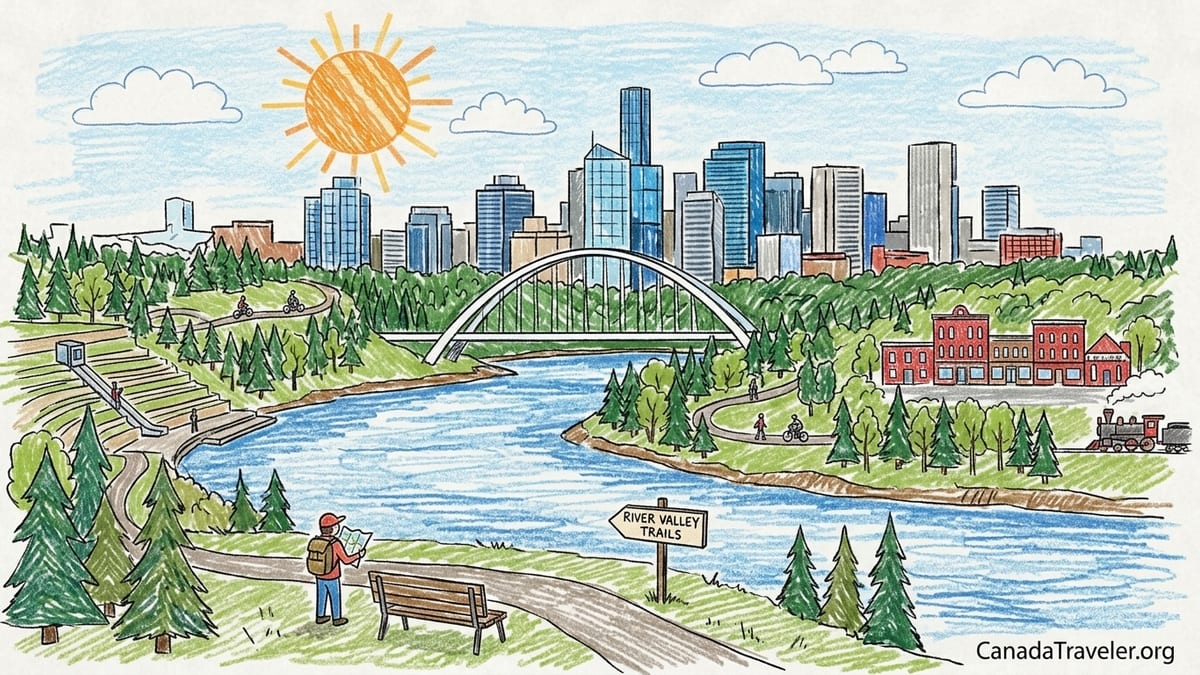
I based myself downtown, a few blocks from Jasper Avenue, to make it easy to reach both the river valley and Old Strathcona by foot and transit. Edmonton’s skyline is compact but vertical, a cluster of glass towers that drops abruptly toward the deep trench of the North Saskatchewan River. Standing on 100 Street and looking south, I could already see treetops filling the valley between towers and the opposite bank.
From downtown, it took me less than ten minutes on foot to reach Louise McKinney Riverfront Park at the east end of the core. A sloping promenade leads from the city grid down toward the water, and I used the 100 Street Funicular on the way down to save my knees for the rest of the day. Edmonton brands its river valley as the largest stretch of urban parkland in North America, with more than 160 kilometres of multi use trails lacing both banks, and you feel the scale as soon as you step off the concrete and onto the path network along the river.
Louise McKinney itself is a gentle introduction, a terraced park with wide paved paths, benches facing the river, and open lawns that make you forget you are minutes from office towers. To the west, the skyline stacks up over the curve of the river, while to the east, the valley bends toward forested slopes. I picked up the riverside multi use trail and started walking west, following the water as it threaded through the city.
The first impression was the contrast. On my left, the broad river and cottonwoods softened into a continuous band of green; on my right, above the bluff, towers caught the sun and traffic hummed along Jasper Avenue and 97 Avenue. Within a few steps, I had walked from a gridded prairie city into something closer to a river canyon, with footbridges, boat docks and unpaved side trails filtering off into pockets of quieter forest.
Walking the River Valley: Views, Grades and Detours
My rough route for the morning was to follow the north bank from Louise McKinney west toward the Walterdale Bridge and the Alberta Legislature, a distance of about 4 kilometres that looks straightforward on the map. In practice, it felt longer, partly because of the rolling topography that municipal trail maps do not fully convey. Some stretches were flat and paved; others twisted upward along steeper slopes that would be a challenge for anyone with mobility issues or a stroller.
Between Louise McKinney and the Low Level Bridge, the main trail stays close to the water, and construction notices at the park entrance warned of occasional detours inland. Where erosion work had closed a riverside section, I had to follow signs up a short, sharp climb into a residential street before dropping back down along an alternate path. It was perfectly manageable in good weather, but it was a reminder that “multi use” in Edmonton can include steep grades and gravel underfoot rather than a purely flat promenade.
West of the Low Level Bridge, I passed through Irene Parlby Park and Rossdale. Here the path undulates more noticeably, threading between mature trees and the river. Side spurs climbed toward viewpoints perched above the water. I detoured up one short, unpaved slope, maybe 200 metres, to a lookout with a sweeping view back toward downtown. From there, the Walterdale’s white arch framed the skyline, with the river bending around Rossdale’s meadows in the foreground.
The final stretch to the Walterdale Bridge stayed mostly paved but narrower, shared by cyclists, joggers and dog walkers. By the time I reached the foot of the bridge, I had spent a relaxed two hours including photo stops, a coffee break on a bench and brief pauses to check the route when construction fencing appeared. Ambitious walkers could cover the distance in under an hour, but building in extra time lets you cope with route changes and enjoy the river corridor instead of racing it.
Walterdale Bridge and the Legislature: City and Nature in One Frame
Walterdale Bridge quickly became my mental postcard of Edmonton. From the trail level on the north bank, its white arch rises cleanly over the green riverbanks, with the downtown towers stacked up just beyond. I walked partway onto the bridge itself, where separate sidewalks on each side let you stop for photography without blocking cyclists. Looking upstream, the river valley reads as a continuous park ribbon, and only when you turn around do you see how close you are to steel and glass.
From the bridge, it is a short but noticeable climb to reach the Alberta Legislature grounds on the north bluff. I followed a set of switchback paths and stairs that probably gain about 40 to 50 metres of elevation in a few minutes. It left me slightly winded with a daypack, and I watched cyclists grind slowly up the hill. For travellers who prefer an easier approach, it can be simpler to ride the LRT to Government Centre and walk downhill to the river rather than the reverse.
The Legislature grounds are worth the effort. Once you crest the bluff, a broad lawn spills toward the sandstone dome of the provincial parliament, with fountains, gardens and informal walking paths that look back over the river valley. From several viewpoints along the edge of the grounds, I could trace the route I had just walked, the path appearing and disappearing among trees on both sides of the river. It is one of the few places where the breadth of the valley and the tightness of the skyline read in the same frame.
I spent part of the afternoon wandering the Legislature precinct and nearby side streets, then used the LRT from Government Centre station back toward my hotel. Edmonton’s Arc fare system charges a flat 3.75 Canadian dollars for a 90 minute adult ticket loaded at station machines or paid in cash on buses, so my short hop back downtown cost the same as a longer ride across town. The ticket acted as a transfer, so I was able to catch a bus later in the evening within the same window without paying again.
Crossing to Old Strathcona and Whyte Avenue
By late afternoon, I was ready to see how Edmonton’s historic south side compared with the modern business core. Old Strathcona lies just across the river, centred on Whyte Avenue between about 99 Street and 109 Street, and is easily reached by LRT to University station followed by a short bus or by bus directly over the High Level Bridge. I opted for the latter, using the same 3.75 fare within my transfer window to ride from downtown to near 104 Street and 82 Avenue.
Most visitors treat Whyte Avenue as a nightlife strip, but arriving in late afternoon revealed its other role as Alberta’s largest preserved early twentieth century commercial district. Before amalgamation with Edmonton in 1912, Strathcona was a separate city, grown around the northern terminus of the Calgary and Edmonton Railway. When trains first arrived on the south bank in 1891, this is where they stopped, and merchants clustered around the station along What is now 82 Avenue and 104 Street.
That railway DNA still shows. At the east end of the district, the old Canadian Pacific Strathcona Station in red brick anchors the former rail yards. Along Whyte itself, original buildings like the 1891 Strathcona Hotel and early brick blocks such as the 1902 Gainer Block survive among newer infill. Walking the sidewalks, I passed recessed doorways, tall display windows and painted signs that would not look out of place in a sepia photograph, even if they now advertise craft beer and boutique clothing.
In between the heritage facades, Old Strathcona feels very lived in. Cafes like the long running Sugarbowl closer to the university and independent coffee bars along Whyte were full of students, freelancers and families. I ducked into a small local bookshop that shared space with a gallery, then stepped back outside to the smell of shawarma from a Lebanese restaurant and the line forming for an ice cream window. None of it felt like a staged heritage village; it was simply a busy main street that happened not to be bulldozed for a suburban mall.
Eating, Drinking and Walking in a Sprawling City
One of Edmonton’s challenges is its sheer physical size. The city covers a large area, with residential neighbourhoods spreading far along the ring roads in every direction. Focusing my two day stay on the river valley and Old Strathcona kept travel times manageable, but it still meant thinking about distances. My first day involved about 10 to 12 kilometres of walking, between the river trails, Legislature grounds and laps along Whyte Avenue, even with bus and LRT rides in between.
Food breaks were essential. On my first evening in Old Strathcona, I settled into a casual pub along Whyte for a plate of Alberta beef burger and a pint, paying roughly 24 dollars before tax and tip. Earlier in the day, I had grabbed a coffee and pastry downtown for around 7 dollars and later a takeaway sandwich near the Legislature for about 12 dollars. These prices were in line with other large Canadian cities, but the density of independent options around Whyte Avenue made it easier to avoid chains.
Transit helped bridge the larger gaps. A single 3.75 fare on Arc or in cash bought me 90 minutes of unlimited transfers on buses and LRT within the city, so I could hop from downtown to Old Strathcona, wander on foot, then continue toward my accommodation without worrying about stacking multiple full fares. For airport trips or long suburban rides, more expensive commuter fares apply, but for my central exploring the standard ticket was enough.
In practical terms, anyone planning a similar mall free visit should factor in both walking stamina and weather. In summer, the long daylight makes evening walks along Whyte or the river valley pleasant, but distances between nodes can still surprise travellers expecting a compact European style core. I found that grouping activities by bank of the river and using transit to cross the valley saved both time and energy.
Day Two at Fort Edmonton Park: Stepping Through Time
For my second day in Edmonton, I devoted almost the entire daylight window to Fort Edmonton Park on the city’s southwest side. Reached by a combination of LRT and bus plus a short walk, the park is set within the river valley forest, yet it functions as a large open air museum and heritage park. I arrived shortly after opening time on a summer weekday, having pre checked admission details online.
For the 2026 summer season, a standard adult ticket for general admission was listed at 31 Canadian dollars before tax, with a ten percent promotional discount applied at the gate, bringing the base price down to roughly 27.90 dollars before GST. My ticket included access to the entire site during regular hours, from the recreated Hudson’s Bay Company fort through the 1885, 1905 and 1920s streets, plus unlimited rides on the park’s internal steam train and vintage streetcars on the day of my visit.
I started at the top of the timeline, boarding the steam train from the modern entrance area. The short ride rumbled through trees and along the North Saskatchewan riverbank before depositing us near the replica fur trading fort that gives the park its name. Inside the palisade, costumed interpreters described life at the remote trading post, from buffalo robes and pemmican in the warehouses to cramped staff quarters. It was not a glossy Disney take on the past; the rough hewn timber, simple furnishings and mud underfoot felt appropriately stark.
From the fort, I walked forward through time along the 1885 Street, with simple wooden storefronts, a church and a schoolhouse representing a frontier settlement on the cusp of the railway boom. Further along, 1905 Street introduced bigger brick buildings and more elaborate homes, reflecting Edmonton’s brief period as a newly minted provincial capital. Finally, the 1920s Midway and Motor Cars area delivered early cinema, amusement rides and the arrival of automobiles, complete with a functioning carousel and period ads painted on walls.
The Indigenous Peoples Experience and What Admission Includes
The highlight of my day, and arguably the reason Fort Edmonton Park stands apart from many other North American heritage villages, was the Indigenous Peoples Experience. Opened after a major redevelopment, this large indoor and outdoor exhibit sits slightly apart from the timeline streets, nestled among trees near the river. Entry was included in my general admission ticket and did not require a separate timed reservation on the day I visited, although staff at the gate recommended going earlier in the day to avoid potential crowding.
Inside, the exhibition moves away from costumed reenactment toward multi media storytelling created in partnership with local First Nations and Métis communities. Through soundscapes, film, personal testimonies and artefacts, it traces the deep history of the land now called Edmonton, known in Cree as Amiskwaciwaskahikan. The stories range from pre contact life on the plains and in the river valley to the impacts of treaties, residential schools and contemporary urban Indigenous cultures.
I spent nearly two hours in this building alone, moving at a slower pace than in the outdoor streets. There were places to sit and absorb audio installations, sections where elders appeared on screen to share memories, and interactive components that encouraged visitors to consider ongoing responsibilities to the land and its peoples. Stepping back outside afterward, the recreated fur trade fort and settler streets read differently, framed by knowledge of who had lived on the land for millennia before those structures appeared.
From a value perspective, the 27.90 to 31 dollar adult summer admission felt fair for a full day experience that included both the more traditional heritage park attractions and this in depth Indigenous storytelling space. Food on site ranged from simple snacks to meals in a 1920s style hotel dining room, with mains in the 18 to 25 dollar range. Families with children could easily spend six or more hours among the train rides, costumed interpreters and exhibits without exhausting the content.
Is Edmonton More Than Its Mall
By the time I rode the bus back toward my downtown base at the end of the second day, I had still not glimpsed West Edmonton Mall except as a name on a transit route map. What I had seen instead was a city framed by a serious river valley, a preserved main street rooted in railway history, and a heritage park wrestling publicly with the complexity of its past.
The river valley alone justifies a full day for anyone who enjoys urban walking, running or cycling. With more than 160 kilometres of multi use trails, it functions less as a single park and more as a string of landscapes, from manicured lawns near downtown to quieter stretches west of Fort Edmonton Park. The catch is that not every segment is equally accessible. Steep grades, unpaved connectors and occasional closures for erosion or construction mean that visitors should check current city maps and be prepared for short detours, especially if mobility is limited.
Old Strathcona and Whyte Avenue add a different layer. Understanding that the bricks and storefronts once formed the downtown of a rival city built around a railway terminus gives the nightlife and cafes more context. A walk may take you past the former Strathcona rail station, the long serving Strathcona Hotel, and early twentieth century commercial blocks within a few minutes, surrounded by live theatres and festivals that keep the district from sliding into museum territory.
Fort Edmonton Park, with its four historical periods, operating train and streetcars, and especially the Indigenous Peoples Experience, rounds out the city’s living history credentials. It is not a quick stop; the park rewards a full second day with time to listen, question and reflect, rather than simply checking boxes on a sightseeing list.
The Takeaway
So does Edmonton deserve two days on a wider Alberta itinerary that might also include the Rockies, Drumheller’s badlands or Calgary’s cultural scene. If you are mainly chasing mountain vistas or national parks, you could be tempted to treat the city as a transit point. Yet if you value the way a place tells its stories through landscapes and streets, Edmonton’s river valley and heritage districts make a strong case for a dedicated stop.
Travellers who will get the most out of a mall free two day visit are those who enjoy substantial urban walks, appreciate historic architecture and are willing to engage with complex histories. The river valley’s long multi use trails reward cyclists and runners, while the combination of Old Strathcona and Fort Edmonton Park will appeal to anyone curious about how railways, resource booms and Indigenous histories shaped this part of the Prairies.
Families with school age children can comfortably substitute the mall’s rides with train journeys at Fort Edmonton Park, time at the Indigenous Peoples Experience and picnics or playground visits in the river valley. Solo travellers and couples focused on food and culture will find enough independent cafes, restaurants and small venues along Whyte Avenue and downtown to fill evenings without needing a theme park environment.
West Edmonton Mall remains part of the city’s story, but it is not the only story or even the most interesting one for many visitors. After two days of river views, streetcar bells, brick facades and Indigenous voices, I left feeling that I had met a different Edmonton, one rooted in its valley and its layered past rather than in a single giant retail complex.
FAQ
Q1. How much walking is involved in this two day Edmonton itinerary.
The route I followed involved roughly 10 to 12 kilometres of walking on day one and a similar distance spread across Fort Edmonton Park on day two, but much of it can be shortened by using transit or focusing on smaller sections of the river valley.
Q2. What is the best way to get between downtown Edmonton and Old Strathcona.
The easiest option is to use Edmonton Transit’s LRT to University or Health Sciences station and connect to a bus along Whyte Avenue, or to ride a direct bus over the High Level Bridge, all covered by a single 3.75 Canadian dollar adult fare within a 90 minute transfer period.
Q3. Are the river valley trails suitable for all fitness levels.
Many sections near downtown are wide, paved and relatively flat, but the network also includes steep hills, stairs, gravel connectors and occasional detours due to closures, so visitors with limited mobility should plan routes carefully and be prepared to backtrack.
Q4. Is Fort Edmonton Park suitable for a full day visit.
Yes, a summer visit with general admission can easily fill six to eight hours, including time in the Hudson’s Bay fort, the 1885, 1905 and 1920s streets, multiple rides on the train and streetcars, and an extended visit to the Indigenous Peoples Experience.
Q5. How much does it cost to visit Fort Edmonton Park in summer 2026.
During the 2026 general summer season, adult day admission was advertised at about 31 Canadian dollars before tax, with a ten percent discount sometimes applied at the gate, and that price included most attractions and rides inside the park.
Q6. Can I visit the Indigenous Peoples Experience separately from the rest of Fort Edmonton Park.
In the fall and winter shoulder seasons the Indigenous Peoples Experience can operate with its own hours and admission, but in summer it is typically included in the regular Fort Edmonton Park general admission ticket.
Q7. Is Old Strathcona safe to walk around in the evening.
On my visit, Whyte Avenue felt busy and generally comfortable in the early evening, with a mix of students, locals and visitors, although as in any city, it is sensible to stay aware of your surroundings and stick to well lit main streets late at night.
Q8. Do I need a car for this two day Edmonton itinerary.
You can complete this itinerary using transit and walking if you stay downtown or near Whyte Avenue, though a car may be convenient if you are carrying gear, travelling with young children or connecting to rural parts of Alberta before or after your stay.
Q9. When is the best time of year to experience the river valley and Fort Edmonton Park.
Late spring through early autumn offers the most reliable weather for long walks and coincides with Fort Edmonton Park’s main operating season, while winter transforms the river valley into a cross country skiing and snowshoeing area but limits some attractions.
Q10. Is Edmonton worth including if I am already visiting Banff or Jasper.
If your interests extend beyond mountain scenery to include urban trails, heritage districts and Indigenous history, adding two days in Edmonton provides a useful contrast to the Rockies and helps round out an Alberta itinerary.