


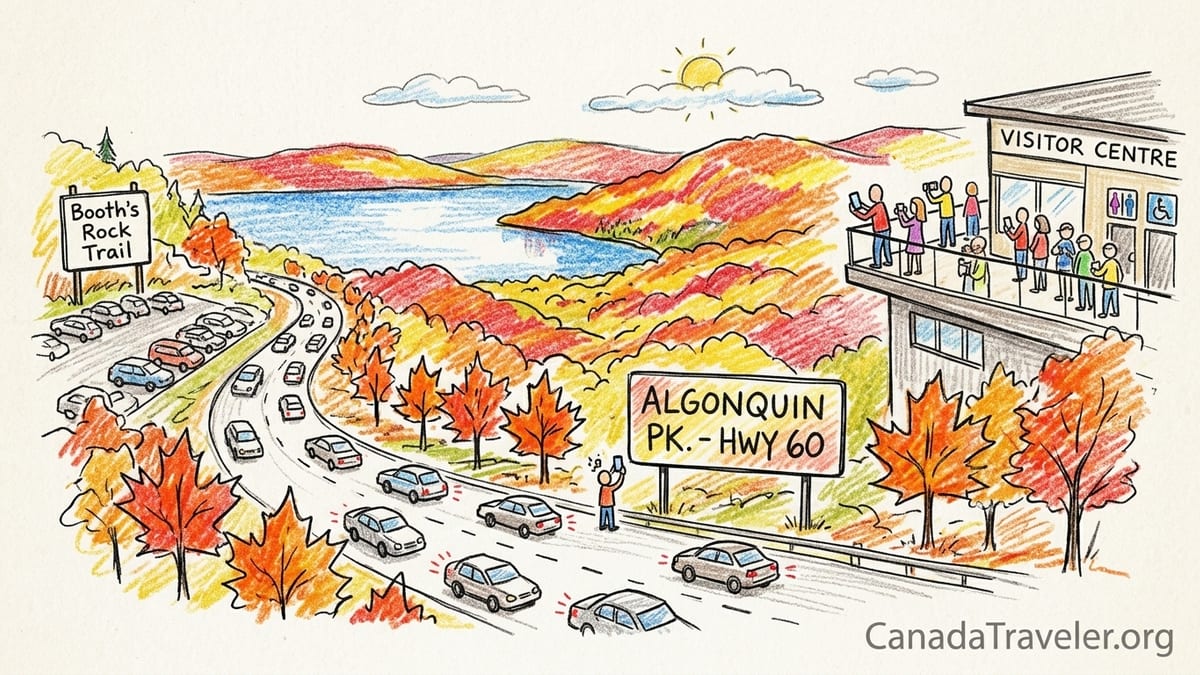
I visited Algonquin Provincial Park for fall colours on Saturday, September 26, 2026, expecting that classic, quiet Ontario postcard: blazing maples, mirror-calm lakes, and a few friendly hikers on the trail. I got the colour. I also got the crowds that come with it, the kind that turns a wilderness day trip into something closer to a slow-moving festival on a two-lane highway.
The Weekend I Chose, And Why It Set Me Up For Crowds
I went on Saturday, September 26, 2026, aiming for that early-fall window when Algonquin’s sugar maples and red maples typically flare up along the Highway 60 corridor. It was the exact kind of date Destination Ontario inspires when it highlights Algonquin and Muskoka as fall-colour standouts: an easy road-trip north, a short peak period, and a promise of “kaleidoscope” scenery that feels urgent because you know it will not last.
That promotion works, and it works in a very practical way. Algonquin’s most accessible fall-colour experience is concentrated along Highway 60, the park’s main east-west spine with trailheads, lookouts, picnic areas, the Visitor Centre, and the Logging Museum clustered within an easy day-trip corridor. When most people search “Algonquin fall colours,” they are effectively searching for the same 55 to 56 kilometre stretch of road and the same handful of famous stops.
The problem is the calendar is just as concentrated as the geography. In 2026, the Friends of Algonquin Park reported peak maple colour on September 29, 2026, only a few days after my trip. In other words, I picked a weekend that felt “smart” for foliage, and it was, but that also meant I picked the period when demand reliably surges, and when day-use permits can sell out for the Highway 60 corridor.
Highway 60 On A Peak Fall Saturday: Stunning Views, Constant Pressure
The first thing I noticed once I reached the park boundary was how the drive itself becomes part of the attraction in late September. Highway 60 cuts through mixed forest and rises and dips over the Canadian Shield. On a day with bright skies, the colour is not limited to scenic lookouts, it is continuous, spilling down slopes and along the shoulders like someone poured paint onto the hills.
The second thing I noticed was how that beauty changes driver behaviour. Even with Ontario Parks reminders not to park on the road shoulder, the temptation is obvious: you crest a rise, see a valley full of orange and red, and you want to stop right now. That urge, multiplied across hundreds of vehicles, creates the feeling that the highway is under constant pressure. You see brake lights in places that should be smooth cruising, and you start scanning not just for moose but for people stepping out of cars with cameras.
Conditions were not dangerous in the sense of snow or ice, but they were mentally tiring. The corridor is not a closed scenic drive with pull-offs every few seconds. It is a real highway through a park that is also serving campers, hikers, museum-goers, and people who are simply passing through between Oxtongue Lake and Whitney. On that Saturday, the foliage was spectacular, but the driving required the kind of attention that made it hard to relax into the moment.
The Day-Use Permit: What I Booked, And What Would Have Happened Without It
I booked an Ontario Parks advance Daily Vehicle Permit for “Algonquin - Hwy 60 Corridor” as soon as it opened at 7:00 a.m. Eastern Time, five days before my visit, using the Ontario Parks reservation system. Ontario Parks sells advance daily vehicle permits up to five days ahead, and at Algonquin the permit is location-specific. In plain terms, “Algonquin” is not one single day-use bucket. You choose the area, and for my trip that meant the Highway 60 corridor day-use area.
I paid the current day-use vehicle permit price that applies to Highway 60 day use, which the Friends of Algonquin Park lists at $21.00 per vehicle per day, taxes included. When I booked, I had to enter a license plate number, which is part of how Ontario Parks verifies entry for digital permits. If you do not know your plate yet, the Friends of Algonquin Park notes you can use a placeholder and update it later.
Here is what mattered most: the permit guaranteed access on a day when capacity can hit a ceiling. Ontario Parks is clear that busy days can fill to capacity and that booking in advance is what guarantees entry. Without that advance reservation, I would have been gambling on whatever remaining capacity existed at arrival. In peak fall, that is the kind of gamble that can turn a three-hour drive into a frustrating turnaround, or force you into a backup plan you did not actually want.
One nuance that surprised me, and that I would plan around next time, is how specific permits can get in fall. In 2026, the Friends of Algonquin Park notes that Booth’s Rock Trail required a special combined permit during a defined fall period, with two different Highway 60 permit options: one that includes Booth’s Rock and one that does not. There is no cost difference, but access is managed by capacity. If you show up thinking “I have Highway 60, I can do any Highway 60 hike,” you can end up discovering that one headline trail is effectively its own controlled experience.
Parking And Trailheads: The Real Bottleneck No One Brags About
Fall in Algonquin is often described with big, sweeping words: blazing, brilliant, peak, iconic. The actual friction point is smaller: parking lots. The Highway 60 corridor has numerous trailheads, but some are far more popular than others, and on a peak weekend those lots fill in waves. When that happens, the experience changes in a way no photo can show. You do not just walk up and go. You loop, you wait, you reassess, and you watch other cars do the same.
On my September 26 trip, the “headline” stops felt busiest. Whenever I pulled into a lot tied to a famous view or an easy, high-reward trail, there was a restless, competitive energy: drivers creeping along rows hoping someone would load up, hikers tightening boots beside open trunks, groups clustering around trail maps. It was not rude. It was simply saturated, as if every car had the same itinerary saved on their phone.
What surprised me was how queues form in places you do not expect. It is not just the gate, because digital entry and advance permits reduce that old-style line-up problem. Instead, queues shift to chokepoints inside the park: the best lookouts, the washrooms at peak times, the short interpretive trails that attract families, and the Visitor Centre parking area where many people naturally want to start or end their day.
If you are planning a fall Saturday, the practical truth is this: your day will be shaped less by how fast you hike and more by how efficiently you move between parking areas. And if your plan requires snagging a spot at multiple top trailheads between late morning and mid-afternoon, you should assume you will lose time to full lots and slow internal traffic.
The Visitor Centre And Famous Viewpoints: Peaceful In Photos, Chaotic In Real Life
I built my day around the classic stops: scenic lookouts, at least one marquee trail, and time at the Visitor Centre. The Algonquin Park Visitor Centre is legitimately excellent. It has “world class exhibits,” a theatre presentation, a bookstore, and that panoramic viewing deck that makes you feel like you are looking out over endless wilderness. It is also, in fall, exactly where many people funnel at the same time.
Inside, the crowding felt different from the trail crowding. On trails, people spread out over time. In the Visitor Centre, everyone compresses into the same rooms, the same displays, and the same deck. The atmosphere on my Saturday visit felt like a popular museum on a free-admission day: families moving in clusters, visitors waiting for space at interpretive panels, and a steady line of people flowing toward the most photogenic windows and viewpoints.
On the deck, the view was still jaw-dropping, but the mood was not hushed. You could hear constant conversation and the repeated rhythm of phones being raised for photos. I do not think the crowd ruined it, but it changed it. I had imagined that deck as a place to linger, breathe, and watch the hills shift colour in the distance. Instead, it became a place to take in the scene quickly, then move aside so someone else could step up.
This is the collision at the heart of peak fall Algonquin: the foliage creates a sense of wonder, but the popularity creates a sense of urgency. You start rushing the very moments you came to savour.
How I Found Quiet Anyway: A Lake Stop, An Early-Morning Window, And An Overnight Lesson
The best part of my day was not the most famous viewpoint. It was a quieter lake-side pause where the experience was slower: fewer people, less chatter, more time to actually register the details, the sound of wind in leaves, the soft knock of small waves against shore. In Algonquin, water does something special to fall colour. It doubles it. A band of orange trees becomes a band of orange trees plus their reflection, and suddenly the same colour feels more immersive and less like a backdrop for crowds.
I also noticed how timing, even within a single day, changes everything. Earlier in the morning, before late sleepers arrive and before day-trippers finish breakfast in Huntsville or Lake of Bays, you can still catch pockets of calm. Parking is easier, trails feel less like a procession, and you can take a photo without feeling like you are blocking someone else’s once-a-year trip.
My bigger lesson was about overnighting. On my day trip, I was boxed into peak arrival and departure waves: drive up with everyone, compete for lots with everyone, then leave when it feels like the day-use energy is cresting. The people who seemed most relaxed were not necessarily the fittest hikers. They were the ones who did not appear rushed. Some were campers. Some had booked a lodge or resort nearby. They could start early, take a mid-day break when the corridor was busiest, and return to a trail or lake as the light softened and the crowds thinned.
Ontario Parks itself emphasizes that Algonquin has a “second peak” after the maple blaze, often called the golden encore, when birch, poplar, and understory colour continue even after the canopy maples fade. That matters for crowd strategy, too. You can still get a real autumn hit without aiming for the single most famous week. If your goal is beauty plus breathing room, that slightly later period can be a better trade.
The Takeaway
I do not think Algonquin is overrated. When the maples ignite, the Highway 60 corridor truly earns its reputation. What I learned on Saturday, September 26, 2026 is that peak fall is not one experience. It is two experiences stacked together: one natural, one logistical. The leaves are effortless. The crowd management is not.
If I could redo that trip with the same goal, I would not “avoid Algonquin.” I would edit the plan so the park’s popularity does not dominate the day. That means choosing a weekday if at all possible, starting earlier than feels reasonable, building the day around fewer headline trails, and committing to an overnight stay so the best moments happen at dawn and dusk rather than at noon.
Most importantly, I would monitor current colour reports before locking in a date. Ontario Parks posts regular fall colour updates, and the Friends of Algonquin Park posts detailed corridor-specific notes that make it easier to time a visit. In 2026, for example, the Friends of Algonquin Park pinpointed peak maple colour on September 29, and Ontario Parks’ own mid-October updates described the park moving into later-season colour with significant leaf fall. That kind of timing detail is the difference between arriving on the one weekend everyone chose and arriving when the colour is still gorgeous but the park has room to feel like a park.
My improved plan is simple: book the Highway 60 corridor day-use permit the moment it opens five days out at 7:00 a.m. Eastern, pick a Tuesday or Wednesday, arrive at the first trailhead at daybreak, skip at least one “must-do” hike in favour of a quieter lake stop, and stay overnight either in-park (if I can secure it) or nearby so I can be on the water or on a short trail when the corridor is still waking up.
FAQ
Q1. What exact date did you visit Algonquin for fall colours?
Saturday, September 26, 2026, during the peak build-up period for maple colour along the Highway 60 corridor.
Q2. Do you need a permit to drive through Algonquin on Highway 60?
No permit is required if you are simply passing through without using park facilities, but a permit is required if you stop to hike, use washrooms, picnic areas, museums, or other day-use facilities.
Q3. What did you book for day use, specifically?
I booked an Ontario Parks advance Daily Vehicle Permit for “Algonquin - Hwy 60 Corridor,” which guarantees day-use access to that area on the date selected.
Q4. When do Algonquin advance day-use reservations open?
Ontario Parks opens advance daily vehicle permits at 7:00 a.m. Eastern Time, five days before your visit date.
Q5. How much was the Highway 60 day-use permit?
The Highway 60 corridor daily vehicle permit is listed at $21.00 per vehicle per day (tax included) by the Friends of Algonquin Park, which reflects current day-use pricing for that corridor.
Q6. What would have happened if you showed up without a reservation?
On peak days, the park can reach capacity for specific day-use areas, which can mean no permits available. Booking in advance is the only way to guarantee entry for your date and area.
Q7. Why did the famous viewpoints feel less peaceful on your trip?
Because peak foliage concentrates visitors into the same handful of short trails, lookouts, and Visitor Centre stops, creating crowded decks, busy lots, and a sense of constant motion.
Q8. Are all Highway 60 trails included with a Highway 60 day-use permit?
Not always during peak fall management periods. In 2026, Booth’s Rock Trail required a special permit option during a defined fall window, separate from the standard Highway 60 day-use option.
Q9. Where did you find a quieter fall-colour moment in the corridor?
At a less “headline” lake-side stop where reflections amplified the colour and fewer people lingered, especially earlier in the morning before mid-day crowds peaked.
Q10. What would you do differently next time for peak fall?
I would go on a weekday, start at daybreak, book the day-use permit the moment it opens, plan fewer famous stops, consider an overnight stay, and monitor current colour reports before committing to a specific date.