

I came to Ontario canoe country with a simple idea of what a “canoe trip” would feel like: a calm paddle, a tidy campsite, and maybe a postcard sunset. What I got instead was a backcountry loop in Algonquin Provincial Park that demanded real logistics, real sweat, and a level of attention to wind and water I had not needed on casual day paddles. Over three days and two nights, I learned the hard way that Ontario canoeing is not just a sport you try on the weekend. It is a travel language, a skill set, and a cultural inheritance that turns a map into a lived place.
The Trip I Actually Paddled: A Portage-Based Loop From Lake Opeongo
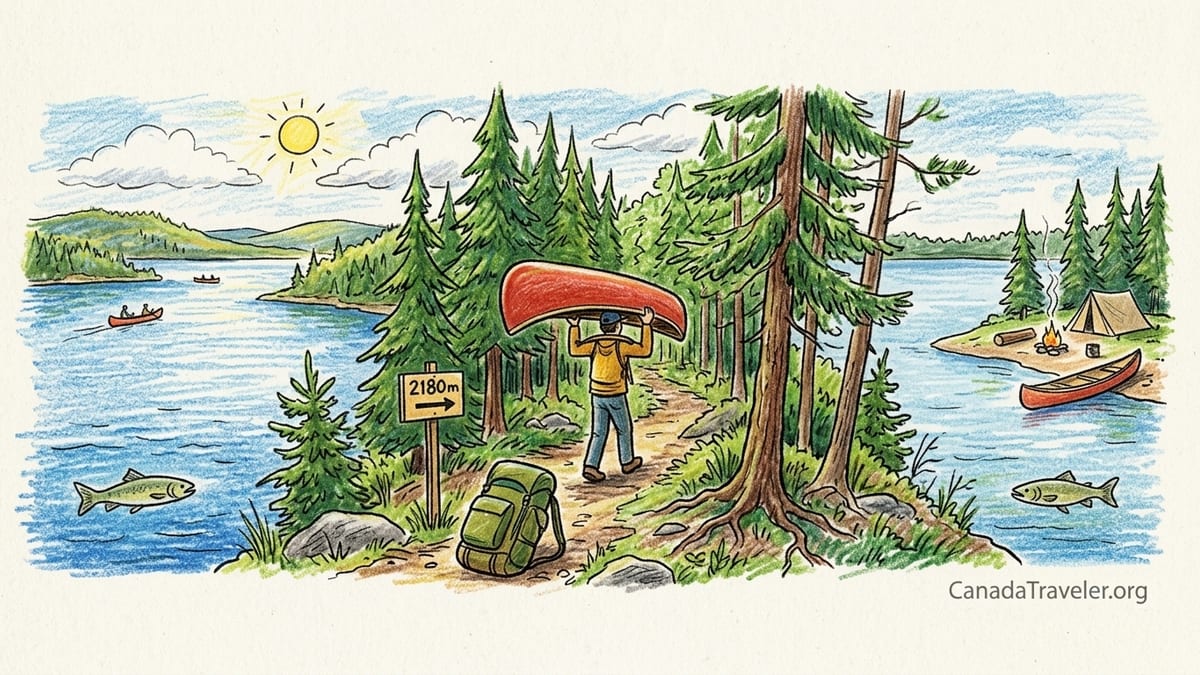
This was not a “paddle out and back to the car” day trip. It was a portage-based backcountry canoe-camping route inside Algonquin Provincial Park, launched from Access Point 11 at Lake Opeongo. The core route was: Lake Opeongo (South Arm) to the North Arm, then the long carry into Happy Isle Lake, and back out the same way. I planned it as a three-day, two-night loop with one big portage as the centerpiece, because I wanted a true canoe-tripping experience without committing to a week.
Algonquin is often described as a network rather than a single “trail,” and that matters the minute you start plotting your nights. Ontario Parks’ backcountry system has you reserve by lake or zone for each night, not a specific numbered campsite on that lake, and the portages are marked as part of the official canoe route network. In practical terms, that means you book your intended lakes, then you arrive and choose an open campsite on that lake when you get there. It is freeing and stressful at the same time, especially when you roll in late and you are scanning shorelines for a landing that looks usable in wind.
My Day 1 plan was to start early, paddle the open water of Opeongo before the afternoon winds, and push to Happy Isle Lake via the 2,180 metre portage. Day 2 was a layover day on Happy Isle to swim, dry gear, and take a short paddle without moving camp. Day 3 was the return: portage back to Opeongo, then paddle back to the access point. I built slack into the schedule because Opeongo is big water and I wanted the option to wait out a whitecapped day.
If you are used to casual lake paddles, the shift is immediate. A day paddle is about rhythm and scenery. A canoe-camping trip is about decisions: launch time, wind direction, portage efficiency, food protection, campsite exposure, and whether your gear can survive a surprise downpour. Those decisions, more than the strokes, are what turned this into a distinctly Ontario experience for me.
Rentals, Reservations, And The Reality Of “Getting On The Water”
The first Ontario lesson is that canoe travel is often built around outfitters and park systems that have been doing this for decades. For Algonquin, the backcountry reservation is not an optional detail; it is the backbone of the trip. Ontario Parks explicitly notes that Algonquin alone offers everything from easy paddle-in campsites to trips lasting several weeks, with marked portages and lake or zone-based backcountry reservations. That spectrum is real. The same park that hosts an easy evening paddle on a frontcountry beach can also feed you into a maze of lakes that will punish sloppy planning.
For the canoe and core safety kit, I rented a lightweight tripping canoe and the basics you should never “wing”: paddles and properly fitting PFDs. Many Algonquin-area outfitters bundle paddles with rentals, and some include a safety kit such as a bailer, rope, and whistle. I still checked everything at pickup like it was my own gear: PFD buckles, paddle blades for cracks, and whether the canoe had a proper yoke pad for portaging.
Where I spent more time and money than expected was on the small things that make a canoe trip work: dry bags, a pack that can actually be carried over a long portage, and a food storage plan that did not rely on optimism. Outfitters around Algonquin rent canoe packs and camping gear, and for this trip I treated rentals like a test drive: if a specific pack carried well on a 2.18 kilometre portage, it was worth remembering for future trips. If it fought me, it was not coming back.
One more logistical detail surprised me: I assumed I could casually start mid-morning. But with a big lake like Opeongo, wind timing becomes the schedule. A late start is not just inconvenient; it can force you into the worst water of the day. If you are trying to reach a reserved lake by evening, starting late can cascade into rushed landings, sloppy campsite choices, and arriving when the best sites are already taken.
What Carrying A Canoe Actually Felt Like On A 2,180 Metre Portage
I knew “portaging” meant carrying the canoe. I did not understand the sensation until the first real lift. Even with a lightweight canoe, the first few steps feel awkward, like your body is negotiating a new center of gravity. The yoke settles, the hull blocks part of your vision, and your world narrows to foot placement, the slope of the trail, and the next place you can safely set down.
The portage between Lake Opeongo’s North Arm and Happy Isle Lake is long enough to expose every weakness. If you are overpacked, you do not just feel it. You pay for it repeatedly, because most groups end up doing multiple carries unless they are disciplined ultralight travelers. I thought I packed “reasonably.” On the trail, I realized I had packed like a car camper. Too many duplicate layers, too much food “just in case,” and a few items that had no business coming, like extra shoes that were comfortable but not functional.
The physical difficulty was not a single dramatic struggle; it was cumulative fatigue. The portage has stretches where you can find a rhythm, and stretches where roots and uneven ground force smaller steps. My shoulders and neck felt the pressure of the yoke, and my forearms stayed tense longer than they needed to because I was gripping the gunwales out of habit. The simplest thing that helped was learning to relax: let the yoke carry the load, keep steps short, and stop before you are wrecked.
I also made a classic mistake with footwear. I brought trail shoes that felt fine on dry ground, but the landings were muddy and the trail had wet sections. By the end, my feet were damp and grit had rubbed in places that do not show up on a day hike. Ontario portages are not just hiking trails. They are transitions between water systems, and they are often wet at exactly the worst points.
Weather, Wind, Cold Water, And Why Big Lakes Change Everything
Ontario canoe country is beautiful, but it is not gentle. The most sobering part of the trip was how quickly conditions could flip from calm to complicated. Opeongo is Algonquin’s largest lake, and on big water the wind does not just “pick up.” It creates organized waves and whitecaps that demand technique and humility. I learned to read the lake in a way I had never bothered with on smaller water: look for dark patches that signal gusts, watch how the wind lines up with long open fetch, and plan shore-hugging routes instead of aiming straight across.
Rain was less dramatic than wind, but more persistent. A steady rain turns camp into a systems problem. Where is your dry bag actually sealed? Where do you set the pack down so it does not wick water? Which layer do you protect so you have something dry to sleep in? The most important dry bag on my trip was not for electronics. It was for sleeping clothes and the compressible insulation layer I needed at night.
Water temperature was the quiet risk that sat underneath everything. Even on days that felt warm in the sun, the lake could feel shockingly cold when I waded in to load the canoe. It changed how I dressed and how I thought about capsizing. On a casual beach day, cold water is a thrill. On an open lake in wind, it is a safety factor that should control your decisions, including whether you attempt a crossing late in the day.
And then there were the bugs. Mosquitoes were ever-present around camp and at shaded landings. Black flies, when they are active, are a different kind of problem: small, persistent, and capable of driving you into the tent early if you do not have a head net and long sleeves that actually seal at cuffs. I had underestimated this, and the lesson was immediate. If you are planning a spring or early summer trip, build bug management into your gear like you would build rain protection. Otherwise, the trip becomes a long negotiation with your own skin.
Campsite Selection, Food Storage, And The Small Decisions That Decide Your Night
Because Algonquin backcountry reservations are by lake or zone, not a specific site, arriving to a lake feels like arriving to a neighborhood without an address. You paddle the shoreline and judge what you see: a landing that will not swamp your canoe in waves, a flat tent footprint, a cooking area with some wind protection, and a latrine trail that is obvious enough to find but not so close that you hear everyone else’s night routine.
I made my worst timing mistake on Day 1: I started later than I should have, and by the time I reached Happy Isle Lake, I was choosing from what was left, not what was best. I still found a workable site, but it was more exposed than I wanted. When the wind shifted, I felt it in my sleep system. The site was scenic, but it taught me that “pretty” is not the same as “good,” especially if you are new and you need forgiving conditions.
Food storage was the other defining detail. I did not see bears on this trip, so I will not pretend I did. But I did see evidence that animals had visited other sites: scuffed ground near a fire pit, chewed bits of packaging someone had left behind, and the general mess that tells you a place gets traffic. The correct response is not fear; it is discipline. I treated food like a scented liability: keep it sealed, keep camp clean, and never leave snacks loose in a pack on the ground.
One more mistake I made was trusting gear that could not stay dry. A “water-resistant” stuff sack is not a dry bag. A backpack cover does not help when it is in the canoe getting hit by waves. After the first wet landing, I reorganized my entire system: critical items in true dry bags, then those bags placed inside a canoe pack that could handle being set down in wet sand. That reshuffle took time, but it saved my second night.
The Moment I Understood Why Canoeing Is Culturally Central To Ontario
The cultural shift happened for me on the portage, not on the water. I had the canoe overhead, moving in that narrow tunnel of trees, and I realized that canoe travel is a form of access. Roads are optional here. The canoe route network is a parallel geography, one that makes the interior legible if you can paddle and carry. In that moment, the canoe stopped feeling like recreational equipment and started feeling like an Ontario tool, the way snowshoes or skates make sense in other seasons.
Ontario canoeing is culturally central because it is embedded in how people move through the landscape. You feel it in the infrastructure: marked portages, mapped routes, a reservation system designed around lakes, and outfitters who can set up a complete trip from a phone call. You feel it in the habits: early starts to beat the wind, the quiet choreography at landings, and the way people talk about distances in portage metres as casually as highway exits.
It also hit me that canoeing in Ontario is not just about “doing an activity.” It is about entering a shared tradition of travel that rewards patience and punishes bravado. On Opeongo, I watched the lake texture change in minutes. That is when you understand why locals respect the water. Not in an abstract way, but in a practical way: you plan your day around it because you have to.
When I finally paddled into the access point on the last day, tired and slightly salt-stained with dried sweat, I did not feel like I had finished a sport. I felt like I had completed a small, honest journey. That is the difference. Ontario canoe country makes distance personal.
The Takeaway: Beginner, First Overnight, And Ambitious Trips (What I Paddled Vs. What I Researched)
What I personally paddled was a portage-based backcountry trip in Algonquin Provincial Park from Lake Opeongo (Access Point 11) into Happy Isle Lake via the 2,180 metre portage, camping two nights in the backcountry and returning the same way. If you want a single-trip lesson in what canoe tripping actually demands, this route delivers: big water risk on Opeongo, a genuinely long portage, and the full camp system of reservations by lake, campsite selection on arrival, and weather management.
For a complete beginner who wants Ontario canoeing without the deep-end stress, I would recommend starting with a simple day paddle on a smaller, more protected lake or a sheltered bay, then practicing landings, packing, and paddling into wind for an hour before committing to overnight logistics. A beginner’s success has less to do with grit and more to do with systems: a properly fitted PFD, a paddle you can use efficiently, and a packing setup where sleeping gear stays dry even if you misjudge a landing.
For a first overnight trip, my recommendation is to choose a paddle-in campsite scenario or a route with short, forgiving portages, and to start early enough that you can be picky about where you sleep. In Algonquin specifically, Ontario Parks and the Friends of Algonquin Park emphasize that there are options from easy paddle-in campsites to multi-week trips, and the reservation model supports that kind of progression. If you are moving from day paddles to overnight, prioritize a route that lets you bail out safely if the wind rises, and keep your daily distances modest so you can learn camp routines without racing sunset.
For a more ambitious wilderness trip, I would keep Algonquin on the list but move deeper into the interconnected network where longer carries and more remote lakes start to feel like a true expedition. This is where gear weight becomes the real limiter. A light canoe and a disciplined packing system change your world. On a long portage, ten “unnecessary” pounds can feel like a mistake you repeat for kilometres. If you want the wilderness experience without the guesswork, it is also worth considering a guided or partially outfitted trip through a reputable outfitter, especially for groups new to the planning side of route travel.
FAQ
Q1. Is canoeing in Ontario mostly day paddling or backcountry trips?
Both. Ontario has plenty of easy day paddles, but its most distinctive canoe experiences are portage-based backcountry trips where you travel lake to lake and camp overnight.
Q2. What did you paddle in Algonquin, exactly?
I launched from Access Point 11 on Lake Opeongo in Algonquin Provincial Park, portaged from Opeongo’s North Arm into Happy Isle Lake on the 2,180 metre carry, camped two nights, and returned the same way.
Q3. Do you reserve a specific campsite in Algonquin’s backcountry?
No. For backcountry paddling, you reserve by lake or zone for each night, then choose an available campsite on that lake when you arrive.
Q4. How hard is it to carry a canoe on a long portage?
Harder than it looks. Even with a lightweight canoe, a long portage becomes a test of balance, shoulder comfort, footwear, and how well you packed your gear.
Q5. What gear made the biggest difference on your trip?
A properly fitted PFD, true dry bags for sleeping gear, and a canoe pack that carried comfortably mattered more than extra clothing or luxury camp items.
Q6. What was your biggest mistake?
Starting too late on the first day. It reduced my campsite options and increased pressure to travel in less favorable afternoon wind on big water.
Q7. Are mosquitoes and black flies really that bad?
They can be. I dealt with constant mosquitoes around camp and learned to treat bug protection like essential safety gear, especially near wet landings and shaded portages.
Q8. How do wind and waves affect canoe travel in Ontario?
On large lakes, wind can build real waves and whitecaps quickly. It influences launch time, route choice, and whether you can safely cross open water.
Q9. What should a total beginner do for a first trip?
Start with a sheltered day paddle, practice packing and landings, then attempt a simple overnight where you can camp on the same lake you launch on or do only short portages.
Q10. What’s a good next step after a first overnight?
Move to a multi-night route with modest daily distances and one or two manageable portages, then build toward longer loops where efficiency and weather judgment matter more.