


Ontario is one of North America’s most compelling cool-climate wine provinces, sitting in that Great Lakes moderated band between roughly 41° and 44° north where varieties like Riesling and Pinot Noir shine, sparkling wine feels natural, and Icewine can be world-class when winter cooperates. But “Ontario wine country” is not one destination. Niagara is the big, infrastructure-rich hub with the densest concentration of tasting rooms and the clearest sub-appellation story. Prince Edward County is a cooler, scrappier, food-and-weekend-getaway region where the best plan is often fewer stops and more time. Lake Erie North Shore, in the Windsor-Essex corner and on Pelee Island, trades crowds for open roads, warmer ripening, and a smaller-scale feel that can be a relief if you are trying to slow down. And beyond the three headline VQA regions, pockets such as Norfolk County are quietly building an “emerging wine country” itinerary that works especially well when you want beaches, backroads, and craft beverage hopping without Niagara’s busiest corridors.
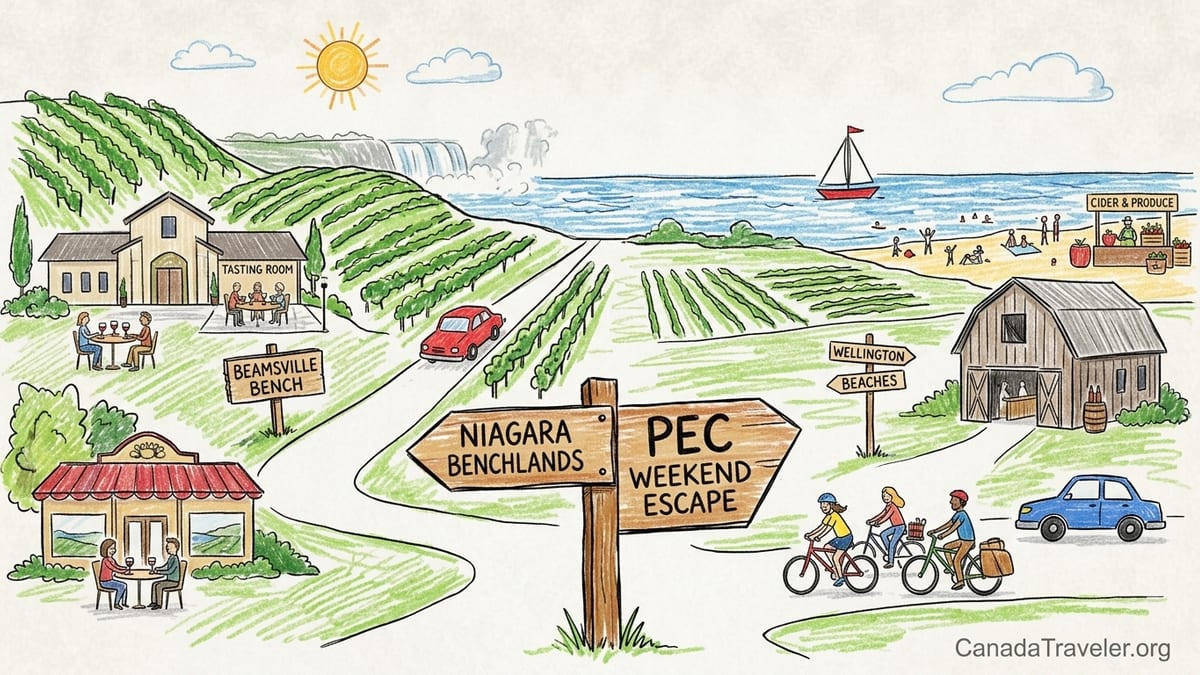
Choose Your Ontario Wine Region Like You Choose Your Trip
If you plan Ontario by winery rankings alone, you will miss what actually makes each region worth a drive. The most useful question is: what kind of trip do you want? Niagara is the easiest for first-timers who want choice, structure, and a full-service tasting scene with polished experiences, dining, and accommodations built around wine tourism. Prince Edward County (PEC) is the weekend escape: cooler, windier, and often more about pairing tastings with beaches, farm stands, and dinner reservations than squeezing in a marathon of flights.
Lake Erie North Shore is the “drive, breathe, and take your time” destination. Wineries are spread across Essex County roads around Harrow, Kingsville, Colchester, and Leamington, and you can tack on Lake Erie shoreline stops and parks without fighting the same volume of tour buses you will see in Niagara. If you like the idea of a wine trip that feels like a road trip, this region fits. Meanwhile, emerging areas such as Norfolk County are not trying to out-Niagara Niagara; they are building local tasting rooms and small-batch producers that make sense as a day trip from Hamilton, London, Kitchener-Waterloo, or cottage country routes.
There is also a seasonal reality check. Ontario’s classic wine-tour rhythm is late spring through early fall for patios and vineyard wandering, with harvest energy ramping up from late summer into fall. Icewine is its own winter travel reason, centered most famously around Niagara-on-the-Lake’s January festival weekends. If you are visiting in the cold months, plan around indoor seated tastings, winter road conditions, and limited hours, then treat Icewine events as the “anchor” experience rather than expecting every winery to feel like July.
Niagara: Ontario’s Largest Region, Most Sub-Appellations, Most Tasting Infrastructure
Niagara is the province’s largest and most concentrated wine destination, and it is where the sub-appellation conversation becomes practical for travelers. A label might say “VQA Niagara Peninsula,” but you will also see more specific names that point to genuinely different growing conditions, such as Four Mile Creek, Niagara River, St. David’s Bench, Niagara Lakeshore, Creek Shores, Lincoln Lakeshore, and the benchlands of the Niagara Escarpment including Beamsville Bench, Twenty Mile Bench, and Short Hills Bench. For a visitor, this matters because you can build a day around a style and landscape instead of pinballing across the region.
Think of Niagara as several trips hiding inside one. Niagara-on-the-Lake and the flatter lakeshore areas are where you will often see bigger properties and an efficient “taste-and-go” rhythm, especially along well-trafficked routes. Head west toward Lincoln and the Twenty Valley benchlands and the pace can feel more rural and slope-driven, with an easy pairing of wineries and escarpment scenery. If you only have one day, pick one cluster and stay in it. The mistake is trying to do Niagara-on-the-Lake in the morning and the benchlands in the afternoon, then losing an hour to traffic and parking when you could be lingering over a seated tasting.
Niagara is also the region where you have the widest range of tasting formats. Walk-in bar flights still exist, but it is increasingly common to see timed reservations for seated tastings, guided flights, and food-paired experiences. Travelers should budget realistically: a casual flight might be one price point, but a premium guided tasting with a curated lineup and pairings can jump quickly. If your group is six to eight people or more, plan on booking in advance, not improvising at the door.
Because Niagara is built for visitors, it is also the easiest place in Ontario to design a trip with “non-wine” anchors: theatre nights in Niagara-on-the-Lake, the Niagara Parkway for scenic drives, winter festival programming, and big-deal restaurant options. That infrastructure is a benefit, but it is also why Niagara can feel busiest in peak season. If you want Niagara’s wine without Niagara’s most crowded tasting rooms, the solution is often micro-planning: go earlier in the day, visit midweek, and choose a narrower geographic slice rather than chasing famous names across the map.
Prince Edward County: Cooler Climate, Weekend-Getaway Energy, Food-First Planning
Prince Edward County feels different the minute you arrive. It is Ontario’s northernmost VQA wine region, surrounded by Lake Ontario and the Bay of Quinte, and it wears its cooler conditions in the form of brisk breezes, shorter patio seasons, and wines that often lean into tension and freshness. It is also a region where visitors frequently plan around a weekend: arrive Friday, taste Saturday, beach or brunch Sunday, and head back toward the GTA, Kingston, or Ottawa.
PEC rewards travelers who do fewer wineries well. Instead of trying to “collect” ten stops, plan two or three wineries with time for food. A very real, concrete example: Sandbanks Winery publishes a classic tasting flight priced at $10 for five wines, a straightforward, walkable way to calibrate your palate early in the day before you move into more specialized tastings. In the County, those tasting fees add up quickly if you do too many stops. A sensible pace is often three wineries in a day if you are also doing lunch and a beach or town stop, and maybe four only if you keep everything in the same tight corridor and avoid long seated experiences.
Food is the County’s secret weapon. Many trips naturally revolve around dinner in Picton, Wellington, or along the County’s rural restaurant circuit, plus stops at cideries, farm shops, and roadside stands. This is also a region where your itinerary might mix categories by design: sparkling-focused producers, a cider stop, and a long, late lunch instead of a winery sprint. If you are traveling with friends who are not all equally into wine, PEC tends to keep the group happy because the non-wine portion of the weekend is genuinely strong.
Transportation is the County’s stress point. The roads are rural, taxis can be limited at peak times, and cell coverage can be uneven in some stretches. If you want to drink more than a taste or two, a guided tour can be less about luxury and more about making the day workable. Concrete example: County Casual Tours publishes per-person pricing by tour length, with a 5-hour tour for two people listed at $230 plus tax (and with tastings typically budgeted at roughly $10 to $15 per stop). That sort of structure can make the total cost easier to predict, especially if you are staying outside Picton or Wellington where late-night rides are not guaranteed.
Lake Erie North Shore: Warmer Southern Ripening, Smaller Crowds, Road-Trip Feel
Lake Erie North Shore (often discussed in the Windsor-Essex context, plus Pelee Island) offers the most “southern edge” wine feeling in Ontario. It is a region shaped by lake effect and a warmer growing season relative to Niagara and Prince Edward County, and it often appeals to travelers who want to get out of the GTA orbit and try a different pace. The scenery shifts too: flatter farmland, big skies, long straight county roads, and a shoreline that can feel like summer sooner than you expect if you are arriving from Toronto or London.
Practically, Lake Erie North Shore works best as a driving trip. Wineries are not packed into one village square; they are spread across Harrow, Kingsville, Colchester, and Leamington corridors, and a car is essential. That said, the “smaller-scale feel” is real. You are more likely to park easily, chat longer, and avoid the bottleneck effect that can happen in Niagara on Saturdays. If you want a concrete itinerary anchor, Pelee Island Winery runs tastings both at its Kingsville winery and at its seasonal Pelee Island Pavilion, which is positioned as a scenic waterfront experience on the island and typically requires more intentional planning, including ferry logistics if you are crossing to Pelee Island.
Guided options exist here, too, and they can be especially useful if your group is staying in Windsor and wants a safe afternoon out. One example is Grapevine Tours in the Windsor-Essex area, which markets North Shore winery tours and notes tasting fees included in some packages. If you are the planner in a group, the value is not just the ride: it is the routing, timing, and the fact that nobody has to be the designated driver for the whole day.
This region is also a strong choice for travelers who want a mixed itinerary with nature and shoreline time. You can pair tasting stops with lakefront parks, farm markets, and summer beach planning in a way that feels less like “wine tourism district” and more like “we’re exploring the south shore for the weekend.” If your goal is to avoid Niagara’s busiest tasting rooms without giving up Ontario wine altogether, Lake Erie North Shore is the most different alternative among the major regions.
Icewine, Sparkling, And Harvest Timing: When To Go And What To Order
Ontario’s reputation is tied to cool-climate strengths, and travelers feel that in the glass quickly. Riesling is a safe bet province-wide, Pinot Noir is a classic “try the region” choice in Niagara and PEC, and sparkling wine is one of the smartest things to order on a tasting trip because it tends to show place, acidity, and winemaking intent clearly. If you want the “Ontario signature,” though, Icewine is the conversation starter, and Niagara remains the easiest place to experience it as a visitor because the region has built winter events around it.
A concrete planning example: the Niagara-on-the-Lake Icewine Village is scheduled over two weekends in January, with posted dates of January 17 to 18 and January 24 to 25 and hours listed as noon to 6 p.m. Admission is free, and visitors can upgrade with VIP tickets. The event lists a 3-hour VIP Pass at $75 and a Full Day VIP Pass at $100, positioning it as a festival-style way to taste multiple producers in one walkable setting rather than driving winery to winery in winter conditions. If you are planning a January Ontario trip, this is the kind of “fixed date” anchor you can build around.
Icewine itself is not a casual purchase, and it should not be approached like a standard flight pour. Tastings are often small and prices reflect the labor and risk involved. Expect that a winery might pour Vidal Icewine, Riesling Icewine, Cabernet Franc Icewine, or even Sparkling Icewine, depending on the producer and the year’s conditions. If you want to be a smart taster, ask how the Icewine was made and what the picking conditions were like, then compare a couple of styles side by side rather than treating it like a dessert shot at the end of a long day.
For harvest timing, the traveler-friendly translation is simple: late summer through fall is when vineyards look and feel the most alive. You might see grape bins, tractor traffic, and more behind-the-scenes movement, but also a tighter reservation environment because wineries are balancing tourists with production. If you visit during harvest, book tastings earlier and keep your daily winery count lower. In high season, a reasonable expectation is two to four wineries per day depending on how long you linger. Two is ideal if you are doing long seated tastings and dining. Three is a strong “weekend pace.” Four can work if you keep it tight and efficient, but five or more usually turns into a blur unless you are spitting consistently and treating it like a professional tasting day.
DIY Driving Versus Guided Tours: Costs, Pacing, And Designated-Driver Reality
Ontario wine regions are drivable, but drivable does not always mean easy. The right choice depends on your group size, your tolerance for planning, and whether you actually want to taste or just sip lightly. A DIY day is best when you can keep distances short, start early, and accept that one person has to be the designated driver with a real plan: minimal alcohol intake, lots of water, and a willingness to skip that extra pour. This works well in Niagara when you choose one sub-region and stick to it. It can also work in PEC if you stay in a tight cluster near Hillier and Wellington and you are disciplined about time slots and reservations.
Guided tours earn their keep when the logistics are the trip. PEC is a prime example: if you are staying at a rural rental outside Picton, you may not want to gamble on last-minute rides. One concrete model is County Casual Tours’ published per-person pricing for custom tours by length, with the reminder that tasting costs are additional and often around $10 to $15 per stop. That transparency helps groups estimate the true cost of “nobody has to drive” before they arrive. Another example on the County side is PEC Wine Tours’ seasonal hop-on programming, including a published “Wassail 2026 Hop-On Bus” concept with a stated price of $110 per spot and tasting fees included, aimed at making a winter event day simple.
Niagara has its own version of this choice, but the calculus is different: the region’s density and infrastructure make it easier to self-direct, yet the crowds and reservation systems can make a guided day smoother for groups who do not want to manage timing. If you are visiting on a summer Saturday, a driver-guide can also remove the friction of parking and route planning, especially if your group wants to include a nicer lunch stop without watching the clock.
No matter where you go, the most common mistake is cramming too many wineries into one day and turning your trip into a commute. A sensible Ontario baseline is three wineries per day for most leisure travelers. If you want to add a winery restaurant lunch or a longer food pairing experience, drop to two. If you want to do four, keep it to quick flights, make reservations, and be honest about what your group can actually enjoy without rushing. Ontario wine country is at its best when you remember you are traveling, not speed-running.
The Takeaway
Ontario’s wine story is not one trip. Niagara is the best fit for first-timers who want variety, defined sub-appellations, and the broadest tasting and dining infrastructure, plus the easiest winter Icewine festival scene. Prince Edward County is the better choice when you want a cooler-climate, food-forward weekend where two to three wineries per day feels perfect and the “town plus beach plus dinner” rhythm is the point. Lake Erie North Shore is the antidote to crowding, ideal for travelers who want warmer southern ripening, open-road touring, and a smaller-scale, slower pace in the Windsor-Essex and Pelee Island orbit. Emerging areas like Norfolk County make sense when you want a less-hyped day trip vibe and an excuse to explore new tasting rooms without comparing everything to Niagara.
If you are planning trip profiles, here is what tends to work in the real world. First-time Ontario wine visitors: start with Niagara, pick one sub-region, book two or three tastings, and keep a meal reservation. Serious wine travelers: split time between Niagara benchlands for comparative sub-appellation tastings and PEC for cooler, edgier expressions and sparkling-focused stops, with appointments where available. Romantic weekends: PEC is hard to beat for a two-night escape built around one beach stop, one long dinner, and a small number of tastings. Food-focused trips: PEC first, Niagara second, with your itinerary built around reservations rather than winery count. Travelers trying to avoid Niagara’s busiest tasting rooms: aim for Lake Erie North Shore for a different Ontario experience, or visit Niagara midweek and stay away from the most concentrated Saturday hotspots by choosing a single benchland corridor and starting early.
Ontario rewards the traveler who plans by mood and geography, not by bragging rights. Pick the region that matches your pace, budget for tasting fees like you would budget for museum tickets, and design your day so the designated-driver plan is as real as your dinner reservation.
FAQ
Q1. Which Ontario wine region is best for first-time visitors?
Niagara is usually the easiest start because wineries are concentrated, tasting options are broad, and accommodations and restaurants are built around wine tourism.
Q2. How many wineries are sensible in one day in Ontario?
For most travelers, three wineries is a comfortable day. Two is better if you want a long lunch or seated food pairings. Four is doable only with tight routing and shorter tastings.
Q3. Do I need reservations for tastings?
In Niagara and Prince Edward County, reservations are increasingly common for seated or guided tastings, and they are strongly recommended on weekends and for groups.
Q4. What do tasting fees typically cost in Prince Edward County?
Many standard flights in the County land in the $10 to $20 range, with some published examples such as Sandbanks’ $10 classic flight for five wines and higher prices for guided or premium experiences.
Q5. Is Lake Erie North Shore good if I want fewer crowds?
Yes. Wineries are more spread out across Essex County and the pace is typically quieter, making it a strong alternative if Niagara feels too busy.
Q6. When is the best time to visit for harvest vibes?
Late summer through fall is the classic window for vineyard energy. Book tastings earlier in the day and keep the schedule lighter because wineries are busy with production.
Q7. When and where can I try Icewine events as a traveler?
Niagara is the most event-driven destination for Icewine, including January programming in Niagara-on-the-Lake such as the Icewine Village weekends and VIP tasting options.
Q8. Is a guided tour worth it in Ontario wine country?
It can be, especially in Prince Edward County where distances, limited ride options, and reservation timing make a driver-guide a practical choice for groups.
Q9. What’s the easiest region for a romantic weekend?
Prince Edward County often wins because it pairs well with a two-night stay, fewer winery stops, strong dining, and easy add-ons like beaches and small towns.
Q10. What should I order if I want Ontario’s signature styles?
Start with Riesling and sparkling wine for a clear expression of Ontario’s cool-climate strengths, then add an Icewine tasting if you want the region’s most famous sweet-wine tradition.