


Banff, Jasper and Waterton are three of the most storied national parks in the Canadian Rockies, and choosing between them is rarely simple. Each protects peaks, lakes and wildlife, but they feel very different once you are on the ground. Banff is Canada’s oldest national park and has the most developed tourism infrastructure, Jasper covers the largest area with broad valleys, lakes and wildlife habitat, while Waterton sits where prairie meets the Rockies and shares a border with Montana’s Glacier National Park as part of the Waterton-Glacier International Peace Park. The right choice for you depends less on finding a universal “best” park and more on matching the park to the kind of trip you actually want.
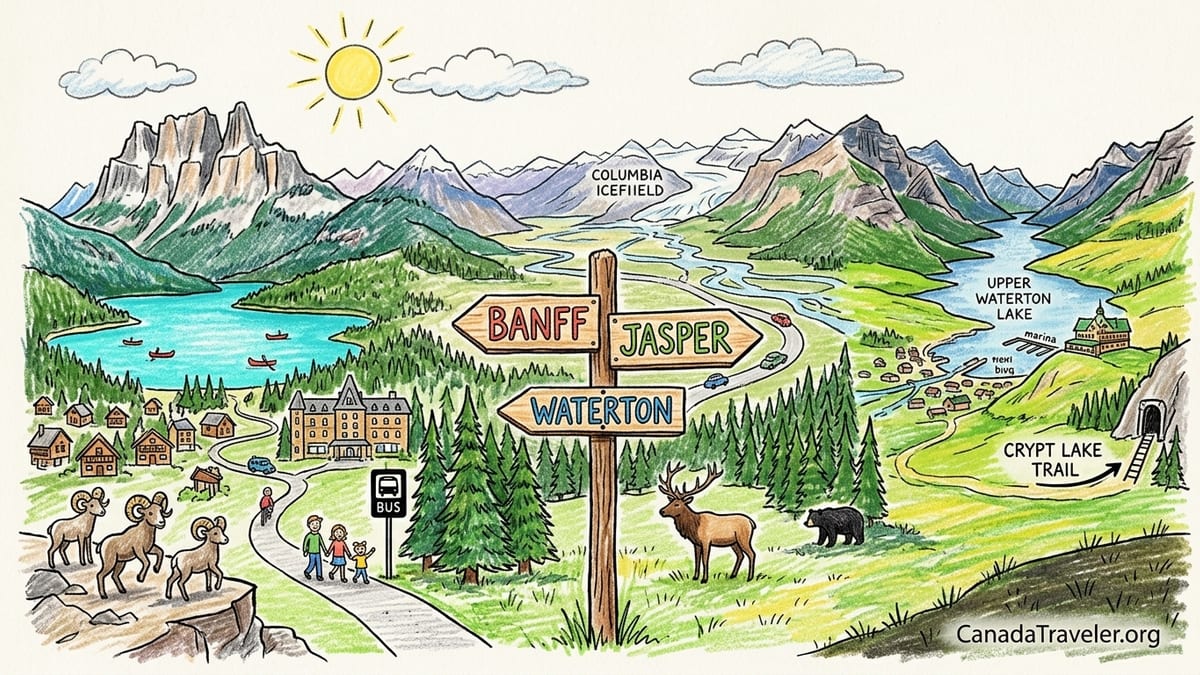
Big-picture differences between Banff, Jasper and Waterton
Banff National Park is the classic Canadian Rockies postcard. Centered on a busy resort town just 90 minutes from Calgary, it combines huge mountain scenery with a full-scale tourism economy. You can step off a shuttle, walk to a hotel, supermarket and restaurants, then be at Lake Louise or Johnston Canyon on a scheduled bus in under an hour. That convenience brings crowds, especially in July and August, but it also makes Banff the easiest choice for first-time international visitors or short trips of three to five days.
Jasper National Park covers a much larger area, stretching north from the Columbia Icefield along the Athabasca River. The valleys here are broader, the peaks feel more distant, and wildlife habitat is more continuous. On the ground that translates to more frequent elk and black bear sightings, long drives without development, and hiking trails like Bald Hills or Sulphur Skyline that feel far from town even on a day trip. The 2024 Jasper wildfire damaged part of the townsite and some access roads, and recovery is ongoing, but Parks Canada has steadily reopened major corridors and many popular day-use areas while keeping burned zones closed for safety and restoration.
Waterton Lakes National Park is smaller and more off to the side, tucked in Alberta’s southwest corner. Here the prairies run right into the Front Range, so you get a dramatic “prairie meets peaks” skyline that feels different from the deep interior valleys of Banff and Jasper. The compact Waterton village is seasonal and walkable, with accommodation, cafes and the marina all within a few blocks, but much of the year it is quiet compared with Banff’s bustle. Because Waterton shares ecosystems with adjacent Glacier National Park in Montana, many visitors combine the two, but Waterton alone can easily fill several days of hiking and lake time.
In simple terms, think of Banff as the most accessible, Jasper as the largest and wildest-feeling, and Waterton as the most intimate and transitional, where grassland, lake and peaks collide. From there, your priorities for scenery, hiking, wildlife and logistics will tilt the decision.
Scenery, lakes and photography
For iconic blue-green lakes and sharp peaks right off the highway, Banff is hard to beat. The Lake Louise and Moraine Lake basins concentrate world-famous scenery into short distances, and even secondary spots like Minnewanka, Two Jack, Vermilion Lakes and Johnson Lake are within a short drive or shuttle from Banff town. Photographers can shoot sunrise reflections at Vermilion Lakes, mid-morning glacial color at Lake Louise, and sunset alpenglow around Castle Mountain without long approaches. The trade-off is that you share those views with very large numbers of people in summer and on long weekends.
Jasper’s lakes are usually less immediately famous but feel more expansive. Medicine Lake, Pyramid Lake, Patricia Lake and the chain of ponds along the Pyramid Bench offer broad, layered views of mountains across open water. Valley of the Five Lakes, just off the Icefields Parkway, showcases small, intensely colored lakes with multiple viewpoints along a relatively short loop. On the Icefields Parkway between Banff and Jasper, both parks share access to glacier-fed lakes and hanging valleys, so those long-distance highway views do not belong to one park alone.
Waterton’s scenery is all about contrast. The main Waterton Lake cuts deep into the mountains while the eastern shoreline is open prairie. From the marina or Bear’s Hump, you see open grassland to the north and east, steep forested slopes to the west and south, and the long finger of Upper Waterton Lake stretching toward the United States. Photographers looking for a different Rockies look often appreciate the way wildflower meadows, red-rock creek beds and wind-swept grasslands frame the peaks. On clear days, evening light coming across the prairies can give especially strong side-lighting on the mountains above the village.
If you are traveling primarily to capture classic turquoise lake images on a tight schedule, Banff has the highest concentration of marquee viewpoints per kilometer of road. If you want a mix of lakes, braided rivers and wide open valleys that feel more like habitat than backdrop, Jasper stands out. For skyline shots that show mountains rising directly from prairie and for strong sunrise or sunset side-light, Waterton earns its place.
Easy hikes and short walks
In Banff, easy hiking options are plentiful and well supported. Johnston Canyon is one of the signature short walks, following catwalks bolted into a narrow gorge to reach the Lower and Upper Falls. It is accessible to most visitors and is typically snow-packed but walkable in winter with traction aids. Around Lake Louise, the shoreline path provides flat views of Victoria Glacier with minimal effort, while the combined trail to Lake Agnes and its historic teahouse offers a moderate climb that many casual hikers manage, rewarded by a small alpine lake and refreshments in peak season.
Banff town itself is ringed by relatively gentle options. The Fenland Trail and Bow River path make good leg-stretchers after driving in from Calgary. Around Minnewanka Loop you will find short walks to Stewart Canyon or along the lakeshore. For families with strollers or mobility concerns, the paved section of the Bow River trail and the flat portion of the Marsh Loop near the Cave and Basin area can work well.
Jasper also offers accessible day walks, though often with a slightly more rugged feel. The Valley of the Five Lakes loop is a standout, with rolling terrain and frequent stops along vibrant small lakes of different shades. The trail is rooty in places but not steep, and it gives a strong sense of Jasper’s forest-and-lake landscape in half a day or less. Short outings around Pyramid Island, Lac Beauvert near Jasper Park Lodge and the Athabasca Falls and Sunwapta Falls viewpoints along Highway 93 are all suitable for visitors who prefer walking paths to hiking trails.
In Waterton, Bear’s Hump has traditionally been the must-do short hike, climbing steeply but briefly from the visitor center area to a rocky viewpoint directly above the village. From here you see the entire Waterton Lakes chain and the transition from prairie to peaks. While the elevation gain is sharp over a small distance, many families manage it in under an hour up and less down. For something gentler, the lakeshore path south of town, parts of the Prince of Wales hill area and Red Rock Canyon’s short loop offer easy walking when open.
Challenging hikes and mountain objectives
For hikers looking to earn their views, all three parks offer standout full-day routes. Around Lake Louise in Banff, the Plain of Six Glaciers trail pushes beyond the busy lakefront into a broader basin framed by ice and rock. It involves sustained but moderate climbing and can be extended by connecting with the Highline to Lake Agnes to form a scenic loop. This route gives strong glacier views and a sense of the larger valley while still starting and ending at a major shuttle stop.
In Jasper, Bald Hills near Maligne Lake is a classic objective hike. It climbs through forest to reach open ridges with panoramic views over Maligne Lake and the surrounding peaks. The trail has variants, with steeper and more gradual options, but in all cases it feels like a proper mountain day. Sulphur Skyline, accessed near Miette Hot Springs when the road and trail are open, delivers big summit views for a relatively short but steep ascent, although access and operations in that area can change due to maintenance or, in recent years, wildfire considerations, so it is important to verify current conditions before planning your day.
Waterton’s signature challenge is Crypt Lake. This is a serious 17.2 kilometer return hike with roughly 675 meters of elevation gain, involving a mix of forest trail, exposed traverses, a short tunnel through the cliff and a bolted ladder. In normal seasons, most hikers reach the trailhead via a private boat shuttle from the Waterton marina, which adds schedule constraints and a cost for the ferry. Parks Canada and local outfitters describe Crypt Lake as demanding, and anyone with a fear of heights or limited mountain experience should evaluate it carefully.
Beyond Crypt Lake, Waterton also has demanding routes such as Carthew-Alderson and hikes toward the U.S. border that cross high passes and traverse burn areas from earlier fires. In Banff and Jasper, the menu of difficult trails is long, but examples like the Cory Pass loop near Banff or the Skyline Trail in Jasper illustrate the difference between day hikes and multi-day backpacking. The Skyline in particular remains a marquee backcountry route, but because sections of Jasper’s backcountry infrastructure were affected by the 2024 wildfire, booking and route options can shift from one season to the next, which makes checking current Parks Canada advisories essential.
Wildlife, atmosphere and crowd levels
For wildlife viewing, Jasper typically feels more productive, especially outside the peak midday hours. The wide Athabasca Valley and relatively sparse development give elk, black bears and other large mammals more room to move, and motorists often see wildlife along Highway 16 east of town or on the Pyramid Bench access roads. That said, the 2024 wildfire altered habitat near the townsite, and early recovery years often see changes in where animals concentrate. Visitors are asked to be particularly careful around wildlife attracted to new vegetation in recently burned areas and to respect any closures or buffer zones.
Banff’s valley bottoms are narrower and more developed, yet wildlife encounters are still common, especially along the Bow Valley Parkway and in early morning or evening around Lake Minnewanka Road. The park has a long track record of managing human-wildlife conflict in a very busy environment, with seasonal closures and travel restrictions on some corridors to give animals respite. Visitors drawn primarily by wildlife photography may find Banff reliable if they schedule dawn and dusk drives, but should expect more vehicles and tighter rules than in Jasper.
Waterton’s wildlife is shaped by its edge-of-prairie location. Bighorn sheep and deer are often visible right in or near the village, and the wind-swept grasslands support species that you do not usually associate with deep mountain valleys. Because the park is smaller and roads are fewer, you may see less variety of roadside encounters than along the Icefields Parkway, but the context feels very different. Crowds in Waterton spike on summer weekends and during wildflower season, but on shoulder-season weekdays the village and trails can feel notably quieter than Banff, especially in the evening once day-trippers leave.
In terms of overall density, Banff is by far the busiest, particularly in July and August and on long weekends. The town’s restaurants can require reservations, sidewalks are crowded and popular photo stops may feel compressed. Jasper has traditionally been less crowded, though summer still feels busy in the town core and at major attractions like Maligne Canyon. In the wake of the 2024 wildfire, visitor numbers dipped during closure periods and then began to recover as services reopened, which can mean a mixed pattern of busy and quiet areas depending on what is open in any given season. Waterton feels more like a holiday village than a year-round town, with a clear on-season and an off-season where many businesses close and the streets are very quiet.
Towns, accommodation and prices
Banff town is a full-service resort community. You will find a spectrum of accommodation from hostels and budget motels through midrange hotels to high-end properties. Recent data from hotel and vacation rental analytics indicates that average nightly rates in Banff over the past year have been significantly higher than the Alberta and Canada averages, with mid-summer prices for standard hotel rooms often several hundred Canadian dollars per night and peak luxury properties reaching well above that range. Even in shoulder seasons prices can be relatively high compared with other Alberta destinations. Booking several months in advance for July and August is normal, and free cancellation rates tend to price higher than non-refundable options.
Jasper’s accommodation market is smaller. Before the 2024 wildfire, the town offered a mix of hotels, cabins, hostels and private home accommodations. The wildfire destroyed a portion of the town’s housing stock, including some visitor accommodation, and damaged infrastructure such as bridges around the town. Since then, recovery plans from Parks Canada and the Municipality of Jasper have focused on restoring essential services and rebuilding, and tourism bodies have emphasized that many hotels, cabins and campgrounds remain open while some properties are out of service. As a visitor you should expect slightly fewer options than in previous years and should check directly with your chosen lodge or hotel regarding their current status and any changes in capacity.
Waterton’s village is compact and highly seasonal. Most accommodation is within walking distance of the lake and marina, but the number of rooms is limited, and some properties open only from late spring to early fall. Prices can approach Banff levels on peak summer weekends despite the smaller scale, simply because supply is limited and demand has grown. On weekdays and in shoulder months like late May or September, rates can drop considerably, but there is less of a budget tier than you might expect. If you are sensitive to price but want Waterton, consider visiting slightly outside school holiday windows and being flexible on exact dates.
Across all three parks, it is important to factor in the cost of food and fuel. Banff has the widest grocery and restaurant choice, which can help you manage your budget by mixing restaurant meals with self-catered options. Jasper’s grocery options are adequate but more limited, with some higher prices on imported items, while Waterton has only small stores and relies heavily on seasonal restaurants. Many travelers choose to stock up on bulk groceries in Calgary or Lethbridge before entering the mountains, particularly if they plan to camp.
Campgrounds, transport and practical logistics
All three parks are managed by Parks Canada, which uses a centralized reservation system for most front-country campgrounds. For the current season, vehicle-accessible campsites in popular campgrounds in Banff and Jasper often book out quickly when reservations open, especially for summer weekends and holiday periods. Serviced sites suitable for larger RVs are in particularly high demand. Waterton’s main townsite and nearby campgrounds can also fill fast in July and August, although some first-come, first-served sites may be available outside peak dates. Because details change year to year, travelers should check the latest booking windows and campground opening dates before finalizing itineraries.
Banff has by far the best public transport network. Shuttle systems link Banff town with Lake Louise and, when operational, Moraine Lake, and local buses and seasonal shuttles connect outlying attractions within the Bow Valley. These services reduce the need to compete for limited parking at major trailheads and allow visitors without a car to see key sites. Banff town itself is very walkable, and many hotels are within a few blocks of transit stops. In addition, private tour operators run day trips along the Icefields Parkway toward the Columbia Icefield, though these can be relatively expensive compared with self-driving.
Jasper has more limited transit. The town is walkable and some hotels provide shuttles to nearby attractions, but many trailheads, including those for Bald Hills and some sections of Valley of the Five Lakes, assume you have your own vehicle. Commercial tours can fill some gaps, but there is no equivalent of Banff’s extensive shuttle network. The 2024 wildfire temporarily closed the park to visitors and disrupted some transport services, but over time key highways such as the Yellowhead Route and Icefields Parkway have reopened, with localized closures where bridges or side roads were damaged. Before traveling, visitors should check both Parks Canada advisories and municipal updates to confirm which roads and facilities are open.
Waterton is small enough that once you arrive, you can park the car and walk. The marina is in the heart of the village, trailheads for Bear’s Hump and the lakeshore are close to lodging, and cycling can cover slightly longer distances such as the Red Rock Parkway when open. There is no extensive public transport system inside the park, but seasonal boat services on Waterton Lake, including those used to access the Crypt Lake trail, function as a kind of water-based transit. Because these boats operate on fixed schedules and can sell out on busy days, it is wise to book your preferred departure times in advance once your hiking plans are set.
Winter, shoulder seasons and year-round appeal
Banff is the only one of the three that comfortably functions as a four-season international resort. Winter brings downhill skiing at nearby Sunshine Village and Lake Louise Ski Resort, along with cross-country skiing, snowshoeing and winter sightseeing. Many hotels and restaurants stay open year-round, and town infrastructure is geared to manage snow and cold. Shoulder seasons like late October or early May can feel quieter and offer lower room rates, though some high alpine roads and facilities may still be closed due to snow.
Jasper also has a long winter season, historically centered on Marmot Basin ski area and ice walks in Maligne Canyon. The 2024 wildfire introduced uncertainty for upcoming winters, especially regarding access to specific facilities and the capacity of the town to host normal visitor numbers while rebuilding. Tourism Jasper emphasizes that much of the surrounding landscape remains intact and that the community is welcoming visitors again, but travelers planning a winter visit in the next few years should watch for updated information on accommodation availability, ski hill operations and any lingering infrastructure constraints.
Waterton is much more seasonal. In winter, strong winds and reduced services mean the village can feel really quiet, with only limited accommodation and food options open and some roads subject to weather-related closure. Spring and early summer bring spectacular wildflower blooms on the grasslands, which many hikers and photographers target specifically. Late summer and early fall can offer stable weather for longer hikes like Crypt Lake, though smoke from regional wildfires can affect visibility in some years. If you are hoping to see Waterton’s restaurants, boat tours and shops in full operation, focusing on late June through early September is usually safest.
For travelers who prefer crisp air and fewer people, shoulder seasons in Banff and Jasper can be rewarding, but it becomes even more important to check what is open. For example, teahouses at Lake Agnes and along the Plain of Six Glaciers have defined operating windows and may close earlier than the hiking season itself. In Jasper, some attractions and secondary roads may remain closed for recovery work even when snow is not the limiting factor.
Costs, park fees and value for money
All three parks charge daily admission fees per person or per vehicle, managed by Parks Canada. Many Canadian residents and frequent visitors choose to buy an annual Discovery Pass, which covers entry to national parks and historic sites for a year and can pay for itself quickly if you spend a week or more in the system. For shorter trips, paying daily at the park gate or via machines in town is common. The fees are standardized across parks, so you do not pay extra just because Banff is more famous, but you will pay again if you exit and enter on separate days unless you hold a pass.
Accommodation and activities are where costs diverge. Banff’s high demand translates into some of the highest nightly rates in the Canadian Rockies. A family booking a standard hotel room for a mid-July weekend may see prices several times higher than in Calgary, and popular guided activities such as lake cruises or canyon tours add to the bill. Jasper’s rates are generally a bit lower at comparable properties, although the difference has narrowed in recent years and the post-wildfire reduction in available rooms could put upward pressure on prices in the short term. Waterton, with fewer rooms but strong summer demand, often matches or slightly undercuts Banff on price while offering a narrower spread of categories.
Camping offers the most consistent way to keep costs down. Nightly campground fees vary by site type and hook-up level, but they are much lower than hotel rates and include access to basic facilities. Backcountry permits for multi-day hikes such as Jasper’s Skyline Trail or Banff’s Skoki area carry their own fees, but again these are modest relative to hotel prices. Rental costs for equipment such as canoes on Lake Louise or bikes in Banff, shuttles to trailheads and winter gear can add significantly to a budget-focused trip if used frequently, so it helps to choose a few key experiences rather than trying to do every paid activity.
In terms of overall value, Banff delivers maximum convenience and famous scenery for the price, appealing to travelers who are willing to spend more for ease and iconic experiences. Jasper can feel like better value for those who prioritize space, wildlife and a slower pace, accepting a slightly leaner selection of services in exchange. Waterton offers strong value for travelers who want a quieter village, are able to visit in shoulder periods, or plan to combine the park with Glacier National Park over a longer regional itinerary.
The Takeaway
If your priority is a first-time Rockies experience with minimal logistical friction, Banff is usually the best fit. It places you in the heart of classic Canadian mountain scenery with extensive shuttles, plenty of accommodation and a huge range of easy walks like Johnston Canyon and Lake Louise shoreline, plus moderate hikes such as Lake Agnes and Plain of Six Glaciers. Families with mixed abilities, short trip windows and a desire for shops, pools and restaurants within walking distance tend to be happiest here, accepting higher prices and busier trails as part of the package.
Choose Jasper if you want a bigger sense of space and more consistent wildlife viewing, and you are comfortable with a slightly quieter town that is still in recovery mode after the 2024 wildfire. Hikes like Valley of the Five Lakes, Bald Hills and Sulphur Skyline (when open) give you classic mountain days with a less theme-park feel than some of Banff’s hotspots. Jasper rewards travelers who rent a car, are ready to check closure notices and are willing to drive a little farther between trailheads. Over the next few years, it will particularly suit visitors who feel drawn to support a recovering community while accepting that some familiar facilities have changed.
Waterton is the right choice if you are looking for a compact, walkable village, dramatic prairie-to-peak scenery and a slightly more offbeat Rockies experience. Short, steep viewpoints like Bear’s Hump, moderate outings to Bertha Falls and demanding days on Crypt Lake create a satisfying hiking progression without constant driving, and evenings feel low-key once the day crowd goes home. It suits couples, photographers and hikers who value atmosphere over amenities and are comfortable with a pronounced off-season where fewer services are available.
Combining parks makes sense when you have enough time and keep expectations realistic. With five to seven days, many travelers happily link Banff and Jasper via the Icefields Parkway, spending several nights in each and mixing lakes, glaciers and wildlife along one continuous route. A similar-length trip that pairs Waterton with Glacier National Park to the south can also be very rewarding. Trying to squeeze all three parks into a three to five day window, however, often leads to rushed drives, shallow experiences at each stop and limited flexibility for weather or closures. In that case, you are usually better off choosing one primary base that matches your priorities, with perhaps a brief side trip along the Icefields Parkway or down to Waterton rather than a full three-park circuit.
FAQ
Q1. Which park is best for a first-time visitor to the Canadian Rockies?
For most first-time visitors with limited time, Banff works best. It combines famous scenery, extensive shuttles, many easy hikes and the widest range of hotels and restaurants, making logistics straightforward.
Q2. How has the 2024 Jasper wildfire affected travel plans?
The 2024 wildfire damaged part of Jasper’s townsite and some infrastructure, and some areas remain closed for safety and recovery. However, major highways, many trails and a substantial portion of accommodation have reopened, so trips are still very possible if you check current advisories and book ahead.
Q3. Is Crypt Lake in Waterton suitable for beginners?
Crypt Lake is a demanding 17.2 kilometer return hike with about 675 meters of elevation gain, exposure, a tunnel and a ladder section, usually accessed by boat shuttle. It is generally not recommended as a first-ever mountain hike or for those uncomfortable with heights.
Q4. Can I visit Banff, Jasper and Waterton all in one long weekend?
It is technically possible to drive between all three in three to five days, but it usually feels rushed and tiring. You will spend much of your time in the car and have little flexibility for weather, so most travelers are better off focusing on one park or at most pairing Banff with Jasper or Waterton.
Q5. Do I need a car, or can I rely on public transport?
In Banff you can rely largely on shuttles and local buses, especially between town, Lake Louise and other popular spots. In Jasper a car is very helpful, as transit is limited. In Waterton you can park once and walk or use boat shuttles, but you will likely need a vehicle to reach the park in the first place.
Q6. Which park is best for families with young children?
Banff is usually the easiest choice for families, with short, stroller-friendly paths, a wide range of accommodation, pools and indoor activities. Jasper and Waterton can also work well, but require more planning around driving distances, services and trail difficulty.
Q7. How far in advance should I book accommodation and campsites?
For July and August, booking hotels in Banff and Waterton several months ahead is wise, and securing popular campgrounds as soon as the Parks Canada reservation system opens is recommended. Jasper also benefits from advance booking, especially while some properties remain offline during wildfire recovery.
Q8. Are winter visits realistic in all three parks?
Banff and Jasper support winter tourism with open hotels, maintained roads and ski areas, though Jasper’s capacity may vary as it rebuilds. Waterton is much quieter in winter, with limited services and strong winds, so it suits self-sufficient visitors looking for solitude rather than a full-service ski base.
Q9. Which park offers the best chance to see wildlife?
Jasper often feels best for wildlife, with broad valleys and relatively low development leading to frequent elk and bear sightings along highways and side roads. Banff and Waterton also have abundant wildlife, but Banff’s busier corridors and Waterton’s smaller size shape where and how often you might see animals.
Q10. When does it make sense to combine two parks in one trip?
Combining Banff and Jasper works well with at least five to seven days, allowing time on the Icefields Parkway and in both towns. Pairing Waterton with Glacier National Park or with a few days in Banff can also be rewarding if you have a week or more. With less time, focusing on a single park usually leads to a more relaxed and satisfying trip.