

Most travelers arrive in Alberta with a single image in mind: turquoise lakes backdropped by jagged Rocky Mountain peaks. Banff, Lake Louise and Moraine Lake have earned their global fame, but they represent only one slice of a province that stretches from high alpine passes to rolling foothills, wheat-yellow prairies, dinosaur-filled badlands, dark boreal forest and a north country of vast lakes and night skies. If you already know the Canadian Rockies by name, this is your invitation to use Alberta’s 13 tourism regions as your map to a much bigger, more varied adventure.
Understanding Alberta’s Regions and Landscapes
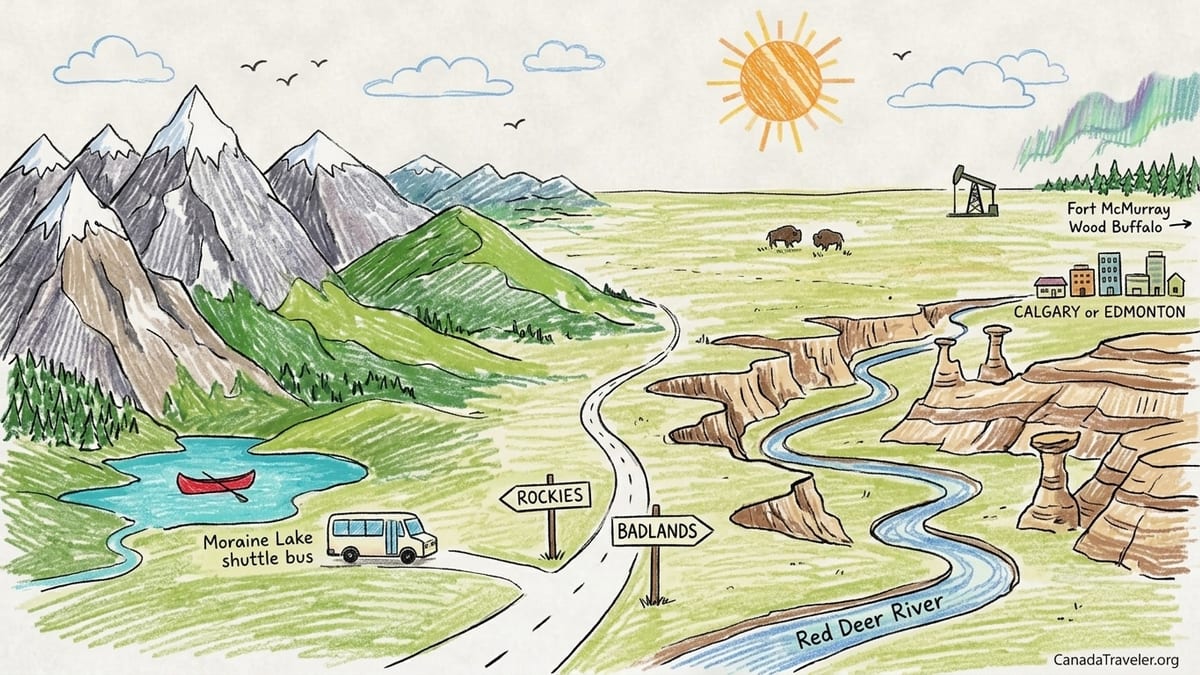
Alberta’s geography reads like a cross-section of the continent. In the west, the Canadian Rockies rise sharply along the border with British Columbia. East of the peaks, the land steps down through wooded foothills into open prairie grasslands that run toward Saskatchewan. South and east of Calgary, rivers like the Red Deer and Bow have carved a surreal maze of gullies and hoodoos known as the Canadian Badlands. North of Edmonton, the province gives way to boreal forest, muskeg and thousands of lakes, then finally to a sparsely populated frontier bordering the Northwest Territories.
Travel Alberta organizes this variety into 13 tourism regions, including Canadian Rockies, Southern Rockies, Northern Rockies, Canadian Badlands, Historic Plains, Foothills, West Country, Calgary & Area, Edmonton & Area, Central Prairies, Lakelands, Wildlands and Fort McMurray Wood Buffalo. Each region has its own character and trip patterns, from day hikes around Canmore to multi-day paddling between boreal lakes near Lac La Biche. It is not realistic to combine all of them into a single short holiday, especially if you hope to do more than drive past the views.
For most visitors, Calgary and Edmonton serve as practical entry points. The Calgary and Area region gives fast access to Banff, Canmore, Kananaskis and the Southern Rockies around Waterton. Edmonton and Area faces north and east into Lakelands, Wildlands and the Fort McMurray Wood Buffalo region. The Canadian Badlands and Historic Plains spread between them, while the Central Prairies, Foothills and West Country fill in the agricultural heartland and ranch country. Thinking in regions, rather than in individual postcards like “Lake Louise,” makes it easier to design a realistic itinerary.
This article focuses on the highlights beyond the classic Banff and Lake Louise combination, while still acknowledging that many first-time visitors will start there. For each destination, you will find practical detail on what people actually do, how long to stay, how to reach it from Calgary or Edmonton, what seasons work best, the kind of accommodation available and the main limitations you should consider when planning.
Canadian Rockies: Banff, Lake Louise, Jasper and Kananaskis
Banff and Lake Louise sit squarely in Alberta’s Canadian Rockies region and remain unavoidable reference points. Banff townsite is about a 90-minute drive west of Calgary on Highway 1. Many visitors base here for two or three nights to ride the Banff Gondola, soak at the Upper Hot Springs, stroll Banff Avenue and drive to viewpoints like Vermilion Lakes. Lake Louise village, another 40 minutes up the highway, is the launch point for canoe rentals on Lake Louise itself and hikes to the Lake Agnes Tea House or Plain of Six Glaciers. Moraine Lake, in the same area, is now subject to mandatory shuttle or commercial tour access in peak season, so you should plan several months ahead if you want sunrise photos from the famed rock pile.
The biggest limitation around Banff and Lake Louise is crowding. In July and August, parking lots at Lake Louise and Johnston Canyon fill extremely early in the morning, restaurant waits can stretch past an hour and even easy family hikes feel busy. Accommodation is also expensive at this time of year, with basic hotel rooms in Banff commonly priced in the mid-hundreds of Canadian dollars per night and prime lakefront stays far higher. Shoulder seasons in late May to mid June and mid September to early October generally bring fewer visitors, but also colder nights and a higher chance of snow on trails and mountain passes.
Jasper National Park, about 4 hours northwest of Edmonton or at least 3.5 hours north of Lake Louise along the Icefields Parkway, offers a slightly quieter atmosphere while still delivering archetypal Rockies scenery. Visitors typically spend two to four nights here, using Jasper townsite as a base. Popular activities include boat cruises on Maligne Lake, short walks to Maligne Canyon, visiting Athabasca Falls and Sunwapta Falls, and looking for wildlife such as elk and black bears along the Pyramid Lake Road or near the town golf course. The park is also designated as a dark sky preserve, and in October the Jasper Dark Sky Festival draws stargazers for guided telescope sessions and night photography workshops. Limited road access during winter and spring storms is the park’s main constraint, so drivers need to carry emergency supplies and check Parks Canada bulletins for closures.
South of Banff, Canmore and Kananaskis sit in the Foothills and West Country adjacent to the Canadian Rockies region. Canmore lies only an hour from Calgary, just outside Banff National Park’s gates, and functions as an alternative base for visitors who want mountain views with a less overt resort feel. From town, you can hike family-friendly trails like Grassi Lakes or more strenuous routes such as Ha Ling Peak, and you will find a dense selection of vacation rentals and mid-range hotels compared with Lake Louise’s small cluster. Kananaskis Country, reached via Highway 40, serves up mountain hiking, road cycling, cross-country skiing and snowshoeing in a series of provincial parks and recreation areas. Travel here requires more self-sufficiency than Banff’s central corridor: there is no large town, fuel stations are few and cellular reception can be patchy, but the reward is quieter trails and a more local atmosphere.
Southern Rockies: Waterton and the Meeting of Prairie and Peaks
In Alberta’s Southern Rockies region, Waterton Lakes National Park feels almost like a secret relative of Banff. It lies about 3 hours south of Calgary, with the last stretch rolling through grain fields and wind farms before the mountains rise sharply at the edge of the prairie. The park’s signature image is often the historic Prince of Wales Hotel perched on a bluff above Upper Waterton Lake, but the real appeal is the way open grasslands run right up to rocky slopes. Bighorn sheep and deer frequently wander through Waterton townsite, and on quiet evenings you can sometimes hear the wind carrying the sound of aspens rustling on the hillsides.
Visitors tend to stay two or three nights in or around Waterton, spending days hiking trails like Bears Hump or the longer Carthew-Alderson route, taking scenic boat trips down the main lake, renting bikes, or watching for wildlife from roadside pullouts. The small town offers a compact strip of lodgings and eateries, from simple motels and cabins to more upscale lakeview rooms. Unlike Banff, there is no large year-round town nearby, so booking in advance is essential in July and August. Shoulder seasons in June and September can be glorious, with wildflowers on the slopes or golden larch higher up, but some services close outside the main summer window.
Reaching Waterton from Edmonton is a longer proposition, usually at least 6.5 to 7 hours by car via Calgary or through Lethbridge in the Historic Plains region. That travel effort means Waterton works best as part of a longer southern Alberta itinerary, perhaps paired with the Canadian Badlands to the east or the ranch-country Foothills to the north. Winter visits appeal mainly to photographers and those comfortable with limited services; roads may be icy, and many accommodations close for the season, but the mood of the park shifts toward snow-dusted peaks rising abruptly from empty prairie.
The park’s biggest limitation is its small scale and infrastructure. Trails can be affected by past wildfires, and some routes periodically close for repair or wildlife management. Parking in town is limited on summer weekends, and because the park sits against the United States border, cross-border hikes and drives require passports and awareness of current customs rules. For many travelers, though, those same constraints preserve a sense of quiet and intimacy that is hard to find in busier parts of the Rockies.
Prairie Cities: Calgary, Edmonton and Their Surroundings
Calgary, in the Calgary & Area region, often functions as a gateway but deserves time in its own right. With two or three nights, visitors might divide their days between the Glenbow Museum’s art and history collections, the Studio Bell National Music Centre, the Calgary Zoo and walks along the Bow River pathway system. Calgary is also known for western culture, anchored by the Calgary Stampede, which usually runs over 10 days in early July and features rodeo competitions, chuckwagon races, concerts and midway rides. Hotel prices during the Stampede period move sharply higher, so travelers on a budget may prefer to visit in June or late August when downtown business hotels sometimes discount weekend stays.
From Calgary, access to Banff, Canmore and Kananaskis is straightforward via well-maintained highways, and the airport offers frequent flights across Canada and to major hubs in the United States and Europe. The primary limitation for travelers is Calgary’s role as a transit point: it is easy to underestimate how much there is to do in the city and rush through without exploring its neighborhoods, food scene or parks. Integrating at least one full non-driving day here gives you time to recover from flights and experience the region’s urban side.
Edmonton anchors the Edmonton & Area region on the North Saskatchewan River, about 3 hours north of Calgary by road. The city markets itself as Canada’s “Festival City,” hosting events in many months of the year, from a major summer fringe theatre festival to winter light and snow festivals. Visitors with two or three nights might stroll river valley trails, which collectively form one of North America’s largest urban park systems, tour the Royal Alberta Museum and Art Gallery of Alberta, and dine in revitalized districts such as Old Strathcona and the 104 Street warehouse area. Families often include time at West Edmonton Mall for its indoor water park and attractions, especially in winter when outdoor options are constrained by cold temperatures.
Edmonton is the main launch point for northern and eastern adventures, including Elk Island National Park, the Lakelands region around Lac La Biche and Cold Lake, and the long push to Fort McMurray and Wood Buffalo National Park. Winter can be intense, with temperatures regularly falling below minus 20 degrees Celsius, which affects driving, packing and daily planning. On the other hand, cold clear nights also bring higher chances of aurora viewing on the city’s northern fringes or in dark-sky sites a short drive away.
Badlands and Historic Plains: Drumheller, Dinosaur Provincial Park and Indigenous Heritage
East of Calgary, the Canadian Badlands region showcases a very different Alberta. Drumheller, about 90 minutes by car, is the main hub. Visitors come primarily for the Royal Tyrrell Museum of Palaeontology, one of the world’s leading dinosaur museums, which now charges around 25 Canadian dollars for a standard adult admission and operates extended daily hours in summer. Inside, families and enthusiasts move through galleries of full dinosaur skeletons, fossil preparation labs behind glass and exhibits that explain how this part of Alberta once hosted swamps and coastal plains teeming with prehistoric life. Many travelers allow at least half a day, and often a full day, at the museum, followed by short hikes among the hoodoos at the nearby badlands viewpoints.
Accommodation in Drumheller ranges from classic roadside motels and chain hotels to campgrounds and small bed-and-breakfasts. In peak summer weekends, especially when the weather forecast looks good, the town can feel busy with road-tripping families and tour buses, so advance bookings are wise. Drivers arriving from Edmonton should plan on at least a 3.5 to 4-hour trip one way, often routing through Red Deer or directly across rural highways that can be icy or closed during spring floods.
About two hours southeast of Drumheller and just under three hours from Calgary, Dinosaur Provincial Park sits in the Historic Plains region and is distinct from the Drumheller area despite the shared dinosaur theme. The park is a UNESCO World Heritage Site because of its high concentration of late Cretaceous fossils, and much of its core fossil area is protected as a restricted preserve. Visitors typically stay one or two nights at the campground or nearby lodging in the Brooks region and join guided programs like the Bare Bones Bus Tour or fossil prospecting hikes, booked through Alberta Parks. Current brochures list options ranging from short interpretive walks to full-day fossil-hunting experiences, with per-person prices that vary by tour length and age category but remain competitive with other guided nature activities in the province.
The main limitation at Dinosaur Provincial Park is heat and exposure. Summer days can exceed 30 degrees Celsius, and the clay-rich soils become slippery and difficult after rain. Mosquitoes can also be intense near the river. Spring and fall bring more comfortable hiking temperatures and fewer biting insects, though some tours and services may run on reduced schedules outside the main summer months. Access from Edmonton typically involves a 5 to 6-hour drive, making the park better suited to multi-day trips rather than a day excursion.
Further south and east, the Historic Plains region preserves a deeper human story. Head-Smashed-In Buffalo Jump, a UNESCO-listed interpretive centre near Fort Macleod, explores thousands of years of Plains Indigenous hunting practices at one of the world’s best-preserved communal buffalo jump sites. A typical visit takes two to three hours and involves walking the interpretive trails along the cliff top and base, touring the multi-level indoor exhibits and, in summer, watching demonstrations, storytelling or dance performances hosted by Blackfoot interpreters. The site is around 90 minutes from Lethbridge and about two hours from Calgary. Its limitation for some travelers is that you need to engage actively with exhibits and narration rather than expecting a quick viewpoint photo stop.
Writing-on-Stone / Áísínai’pi Provincial Park, closer to the U.S. border in the Historic Plains region, is another UNESCO World Heritage Site focused on Blackfoot cultural landscapes and rock art. Visitors camp along the Milk River, join guided tours into the protected archaeological preserve to view petroglyphs and pictographs, and walk hoodoo trails that overlook the river valley. Because the most sensitive rock art areas are accessible only with interpreters, advance reservations for tours are crucial in high season. Reaching the park means at least a 3.5 to 4-hour drive from Calgary and longer from Edmonton, often along secondary highways with few services, so travelers should start with a full fuel tank and extra water.
Northbound: Elk Island, Lakelands, Fort McMurray and Wood Buffalo
North and east of Edmonton, the Lakelands and Wildlands regions transition into boreal forest and big-sky lake country. Elk Island National Park, only about 40 minutes east of downtown Edmonton on Highway 16, is the easiest first step. The park protects important bison herds and aspen parkland. Day visitors drive slowly along the main loop roads, looking for plains bison grazing near Astotin Lake, join short hikes through aspen and wetlands or paddle rented kayaks and canoes on small lakes. Many people visit as a day trip, but there are also campgrounds and oTENTik cabin-style accommodations that allow for overnight aurora watching when the northern lights are active. The principal limitation is that wildlife viewing is never guaranteed; bison and elk move freely, and some days they remain distant from the roads.
Farther northeast, the town of Lac La Biche sits at the heart of the Lakelands region, roughly 2.5 hours’ drive from Edmonton. This is cottage and campground country, dotted with provincial parks and recreation areas. Summer visitors book cabins or lakefront campsites months in advance, spend days boating and fishing, and hike or bike forest trails in parks like Sir Winston Churchill Provincial Park, which occupies an island connected by causeway. Services here are more limited than in the cities, so travelers should expect fewer dining choices and bring specialized gear with them. In shoulder seasons, some facilities close or move to reduced hours, but the region remains appealing for quieter hiking and birdwatching.
Fort McMurray and the surrounding Fort McMurray Wood Buffalo tourism region sit much further north, about 7 to 8 hours by road from Edmonton along Highway 63, or a short flight from either Edmonton or Calgary. The city itself supports the oil sands industry and has a strong working-town feel, but visitors with a couple of days can explore riverfront trails, visit local museums that interpret the region’s industrial and Indigenous history and head out of town at night in search of the aurora borealis. Several local operators offer northern lights viewing tours during darker months, combining heated shelters and photography tips with access to darker skies than most travelers can find at home.
Beyond Fort McMurray, Wood Buffalo National Park spills across the border between Alberta and the Northwest Territories. It is one of the largest protected areas on Earth, recognized for its bison herds, salt plains and role in conserving migratory whooping cranes. Access requires a very long drive or a combination of driving and regional flights toward communities like Fort Chipewyan or into the Northwest Territories side of the park. Once there, facilities are minimal compared with the Rockies or southern Alberta, and visitors need to be self-reliant with food, fuel planning and navigation. This is not a destination to add casually to a one-week Alberta holiday; it works better as a dedicated backcountry or northern road trip focus, anchored around mid-summer for road conditions or late summer and autumn for aurora viewing.
The major limitation across Alberta’s northern regions is distance. Services thin out quickly outside larger towns, winter driving requires experience with snow and ice, and cellular coverage can be intermittent. On the other hand, travelers willing to commit to these realities find quiet campgrounds, long sunsets and a sense of space that is hard to replicate elsewhere in the province.
Seasonality, Stays and Practical Limitations Across Regions
Alberta’s tourism regions are profoundly shaped by season. In winter, the Canadian Rockies, Foothills and Northern Rockies focus on skiing, snowboarding, ice walks and winter festivals, while the Canadian Badlands quiet down into a stark, sometimes icy landscape. Spring brings shoulder-season complications, with lingering snow in the mountains, muddy rural roads and ice breakup on northern rivers and lakes. Summer unlocks almost all destinations, from Waterton and Writing-on-Stone in the south to Lac La Biche and Wood Buffalo in the north, but also brings peak demand and higher prices. Autumn offers larch season in the Rockies, golden prairies and increased chances of northern lights, though mountain roads can see early snow.
Ideal stay lengths vary by region. Many travelers spend three to five nights in the Canadian Rockies region if they want to split time between Banff, Lake Louise and Jasper. Waterton works well as a two or three-night stop within a larger Southern Rockies or Historic Plains loop. Drumheller and Dinosaur Provincial Park together merit three nights if you want to balance museum time with badlands hiking and guided fossil activities. Calgary and Edmonton both reward at least two nights each, especially if you plan festival, sports or cultural events into your stay. Northern regions like Fort McMurray Wood Buffalo and remote parts of Lakelands and Wildlands justify four or more nights, simply because of the effort involved in reaching them.
Accommodation types also shift by region. In city hubs and the main Rockies corridor, you will find everything from hostels and mid-range chains to luxury hotels, apartments and mountain lodges. In smaller centres like Waterton, Drumheller, Lac La Biche or Peace River, choices skew more toward motels, family-run inns and campgrounds, often with a handful of boutique cabins or glamping setups. Remote parks such as Dinosaur Provincial Park, Writing-on-Stone and Wood Buffalo lean heavily on camping, basic cabins and seasonal lodges. Travelers who prefer private bathrooms and full hotel services may need to focus on certain hubs and treat surrounding landscapes as day-trip destinations.
The most common planning mistake is underestimating travel time and overestimating how much of Alberta you can comfortably cover in one holiday. Distances that look manageable on a map can translate into six or seven hours of highway driving. Road construction, wildlife crossings and weather all add uncertainty. It is sensible to build no more than one long driving day into each three-day window and to allow extra time when moving between regions, especially if you want to stop at viewpoints, trailheads or small towns along the way.
Sample Five-, Ten- and Fourteen-Day Itineraries
Because Alberta’s 13 tourism regions cover such a broad area, it is more realistic to choose clusters than to attempt a province-wide loop. The following example itineraries avoid trying to see everything and instead link destinations that naturally fit together in terms of driving time, activities and season.
A focused five-day trip built around Calgary works well for first-time visitors who already know they want some time in the Rockies but are curious about the badlands and city culture. One pattern is to arrive in Calgary and spend the first night downtown, exploring the river pathways and a museum or two. On day two, drive to Drumheller for the Royal Tyrrell Museum, overnighting there. Day three can be split between more badlands hiking and a return drive via small prairie towns, leading to a second night in Calgary. Days four and five then go west into the Canadian Rockies region for a quick Banff and Lake Louise sampler before flying out. This trip touches three regions Calgary & Area, Canadian Badlands and Canadian Rockies without the unrealistic expectation of reaching Waterton or the north.
A ten-day itinerary can comfortably weave together mountains, prairies and Indigenous heritage. One such route begins in Calgary, with two nights to adjust and explore. Then drive to Waterton for three nights in the Southern Rockies, hiking and taking in the unusual prairie-meets-peaks landscape. After Waterton, move northeast to the Historic Plains, with one night near Fort Macleod or Lethbridge to visit Head-Smashed-In Buffalo Jump. Continue to Dinosaur Provincial Park for two nights of badlands camping and guided fossil experiences. Finish with two nights in Drumheller and the Royal Tyrrell Museum before returning to Calgary. This concentrates on southern Alberta, leaving northern lakes and Wood Buffalo for a future trip.
A fourteen-day plan allows time to link the Canadian Rockies with northern lake and forest regions without turning the trip into a forced march. One example begins in Edmonton with two nights to experience the river valley and festivals. Drive west and south into Jasper National Park for three nights, exploring Maligne Lake, Athabasca Falls and dark-sky viewing. Continue down the Icefields Parkway to Lake Louise and on to Banff for four nights, mixing classic viewpoints with quieter hikes around Canmore or Kananaskis. Next, return to Edmonton for one night of rest and reorganization. The final four nights are then devoted to Lakelands and Wildlands: two nights around Lac La Biche for lakeside camping and paddling, followed by two nights near Elk Island or another dark-sky location for wildlife watching and aurora attempts. This itinerary still covers only a selection of regions Canadian Rockies, Northern Rockies, Edmonton & Area, Lakelands and Wildlands and deliberately leaves Fort McMurray Wood Buffalo and the far south for future visits.
For travelers tempted to add Yoho National Park or other British Columbia destinations to these itineraries, it helps to remember that Yoho lies across the provincial border in British Columbia, even though it is part of the same Canadian Rocky Mountain Parks World Heritage Site as Banff and Jasper. Connecting it to an Alberta trip is simple if you have extra days, but it occupies a separate jurisdiction with its own road conditions, accommodation options and park management priorities.
The Takeaway
Alberta is far more than a single postcard of a turquoise lake below a glacier. From Waterton’s meeting of prairie and peaks to the hoodoos and fossil beds of Dinosaur Provincial Park, the buffalo jumps and rock art sites on the Historic Plains, and the quiet boreal lakes of the Lakelands and Wildlands, the province offers a range of landscapes and experiences that most visitors never see. Using the 13 tourism regions as a planning framework helps you group destinations that make sense together, rather than attempting an exhausting province-wide sweep.
Thoughtful itineraries usually revolve around a few anchor hubs Calgary, Edmonton, Banff or Jasper with side trips into adjoining regions such as the Canadian Badlands, Southern Rockies or Lakelands. Each region rewards slowing down for at least two or three nights, whether you are tracking dinosaur fossils on a guided hike, listening to Blackfoot stories at Head-Smashed-In Buffalo Jump or watching bison graze under northern lights at Elk Island. Trying to string together Banff, Jasper, Waterton, Drumheller, Writing-on-Stone, Fort McMurray and Wood Buffalo in one short visit almost guarantees more highway time than holiday.
Planning with realistic driving times, clear seasonal expectations and a sense of which activities matter most to you will go a long way toward shaping a satisfying Alberta journey. The Rockies may get you here, but it is the contrast between mountains, prairies, badlands, forest and lake country that will likely bring you back.
FAQ
Q1. How many of Alberta’s tourism regions can I realistically visit in one week?
In a seven-day trip, most travelers are comfortable focusing on two or three neighboring regions, such as Calgary & Area with Canadian Rockies and Canadian Badlands, or Edmonton & Area with Lakelands and West Country. Adding more regions usually means long days of driving and less time actually hiking, sightseeing or relaxing.
Q2. Is it possible to visit Banff, Jasper and Waterton in a single short holiday?
It is technically possible to drive between all three in about a week, but doing so leaves very little time for hiking, lake trips or wildlife watching. For most visitors, combining Banff and Jasper in one trip, then saving Waterton and the Southern Rockies for another, leads to a more enjoyable experience with fewer rushed days.
Q3. What is the best season to explore the Canadian Badlands and Dinosaur Provincial Park?
Late spring and early autumn are often ideal, because temperatures are more moderate and trails are less crowded. July and August bring longer days and a full schedule of guided programs, but they can also be very hot, with limited shade in the badlands terrain. Winter visits are quiet and atmospheric but offer fewer guided options and require care on icy trails.
Q4. How do I reach Writing-on-Stone / Áísínai’pi and Head-Smashed-In Buffalo Jump without joining a tour?
Both sites are reachable by private vehicle on paved highways, though the final stretches may pass through rural areas with few services. Renting a car in Calgary or Lethbridge is the simplest approach, and you should begin with a full fuel tank, especially when driving to Writing-on-Stone near the U.S. border. There is no widespread public transit to either site, so fully independent trips require your own wheels.
Q5. Can I see the northern lights without traveling as far as Fort McMurray or Wood Buffalo?
Yes. On clear, dark nights with active solar conditions, the aurora can be visible from areas much closer to Edmonton, such as Elk Island National Park and dark rural locations in Lakelands or Wildlands. The farther you travel from city lights, the better your chances. However, no location in Alberta can guarantee northern lights on a particular date, so it is best to treat them as a possible bonus rather than the sole focus of a short trip.
Q6. Are there family-friendly activities outside Banff and Lake Louise?
Many regions offer family-friendly options. The Royal Tyrrell Museum in Drumheller appeals to children and adults with large skeletons and interactive exhibits. Dinosaur Provincial Park runs guided bus tours suitable for most ages. In Edmonton, families enjoy the river valley parks and indoor attractions, while in Waterton and Kananaskis there are short, well-marked hikes and lakefront strolls that work well with young children.
Q7. Do I need a four-wheel-drive vehicle to explore Alberta’s regions?
Most main attractions, including Banff, Jasper, Drumheller, Waterton, Elk Island and Lac La Biche, are accessible on paved highways suitable for standard rental cars. Four-wheel drive is helpful but not essential unless you plan to travel unpaved backroads, remote resource routes or winter mountain passes during storms. Always check road reports before leaving and avoid venturing down unsigned gravel tracks without local advice.
Q8. How does Yoho National Park fit into an Alberta-focused itinerary?
Yoho National Park lies just across the border in British Columbia, west of Lake Louise. Many visitors who base in Lake Louise or drive the Trans-Canada Highway include day trips to Yoho’s waterfalls and lakes. While it is easy to combine with an Alberta Rockies stay, it operates under Parks Canada’s British Columbia management and is technically outside Alberta, so it should be considered an add-on rather than a core Alberta region.
Q9. What are the main limitations of visiting northern Alberta’s Wood Buffalo region?
The primary limitations are distance, sparse services and variable road conditions. Towns are far apart, fuel stops can be limited, and accommodations are fewer than in the south. Travelers need to be comfortable with long drives, carrying extra supplies and adjusting plans for weather or roadworks. In return, the region offers very dark skies, quiet campgrounds and a sense of remoteness that is rare in more developed tourism corridors.
Q10. How far in advance should I book accommodation and tours in peak season?
For July and August, it is wise to reserve popular hotels in Banff, Jasper, Waterton and Drumheller several months ahead, especially for weekends and holiday periods. Guided programs at Dinosaur Provincial Park and shuttle access to places like Moraine Lake can also sell out early. In shoulder seasons, you can often book closer to your travel dates, but securing at least your first and last nights in advance reduces stress and allows you to focus on enjoying the landscapes.