


I arrived in Banff with a rental car, a trunk full of hiking gear, and a head full of postcards. In my mind, I would wake before dawn, drive empty mountain roads, slide into a quiet parking spot beside a turquoise lake, and watch the first light hit the peaks in silence. Instead, my days became a blur of reservation windows, shuttle queues, parking signs, and confused visitors trying to decode a system that feels more like an airport transfer operation than a visit to a wild national park.
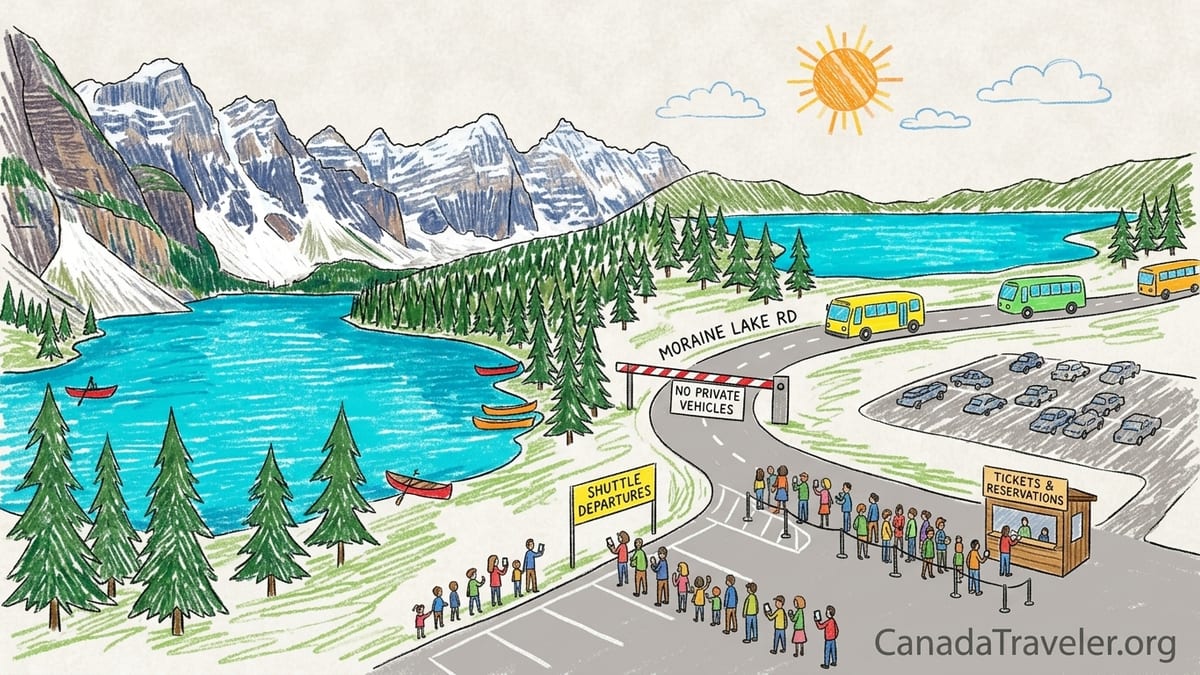
The Dream of Wild Freedom Meets a Managed Machine
I had imagined Banff as the place where the idea of wilderness still lived in some pure form. The images that drew me in were all freedom: a lone car tracing a line through the forest, Moraine Lake glowing blue in the early light, Lake Louise calm and almost empty except for a few canoes and loons. I pictured myself pulling into a half-empty parking lot at sunrise, pouring a thermos coffee, and strolling to the shore whenever inspiration struck.
The reality in 2026 could not have been more different. Instead of driving to Moraine Lake, I found that the road I had dreamed about was off limits to me and every other ordinary driver. Instead of casually dropping into Lake Louise, I learned that roughly three out of four vehicles that try to park at the lakeshore in peak summer are turned away once the lot fills. The promise of freedom is still on the billboards, but on the ground the experience is controlled by a complex system of shuttles, fees, and time slots.
Some of that management is necessary. Banff National Park welcomed more than four million visitors in 2025, and staff recorded more than one hundred thousand vehicle trips on Moraine Lake Road alone between June and October. Without some form of control, the narrow mountain roads and small lakeshore parking lots would be overwhelmed. Yet for an independent traveler, the gap between Banff’s wild image and the highly managed reality is so wide that it feels, at times, like a bait and switch.
I came to Banff to feel small in nature. Instead, my first days were dominated by feeling small in the face of a system I had to learn, navigate, and constantly strategize around just to glimpse the very places used to market the park to the world.
What It Actually Takes to Reach Moraine Lake in 2026
The most jarring discovery of my trip was Moraine Lake. For years, Moraine Lake has been the poster child of the Canadian Rockies, printed on bank notes and splashed across social media. The classic viewpoint on the rock pile above the shore may be one of the most recognized landscapes on earth. I had pictured simply driving there in the blue hour and walking up to the viewpoint before the buses arrived.
That plan died as soon as I read the current rules. As of 2026, Moraine Lake Road is closed to personal vehicles all year. The closure is not seasonal and not just at sunrise. Ordinary private cars cannot drive the 10 kilometre access road under any normal circumstance. The only vehicles allowed are Parks Canada shuttles, Roam and other public transit, and a growing army of licensed commercial operators, along with a few narrow exceptions for people with accessible permits, Moraine Lake Lodge guests, and certain commercial license holders.
This is not just a money grab or an arbitrary inconvenience. It is a safety and traffic management response to the chaos that used to unfold here. In recent years, Parks Canada has reported turning away the large majority of vehicles that attempted to reach Moraine Lake because the small lot filled before sunrise. Staff were dealing with congestion on a narrow mountain road, dangerous illegal parking on the shoulders, and frustrated drivers making risky U-turns.
Seen from that perspective, the closure is rational. But knowing the policy is sensible did not make it any less frustrating as a visitor who had flown across a continent expecting the freedom to explore. Instead of a pre-dawn drive, my sunrise decisions were replaced by spreadsheet-style logistics and alarms set not for hiking but for securing online reservations.
Inside the 2026 Shuttle System: Reservations, Queues and Confusion
The core of Banff’s new reality is the Parks Canada shuttle system to Lake Louise and Moraine Lake. If you want to visit these lakes in the core season without a private tour, you have to play by its rules. Reservations for the 2026 summer season open on April 15 at 8 am Mountain Time. On that morning, Parks Canada releases 40 percent of all seats for the entire shuttle season in one huge batch, and the virtual queues begin.
The remaining 60 percent of seats are not held back as a generous last-minute pool. They are released on a rolling basis at 8 am two days before each departure date. If you want a seat on a Tuesday shuttle, you need to be online at 8 am on Sunday. For a Sunday seat, you are joining the rush at 8 am on Friday. Many travelers only discover this pattern once they are already in Banff, and by then most of the popular morning slots are often gone in seconds.
Even understanding the schedule, the process feels more like booking concert tickets than planning a walk by a lake. At 8 am you stare at a loading screen, watch your place in a virtual queue climb down from the tens of thousands, and hope the time you need does not vanish while the page refreshes. In online discussions, travelers talk about waking up before dawn during their vacation just to battle for the second wave of seats two days ahead, or trying repeatedly and failing as the short-term quota disappears faster each day of their trip.
When you finally have a reservation, the fine print creates more room for error. The ticket that says “Moraine Lake” does not send you to the Moraine Lake parking lot. Check-in is at the Lake Louise Park and Ride, located at the Lake Louise Ski Resort several kilometres away from both famous lakes. You cannot simply drive to Lake Louise and expect to board there. Instead, you drive or ride transit up to the ski hill, park in a large gravel lot, scan your code with staff, and then wait for a shuttle bus that will finally take you down the access road to Moraine Lake or over to Lake Louise.
From Ski Hill Parking Lot to Iconic Lakes: The Hidden Time Costs
On paper, the shuttle diagram is simple. You book a Parks Canada shuttle from the Lake Louise Park and Ride to Moraine Lake or Lake Louise. Once there, you can connect between the two lakes using a “Lake Connector” shuttle as long as you have a valid Parks Canada shuttle reservation or a reservable Roam Transit Super Pass. Then you ride any returning shuttle back to the Park and Ride when you are done. In reality, each arrow on that diagram can translate into long waits, crowded buses, and a constant sense of watching the clock.
The morning I visited, the Park and Ride lot felt more like a theme park staging ground than a national park. Buses lined up, staff with radios tried to keep groups in separate queues, and visitors milled around holding phones and printed confirmations, trying to make sense of which line led where. The setting is functional, but it is a far cry from the romantic idea of quietly approaching a turquoise lake at dawn.
The biggest pain point comes at the Lake Connector stage. During high demand periods, particularly mid-morning and early afternoon at Moraine Lake, the wait for a connector shuttle back to Lake Louise can easily stretch to 30 to 60 minutes. There is no shade structure along the queue, and if you misjudge the timing you may find yourself stuck in line with children who are already cold or exhausted or with camera gear you no longer want to carry.
Those waits compound because you still have to factor in the return shuttle from whichever lake you end your day at back to the Park and Ride. What sounds like a casual pair of lake visits can quietly swallow most of a day. You start by driving from Banff or Canmore to the ski hill, boarding a first shuttle, exploring your first lake while keeping an eye on connector schedules, queueing for the connector, exploring the second lake, then joining yet another queue back to your car. None of this is impossible, but it is a far cry from the spontaneous road-trip freedom that Banff’s marketing suggests.
Lake Louise Parking: A Lottery Few Visitors Win
If Moraine Lake has surrendered entirely to shuttles, Lake Louise still dangles the possibility of lakeshore parking like a lottery ticket. There is a paved parking lot right beside the lake, and you can technically drive there without a shuttle reservation. Paid parking is in effect from early morning to early evening during the shuttle season, and the fee for standard vehicles is high enough that many travelers flinch on first reading. Electric vehicle stalls exist in limited numbers. At first glance, the system seems simple: pay the fee, park, walk to the lake.
The reality in peak season is that the odds are heavily stacked against you. Parks Canada’s own visitor management documents from summer 2025 report that only around one quarter of vehicles that attempted to reach Upper Lake Louise actually secured a spot in the lakeshore lot. Approximately one thousand personal vehicles per day successfully parked, while roughly seventy-five percent were turned away once the lot filled early in the morning and remained closed for most of the day.
In practice, that means many families still drive the steep hill toward the lake, only to be stopped at a traffic control point where staff explain that the lot is full and will likely remain so for hours. Those drivers then either turn back to hunt for a space in the small Lake Louise village parking areas, give up and head elsewhere, or retreat to the ski hill in hopes of finding a last-minute shuttle seat. For visitors with only one or two days in the area, this can feel less like careful management and more like a rigged game.
It is important to stress that parking restrictions and paid fees are not arbitrary. Revenue from Lake Louise parking helps offset the cost of operating shuttles and other transportation services in a park that sees millions of visits each year. Vehicles cannot safely line the roadside up the hill to the lake, and unmanaged traffic would be a genuine hazard. Yet none of that softens the blow when you realize that you have built your entire day around the idea of seeing Lake Louise, only to be waved away at a gate you never knew existed.
Real-World Impacts on Families, Photographers and Time-Crunched Travelers
The controlled access model hits different groups in different ways, but it is particularly harsh on families, serious photographers, and anyone visiting under significant time pressure. The careful, highly managed system is optimized around the average visitor who is content with a mid-morning lake visit in bright light and who is relatively flexible about times. The more your needs diverge from that median, the more you feel the system’s hard edges.
For families, the challenges start before you even leave your accommodation. Instead of simply loading kids into a car and driving up to a lake when everyone is ready, you need to secure a specific time window months in advance or hit a narrow reservation drop two days before your chosen date. Miss your shuttle window because a child is sick or you underestimated how long breakfast would take, and you risk forfeiting the seat entirely on a day that may have no other slots available.
Once you reach the Park and Ride, the stress continues. Keeping small children entertained while waiting 30 minutes in a connector queue at Moraine Lake is not anyone’s dream of a family holiday. Strollers are awkward to manage on packed buses. Tired kids may fall asleep during the ride only to be woken up and shuffled off into another line. For caregivers, the lakes can start to feel like checkpoints in an obstacle course instead of the restful reward at the end of a journey.
Photographers arguably feel the pinch even more sharply. The most beautiful light at Moraine Lake and Lake Louise comes at sunrise and sunset. Sunrise tours do exist through private shuttle operators, but the closure of Moraine Lake Road to private vehicles has effectively eliminated the classic independent photographer’s ritual of driving up in the dark, setting up quietly, and waiting for the first glow on the Ten Peaks. Now you are tied to shuttle schedules, surrounded by dozens of tripods in confined spaces, and constrained by return-bus timetables that may cut short the blue hour you came for.
Banff Townsite Grinds: Traffic, Prices and Overloaded Trails
Even beyond the lakes, the impression of being inside a managed tourism machine rather than a wild landscape repeats itself in Banff townsite. On a busy summer afternoon, Banff Avenue and the main bridge over the Bow River clog with vehicles and pedestrians. Drivers circle for spots in the downtown parkades while hotel guests queue at front desks. The mountains loom magnificently above, but at street level the experience is closer to a resort town at peak season than a quiet gateway to wilderness.
Many businesses in town cater almost exclusively to short-stay tourists, and prices reflect that. A simple sit-down lunch in the centre of Banff can easily reach the cost of a dinner in a mid-range city restaurant elsewhere in Canada. Souvenir shops, branded outdoor clothing outlets, and dessert bars crowd the main streets. It is pleasant enough in its own way, but it does not feel like the rustic mountain outpost that Banff’s romantic reputation might suggest.
Out on the trails, some of the most heavily promoted “must do” walks feel similarly overloaded. Johnston Canyon, perhaps the most famous family hike in the area, is a prime example. The trail is justifiably popular, winding through a narrow limestone gorge with catwalks bolted into the cliff above turquoise water. But arrive anytime from mid-morning to mid-afternoon in high season, and the experience can feel like a one-way sidewalk. Visitors shuffle along at group pace, pausing for photos from the same few viewing platforms, and traffic stalls entirely whenever someone stops in the middle of the path for a selfie.
None of this is unique to Banff. Many iconic national parks face the same pressures. What makes it feel more pointed here is how sharply it contrasts with the images used to promote the region: solitary hikers, empty lakeshores, and quiet moments under huge skies. When you are wedged into a crowd at Johnston Canyon or waiting at a bus stop in the Lake Louise ski resort parking lot, that marketing image feels very far away.
Five Key Disappointments Behind Banff’s Perfect Postcards
By the time I left Banff, five disappointments stood out clearly, all rooted in that gap between image and reality. The first was the total loss of independent vehicle access to Moraine Lake. Intellectually I understand the safety and ecological reasons, but as a traveler it is hard not to mourn the disappearance of that simple early morning drive that once defined the experience.
The second was the Lake Louise parking lottery. Knowing that about seventy-five percent of vehicles that try for lakeshore parking in summer are turned away is one thing. Watching drivers be redirected after a long uphill drive, their plans quietly collapsing in the space of a two-minute exchange with a traffic attendant, is another. The policy is rational; the human effect is deflating.
The third disappointment was the time cost embedded in the shuttle system. From the outside, a shuttle every 20 or 30 minutes sounds convenient. On the ground, when those intervals meet long connector queues and the need to return to the Park and Ride before the last bus, the sense of freedom shrinks. Entire days disappear into transit choreography.
The fourth lay in the crowded nature of Banff’s core experiences. From Johnston Canyon to the lakeshore boardwalks, the park’s most famous places now feel, much of the time, like attractions rather than wild spaces. If you arrive expecting solitude, the density of people can be a shock.
The fifth and more subtle disappointment was psychological. Banff still offers real wilderness and profound beauty, but reaching it now demands more planning, more digital literacy, and more tolerance for bureaucracy than the marketing materials ever hint at. It is not that Banff has nothing to offer. It is that the visitor experience at its most iconic sites feels misaligned with the story being sold.
Planning Smarter: Roam Transit, Canmore Stays and Quieter Corners
Despite my frustrations, I did find ways to work with the system rather than constantly fight it. Public transit plays a key role in that adjustment. Roam Transit connects Canmore, Banff, the Lake Louise area, and in some seasons Moraine Lake. A reservable Roam Super Pass can, in certain months, double as your ticket onto the Lake Connector shuttles between Lake Louise and Moraine Lake. It will not solve the reservation puzzle entirely, but it can simplify your movements and save you from driving and parking stress inside the park.
Roam’s fares between Banff and Lake Louise are, as of 2026, relatively reasonable compared with the cost of gas, paid parking, and the indirect costs of failed parking attempts. A return express trip from Banff to Lake Louise on Roam is priced at a level that makes ditching the car for the day a sensible choice, especially if you are already paying Banff’s daily park entry fees. For visitors staying several days, day passes that cover multiple routes often deliver even better value.
Another practical shift is to base yourself in Canmore rather than Banff. Canmore sits just outside the national park boundary, which means you do not start paying park entry fees the moment you step out the door. Accommodation can be slightly more affordable and more spacious, and the town retains a more lived-in feel, with grocery stores and local services alongside tourism-focused businesses. From Canmore you can ride Roam into Banff or drive to the park boundaries on your own schedule, then transition to shuttles only when necessary.
Perhaps the most powerful mindset change is to broaden your definition of success. Rather than equating “Banff” exclusively with Moraine Lake, Lake Louise and Johnston Canyon, look to less-hyped alternatives. Lakes along the Icefields Parkway, viewpoints off the main highway, and trails around smaller lakes and passes can offer equally spectacular scenery with a fraction of the crowds. They may not appear on the average postcard rack, but they are where Banff still feels closest to the wild freedom that first drew me in.
The Takeaway
Banff in 2026 is not the carefree driving destination that its postcard images suggest. It is a heavily managed, high-demand national park where traffic control, shuttle logistics, and reservation systems shape almost every visit to its most iconic lakes. Moraine Lake Road is permanently closed to ordinary private vehicles. Lake Louise parking functions as a high stakes lottery that most drivers lose. Crowds fill the townsite and the most famous trails for many hours of the day.
These measures exist for real reasons: safety on narrow mountain roads, protection of fragile lakefront ecosystems, and the sheer pressure of millions of visitors in a limited space. But for travelers arriving with dreams of open roads and spontaneous stops, the contrast between expectation and reality can be startling. The feeling of being processed through a system can overshadow the beauty of the places you have come so far to see.
If you are planning a visit, treat Banff less as an unstructured road trip and more as a complex itinerary. Learn the shuttle rules early. Remember that reservations open on April 15, with 40 percent of seats released then and the remaining 60 percent appearing in a short two day window before each date. Understand that your Moraine Lake journey begins not at the lake but at the Lake Louise Ski Resort parking lot. Accept that connector waits can run up to an hour in busy times, and that lakeshore parking at Lake Louise is something close to a statistical miracle in peak summer.
At the same time, give yourself permission to step sideways from the postcard script. Ride Roam Transit and let someone else handle the driving. Base in Canmore if Banff feels too crowded or expensive. Leave room in your plans for lesser known valleys and lakes, where the mountains are no less grand and the mood is far closer to the wild freedom you probably came looking for. Banff is still beautiful beyond words. To find that beauty now, you just have to look past the marketing, acknowledge the machinery, and choose your own path through it.
FAQ
Q1. Can I drive my own car to Moraine Lake in 2026?
Private vehicles are not allowed on Moraine Lake Road at any time in 2026. Access is through Parks Canada shuttles, Roam Transit when operating, authorized commercial shuttles and tours, or limited exceptions such as guests of Moraine Lake Lodge and certain accessible permit holders.
Q2. Where do I catch the Parks Canada shuttle for Lake Louise and Moraine Lake?
All Parks Canada shuttles to Lake Louise and Moraine Lake depart from the Lake Louise Park and Ride at the Lake Louise Ski Resort, several kilometres from the lakes themselves. You must check in there, not at the lakeshore.
Q3. How does the 2026 shuttle reservation system work?
For summer 2026, 40 percent of all shuttle seats are released for booking at 8 am Mountain Time on April 15. The remaining 60 percent are released at 8 am exactly two days before each travel date, in rolling daily batches.
Q4. How long might I wait for the Lake Connector shuttle between Lake Louise and Moraine Lake?
During busy periods, especially late morning and afternoon, waits for the Lake Connector can reach 30 to 60 minutes. At quieter times, lines are shorter, but travelers should build potential waits into their plans.
Q5. Is it realistic to park at Lake Louise lakeshore without a shuttle?
You can drive to Lake Louise, but in peak summer roughly three quarters of vehicles that attempt to park at the lakeshore are turned away once the small lot fills. Success is most likely very early or later in the evening, and even then is not guaranteed.
Q6. Are the shuttles just a way to charge extra fees?
The shuttle system and parking fees are primarily traffic management and safety tools in response to heavy visitation and limited road capacity. Revenue from paid parking helps offset shuttle and transportation costs, but the restrictions were introduced after years of congestion, illegal parking, and safety concerns.
Q7. What are my options if I cannot get a Parks Canada shuttle reservation?
If shuttle reservations are sold out, you can look at Roam Transit routes that serve Lake Louise, or consider licensed private shuttle and tour operators that run to Moraine Lake and Lake Louise. These services cost more than the Parks Canada shuttles but can be a fallback when public seats are gone.
Q8. Is staying in Canmore a good alternative to Banff townsite?
Yes. Canmore sits just outside the national park boundary, often offers better-value lodging and a more local feel, and is connected to Banff and Lake Louise by Roam Transit and the highway. Many visitors base in Canmore to avoid some of Banff’s congestion and higher prices.
Q9. How can I avoid the worst crowds at Banff’s famous sites?
Arrive very early or later in the evening, target shoulder seasons, and consider skipping the headline spots on peak weekend mornings. Explore less-promoted lakes and trails off the main corridors, where numbers are lower and the experience feels more peaceful.
Q10. Is Banff still worth visiting given all the crowds and rules?
Yes, but expectations matter. The days of simply driving up to Moraine Lake at sunrise are gone. If you plan around the shuttle system, accept that the most iconic places are highly managed, and make time for quieter corners of the park, Banff can still deliver some of the most spectacular mountain scenery in the world.