


I drove into Jasper in late summer 2026 with a car full of guidebooks that were already out of date. On the page, the town was either a total loss or triumphantly back to normal. Out the windshield, it was neither. The reality of visiting Jasper after the July 22, 2024 wildfire is far more complicated than the glossy before-and-after narratives suggest, and it begins long before you see the first “Welcome to Jasper” sign.
Arriving Through a Changed Forest
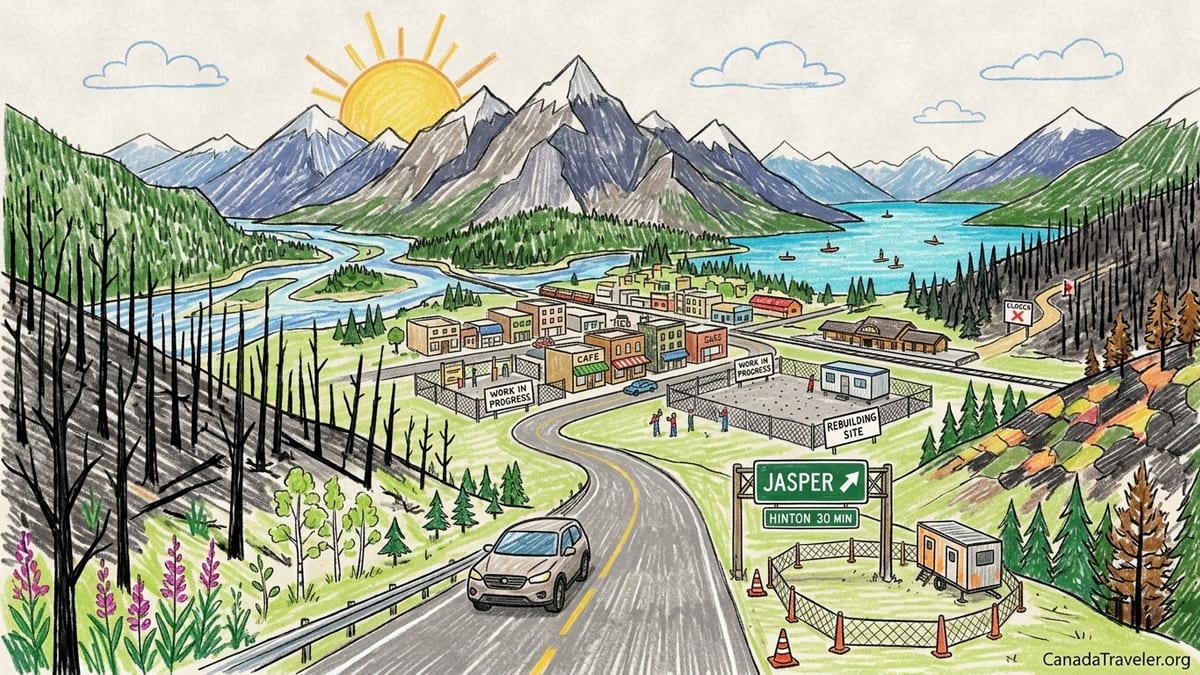
My first real glimpse of Jasper’s recovery came not in town, but along Highway 16 west of Hinton. About 30 minutes out, the forest began to thin in a way that did not look natural. Lodgepole trunks stood blackened and branchless on the ridges, some snapped like toothpicks, others still upright but lifeless. Between them, bright green fireweed, knee-high aspen shoots and small spruce saplings were pushing through charcoal soil. It felt like driving through two landscapes at once: the forest that burned in 2024 and the one that will replace it.
Closer to the park gate, the pattern continued. One hillside would look relatively untouched, the next would be a mosaic burn with patches of green canopy and brown, torched crowns. In a few drainages I noticed heavy equipment parked in cleared pullouts, part of ongoing work on slope stabilization and hazard tree removal that has quietly reshaped many viewpoints. A couple of older scenic pullouts that still appear in printed guidebooks were either coned off or completely gone, overtaken by safety fencing and work trailers.
Inside the gate, the contrast became sharper. The Athabasca River still braided around its gravel islands, the mountains still rose in the same jagged skyline, but the foreground was different. On some stretches, particularly approaching the turnoff for Wabasso Road, the forest looked shaved back from the highway, more open than the photos that appear in pre-2024 brochures. New guardrails and freshly cut ditches hinted at the engineering work that followed the fire, an invisible layer of recovery that visitors may not realize they are driving across.
By the time I reached the outskirts of town, it was clear that “Jasper is gone” was never accurate, but neither was the emerging counter-myth that everything is fine. Whole neighborhoods still stood, yet gaps in the treeline and unexpected views into backyards told another story. I parked with the uneasy feeling that I was arriving in a place that was both familiar and fundamentally changed.
What Really Happened on July 22, 2024
Part of the confusion about visiting Jasper in 2026 comes from the way the disaster itself has been flattened into headlines. The basic facts are stark enough on their own. On July 22, 2024, lightning ignited multiple fires near the townsite under hot, dry, windy conditions. Within hours, the fires grew beyond initial control and moved toward Jasper, driven by winds strong enough to topple trees and loft burning embers over firebreaks.
By the evening, the Municipality of Jasper and Jasper National Park had ordered a mass evacuation that ultimately involved more than 20,000 people, including residents, tourism workers and visitors in surrounding campgrounds and lodges. Buses and private vehicles streamed east toward Hinton and west toward British Columbia in a tense procession, while structural firefighters stayed behind to defend critical infrastructure like the wastewater treatment plant and communication towers.
The fire reached the townsite in the following days. A formal damage assessment later confirmed that roughly 30 percent of Jasper’s structures were destroyed. That number is often quoted without context, and it leads easily to the mistaken conclusion that the town was either almost entirely lost or barely touched. In reality, it meant that several hundred buildings, including homes and some well-known businesses, burned within a tight geographic area, while about 70 percent of the town, along with all core services, remained standing. The broader wildfire complex eventually burned on the order of 33,000 hectares in and around the townsite and nearby valleys.
The fire was declared under control later in 2024 and officially extinguished in 2025, but that administrative milestone did not end the disaster. It marked the shift from response to recovery, a long haul that is still very visible in 2026. When you walk Jasper’s streets today, you are not strolling through a disaster movie set, nor are you in a mountain resort that has simply shrugged off a bad year. You are in a living community still rebuilding after a profound shock.
Walking a Town That Is Neither Ruin nor Miracle
I spent my first afternoon in 2026 doing what most visitors do: wandering Jasper’s compact downtown on foot. From the main commercial strip along Connaught Drive, the first impression is one of continuity. The train station is still the visual anchor. Cafes and gear shops are open, with chalkboard menus on the sidewalk and bikes leaned casually against railings. There are construction workers in high-visibility vests at a few corners, but also families licking ice cream and hikers comparing maps.
Turn just a few blocks off that main axis, however, and the discontinuities appear. I walked along a residential street where three consecutive lots had active rebuilds, with new foundations poured beside older surviving homes with mature trees. Next came a pair of gravelled lots still fenced off, a temporary sign noting future reconstruction plans. On another block, a freshly completed house stood alone with raw topsoil and construction trailers, the only new structure on a street otherwise lined with 1980s bungalows that had survived.
Some empty footprints are subtle, like slightly larger parking lots or community spaces that used to have buildings on them. Others are raw and obvious: a former cluster of staff housing combed flat, now used for temporary offices and equipment. Residents I spoke to described the strangeness of navigating by what is missing. Longtime locals told me about a beloved bakery and a small independent bookshop that were lost in the fire, then would stop mid-sentence as a tourist walked past snapping photos, aware of how much grief is still just below the surface.
Officially, recovery is advancing. By October 19, 2026, the municipality’s rebuild dashboard reported 73 properties at the occupancy stage, meaning people could move back in or businesses could operate again, and another 98 properties under construction. That is significant progress in just over two years, but you feel those numbers on the street not as statistics, but as the drumbeat of nail guns and the rumble of gravel trucks. For a visitor, this means the Jasper you experience is usually a mix of established storefronts, brand new buildings still smelling of fresh lumber, and fenced work sites that look nothing like the photos in older travel articles.
Closed Icons, Open Alternatives: What Was Actually Accessible in 2026
It is in the surrounding park that the gap between guidebook and ground truth grows widest. Many evergreen “best of Jasper” articles lean heavily on Maligne Canyon and the Edith Cavell area, both of which remained closed for the entire 2026 season. Cavell Road, which climbs steeply to the trailheads beneath Mount Edith Cavell’s hanging glacier, was gated and signed as a wildfire-impacted closure. Maligne Canyon, usually one of Jasper’s busiest short walks, was also off-limits through the main canyon system, with access prohibited from the traditional First Bridge parking area through to the Fifth Bridge junction.
That does not mean the entire Maligne corridor was out of reach. Maligne Lake itself was open in 2026, though subject to evolving advisories. On my visit, Parks Canada staff at the Maligne Lake day lodge were carefully explaining to visitors which shoreline trails were available and which informal paths into recovering forest were off-limits. Boat tours were operating with adjusted messaging that addressed the fire directly, pointing out burn patterns on distant slopes as part of their commentary instead of pretending nothing had happened.
Elsewhere, many of Jasper’s signature roadside and near-road attractions were accessible. Athabasca Falls and Sunwapta Falls, both along the Icefields Parkway, were open, with signage reminding visitors to respect new barriers and stay on hardened trails due to increased rockfall and root exposure in burned areas upslope. Pyramid Lake and Lake Annette continued to serve as close-to-town options for sunrise paddles and lakeside walks, though several picnic areas now came with extra warnings about tree hazards on windy days.
By summer 2026, a trio of important trails had also rejoined the official “open” list. Valley of the Five Lakes, a classic family-friendly loop just south of town, reopened with clear messaging about staying on the designated path through regenerating forest. Wabasso Lake, a quieter destination reachable from a side road, was similarly available again, as was the Curator area for experienced hikers familiar with Jasper’s higher routes. In each case, physical reality had outrun the internet. A surprising number of search results still described these routes as closed due to the 2024 wildfire, while user forums and some blogs claimed that Maligne Canyon was open because someone had walked part of it in early 2024. Both sets of posts were wrong for 2026.
Campgrounds, Beds and the Strain on a Limited Town
Accommodation is where the wildfire’s long shadow is most obvious for travelers. The destruction of about 30 percent of Jasper’s structures translated into the loss of hundreds of housing units, including staff accommodation and some commercial properties that had previously hosted visitors. That reduction has collided with a visiting public that often assumes Jasper’s bed base is unchanged from pre-fire days.
On the camping side, Parks Canada has moved quickly, but with limits. By mid-2026, more than 1,600 frontcountry campsites had been restored since the wildfire, primarily through reopening and rebuilding at campgrounds like Whistlers and Wapiti. That represents about three-quarters of the pre-fire frontcountry capacity, a strong recovery by any standard. Backcountry campgrounds were doing even better on paper, with nearly all designated sites accessible again, though some routes changed due to safety concerns in heavily burned valleys.
The catch is that a portion of this capacity, especially at Wabasso Campground, has been set aside as accommodation for contractors and workers involved in the town’s rebuild. In effect, some of the sites that might once have been available for tourists are now part of the construction logistics system. This is not something you see in a booking interface; you feel it as earlier sellouts on summer weekends and fewer last-minute cancellations when weather turns.
Hotels and hostels in town face their own constraints. During my stay, a handful of well-known properties were operating at partial capacity while renovation and expansion work continued. Others had been completely rebuilt and were charging correspondingly higher nightly rates, reflecting insurance realities and construction costs rather than opportunistic price gouging. On a sample August week, basic motel-style rooms that might have gone for around 230 Canadian dollars before the fire were commonly priced closer to 260 or 280, while newer suites and upscale lodges reached well beyond 400. These are illustrative, not fixed, but they match what several front desk managers described: full occupancy at prices that reflect a compressed market.
Five Real Difficulties Visitors Are Running Into
Spending time in Jasper in 2026 means confronting practical challenges that glossy recovery narratives often skip. The first is outdated information. Several major travel sites still host “updated for 2025” Jasper guides that describe Maligne Canyon as a must-do and Mount Edith Cavell as an easy half-day drive-and-hike, with no mention of ongoing closures. I met one German couple at a downtown map board who had planned an entire day around Cavell, only to learn from a handwritten note at their guesthouse that the road was closed for the season. They had stable mobile data, yet multiple high-ranking search results and a recently republished blog had misled them.
The second difficulty is unexpected closure layering. Even when a major attraction like Maligne Lake is open, additional restrictions can affect what you can actually do. During a dry and windy spell while I was there, a fire danger advisory triggered bans on shoreline campfires and restricted the use of some day-use areas in the evenings. Visitors who had seen social media photos of lakeside barbecues from earlier summers were surprised, and in a few cases angry, when they could not replicate that experience. Local operators told me they now spend much of their time gently resetting expectations at check-in counters and tour desks.
A third, more mundane challenge is living with rebuilding in progress. Construction noise starts early in a small mountain town where crews take advantage of long daylight. If your hotel room or rental happens to back onto a rebuild site, you may hear reversing alarms and hammering from 7 a.m. onward. Streets that appear straightforward on a map can be semi-blocked by delivery trucks or fenced for utility work. For locals, this is the sound of recovery. For visitors who arrived expecting alpine quiet, it can be jarring.
Fourth is accommodation scarcity at certain times and price points. Several solo travelers I spoke with had ended up staying in Hinton and driving an extra hour each way because every reasonably priced bed in Jasper was sold out, often weeks in advance. One Calgary family who had camped in Jasper most summers told me they had been unable to get consecutive nights in their preferred campground, even when booking early, because a block of sites was reserved for contractors. None of this is catastrophic, but it does mean that pre-fire habits like rolling into town without a reservation are now more likely to end in frustration.
The fifth difficulty is more emotional, and it centers on changed scenery. Visitors who have been coming to Jasper for decades sometimes struggle to reconcile their memories with what they see now. A favourite treed campsite might back onto a more open, recently burned hillside. A classic photo viewpoint might now include a break in the trees that reveals a rebuilt neighborhood where there was once a continuous forest edge. During a lakeshore walk, I overheard one returning visitor say, “It is beautiful, but it is not my Jasper anymore.” For first-time visitors, the landscapes are still stunning. For those who return after 2024, it can feel like visiting a friend who has been through a life-altering event.
Why Blogs Age Faster Than Burned Forests
The wildfire has exposed a deeper problem in modern travel planning: online content ages far faster than most readers realize. In Jasper’s case, I regularly found blogs written in late 2024 or summer 2025 that were being reshared in 2026 as if they were current, even though key facts had shifted. One popular post still stated that Valley of the Five Lakes and Wabasso Lake were closed “until further notice,” despite both trails being firmly back on the recommended list for summer 2026. Another insisted that “Jasper is open as usual” and encouraged travelers not to worry about closures at all, glossing over the ongoing shutdown of Maligne Canyon and the Cavell area.
This matters because the stakes are higher than a disappointing viewpoint. When someone arrives in Jasper intending to walk into a closed canyon or to park along a restricted roadside to access a burned slope, they risk their own safety and complicate recovery work. Rangers I spoke with described a recurring pattern: visitors citing something they had read online as justification for ignoring fresh signage. In one case, a hiker tried to follow an older GPX track into a closed section of trail because it appeared on a hiking app without the updated closure overlay.
Even institutional information can be hard to parse from afar. Parks Canada’s closure bulletins, Jasper’s municipal rebuild updates, and regional tourism board announcements are all being updated frequently, but search algorithms do not always surface the freshest version first. That is why in 2026, planning a responsible Jasper trip requires more than a one-time search and a downloaded blog post. It means checking official notices close to your travel dates, confirming specifics like shuttle schedules and trail access with local providers, and being prepared to adjust your itinerary on arrival.
The result is a paradox. Jasper needs visitors to return, both economically and psychologically, yet the reality of its evolving recovery does not fit neatly into evergreen content that can sit unchanged for years. For now, the most accurate guides are often unglamorous: the latest park bulletin in a trailhead kiosk, the printed “What’s New” sheet handed over by a hotel receptionist, or the advice of a local guide who spends every day on these trails.
How to Visit Jasper in 2026 With Realistic Expectations
Visiting Jasper after the wildfire is not an exercise in disaster tourism. It is a chance to experience one of Canada’s great mountain landscapes at a pivotal moment in its ecological and human story, provided you come with realistic expectations and a willingness to adapt. That starts with your itinerary. Instead of building your entire trip around a single site like Maligne Canyon or Edith Cavell, plan a broader set of possibilities that emphasizes what is definitively open: Athabasca and Sunwapta Falls, Pyramid Lake, Lake Annette, Maligne Lake under current advisories, and reopened routes like Valley of the Five Lakes and Wabasso Lake.
It also means recognizing that some of the most memorable experiences now come in the transitional spaces. A sunrise paddle on Pyramid Lake may include views across to partially burned slopes where mosaic patches of green and black tell the story of fire’s selective path. A roadside stop along the Icefields Parkway might reveal a hillside where standing dead trees silhouette against new undergrowth, an uncomfortable but honest view of a forest in flux. Rather than cropping those elements out of your photos, consider what it means to document this stage of the park’s life.
Logistically, build more slack into your days than you might have pre-2024. Give yourself time to detour if a planned stop is busier than expected because other attractions remain closed. Be prepared for delays due to construction or roadside vegetation work. When you book accommodation, ask direct questions about potential noise, parking constraints and proximity to active rebuild sites. If you plan to camp, make reservations as early as systems allow, and have a fallback plan in places like Hinton or Valemount if your preferred dates are not available.
Most of all, adjust your mental picture of what a Rockies holiday looks like right now. Jasper in 2026 still offers glacier-fed lakes, big sky sunsets, and wildlife encounters, but it also includes seedling-studded burn scars, high-vis vests on main street, and locals juggling their own recovery with the demands of a busy tourist season. Accepting that complexity before you arrive can turn what might be a jarring surprise into a deeper, more honest connection with the place.
Supporting a Community Still in Recovery
Beneath every decision about what to open, close, or rebuild first is the reality that Jasper is a small community trying to recover while continuing to welcome the world. As a visitor, your choices can either ease that process or add friction. One straightforward way to help is to consciously direct your spending toward locally owned businesses. In practice, that might mean choosing an independent cafe over an international chain for breakfast, booking a walking tour with a Jasper-based guide who can explain the fire’s context, or picking up souvenirs from a local artisan cooperative rather than ordering mass-produced items online.
Patience is another form of support. When a front desk clerk explains that a room will not be ready exactly at check-in time because housekeeping staff are stretched thin in a reduced housing market, or when a server apologizes that a particular menu item is unavailable due to supply disruptions, how you respond matters. Service workers are often themselves displaced residents or people living in temporary accommodation while their homes are rebuilt. The kindness or irritation they encounter from hundreds of visitors each week becomes part of the town’s lived experience of recovery.
On the land, support means following both the letter and spirit of current rules. That includes staying out of closed areas, leashing dogs where required to protect wildlife stressed by habitat changes, and taking “stay on trail” signage seriously in regenerating forests where a single shortcut can slow the return of fragile groundcover. If you witness someone ignoring closures to get a closer photo of burned trees or exploring into taped-off zones, a polite word or a quiet report to staff can help protect the work underway.
Finally, support involves storytelling. When you return home, resist the urge to describe Jasper as either destroyed or fully recovered. Instead, tell the more nuanced truth: that around 30 percent of the town’s structures were lost, that roughly 33,000 hectares burned, that over 20,000 people were evacuated, and that in 2026 you walked streets where new homes rose beside empty lots, and hiked trails where wildflowers bloomed through ash. Sharing that story helps future visitors arrive better prepared and encourages a broader public to understand recovery as a process, not a single before-and-after snapshot.
The Takeaway
Two years after the wildfire, visiting Jasper is an exercise in holding two realities at once. The first is that the town and its surrounding park remain profoundly beautiful, with lakes, peaks and wildlife experiences that fully justify the effort it takes to get here. The second is that this beauty now coexists with visible scars and ongoing disruption that no responsible guide should gloss over. Maligne Canyon and Cavell Road are still closed for the 2026 season. Some neighborhoods are still rebuilding. Construction noise, altered views and booking challenges are part of the experience.
If you come expecting the Jasper of pre-July 2024, you will almost certainly encounter moments of surprise, disappointment or discomfort. If you come expecting a burned-out ruin, you will be equally wrong, and you may miss the resilience on display in reopened trails, restored campgrounds and buzzing cafes filled with residents and visitors together. The most rewarding way to experience Jasper now is to accept that it is in transition and to see your visit as a chance to witness and support that transition respectfully.
That means checking current advisories, prioritizing open areas like Maligne Lake, Athabasca Falls, Sunwapta Falls, Pyramid Lake, Lake Annette, Valley of the Five Lakes, Wabasso Lake and Curator, and giving yourself permission to feel both joy at the landscape and empathy for the community. Jasper is not what it was before July 22, 2024, and it may never be exactly that again. Yet in 2026 it remains very much alive, a mountain town and national park writing its next chapter in the full view of those who choose to visit with open eyes.
FAQ
Q1. Is it still worth visiting Jasper in 2026 after the wildfire?
Yes. While some areas remain closed and the town is visibly rebuilding, many of Jasper’s most compelling lakes, waterfalls and trails are open, and your visit can directly support local recovery.
Q2. Which major attractions are closed for the entire 2026 season?
Cavell Road and the Mount Edith Cavell area, along with the main Maligne Canyon trail system from the traditional First Bridge access through to the central canyon, remain closed for 2026 while safety work and rehabilitation continue.
Q3. What key sites and areas are open to visitors in 2026?
Maligne Lake, Athabasca Falls, Sunwapta Falls, Pyramid Lake, Lake Annette, and reopened trails such as Valley of the Five Lakes, Wabasso Lake and Curator are open, subject to current advisories and any short-term restrictions.
Q4. How has the wildfire affected camping options in Jasper?
By 2026, around 1,600 frontcountry campsites had been restored, especially at Whistlers and Wapiti, but some sites are allocated to rebuild workers, so advance reservations are strongly recommended and flexibility is important.
Q5. Are hotel prices higher in Jasper since the fire?
In general, yes. With fewer total rooms and ongoing demand, many mid-range properties charge somewhat more than before 2024, and rebuilt or upgraded accommodations often have higher rates that reflect construction and insurance costs.
Q6. How can I get reliable, up-to-date information on closures and openings?
Check Parks Canada’s most recent bulletins for Jasper National Park, review current notices on the municipal and tourism office channels close to your travel dates, and confirm details with local operators once you arrive.
Q7. What should I do if information I find online conflicts with signs or advisories on-site?
Always follow the most recent on-site signage and official instructions, even if a blog, app or older brochure claims an area is open; conditions evolve faster than many online sources are updated.
Q8. How can I visit Jasper without adding stress to the local community?
Book early, arrive with realistic expectations about construction and altered landscapes, be patient with staff, respect housing pressures, and spend money at locally owned businesses where possible.
Q9. Is it appropriate to take photos of burned areas and rebuilding work?
It is acceptable to photograph landscapes that include burn scars, but be sensitive when photographing near homes or construction sites, avoid intruding on residents’ privacy and never cross closures for a better angle.
Q10. What is the single most important mindset to bring to Jasper in 2026?
Come ready to appreciate both beauty and recovery at the same time, understanding that Jasper is a living community healing from a major fire, not a theme park that can instantly reset to how it looked before July 2024.