


By the time I rolled into the Columbia Icefield Glacier Discovery Centre after a blue-sky drive up the Icefields Parkway, I was prepared to be impressed. I had paid for the full Columbia Icefield Adventure package, the combination ticket that includes both the giant Ice Explorer bus out onto Athabasca Glacier and the Columbia Icefield Skywalk above the Sunwapta Valley. For two adults, the total with tax nudged close to C$250, in line with 2026 combo prices that often hover around C$125 per adult for peak summer departures. I wanted to see if that premium was actually justified, or if I could have had just as powerful a experience by pulling into the public parking lots and exploring the free viewpoints instead.
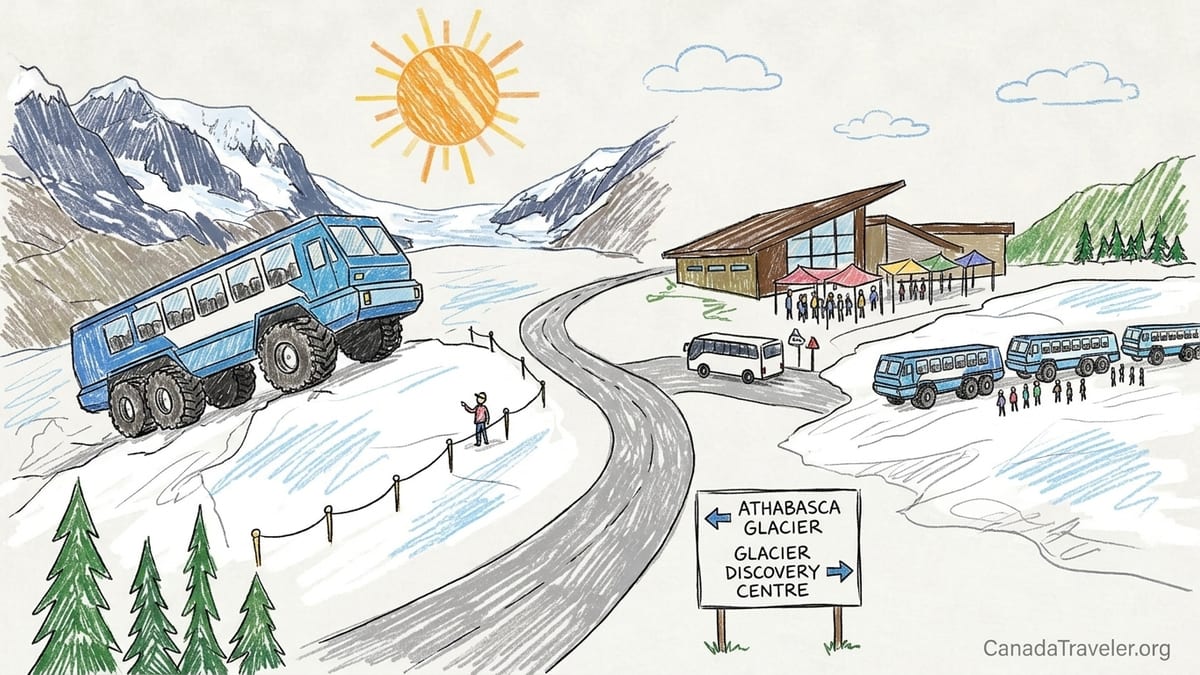
Arrival at the Glacier Discovery Centre: Expectations vs Reality
The Icefields Parkway drive itself feels priceless. North of Lake Louise the mountains close in, glaciers hang off the ridges and pullouts give you constant excuses to stop. By the time you crest the hill and see the white bulk of the Columbia Icefield and the tongue of Athabasca Glacier sliding toward the valley floor, you already feel like you are inside an oversized alpine amphitheatre. The Columbia Icefield Glacier Discovery Centre sits directly opposite, a modern building on the east side of Highway 93 where Pursuit runs its ticketing, check in and boarding for both the Ice Explorer tours and the Columbia Icefield Skywalk.
Inside, the mood is part visitor centre, part cruise terminal. Large digital boards cycle through departure times, lineups snake across the lobby and staff herd passengers into color coded queues. In 2026, Pursuit’s own rates and third party resellers show the combined “Columbia Icefield Adventure + Skywalk” product commonly priced in the C$120 to C$130 range per adult in high season, with child tickets discounted but still substantial. That means a couple is committing roughly C$240 plus tax and a family of four can easily cross C$450 before they have even bought a coffee at the cafe upstairs.
My time on site tracked closely with what regional guides describe as the norm. The official experience is usually billed as about 2.5 to 3 hours door to door, including the glacier segment and the Skywalk. In practice, between arriving early as instructed, queuing to check in, waiting to board the first motorcoach and building in buffer time in case of weather delays, the block you need to reserve out of your day can swell past four hours. That is a major slice of time on what for many people is a single day devoted to the Icefields Parkway.
Even before stepping onto a vehicle, I started to question the tradeoff. I was looking across the road at Athabasca Glacier and the free Toe of the Glacier trailhead parking area, already busy with independent visitors who were simply walking toward the ice at their own pace. They were getting dramatic views and a sense of the glacier’s scale without standing in a single ticket line. I, on the other hand, was watching the clock until my boarding group number was finally called.
Three Different Experiences, Often Confused
Part of the confusion, and one reason many travelers feel misled, is that people casually talk about “doing the Columbia Icefield” as if it is one thing. In reality there are three very different experiences in this small stretch of valley, and they overlap much less than the marketing suggests. The first is simply viewing Athabasca Glacier from public areas along the parkway and walking the short trail to the Toe of the Glacier viewpoint. The second is the paid Ice Explorer ride onto a designated, groomed section of the glacier, where you can step out and stand on the ice inside a controlled area. The third is the Columbia Icefield Skywalk, the glass-floored platform that hangs about 280 metres above the Sunwapta Valley.
It is crucial to be explicit here. The Skywalk is not on the glacier. It does not overlook Athabasca Glacier directly, and a Skywalk-only ticket does not include any opportunity to walk on glacier ice. The structure is built along a cliff edge several kilometres south of the glacier, facing a different valley. Pursuit and regional tourism boards are clear about this if you read the fine print, which describes the Skywalk as a cliff-edge walkway and glass floor observation platform about 280 metres, or 918 feet, over the Sunwapta Valley. Yet in day-to-day conversation, I consistently meet visitors who assume the glass floor will be over the glacier itself and only realize the difference when they are already strapped into a bus seat.
The Ice Explorer, by contrast, is the glacier experience proper. From the Discovery Centre you first board a standard motorcoach that shuttles you across the highway and up to a staging point. There you transfer to a massive low geared Ice Explorer vehicle which crawls down a steep gravel ramp and out onto a cordoned off portion of Athabasca Glacier. Within that footprint you are allowed to walk on the ice for a limited time, surrounded by other groups doing exactly the same thing. Without the context of the free public viewpoints, it can feel like the only way to access the glacier, which is exactly how the product is pitched. Once you realize how much is available from the roadside and short hiking trails, the calculus shifts.
My own disappointment grew out of that disconnect between what is bundled together under one big name and what each part actually delivers on the ground. The raw landscape is astounding almost everywhere you look. The paid components need to add a significant layer of insight, unique access or emotional impact to justify their price. Too often they did not.
Time on Buses vs Time on Ice
Looking back at my day, what surprised me most was not the cost but the ratio of transit time to actual glacier time. By the time my assigned departure rolled around I had been at the Discovery Centre for just under an hour, much of it spent standing in line or browsing the gift shop because there is little else to do inside. Boarding the first bus felt like progress, but that was just the beginning of the choreography.
From the Discovery Centre to the Ice Explorer staging area took about 15 minutes on a conventional coach. There was a short wait while a previous group cleared, followed by a safety briefing and boarding of the Ice Explorer itself. These multi wheel vehicles are engineering curiosities, purpose built to operate on the ice and capable of handling extremely steep grades. They are also slow. The crawl down the access ramp and out onto the glacier surface took roughly another 15 minutes. By the time the driver parked in the designated zone and opened the doors, forty to fifty minutes had already elapsed since we left the main building, all of it spent inside one bus or another.
Once on the ice, our group was given about 20 to 25 minutes of free time. That window felt shorter in practice. People spilled out, jostled for the flattest ice patches and selfie angles, and lined up to fill water bottles in a channel of meltwater that staff had shovelled open. It was undeniably novel to feel crampon like traction underfoot and hear the crackle of ice instead of gravel, but the crowd density and roped boundaries made it hard to feel any sense of wilderness or remoteness. You are always aware that you are standing inside a human made enclosure while other buses maneuver in and out.
After the ice time ended we re boarded, crept back up the access ramp and changed vehicles again at the staging point. Another conventional bus shuttled us down past the Discovery Centre and along the parkway to the Skywalk turnoff, a ride of roughly ten minutes. At the Skywalk, guests typically have around 45 minutes on the walkway and interpretive exhibits before catching yet another shuttle back to the Discovery Centre. End to end, a nominal three hour adventure yielded perhaps half an hour actually on the glacier and maybe forty minutes on the glass walkway. Everything else was logistics.
Scale of the Ice Explorers vs the Promise of Wilderness
The promotional photos lean hard into the contrast between the small human visitor and the vast frozen landscape. They show tiny figures standing in a white expanse under towering peaks, or a lone Ice Explorer dwarfed by the icefield. The reality, at least on my departure, felt closer to an industrial site tour. Multiple Ice Explorers were spaced out in a loose grid on the glacier surface, each holding several dozen passengers. The machines themselves are enormous, weighing many tonnes and riding on tires taller than most people. Climbing their metal steps feels more like boarding heavy equipment than joining an alpine expedition.
I found that scale jarring compared with my expectation of a wilderness encounter. On other glaciers in the Rockies where motorized access is not allowed, such as on guided hikes that approach via moraine trails, there is a sense that you are entering a fragile environment one careful step at a time. At Athabasca Glacier the approach by Ice Explorer normalizes the idea that it is acceptable to drive heavy vehicles repeatedly across the ice surface as long as they stay within a defined zone. From a visitor experience perspective that may feel efficient, but it strips away much of the subtlety and quiet that I associate with high mountains.
The environmental questions are even harder to ignore once you have seen the setup firsthand. Park signage and official climate interpretations stress that Athabasca Glacier has been retreating for more than a century and that its rate of retreat has increased since the late twentieth century. Researchers mapping the glacier’s mass and flow have documented thinning ice, changing velocities and a steady pull back from the valley floor, trends that mirror the broader global pattern of glacier loss in a warming climate. When those same visitors are then invited to board large, fuel hungry vehicles to trundle across the remaining ice, the tension is obvious.
To be clear, I do not pretend to know the exact carbon footprint of the Ice Explorer fleet or its relative impact compared with the tens of thousands of private cars that arrive via the parkway each season. I also recognize that a tightly controlled motorized zone may concentrate impacts in a smaller area than free roaming visitors would create. But standing beside a line of idling engines on a shrinking glacier and listening to polite, scripted commentary about climate change felt unavoidably contradictory. For a product charging around C$125 per adult in 2026, I wanted a more thoughtful integration of environmental reality into the design of the experience, not just words layered on top.
The Columbia Icefield Skywalk: 280 Metres of Height, Limited Emotional Punch
The Skywalk segment begins prosaically. From the Discovery Centre or the glacier staging area you ride a standard highway coach south for several kilometres to a parking area carved into the cliff side above the Sunwapta River. There is no public parking here, so every visitor is funnelled through the same shuttle system. From the drop off point you follow a one way, gently sloping interpretive path that hugs the cliff before reaching the main attraction: a curved, glass floored walkway that cantilevers out over the valley.
The numbers sound impressive. Pursuit, Parks Canada and engineering case studies all note that the glass platform projects about 35 metres out from the cliff and hangs approximately 280 metres, or 918 feet, above the valley floor. On paper that vertical drop rivals many city skyscraper viewpoints. In person, the effect depends heavily on weather, crowding and your own appetite for heights. On my visit, a mix of cloud and flat midday light muted the depth perception. The valley was undeniably far below, with the Sunwapta River braided in pale threads and waterfalls tumbling off the opposite wall, but the glass did not produce the visceral lurch I had expected.
Part of that is simply how our eyes work at altitude. Surrounded by giant peaks, a 280 metre void feels proportionally less extreme than the same drop would in an urban setting where you have more familiar scale references. Part of it is the social atmosphere. The platform is relatively narrow and on busy departures quickly fills with people taking photos, edging along the railings and lying down mid span for forced perspective shots. You are rarely alone with your own reaction. After an initial circuit and a few glances straight down through the clear panels, I found the novelty wearing thin. The interpretive signs along the walkway, which explain glacial geology, wildlife and engineering, were thoughtful, but they are not unique to this location in the sense that similar information is available in visitor centres throughout the Rockies.
Crucially, the Skywalk does nothing to deepen your understanding of Athabasca Glacier itself. You can see distant ice and summits, but the primary viewpoint is the Sunwapta Valley, not the glacier you have just paid to stand on. Visitors who have bought Skywalk-only tickets, which regional listings put in the C$40 to C$50 range for adults in recent seasons, get no direct glacier access at all. Many only realize this distinction after purchasing, based on conversations I overheard in the shuttle queues. As a result, my lingering impression of the Skywalk was of a cleverly engineered but somewhat generic vertical thrill, not a must-do complement to the glacier segment.
Crowding, Weather and the Reality of a Timed Package
The Columbia Icefield is famous for unpredictable weather. Clear mornings can turn to rain or sleet in less than an hour, even in midsummer. When you book the Columbia Icefield Adventure, you are locking yourself into a fixed departure time that may or may not align with the best conditions of the day. On my trip, clouds thickened noticeably between check in and boarding, dulling the light on the glacier. Wind picked up on the ice, which made the short walking window less pleasant and sent many people back to the bus early to warm up.
Because the experience is choreographed as a series of buses with limited capacity, there is little flexibility once you are in the system. If low cloud hides the summits or rain spatters the glass floor, you still follow the same route at the same pace. Independent visitors at the Toe of the Glacier viewpoint, by contrast, can simply wait out a shower in their car or reschedule their short walk to a brighter patch in the day. They are not juggling shuttles and fixed time slots. On a bluebird day the package will obviously feel more magical, but paying over C$100 per person does nothing to increase your odds of those perfect conditions.
Crowding amplifies the weather frustrations. The Ice Explorers run at regular intervals throughout the operating season, which recent guides describe as stretching from early May to early or mid October, with peak volumes in July and August. On my departure every seat was filled, and the glacier surface itself looked more like a parking lot than a wild icefield. The Skywalk felt similar. At no point did I have the glass floor to myself. There was always someone’s boot, tripod or stroller edging into my frame. If your personal definition of value includes a degree of solitude or quiet awe, the current scale of operations cuts directly against it.
From a practical perspective, the crowding also chews up more of your day. Every queue, from washrooms at the Discovery Centre to boarding checks at the Skywalk, adds friction. By mid afternoon I found myself calculating the remaining drive time to Jasper and mentally subtracting from my margin for dinner, rather than soaking in the scenery. That creeping time pressure is the opposite of how I like to experience long mountain roads, where spontaneous stops and detours are half the joy.
Glacier Retreat, Climate Context and Motorized Tourism
Even if you strip away the operational annoyances, any honest assessment of the Columbia Icefield Adventure has to grapple with the long term fate of Athabasca Glacier and the optics of running heavy vehicles on its surface. Parks Canada information panels in the area underline that the glacier has been receding for more than 125 years and that its rate of retreat has accelerated in recent decades. Historical photographs and year marked posts along the public trail show where the ice once lay in the 1890s, the 1940s and the 1980s, now bare rock and rubble. Academic studies of Athabasca Glacier’s geometry and flow between the early 1960s and 2020 document persistent thinning and changes in how quickly the ice moves downslope, signals consistent with sustained negative mass balance.
These local changes are part of a much larger story. Syntheses of glacier monitoring data from around the world find that the majority of glaciers have been losing mass since the mid twentieth century and that the rate of ice loss has generally increased since about 1980. News reporting on recent glacier collapses and disasters in other mountain ranges reinforces that retreating ice can destabilize surrounding slopes and reshape entire valleys. In that context, the Athabasca Glacier is both a spectacular attraction and a visible indicator of human driven climate change. Visitors are literally watching frozen water stored over centuries melt away in front of them.
Does riding a diesel powered Ice Explorer for a handful of minutes meaningfully change the trajectory of the glacier’s future compared with global emissions from cities, industry and transportation? Probably not, at least not in isolation. But tourism is also a storytelling industry. When the signature glacier product in one of Canada’s flagship national parks centers on a fleet of heavy vehicles and sees hundreds of thousands of riders each season, it sends a particular message about what kind of experiences we consider acceptable on a vanishing landscape. For the price being charged in 2026, I had hoped for a model that foregrounded low impact access and deep interpretation, perhaps through small group guided walks from the ice margin using minimal equipment and no engines, something that already exists in limited form with independent guiding companies.
Instead, the Columbia Icefield Adventure felt like a volume driven, spectacle oriented product bolted onto a sobering piece of climate evidence. That dissonance was a major part of why I left questioning whether my money had supported the kind of relationship with the icefield that I actually believe in. Travelers who care about their footprint will want to think carefully about that before swiping their card.
Counting the Cost: Package vs Free Alternatives
On paper it is easy to see why so many visitors default to the Columbia Icefield Adventure package. It is visible, heavily advertised and simple. You pay once, follow a clearly scripted route and emerge hours later with a handful of photos that certainly look impressive on a screen. But the value equation tilts quickly once you start tallying what else you could do with the same budget on the Icefields Parkway.
In 2026, commonly advertised combo prices around C$125 per adult put a two person bill close to C$250. A family with two school age children may pay between C$350 and C$450 depending on dates and dynamic pricing. Add fuel, snacks and perhaps a small souvenir and the total expenditure for a single half day can rival several nights of campground fees or a significant contribution toward a wildlife tour or guided hike elsewhere in the Rockies. By contrast, the Toe of the Glacier viewpoint across the highway is free aside from the national park pass, which you already need to drive the parkway at all.
The free side of the road offers more than a single overlook. A signed trail leads from the main parking area toward the glacier’s current terminus, passing markers that show where the ice front lay in different historical years. Interpreted panels explain basic glaciology and climate change trends. Even on a quick 30 to 45 minute stroll, you get a clear sense of the glacier’s retreat, the texture of its moraines and the powerful meltwater stream that drains its front. Combine that with multiple other free pullouts along the parkway, from Peyto Lake’s high viewpoint to the sweeping curves of the Saskatchewan River Crossing, and you can assemble a full day of world class scenery with only your picnic lunch to buy.
For travelers who still want to step onto the ice but prefer a less mechanized approach, independent companies operate small group guided glacier walks accessed from the margin rather than by vehicle. These products have their own costs and constraints and are not necessarily cheaper than the Ice Explorer, but they usually involve more time on the ice and a stronger educational component. In my value calculation, if I were going to pay a triple digit ticket again, I would be more inclined to choose one of those alternatives than repeat the Columbia Icefield Adventure as currently structured.
Who Will Find It Poor Value, Who Might Still Appreciate It
After a full day between the Discovery Centre, the glacier and the Skywalk, my conclusion was blunt. For my travel style, the Columbia Icefield Adventure as a paid package was not worth the money. The amount of time spent in queues and on buses, the crowded feel on the ice, the relatively modest emotional punch of the Skywalk and the tension between climate messaging and motorized access all combined to dilute the experience. I left with as many photos from the free roadside pullouts as from the ticketed segments, and the most powerful moment for me personally came while standing quietly at the Toe of the Glacier, looking upslope at how far the ice has already retreated.
There are, however, visitors for whom the package may still make sense. Travelers with limited mobility who cannot confidently walk the rougher sections of the public trail may appreciate the ability to step directly onto a groomed ice surface from a vehicle, with railings and relatively flat footing. Families with children who thrill at large machines and glass floors may find the spectacle alone worth the cost, especially if they bundle it with other Pursuit attractions through a discount pass. First time international visitors with only a day in the Rockies and no appetite for detailed trip planning may also welcome the plug and play simplicity.
Even for those groups, I think it is important to go in with clear eyes. Understand that your actual time on the glacier will likely be under half an hour, that the Skywalk is several kilometres away and not on the ice, and that you will share both experiences with many other people. Recognize that you are buying a highly managed, mass market product, not a quiet backcountry encounter. If you accept those parameters and still feel the package fits your needs, you will be less likely to leave disappointed.
If, on the other hand, you value flexibility, dislike crowds, care deeply about minimizing your environmental footprint or are traveling on a tighter budget, the free and lower impact options around the Columbia Icefield are strong enough that skipping the premium package is an entirely reasonable choice. You will not be missing “the only way” to see the glacier. You will simply be choosing a different relationship with it.
Enjoying the Columbia Icefield Without Automatically Buying the Package
On my drive back down the Icefields Parkway that evening, the part of the day I kept returning to was not the moment I stepped off the Ice Explorer, nor my careful walk onto the glass of the Skywalk. It was the slow approach on foot from the public parking lot to the Toe of the Glacier viewpoint, feeling the wind coming off the ice and hearing the low roar of meltwater under grey clouds. There was no soundtrack, no timetable and no commentary except the snippets of conversation between other visitors who were also trying to reconcile the beauty of the scene with its fragility.
If I were planning the day again, I would devote the bulk of my time to that side of the road and to the many other free stops along the highway. I would start early to catch softer light, park at several of the roadside viewpoints that look directly toward the icefield and take a slow, unhurried walk toward the glacier front. I would read every interpretive panel that Parks Canada has installed, which do an admirable job of grounding the spectacle in science. If I still wanted a higher vantage point in the afternoon, I might consider the Skywalk as a stand alone if it were available at a substantial discount and if the weather promised excellent visibility, but I would no longer view it as a must do component.
The key is to remember that the Icefields Parkway itself is the destination, not just a transit corridor to the paid attraction. Lakes, waterfalls, side valleys and short trails crowd its length. A picnic beside the milky North Saskatchewan River can be as memorable as any engineered platform if you give it time. For many travelers, especially repeat visitors or those comfortable driving mountain roads, curating their own string of short walks and viewpoints will deliver richer value than a few tightly scheduled hours inside a commercial product.
For me, the exercise of critically examining the Columbia Icefield Adventure sharpened my sense of what I actually want from glacier tourism. I want experiences that slow me down, that emphasize the fleeting nature of ice in a warming world and that minimize additional stress on fragile environments. On those measures, the 2026 incarnation of the Ice Explorer and Skywalk combo fell short.
The Takeaway
So, is the Columbia Icefield Adventure worth the money in 2026? My own answer, after paying full price and committing most of a day to the experience, is no. Not when equally powerful, often more contemplative encounters with Athabasca Glacier and the surrounding mountains are available for free across the highway. The paid package wraps that landscape in layers of logistics, crowding and spectacle that, for me, stripped away more than they added.
If you are the kind of traveler who thrives on independent exploration, who prefers trail dust to ticket stubs and who reads the climate change panels with a knot in your stomach, you may walk out of the Glacier Discovery Centre feeling that your money could have been better spent elsewhere. If, however, you want a short, neatly packaged taste of glacier ice and a quick jolt of height over a valley, and you are comfortable with both the cost and the environmental optics, the Columbia Icefield Adventure can still deliver those specific thrills.
Either way, do not confuse marketing shorthand with geography. Viewing Athabasca Glacier from public areas, riding an Ice Explorer onto a cordoned section of the ice and visiting the Columbia Icefield Skywalk are three different products with three different characters. Knowing that before you book will help you make an informed choice that matches your values, your budget and your expectations. For my part, next time I drive the Icefields Parkway I will leave the giant buses to others and spend my time with the glacier on its own quieter terms.
FAQ
Q1. Is the Columbia Icefield Skywalk on Athabasca Glacier?
The Skywalk is not on the glacier. It is a glass floored platform built along a cliff several kilometres south of Athabasca Glacier, overlooking the Sunwapta Valley rather than the ice itself.
Q2. Does a Skywalk ticket include walking on the glacier?
No. A Skywalk only ticket covers shuttle transport from the Glacier Discovery Centre, access to the cliff edge walkway and the glass platform, plus interpretive material. It does not include any access to glacier ice.
Q3. How much time do you actually spend on Athabasca Glacier during the Columbia Icefield Adventure?
On a typical combined tour of about 2.5 to 3 hours, most visitors spend roughly 20 to 25 minutes outside on the glacier itself. The rest of the time is taken up by check in, bus transfers, briefings and travel to and from the Skywalk.
Q4. How high is the Columbia Icefield Skywalk above the valley floor?
Official descriptions place the Skywalk’s glass platform around 280 metres, or 918 feet, above the floor of the Sunwapta Valley, with the structure projecting roughly 35 metres out from the cliff.
Q5. How much does the Columbia Icefield Adventure cost in 2026?
In 2026, widely advertised prices for the combined Ice Explorer plus Skywalk package often fall around C$125 to C$130 per adult in peak summer, with child discounts and dynamic pricing by date and seller.
Q6. Are there free ways to see Athabasca Glacier without buying a ticket?
Yes. The Toe of the Glacier viewpoint and its access trail across the highway from the Glacier Discovery Centre are free aside from the national park pass, and several roadside pullouts offer excellent glacier and icefield views.
Q7. Is the Columbia Icefield Adventure suitable for people who dislike crowds?
The experience involves multiple large buses, set departure times and busy platforms on both the glacier and the Skywalk, especially in July and August. Travelers seeking solitude may find it uncomfortably crowded.
Q8. How does weather affect the value of the tour?
Cloud, rain or high winds can significantly reduce views and comfort on both the glacier and the Skywalk, but tickets are tied to fixed times. Independent visitors at public viewpoints have more flexibility to work around conditions.
Q9. Are there lower impact alternatives to the Ice Explorer for accessing glaciers?
Some independent guiding companies offer small group glacier walks accessed on foot from the ice margin, emphasizing education and minimal equipment instead of heavy vehicles. These can provide longer, more in depth time on the ice.
Q10. Who is most likely to find the Columbia Icefield Adventure worth the money?
Travelers with limited mobility, families whose children are excited by big machines and glass floors, and visitors short on planning time but eager for a simple, all in one glacier sampler may feel the package still delivers acceptable value despite its cost.