


I thought I had done everything right. I booked BC Ferries months ahead, locked in what looked like a bargain Saver fare for my car, and built a meticulous Vancouver Island road trip around a mid‑June 2026 sailing from Vancouver to Nanaimo. Yet a single ferry-planning mistake choosing the wrong Metro Vancouver terminal for the route we actually needed almost unraveled a week of carefully coordinated hotel check-ins, dinner reservations, and prepaid activities from Victoria to Tofino.
The Real Itinerary That Went Sideways
My plan was straightforward on paper. On Friday 19 June 2026, I was driving a standard under‑height rental SUV, well under 20 feet long, from downtown Vancouver to Vancouver Island. Night one was a non-refundable boutique hotel in downtown Victoria. Night two and three were already paid for in Tofino. I booked a vehicle-and-driver Saver fare on what I thought was the logical sailing: Tsawwassen to Duke Point, one of the two Nanaimo routes.
On BC Ferries’ own sailing specials and fare examples in 2026, under‑height vehicle-and-driver Saver fares on major Vancouver to Vancouver Island routes were advertised “from $49” on select sailings, with adult passengers at $15 instead of the regular $21. That matched what I saw for an off‑peak mid‑day sailing. My vehicle base Saver fare was just under fifty dollars and the driver portion was rolled in. It felt like I had beaten the system and freed up money for better meals in Tofino.
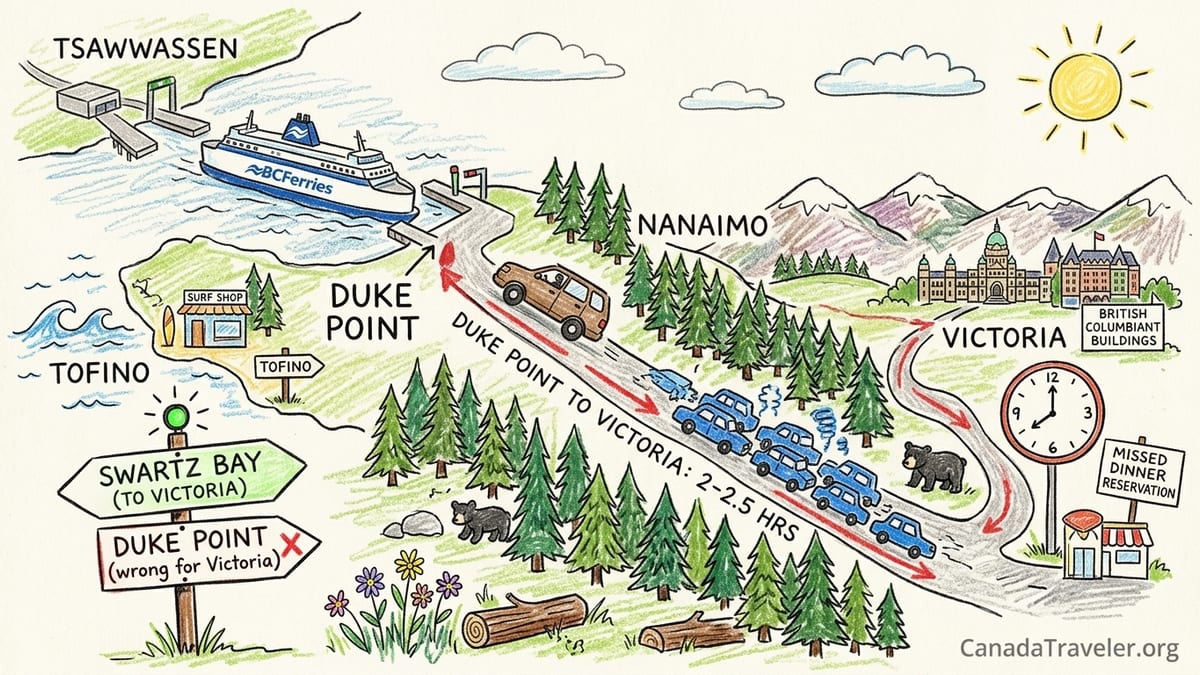
The problem was that my first destination was Victoria, not Nanaimo. By booking Tsawwassen–Duke Point instead of Tsawwassen–Swartz Bay, I set myself up for an extra 90 minutes to 2 hours of driving at the wrong end of the Strait of Georgia, cutting straight through a Friday afternoon Vancouver Island traffic pattern I had not allowed for. I had optimized for price, not geography, and the knock-on effects were brutal.
BC Ferries’ own fare guide effective 16 June 2026 shows how tempting that Saver tier can look when you compare it to at-terminal prices. In the same tables, published examples for at-terminal standard vehicle-and-driver fares on these major routes can come out around 110 Canadian dollars or more on peak sailings once you combine the vehicle charge with the regular adult driver fare, especially after 2026 increases that pushed passenger fares to about 21 dollars for adults and raised standard vehicle charges. The catch is that Saver is an availability-dependent fare category, not a guaranteed price. In my case, I chose the wrong “bargain” and paid for it in other ways.
Tsawwassen, Horseshoe Bay, Swartz Bay, Duke Point and Departure Bay Explained
To understand how I went wrong, you need to understand the three big Metro Vancouver to Vancouver Island corridors and what they connect to. Tsawwassen–Swartz Bay is the main Vancouver to Victoria route, linking a terminal south of Vancouver with a terminal north of Victoria on the Saanich Peninsula. From Swartz Bay it is about a 30 to 40 minute drive along Highway 17 to downtown Victoria. This is the crossing most visitors should book when their first stop is the provincial capital, Sidney, Saanich, or points down the Sooke Road.
Tsawwassen–Duke Point is a separate route aimed at drivers whose target is Nanaimo’s south side, mid‑Island destinations like Parksville and Qualicum Beach, or who are heading across the island on Highway 4 to Tofino and Ucluelet. Duke Point sits southeast of Nanaimo, connected to Highway 19. It is convenient for drivers going north or west once they reach the Island, but it is a long way from Victoria. From Duke Point to downtown Victoria you face a two to two-and-a-half hour drive, depending on traffic, instead of the much shorter run from Swartz Bay.
The third leg in this triangle is Horseshoe Bay–Departure Bay. Horseshoe Bay is in West Vancouver, north of downtown, and Departure Bay is on the north side of Nanaimo. This route is ideal for North Shore departures and for passengers connecting to the Nanaimo side of Vancouver Island, especially those continuing toward Campbell River or mid‑Island communities. For a Victoria-first itinerary like mine, though, either Nanaimo route bakes in significant backtracking.
By choosing Tsawwassen–Duke Point, I effectively landed almost three hours of extra Island driving into an already packed day: a 45‑minute drive from downtown Vancouver to Tsawwassen, a roughly 2‑hour Island highway run down to Victoria from Duke Point, and then later, a long push from Victoria back through Nanaimo for Tofino. If I had booked Tsawwassen–Swartz Bay, I would have been in Victoria under 3 hours after leaving downtown Vancouver, including the 95‑minute ferry crossing. Instead, I had accidentally created a loop that treated Victoria as a side trip rather than my primary destination.
Saver, Prepaid, Flexible and At-Terminal: What the Prices Really Mean
BC Ferries now markets a tiered structure on its major Metro Vancouver to Vancouver Island routes. Saver fares are the headline-grabbing numbers: as of mid‑2026, the company’s own sailing specials promote under‑height vehicle-and-driver Saver fares on select sailings from about 49 dollars each way between Metro Vancouver and Vancouver Island, and walk-on saver fares at roughly 15 dollars per adult. These are capacity-limited and tied to specific lower-demand sailings and time slots, often early morning or late evening, and to less popular departure days.
Above Saver sits the standard prepaid fare. This is essentially the regular tariff for a vehicle plus driver when booked and paid for in advance. After spring 2026 fare increases, media reports and fare tables indicated that a standard vehicle and driver on a major route would often cost close to or just under 90 dollars on many sailings when booked, combining a standard vehicle charge with the adult driver fare. Prepaid gives you a reserved space within the booked category and a clear change and cancellation policy, but without the sharp discounts that Saver can offer.
Flexible, where offered, layers on the ability to change sailings without the same penalties or restrictions, which can matter on unpredictable road trips or when you are not entirely sure which sailing you will make. The most expensive option is effectively paying at the terminal without a booking. BC Ferries’ fare guide for June 2026 shows at-terminal vehicle fares that, when combined with passenger charges, can land a standard car and driver in the neighbourhood of 100 to 110 dollars or more on the primary Vancouver to Victoria and Vancouver to Nanaimo routes, especially on peak days. Those examples illustrate the potential cost spread between a well-timed Saver and an unreserved drive‑up, without guaranteeing that you will always see those exact numbers on every date or sailing.
The critical point is that Saver, prepaid and flexible are not fixed seasonal prices. They are fare categories with availability that changes by sailing, day, and route. My Duke Point Saver booking was cheap because it was a less popular mid‑day shoulder season sailing. Had I looked carefully at Tsawwassen–Swartz Bay for the same day, Saver slots for my preferred departure were already sold out, and prepaid or flexible would have cost more. Chasing the cheapest visible number, I ignored where the ferry was actually taking me.
Passenger Charges, Vehicle Size and Campervan Surprises
BC Ferries fare tables slice your bill into two major components. First are passenger fares. In 2026, regular adult fares on the main Vancouver–Vancouver Island routes sit at about 21 dollars when paid at the terminal, with youths aged 5 to 11 at roughly half that and children under 5 free. Saver promotions advertise adults at around 15 dollars when booked on qualifying sailings. Seniors with valid identification receive substantial discounts on many midweek sailings. Those passenger charges apply whether you walk on or ride in a vehicle.
The second component is the vehicle charge itself. On the major routes, a “standard” vehicle is any passenger car or SUV under about 7 feet high and under 20 feet long. BC Ferries’ published fare calculators confirm that once you exceed 20 feet in length often with campervans, trailers or large motorhomes you start paying by the additional foot. That is where many road-trippers on Vancouver Island itineraries get a shock. A compact rental SUV fits under the basic standard vehicle category. A campervan or pickup-truck-and-camper combination can quickly incur surcharges that add tens of dollars to each sailing.
In my case the rental SUV kept me in the standard category, but I watched several travelers in the Tsawwassen staging lanes be measured and reclassified as over-length, pushing their total bill substantially higher than the base online quote they had assumed would apply. One family towing a small travel trailer learned at the booth that the trailer length, not the tow vehicle, governed their charge. On a return trip with multiple Island segments, those extra per-foot surcharges can rival an entire hotel night, particularly on the longer runs.
This matters for budgeting a full road trip loop through Victoria, Nanaimo and Tofino. A party of two adults and two children in a standard car paying at the terminal on a busy 2026 weekend might see roughly 21 dollars each for three chargeable passengers plus the vehicle charge, landing their one-way cost on a major route close to or over the low hundreds. With a savvy Saver booking that same group might cut the vehicle component by dozens of dollars, but only if they accept off‑peak times or less popular routes. Larger campervans and RVs simply start from a higher baseline.
Why the Check-In Window Can Make or Break Your Sailing
BC Ferries is unusually specific about its check-in rules for booked vehicles on major routes. On the Tsawwassen–Swartz Bay, Tsawwassen–Duke Point and Horseshoe Bay–Departure Bay sailings, booking check-in at the terminals typically opens 60 minutes before the scheduled departure and closes 30 minutes before. The company states bluntly that if you arrive before check-in opens or after it closes, your booking will not be honoured and you will travel based on your order of arrival as if you had no reservation at all.
In practice that window is unforgiving. On my June sailing, I hit an accident on Highway 99 southbound that turned a 45‑minute drive into more than an hour. I reached the Tsawwassen causeway about 29 minutes before departure, and although my reservation was in the system, I was waved into the unreserved lane and told I would be loaded “as space allowed” behind the other standby vehicles. Any priority I thought I had paid for evaporated with a single missed minute of the window.
Internal BC Ferries documents and reservation policy PDFs explain why that 30-minute cut off exists. Terminal staff need time to calculate remaining deck space, balance reserved and drive‑up traffic, and stage the right mix of vehicles. There are occasional flexible extensions when a vessel is already running late, but as a customer you cannot count on exceptions. Staff interviews and traveler accounts from 2025 and 2026 are filled with stories of vehicles that reached the booth 25 minutes before sailing and lost their booking status entirely.
The reverse is also risky. If you arrive more than 60 minutes before departure, especially at peak times when previous sailings are still loading, you may be directed into a general holding area or even a separate standby lane until the reservation window formally opens. Several regular commuters report being asked to circle out of the terminal area when they showed up 75 or 90 minutes early. On busy summer days, getting that timing wrong can move you behind hundreds of other vehicles and erase the whole point of booking.
Unreserved in 2026: One to Three Sailing Waits and Real-World Delays
The other half of my mistake was assuming that, in a worst case, driving up unreserved would only mean missing a single ferry. That assumption has not aged well in the 2026 climate of reduced capacity, vessel maintenance backlogs, and surging demand. Local news coverage and traveler reports across the 2026 summer season recorded routine one-to-three-sailing waits on major routes like Tsawwassen–Swartz Bay and Tsawwassen–Duke Point for vehicles without bookings, even outside long weekends.
In August 2026, for example, a widely shared account from Tsawwassen described an eight-sailing posted wait at one point in the day, with terminal staff telling drivers to expect at least two or three missed sailings if they did not already hold a reservation. Other drivers recount arriving at mid‑day on a Saturday and not boarding until early evening, despite being in line for hours. These waits were amplified on days when a ship was pulled from service for repairs or when heavy commercial and oversized traffic soaked up available deck space.
On my June trip, once my reservation priority was lost, I was effectively downgraded to unreserved status on a sailing that was already near capacity. I made the ferry, but a line of vehicles behind me was left in the lot for the next run. Had I missed that one, the 95‑minute crossing time plus at least a two-hour wait for the next sailing would have destroyed my Victoria evening entirely.
The real consequence of a one or two sailing wait is not just lost hours at the terminal. It is everything you planned on the other side. A two-sailing delay on Tsawwassen–Swartz Bay in the afternoon can mean rolling into Victoria after 9 or 10 p.m., long after many restaurant kitchens close and well past standard hotel front-desk hours. For Tofino and Ucluelet, which are a further 3 to 3.5 hour drive beyond Nanaimo on a winding two-lane road, missing a mid‑day Nanaimo sailing can push your arrival past midnight or even into the following day if fatigue or wildlife on the road forces you to stop.
How Ferry Delays Ripple Through Hotels, Meals and Activities
Once I realized the timing implications of my terminal mistake, I started recalculating everything. My original plan had us leaving downtown Vancouver at 9:00 a.m. for an 11:00 a.m. sailing, landing around 12:35 p.m., and rolling into Victoria about 2:00 p.m. with time for a relaxed check-in and a 7:00 p.m. dinner reservation at a harbourfront restaurant. By landing in Duke Point instead and flirting with the loss of my reservation window, the math looked very different.
If traffic or a sailing wait had pushed me onto a later ferry, say the 1:00 p.m. sailing from Tsawwassen, I would not have reached Duke Point until after 2:30 p.m. Add a realistic 2 to 2.5 hours of driving to Victoria and a 30‑minute buffer for gas or a quick break, and my arrival could easily slide to 5:15 or 6:00 p.m. In heavy Friday traffic, that window can stretch further. Any two-sailing wait would push check‑in close to or after 8:00 p.m. If the hotel had a strict cut-off or limited reception hours, I would have been on the phone from the ferry deck begging them to hold my room.
The same calculus applies to prepaid activities. Many whale‑watching operators out of Victoria, Tofino and Ucluelet schedule afternoon departures around 1:00 to 3:00 p.m., with strict cut‑off times 30 to 45 minutes beforehand for fittings and safety briefings. Suppose you book a 3:00 p.m. Victoria whale‑watching trip on the day you arrive. Miss your targeted Tsawwassen–Swartz Bay sailing and you can easily arrive at the waterfront after the boat has left. Most operators will not refund within 24 hours of departure. Suddenly the 40 or 50 dollars you saved on a ferry fare looks tiny next to a forfeited tour costing several hundred dollars for a family.
Once you are aiming for Tofino, the margins shrink further. The Pacific Rim Highway has little room for error when it comes to night driving. Road closures for construction, storm debris, or accidents have all occurred in recent seasons. A naive assumption that “we can always just drive late” ignores the reality of fatigue, wildlife on the road, and the limited late‑night services in small Island communities. A misbooked Vancouver ferry can cascade into unsafe decisions hours later.
Car versus Walk-On: Do You Really Need the Vehicle?
In the middle of my ferry fiasco I had a passing thought: what if I had simply walked on and rented a car on the Island instead of hauling a vehicle across the Strait? BC Ferries introduced foot passenger bookings on its busiest South Coast routes, including Tsawwassen–Swartz Bay, Tsawwassen–Duke Point and Horseshoe Bay–Departure Bay, and these can offer some insulation from vehicle deck capacity limits. Passenger spaces are rarely capped in the same way vehicles are, and saver fares for foot passengers in 2026 were running around 15 dollars per adult on some sailings.
Walking on to Swartz Bay, for instance, opens up a network of buses and shuttle services: regional buses connecting to downtown Victoria, private coaches like the connector services between terminals and city centres, and car rentals either in Victoria or at Nanaimo airports and downtown locations. For a Victoria‑only trip or for travelers comfortable exploring by bus and tour operator, skipping the car on the ferry can eliminate worries about over-length surcharges, reservation windows, and sailing waits for vehicles.
For a road trip that runs from Victoria to Nanaimo to Tofino and back, though, walking on presents different constraints. While buses do connect Nanaimo and Tofino, the schedules are not designed for highly flexible, spontaneous side trips, and rental availability on the west coast has been tight and often expensive in recent summers. Some smaller rental outlets in Nanaimo and on the west coast sell out peak summer inventory months ahead. If you intend to hike, surf, or explore beaches with bulky gear, having your own vehicle from the mainland still makes sense.
The trade-off is control versus complexity. Bringing your own car gives you full flexibility on the Island, but it ties you to BC Ferries’ vehicle deck capacity and their strict reservation system. Walking on simplifies the ferry component and can reduce costs for short city stays, but it adds planning complexity around rentals and bus timetables. On my itinerary, with prepaid hotels dotting a loop that ran hundreds of kilometres, the vehicle was non-negotiable. That only magnified the cost of getting the ferry booking wrong.
Five Preventable BC Ferries Mistakes Road-Trippers Keep Making
After my own near‑miss, I started asking other travelers in ferry lineups and terminals about their biggest planning regrets. The patterns were almost painfully consistent. My misbooked terminal was only one of several avoidable errors that repeatedly turned smooth Vancouver Island itineraries into stress tests.
The first and most fundamental mistake is booking the wrong route for the first night’s destination. Travelers bound for Victoria accidentally book Tsawwassen–Duke Point or Horseshoe Bay–Departure Bay because those sailings are cheaper or at more convenient times, not realizing they are landing hours from their hotel. Similarly, some Tofino‑bound visitors book Tsawwassen–Swartz Bay, then discover that they must drive the length of the Saanich Peninsula, skirt Victoria traffic, and still face the long haul north and west to the Pacific Rim.
The second mistake is treating Saver fares as if they were the standard price. These discounted vehicle-and-driver fares from around 49 dollars on select sailings are powerful marketing tools, but they exist within narrow windows of availability and carry stricter change conditions. Travelers assume they will be able to move their sailing for a small fee, only to discover that switching out of a Saver booking means paying the difference to a much higher fare class plus change or cancellation fees when plans shift.
The third mistake is ignoring the check-in window until it is too late. People build their departure time around the scheduled sailing, not the 60-to-30-minute arrival requirement that protects their reservation. They treat the ferry like a train or a bus, aiming to show up 15 minutes before departure, then watch their booking downgrade to standby when they hit the booths a few minutes after the cut‑off. This is especially common on long weekends and school holidays, when highway congestion regularly chews away those last 15 minutes.
The fourth mistake involves underestimating the cost and risk of traveling unreserved on peak days. Drivers roll up on Friday afternoons, holiday Mondays or sunny summer Saturdays assuming they will catch “the next boat,” not realizing that in 2026 there were documented one, two and even three sailing waits on major routes during busy periods, especially when vessel maintenance or staffing issues reduced capacity. These waits can translate into four to eight hours of unexpected downtime and cascading missed check-ins and activities.
The fifth recurring mistake is failing to build ferry flexibility into daily plans. Road-trippers schedule non-refundable whale‑watching tours, spa appointments, and dinner reservations within an hour or two of their planned arrival, leaving no room for traffic jams, marginal waits, or weather delays. One couple I spoke to on board had lost both a Tofino surf lesson and a Victoria tasting menu because of compounded delays that started with a single missed check-in window at Horseshoe Bay.
The Takeaway
If there is a single lesson from my near‑ruined Vancouver Island road trip, it is that BC Ferries bookings are not a background detail to be sorted after you map the fun parts. On this coast, ferry planning is the skeleton your entire itinerary hangs from. A bargain Saver fare on the wrong route can cost you twice over in lost time and cancelled plans. A missed check-in by five minutes can erase your carefully reserved spot and push your arrival past midnight. A casual assumption that “we will just drive up” can strand you in a Tsawwassen asphalt sea for three sailings while your prepaid Tofino lodge wonders whether you are coming at all.
For anyone planning a 2026 or 2027 Vancouver Island road trip, treat BC Ferries as the first and most inflexible booking, not the last. Start by matching your terminal precisely to where you sleep that first night, then step backward: check-in window, highway travel time, and backups for delay. Decide consciously whether you value the lower cost of Saver or the flexibility of higher fare classes. If your budget and nerves can handle it, consider occasionally leaving the car behind and building a foot passenger plus rental strategy for city‑focused legs.
After this trip, I now block out the ferry first, then hotels, then activities. I allow at least a one-sailing buffer between a major crossing and any prepaid experience. I add a mental surcharge to every Saver fare: if it ties me to a time or route that could put my whole itinerary at risk, it is not cheap enough. That level of caution may feel excessive when you first start planning, but somewhere between Tsawwassen asphalt and Pacific Rim beaches, you will be very glad you built your road trip on something sturdier than wishful thinking.
FAQ
Q1. What is the safest BC Ferries route to book if my first night is in Victoria?
For a first night in Victoria, you should book Tsawwassen–Swartz Bay, then drive 30 to 40 minutes down Highway 17 into the city. Booking either Tsawwassen–Duke Point or Horseshoe Bay–Departure Bay will add roughly 2 hours of extra driving each way to reach Victoria.
Q2. How early do I need to arrive for a BC Ferries vehicle reservation?
On the main Metro Vancouver to Vancouver Island routes, you generally need to arrive at the terminal between 60 and 30 minutes before scheduled departure to keep your reservation priority. Arrive before the window opens or after it closes and you risk being treated as unreserved standby traffic.
Q3. Are Saver fares on BC Ferries always around 49 dollars for a car and driver?
No. The roughly 49 dollar figure is a starting “from” price for under‑height vehicle-and-driver Saver fares on select sailings in 2026, not a fixed rate. Saver availability and pricing vary by route, date, and departure time, and sell out on popular sailings.
Q4. How expensive is it to pay at the terminal without a booking?
Paying at the terminal at 2026 rates can push a standard vehicle and driver on major routes toward or above about 100 to 110 dollars once you combine the vehicle charge with the adult driver fare, especially on busier sailings. Exact totals depend on the route, date and any discounts or surcharges.
Q5. What happens if I miss the 30-minute check-in cut-off with a reservation?
If you arrive after the booking check-in closes, usually 30 minutes before departure, BC Ferries states that your reservation may not be honoured. You are likely to be sent to the unreserved lanes and loaded only if there is remaining deck space after reserved and earlier-arriving traffic.
Q6. How long can I expect to wait if I travel unreserved during busy periods?
In 2026 there were documented one-to-three-sailing waits for unreserved vehicles on popular routes during busy periods and on days with reduced capacity. That can translate into delays of three to six hours or more, depending on the schedule and any cancellations.
Q7. Do campervans and trailers pay more than standard cars?
Yes. BC Ferries treats vehicles over about 20 feet long or over standard height as over-length or over-height and charges extra, often by the foot. Campervans, motorhomes and vehicles towing trailers can pay substantially more per sailing than a standard under‑height passenger car.
Q8. Is it easier to walk on and rent a car on Vancouver Island instead?
For trips focused on Victoria or Nanaimo, walking on can be simpler and cheaper, with saver foot passenger fares and good bus and coach connections. For complex road trips to Tofino, Ucluelet or remote areas, bringing your own vehicle usually offers more flexibility, despite higher ferry costs.
Q9. How far apart should I schedule ferries and prepaid tours or dinner reservations?
It is prudent to allow at least one full sailing buffer between a major ferry crossing and any non‑refundable tour or important dinner reservation. On busy days, plan several hours of margin in case of highway delays, sailing waits or minor schedule disruptions.
Q10. What is the best way to avoid my BC Ferries booking ruining my road trip?
Match your route to your first-night destination, book key sailings well in advance, respect the 60-to-30-minute check-in window, avoid unreserved peak‑day travel, and build generous time buffers before any hotel check-ins, restaurant bookings or prepaid activities.