


By the time I dropped into Osoyoos, the landscape felt like a different country from the wet Pacific coast I had left that morning. The highway slipped between tawny hills, slopes stippled with sagebrush and punctuated by regimented lines of vines and peach trees. Instead of the dense fir and cedar of coastal British Columbia, the South Okanagan greeted me with big sky, dusty light and the shimmer of Osoyoos Lake. This was the beginning of a three-day road trip from Osoyoos to Naramata Bench, a journey that showed just how dramatically BC changes as you cross the mountains into this semi-arid interior valley.
Crossing Into the Semi-Arid South Okanagan
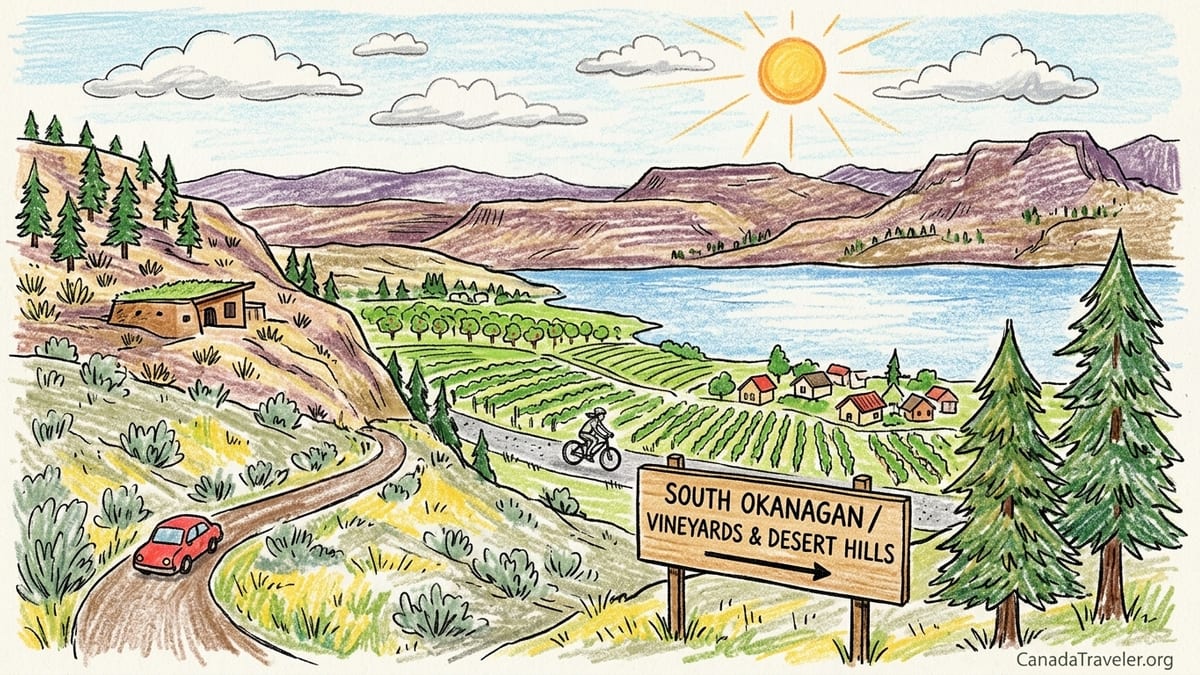
Leaving the Lower Mainland behind, I watched the forest thin out as I climbed over the Cascades and dropped toward the Okanagan. By the time I reached the outskirts of Osoyoos, the air felt hotter and drier, with the sweet, resinous smell of sage replacing the tang of sea salt and damp soil. Even in early summer, the roadside hillsides were already bleached blond, broken only by dark green clumps of antelope brush and scattered ponderosa pines. At the valley floor, orchards and vineyards thrived on irrigation drawn from Osoyoos Lake and the Okanagan River, a reminder that this lush agricultural landscape is layered over an ecology that, left to itself, is dominated by dry grassland and shrub-steppe.
Locals are quick to call this area a desert, and visually it fits many people’s idea of one. Yet ecologists tend to describe the South Okanagan and nearby Similkameen as a semi-arid grassland and shrub-steppe ecosystem rather than a true desert, because it receives more precipitation than classic deserts and supports a broader variety of vegetation. Much of that moisture arrives as winter snow in the surrounding mountains, slowly recharging streams and aquifers. Down in the valley, however, rainfall and humidity are low, summer highs often climb above 30 degrees Celsius, and evaporation is intense. That combination has created one of Canada’s hottest and driest climates, home to a concentration of rare plants, invertebrates, reptiles and birds that do not occur anywhere else in the country.
Driving along the north shore of Osoyoos Lake, I passed roadside fruit stands advertising cherries and apricots, and tidy vineyards sloping toward the water. The shoreline itself felt like a ribbon of green, lined with cottonwoods and willows in sharp contrast to the pale hills above. It is that tension between dry uplands and irrigated lowlands that shapes both the ecology and the human experience of the South Okanagan. For travelers arriving from the coast, the effect is jarring and alluring at once, a reminder that British Columbia contains much more than its famous rainforests and ocean views.
Learning the Land at Nk’Mip Desert Cultural Centre
The next morning I parked at Nk’Mip Desert Cultural Centre on the east side of Osoyoos, where the Osoyoos Indian Band has created one of the most thoughtful introductions to this landscape that a visitor can experience. The low, earth-toned building is partly buried into the slope, with a green roof that blends almost seamlessly into the surrounding hills. This is not an accident. The centre was designed to sit lightly in its environment, using materials and forms that echo the semi-arid terrain around it while keeping energy use in check.
Inside, exhibits introduced the Syilx Okanagan people, whose territory extends along the valley and whose relationship with this land predates the vineyards and highways by many generations. Panels and multimedia displays traced the seasonal rounds of fishing, hunting and gathering, as well as the impacts of colonization and the contemporary work of the Osoyoos Indian Band. A staff member pointed out how the word Nk’Mip, historically anglicized in different ways, refers to a place at the head of the lake, anchoring the band’s identity to specific waters and shorelines. That sense of ongoing connection surfaced again and again, particularly in the way the centre presents stewardship.
Outside, I followed one of the centre’s signed interpretive trails looping across the protected shrub-steppe. A raised boardwalk carried me between clumps of antelope brush, bunchgrasses and prickly pear cactus, each labeled with Syilx and English names. Swallowtail butterflies drifted between purple wildflowers. Somewhere in the sage, a western fence lizard darted out of sight. Interpretive signs explained how sensitive this habitat is to disturbance, and how much of it has already been lost to agriculture and urban development. For the Osoyoos Indian Band, the centre is not simply a museum but part of a broader effort to preserve remaining fragments of this rare ecosystem while supporting a sustainable local economy through tourism, viticulture and other band-owned enterprises.
Back in the shaded courtyard, I lingered over a light lunch from the on-site café, grateful for the evaporative cool of the adobe-like walls and the chance to let all that I had seen sink in. Visiting Nk’Mip early in the trip changed the way I looked at everything afterward. The rows of vines that followed would always sit against the delicate, older story of the desert hills, and the tasting-room conversations would now be layered with Indigenous perspectives on water, land and responsibility.
Osoyoos: Lakeshore Heat, Vineyards and Semi-Arid Evenings
Afternoons in Osoyoos in high summer can feel relentless. On the day I arrived, the forecast high hovered around the low 30s Celsius, and by mid-afternoon the pavement radiated heat. I checked into a simple lakeside motel on the east shore, where many rooms open directly onto small private beaches. Rates in high season often climb into the mid-range bracket, particularly for waterfront properties with kitchenettes, but shoulder-season stays can be more reasonable. My room looked west across Osoyoos Lake toward the golden slopes that give the town its postcard profile.
To cope with the temperature, I divided the rest of the day into early and late outings. In the late afternoon I walked a few minutes down to a public stretch of sand, where families were already in the water with inflatables and paddleboards. The lake here is among the warmest in Canada, and in July and August it can feel more like swimming in a comfortable pool than a mountain-fed lake. Ten minutes of floating on my back was enough to wash away the residual fatigue from the drive. Later, when the sun dipped closer to the ridge and shadows stretched across the shore, I headed out for dinner.
Osoyoos has a small but evolving dining scene that mixes pub-style spots, casual bistros and winery restaurants in the hills above town. On this trip I opted for a farm-to-table restaurant attached to a nearby winery, where dinner mains ran in the range one expects for a resort town and the patio overlooked rows of vines sloping toward the lake. The air stayed warm enough to dine outside well into the evening, with the faint scent of sage carried up from the hillsides. Sipping a glass of South Okanagan Syrah grown just a few kilometres away, it was easy to understand why so much of this valley has been converted to viticulture.
North to Oliver: Golden Mile Bench and Black Sage Bench
The next morning I followed Highway 97 north, leaving Osoyoos for Oliver, which brands itself the Wine Capital of Canada. Here the valley narrows slightly and the patchwork of vineyard blocks becomes even more apparent. On approach, the west side of the valley rises into a distinct terrace that catches the morning sun, while the east side presents a broad, sandy bench that bakes in afternoon heat. These are the Golden Mile Bench and Black Sage Bench, two neighbouring but distinct winegrowing areas that illustrate how subtle changes in slope, soil and exposure shape the wines of the South Okanagan.
Golden Mile Bench, recognized as a sub-geographical indication, occupies the lower slopes on the west side just south of Oliver. Vineyards here sit on ancient alluvial fans made of gravelly, well-drained soils, with a slightly higher elevation that helps cold air slide down into the valley bottom. Because the bench faces east, vines receive more of their sun in the cooler morning hours and enjoy some protection from the most intense late-day heat. Growers point out that this makes the area a bit cooler than its eastern neighbour, favoring balanced ripening of both white varieties such as Chardonnay, Pinot Gris and Gewürztraminer, and reds like Merlot and Cabernet Franc. Standing among the vines during a morning tasting, I could feel that softer light for myself, the sun still low enough to cast long shadows across the rows.
Across the valley, the Black Sage Bench stretches along the east side on a series of sandy terraces. Driving up from the highway, I felt the shift immediately. The soils are lighter and sandier here, and the bench tilts toward the late afternoon sun. On a clear summer day, the combination of radiant heat from the soil and direct exposure can make this one of the warmest vineyard zones in the country. Many wineries on Black Sage focus on fuller-bodied reds, including Cabernet Sauvignon, Syrah and Bordeaux-style blends that benefit from that extra heat and longer ripening window. While I kept my tastings modest because I planned to continue driving, the contrast between the fresher, slightly more restrained wines I had tried on the Golden Mile and the richer expressions here made the valley’s diversity easy to taste.
Practicalities in this stretch matter, especially in high season. Tasting fees at South Okanagan wineries in 2026 commonly fall in the rough range of 10 to 15 Canadian dollars for a standard flight of several wines, with many producers waiving or crediting the fee against a bottle purchase. More elaborate seated tastings or food-pairing experiences can climb to higher prices per person. Reservations are increasingly recommended, particularly on weekends, and several wineries require them outright. I limited myself to one booked tasting before lunch and one short stop afterward, spacing them with plenty of water and food before continuing north toward Penticton.
Penticton: Between Two Lakes and Onto the Kettle Valley Rail Trail
Penticton sits between Okanagan Lake to the north and Skaha Lake to the south, and after the narrower feel of Osoyoos and Oliver, it comes across as a proper small city. I based myself here for two nights in a mid-range hotel a few blocks back from Okanagan Lake’s sandy waterfront. Evening walks along the promenade showed how lake life shapes this community: paddleboarders tracing the shoreline, kids licking ice creams under stately trees, and houseboats anchored just offshore catching the last of the daylight.
I had come to Penticton with one specific outdoor plan in mind. The Kettle Valley Rail Trail, built on the route of an early twentieth-century railway, threads through the hills above town. One of its most accessible highlights is the roughly 16 to 17 kilometre section from Penticton up to the Little Tunnel viewpoint near Naramata. The grade here is a gentle rail slope, around 2 percent, which means the climb is steady but never truly steep. It is the surface and exposure, rather than the incline, that define the experience.
On a clear morning I rented a hardtail mountain bike from a local shop close to the trail access. Several Penticton operators offer both regular bikes and e-bikes specifically for riding sections of the KVR, and it is worth securing a booking in advance during July and August. The shop staff checked tire pressure with the trail’s mix of gravel and sandy stretches in mind and recommended I carry at least two litres of water, plus snacks and sunscreen. By 9 am the air temperature was already climbing, and I was glad I had not waited until midday.
The climb out of Penticton began almost immediately, following the old rail bed above vineyards and orchards. The grade was noticeable but manageable, the kind of steady effort where you feel your legs working but can still hold a conversation. Sections of the trail passed between rock cuts, with excellent views back over Okanagan Lake whenever the hillside opened up. Shade was limited, especially early in the ride, and several stretches traversed exposed slopes where the sun reflected off pale gravel. Even in the morning, the heat built quickly. I passed groups on e-bikes who hardly seemed to notice the grade at all, gliding past while I ground along in an easy gear.
After roughly 16 kilometres, the trail curved toward the famous Little Tunnel, an excavated cut through the rock that frames a panoramic view over vineyards, lake and valley. I stopped just before the tunnel to catch the breeze funneling through the opening and to take in the view. From this vantage point, Naramata’s patchwork of vineyards and orchards spread across the benches below, and the pale line of the KVR traced the hillside behind them. The return ride to Penticton was almost entirely downhill, an easy roll that still required attention on loose sections but gave me time to appreciate the scent of pine and the glint of lake between trees. The full out-and-back took a little over three hours, including multiple breaks, which felt appropriate in the summer heat.
Naramata Bench: Tasting Rooms, Reservations and Responsible Transport
For my final full day, I focused on the Naramata Bench, a gently sloping plateau that runs northeast from Penticton along the eastern shore of Okanagan Lake. The road here winds above the water, lined with small wineries, cideries and farmstands. Unlike the broader valley floor near Oliver, Naramata feels intimate, with vineyards often tucked between rocky outcrops and patches of forest.
Wine tasting culture on the Bench has evolved rapidly. In 2026, many cellar doors list standard seated tastings in the range of roughly 10 to 15 Canadian dollars per person for a curated flight, although at some premium properties or for specialized options such as wine-and-food pairings, library tastings or private experiences, fees climb well above that level. For example, one estate just outside Penticton offers a structured wine and cheese pairing at around 25 dollars per guest, while another on Naramata Bench advertises a more elaborate food-paired tasting at a significantly higher price point. Some operators waive basic tasting fees with purchase of bottles, others do not, so it pays to check individual policies when planning a route.
Recognizing how busy summer days can become, I made reservations at two wineries about 90 minutes apart, leaving plenty of time in between for lunch and short scenic stops. Crucially, I chose not to combine these tastings with more cycling. Instead, I drove as far as a central parking area and then joined a pre-booked afternoon shuttle service that circulates between several wineries. Other visitors opted for guided wine tours that include pick up from Penticton accommodations, which is often the simplest way to avoid driving after multiple tastings. Several local companies also provide on-demand ride services between the Bench and town, giving travelers options for staying within their limits.
The first tasting of the day introduced me to a flight of aromatic whites and lighter reds made from grapes grown on the cooler, lakeside slopes. We sat on a shaded patio overlooking rows of Pinot Gris as a staff member explained how the lake moderates temperature, reducing frost risk and extending the ripening season. The air carried a faint breeze off the water that took the edge off the heat, though the light still felt intense. Later, at a second, smaller winery set back from the main road, I sampled a Syrah and a Merlot grown on slightly warmer, more exposed parcels. The stylistic difference compared with the bold reds of the South Okanagan was clear, but so was the family resemblance. Throughout the day I kept to a strict one-spit, one-sip routine and alternated wine with generous amounts of water.
Between tastings, I grabbed lunch at a café in the village of Naramata, where shaded outdoor tables looked over the lake. Prices reflected the Bench’s popularity but felt fair given the quality and location. After lunch I walked down to the public beach to cool off with a quick swim. Okanagan Lake runs noticeably cooler than Osoyoos Lake, but on a hot July afternoon the brisk water was still welcome. Standing waist-deep, looking back at the terraced rows of vines high on the hillside, I appreciated again how this road trip had taken me from one working lakeshore to another, each shaped by very different microclimates and histories.
Summer Heat, Accommodation and Meals Along the Way
Throughout the trip, the South Okanagan’s summer heat shaped my schedule and logistical choices as much as the geography did. In Osoyoos, daytime temperatures pushed me toward early-morning walks and late-evening dinners, with lake swimming and indoor museum visits penciled in for the hottest hours. In Penticton, I rode the Kettle Valley Rail Trail in the morning and spent afternoons in the shade near the lake or exploring tasting rooms in the relative cool of air-conditioned spaces. On Naramata Bench, I structured winery reservations for late morning and mid-afternoon, intentionally avoiding the most intense midday sun for long walks on exposed gravel.
Accommodation options along this Okanagan corridor cover everything from campgrounds and basic motels to boutique lakeside inns and full-service resorts. In Osoyoos, many travelers gravitate toward beachfront motels or condo-style properties with kitchenettes, which allow for simple self-catering and frequent swims. Penticton offers a broader range, including downtown hotels within walking distance of Okanagan Lake Beach and smaller guesthouses in residential streets. Around Naramata, choices narrow again to a mix of small inns, bed-and-breakfasts and a handful of vineyard stays. Booking ahead for peak summer weekends is essential, particularly if you want to be right on the water or on the Bench itself.
Meals during my trip followed the valley’s agricultural rhythm. Breakfast often came from local cafés or motel kitchenettes, with fruit picked up from roadside stands. In Oliver and Osoyoos, I took advantage of winery restaurants and casual spots that highlight seasonal produce, while in Penticton I balanced one dinner at a higher-end lakeside bistro with a night of simple pub food and a quick takeaway eaten on the beach. Prices across the region have risen in step with its popularity, but carefully mixing sit-down meals with picnics built from market ingredients can keep costs reasonable. The key is flexibility and a willingness to plan meal times around both reservations and the day’s heat.
The Takeaway
Driving back toward the coast after several days in the South Okanagan, I realized that this journey had been less about ticking off wine regions and more about understanding how one valley can contain so many different moods. Osoyoos greeted me with an almost desert-like intensity, its sagebrush slopes and hot lake setting a tone that felt nothing like the misty forests near Vancouver. The visit to Nk’Mip Desert Cultural Centre in particular grounded the trip in an awareness of Indigenous stewardship and the fragility of the shrub-steppe ecology that underlies the region’s apparent abundance.
North of Osoyoos, the contrast between Oliver’s Golden Mile Bench and Black Sage Bench revealed how finely calibrated the relationship between land and wine can be. A modest shift in aspect and soil from one side of the valley to the other translates into noticeably different wine styles. Around Penticton and Naramata, the emphasis shifted again toward outdoor recreation and lakeside lifestyle, framed by the gentler slopes and moderated temperatures of Okanagan Lake. Riding the Kettle Valley Rail Trail to Little Tunnel gave me a close-up, slightly dusty encounter with the valley’s topography, while afternoons in tasting rooms and on patios connected that terrain to the glass.
Looking back, if I had to choose a single thread that defined the trip, it would be the interior landscapes themselves and the ways people have adapted to them. Wine was a constant pleasure, and the interpretive work at Nk’Mip deepened my understanding of Syilx Okanagan culture. The lakes and rail trails offered accessible recreation. Yet it was the feeling of driving from parched hills and hot, shallow Osoyoos Lake through increasingly varied benches and vineyards to the cooler, broader expanse of Okanagan Lake that stayed with me the longest. The South Okanagan is not simply a warm-weather alternative to the coast. It is a distinct world of sagebrush, stone, water and vines, and a road trip from Osoyoos to Naramata is one of the clearest ways to feel that difference in your skin.
FAQ
Q1. How many days do I need for a road trip from Osoyoos to Naramata Bench?
Allow at least three days and two nights so you can spend a full day around Osoyoos and Oliver, then another full day in Penticton and on Naramata Bench.
Q2. Is it safe to cycle the Kettle Valley Rail Trail from Penticton to Little Tunnel in summer?
The trail is generally safe for reasonably fit riders, but heat and limited shade make it important to start early, carry plenty of water and use sun protection.
Q3. Do I need a mountain bike for the Penticton to Little Tunnel section of the KVR?
A gravel, hybrid or hardtail mountain bike is best because the surface includes loose gravel and sandy patches that can be difficult on narrow road tires.
Q4. How steep is the ride from Penticton up to Little Tunnel?
The grade is around 2 percent, which feels like a gentle but steady climb. Most recreational riders can manage it if they pace themselves and take breaks.
Q5. What should I budget for wine tastings in 2026 in the South Okanagan and Naramata?
Standard tastings often cost roughly 10 to 15 Canadian dollars per person, while specialized or paired tastings can be higher depending on the winery and experience.
Q6. Do wineries in Oliver and Naramata require reservations?
Many now recommend or require reservations, especially on summer weekends, so it is wise to book key tastings in advance and confirm policies on group size and timing.
Q7. Can I combine wine touring with cycling in the South Okanagan?
You can cycle between some wineries, but it is safer to limit tastings when riding and to use shuttles, tours or ride services if you plan to drink more than a small amount.
Q8. How does Osoyoos compare with Penticton as a base?
Osoyoos feels smaller, hotter and more desert-like, while Penticton offers a wider range of restaurants, services and access to Okanagan Lake and the KVR trail network.
Q9. When is the best time of year to do this road trip?
Late June through September offers warm weather and open wineries, though July and August are hottest and busiest. Early fall adds harvest activity and cooler nights.
Q10. Is this region really a desert?
The South Okanagan is better described as a semi-arid grassland and shrub-steppe ecosystem, but its hot, dry summers and sparse vegetation give it a desert-like feel.