


British Columbia feels almost like a small country rather than a single province. It stretches from storm-lashed Pacific islands and temperate rainforests through vineyard-lined lakes and cowboy country to the glacier-cut Canadian Rockies along the Alberta border. Driving from Victoria on Vancouver Island to the mountain town of Golden, for example, takes around 9 to 10 hours without stops, even in good summer conditions. Understanding that scale is the first step to planning a realistic itinerary that does not pretend everything is a Vancouver day trip.
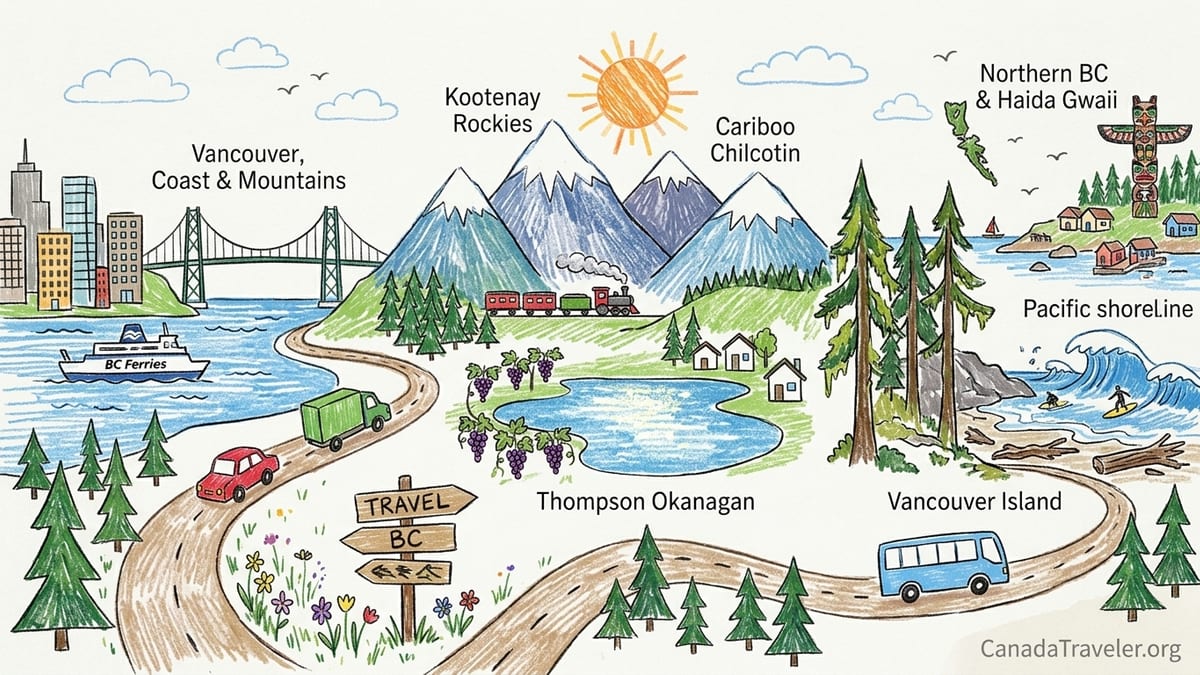
Understanding British Columbia’s Regions and Distances
For planning purposes, Destination BC divides the province into six official tourism regions: Vancouver, Coast & Mountains; Vancouver Island; Thompson Okanagan; Kootenay Rockies; Cariboo Chilcotin Coast; and Northern British Columbia. Vancouver, Coast & Mountains stretches from the city of Vancouver north through Howe Sound to Whistler and east through the Fraser Valley. Vancouver Island covers the island itself, including Victoria, Nanaimo, Tofino and Ucluelet. Thompson Okanagan includes Kamloops, Kelowna, Penticton and Osoyoos. Kootenay Rockies covers the southeastern corner, including Revelstoke, Golden and Yoho National Park. The Cariboo Chilcotin Coast spans central ranch country and remote Pacific inlets, including Wells Gray, Barkerville and Bella Coola. Northern British Columbia stretches from Prince George and Prince Rupert toward the Yukon and Alaska.
On a map these regions touch, but on the ground they translate into full travel days. Vancouver to Tofino on the west coast of Vancouver Island typically involves a drive to the Tsawwassen terminal, a 1 hour 35 minute BC Ferries crossing to Nanaimo or Swartz Bay, then at least 3 hours on winding island highways. Vancouver to Kelowna is about 4 to 5 hours by car in summer. Vancouver to Prince Rupert takes roughly two days of driving, or an internal flight of about 2 hours. Because of these distances, this guide is organized by distinct travel experiences rather than as a list of places you can “pop to” from Vancouver.
Accommodation and transport costs also vary widely by region and season. In downtown Vancouver, the average daily hotel rate in peak summer 2024 sat in the low 400 Canadian dollars per night and many visitors now report 500 to 700 Canadian dollars or more for central hotels on busy dates, with suburban areas like Richmond often around the 300 to 450 Canadian dollar range instead. On Vancouver Island, a standard room in Tofino in high summer can easily cost in the high 300s to 500 Canadian dollars or more per night, while inland motels in the Cariboo or Northern BC might still be found under 150 to 200 Canadian dollars outside peak events. Building a realistic budget starts with deciding which style of British Columbia you want to focus on.
What follows is a hub-style overview of the province’s most compelling areas, grouped by experience: coastal cities and culture, wild Pacific shores and rainforests, mountains and snow, lakes and vineyards, Rocky Mountain drama, and remote history and Indigenous-led experiences. For each destination you will find ideal stay length, best seasons, access notes, a rough cost level, accommodation practicality and the main drawback so you can decide where to invest limited days.
Urban BC: Vancouver and Victoria
Vancouver sits between the Coast Mountains and the Pacific, and many international visitors arrive here first. Its defining attractions are outdoors within the city boundary: Stanley Park’s seawall walk and beaches, Kitsilano and English Bay, and the North Shore mountains of Grouse, Cypress and Seymour across Burrard Inlet. A typical first-time visit deserves at least 3 full days, which allows time for a day walking the seawall and exploring Gastown and Granville Island, a half-day up Grouse Mountain or Lynn Canyon, and another day for neighborhoods like Commercial Drive or Main Street.
Summer and early autumn from June through September offer the most reliable sunshine for beaches and mountain viewpoints, but also the highest prices and crowding. Winter brings rain at sea level and snow on the local ski hills, which can be rewarding if you are comfortable with grey days. Downtown hotels in peak summer often cost 400 to 700 Canadian dollars per night, and even budget chains often start near 300 Canadian dollars, so some travelers base in nearby Richmond or North Vancouver for slightly lower rates. Vancouver International Airport has direct flights across North America, Europe and Asia, and the city has no car ferries within the metro area, so movement is by transit, rideshare, taxi, bike or rental car.
Victoria, the provincial capital on Vancouver Island, offers a calmer, more compact urban experience. The Inner Harbour is ringed by the Legislature buildings and historic Empress Hotel, and the city is known for walkable heritage streets, afternoon tea traditions and gardens such as Butchart Gardens about 30 minutes north. Two full days gives enough time for the harbour, Royal BC Museum and a half-day garden or coastal walk; three nights works well if you also want whale-watching or cycling along the Galloping Goose Trail.
Access to Victoria from Vancouver is via BC Ferries between Tsawwassen and Swartz Bay, with a crossing time of about 1 hour 35 minutes and frequent daily sailings. As of mid 2026, walk-on adult passengers pay just over 20 Canadian dollars each way and a standard vehicle with driver costs a little over 100 Canadian dollars one-way, before taxes and occasional fuel surcharges. Reservations are strongly recommended in summer, and arrival at the terminal at least 45 to 60 minutes before sailing is prudent. Victoria’s main drawback is travel time: including the drive or bus to Tsawwassen, check-in and crossing, it usually takes 4 to 5 hours to get from downtown Vancouver to downtown Victoria.
Pacific Shores and Rainforest: Tofino, Ucluelet and Haida Gwaii
On the outer edge of Vancouver Island, Tofino and nearby Ucluelet offer wide sandy beaches, pounding surf and old-growth coastal rainforest. Long Beach in Pacific Rim National Park Reserve stretches for kilometres, framed by driftwood and sitka spruce, with surfers in wetsuits even in March storms. Many travelers stay 3 to 4 nights here to allow for at least one stormy walk, a surf lesson or hot springs boat trip, and a day of hiking the Wild Pacific Trail near Ucluelet.
The prime period for classic beach weather is late June through early September, when days are longer and drier, but shoulder seasons from March to May and September to early November are popular for storm watching and lower accommodation rates. Access requires a ferry from Vancouver or elsewhere on the mainland to Nanaimo or Victoria, then a scenic and winding 2.5 to 3 hour drive across the island on Highway 4. Summer roadworks and single-lane sections can add delays, and serious storms occasionally close the road in winter, which travelers need to factor in. Tofino has a small airport with limited regional flights, but most visitors arrive by car.
Tofino and Ucluelet have some of the highest coastal accommodation prices in Canada relative to their size. In peak summer, upscale beachfront resorts can easily exceed 600 Canadian dollars per night, while more modest lodges and vacation rentals commonly range from 300 to 500 Canadian dollars. There are campgrounds and hostels that reduce costs but are often fully reserved months ahead. The main drawback is therefore cost and availability, particularly for oceanfront stays and for travelers without a car.
Farther north, Haida Gwaii is a remote archipelago off the BC coast known for Haida culture, moss-draped forests and rich marine life. Most visitors focus on Graham and Moresby Islands, using the villages of Daajing Giids or Masset as bases. A meaningful first visit usually requires at least 4 to 5 full days on the islands, with a week ideal if you hope to enter Gwaii Haanas National Park Reserve and Haida Heritage Site by boat. Access is by ferry from Prince Rupert, which takes around 6 to 8 hours depending on schedule, or by flights from Vancouver or Prince Rupert to Sandspit or Masset.
Haida-owned operators offer boat tours to ancient village sites, wildlife viewing and cultural experiences, and these are often the highlight of a visit. Example day trips into the protected southern area commonly cost several hundred Canadian dollars per person, reflecting the remoteness and small-group nature of the tours. Accommodation runs from simple motels and B&Bs in the 150 to 250 Canadian dollar range to small lodges and fishing resorts that can be far higher. Weather is variable year-round, with frequent rain and wind even in July, so good waterproof gear is essential. The main drawbacks are travel time, cost and the need to book guided experiences well in advance, especially between June and early September.
Mountains and Year-Round Adventure: Whistler, Revelstoke and Golden
Whistler, two hours north of Vancouver along the Sea to Sky Highway, is one of North America’s largest ski resorts and a year-round mountain town. In winter, Whistler Blackcomb offers extensive lift-served terrain, heli-skiing and backcountry tours. In summer, lifts carry hikers and sightseers to high alpine viewpoints, and the bike park draws downhill riders from around the world. A typical stay is 3 to 5 nights, giving enough time to explore both mountains, walk the Valley Trail and visit lakes such as Alta and Lost Lake.
The best skiing conditions usually arrive from January to March, although Christmas and New Year are popular and very busy. Summer from late June to early September brings alpine hiking and festivals. Access is straightforward by car or scheduled shuttle from Vancouver; winter storms can make the highway snowy but it is well maintained, and rental cars require proper winter tires during the designated season. Whistler’s cost level is high. In peak winter and summer, many hotels and condos are in the 350 to 600 Canadian dollar per night range and higher-end properties climb beyond that, with shoulder-season deals in spring and autumn noticeably cheaper. The main drawback is price and crowding on popular dates, including long lift lines on sunny Saturdays.
Farther east in the Kootenay Rockies region, Revelstoke and Golden appeal to travelers who prioritize mountain adventure over large resort villages. Revelstoke is known for deep snowfall, steep tree skiing and Revelstoke Mountain Resort’s long vertical drop, while summer brings alpine hiking, mountain biking and access to Mount Revelstoke and Glacier National Parks. Most visitors should plan at least 2 to 3 nights here, with road trippers often combining it with stops in the Okanagan or Yoho.
Golden, about 150 kilometres east of Revelstoke along the Trans-Canada Highway, sits close to both Yoho and Glacier National Parks and its own Kicking Horse Mountain Resort. In winter, Kicking Horse is prized for its challenging terrain and lift-accessed ridge lines; in summer, the gondola accesses alpine hikes and a mountain-top restaurant. Golden is also a base for rafting on the Kicking Horse River and for visiting national park highlights such as Takakkaw Falls or Emerald Lake in Yoho. A 2 to 4 night stay gives enough time for at least one park day, a mountain activity and a river or bike day, depending on interests.
Revelstoke and Golden are both reached by Highway 1, roughly a 6 to 7 hour summer drive from Vancouver, and each has a mix of motels, lodge-style hotels and vacation rentals. Typical peak-season hotel rates often fall into the 200 to 350 Canadian dollar range, lower than Whistler for comparable quality, with winter weekends during powder cycles commanding a premium. The main drawback is that mountain weather and highway closures through Rogers Pass can disrupt travel in winter and early spring, so itineraries should include extra driving time and flexible reservations.
Lakes, Vineyards and Dryland Ecology: Kelowna, Penticton and Osoyoos
If your image of British Columbia includes sun-warmed lakes and wine tasting, you are thinking of the Thompson Okanagan region. Kelowna, on the shores of Okanagan Lake, is the area’s largest city and a major hub for vineyards, orchards and lake activities. Many visitors spend 2 to 3 nights in or near Kelowna, using their days for wine touring, boat rentals and lakeside dining. Dozens of wineries offer tastings that typically cost under 15 Canadian dollars, often waived with bottle purchase, and organized half-day wine tours in summer commonly start around 120 to 150 Canadian dollars per person.
Penticton, about an hour south of Kelowna, sits between Okanagan and Skaha Lakes and has a more relaxed, small-town feel. It is well suited to family trips that mix swimming, cycling on the Kettle Valley Rail Trail and visiting nearby wineries on the Naramata Bench. A 3-night stay allows a full day on each lake and time for at least one dedicated wine or bike day. Peak season runs from late June through early September, when daytime highs often reach the high 20s to low 30s Celsius. Shoulder seasons in May, early June and late September can bring warm days with lower accommodation rates and fewer crowds.
Osoyoos, near the US border at the southern end of the Okanagan, is Canada’s driest and one of its warmest places, surrounded by desert-like hills and vineyards. It offers a different side of BC, with interpretive centres and Indigenous-led experiences focused on the dryland ecology and Syilx Okanagan culture. A 2-night stay works for travelers driving through between the coast and the Kootenays, while those keen on wineries and lake time may opt for 3 to 4 nights split between Osoyoos and Oliver.
Access to the Okanagan is by road or via flights into Kelowna International Airport from major Canadian cities and some US hubs. Driving from Vancouver to Kelowna typically takes 4 to 5 hours by Highway 5 and 97C or through the Fraser Canyon and Highway 97, subject to summer construction and winter conditions. Cost level ranges from mid to high in peak season. Standard hotels in Kelowna and Penticton in July and August often run from around 250 to 400 Canadian dollars per night, with lakeside resorts higher. Osoyoos has a mix of motels, condos and resorts, many with kitchenettes. The main drawbacks are heat and wildfire smoke risk in late summer; some years see smoke from regional forest fires affecting air quality and views for days at a time.
Rocky Mountain Scenery: Yoho National Park and the Alberta Border
On the BC side of the continental divide, Yoho National Park delivers classic Rocky Mountain scenery with a slightly quieter feel than its Alberta neighbours. It is vital to understand the provincial and park boundaries: Yoho, with its base village of Field and landmarks such as Emerald Lake and Takakkaw Falls, lies within British Columbia, while Banff townsite, Lake Louise and Moraine Lake are in Alberta. Many travelers combine both sides of the divide in one trip, driving back and forth over Kicking Horse Pass on the Trans-Canada Highway.
Emerald Lake, with its turquoise water ringed by peaks, and Takakkaw Falls, one of Canada’s tallest free-falling waterfalls, are the park’s headline sights. Yoho also offers less crowded hikes such as the Iceline Trail and access to the Kicking Horse River for rafting just outside the park near Golden. To do the area justice, plan at least 2 nights focusing on Yoho itself, or 3 to 4 nights split between Field, Golden and Lake Louise if you are visiting both provinces.
Yoho is most accessible from late June to early October, when all park roads are typically open and trails are mostly snow free. Takakkaw Falls Road, which involves tight switchbacks, usually operates on a seasonal schedule that closes for winter and reopens in late spring or early summer; dates can vary by year depending on snow and maintenance. Winter visits are possible along the main highway, but many secondary roads, campgrounds and high trails are closed or only reachable on skis or snowshoes. Access from Vancouver by car involves a full day’s drive of 8 to 9 hours without extended stops, so most travelers break the journey with nights in Revelstoke or Golden.
Accommodation close to Yoho includes lodges at Emerald Lake, simple guesthouses in Field, campgrounds and hotels in Golden. Prices in summer track with the Rockies generally: basic rooms in nearby towns can often be found in the 250 to 350 Canadian dollar range, while lakeside lodges and iconic properties charge significantly more and often book out months in advance for July and August. The main drawbacks are crowding on fine summer days, limited dining options within the park itself, and the reality that you will need a car to reach most trailheads and viewpoints.
History, Waterfalls and Remote Coastal Inlets: Wells Gray, Barkerville, Bella Coola and Prince Rupert
North of Kamloops in the Cariboo region, Wells Gray Provincial Park is sometimes called the Waterfall Park. Helmcken Falls, one of its best-known cascades, drops dramatically into a lava-walled canyon and is accessible by a short walk from a parking area. Many visitors also explore Dawson Falls and Spahats Creek Falls, and those with more time paddle on Clearwater or Murtle Lakes. A 2 to 3 night stay in or near the gateway town of Clearwater allows time to see several waterfalls and fit in a hike or canoe outing.
Wells Gray is generally most enjoyable from June through September, when road access is simplest and hiking trails are clear of snow. In early spring and after heavy summer rains, the waterfalls are at their fullest. Accommodation options in Clearwater and along the park access road include motels, cabins, campgrounds and a handful of lodge-style properties. Mid-range rooms in summer often sit in the 180 to 280 Canadian dollar range, lower than resort towns closer to the Rockies. The main drawback is remoteness once inside the park: services are limited, fuel must be planned carefully and mobile reception is patchy or absent.
Farther north along Highway 26 from Quesnel, Barkerville Historic Town and Park preserves a major gold rush settlement with dozens of heritage buildings, costumed interpreters and live demonstrations. It functions as a living museum where visitors can walk the old main street, watch blacksmithing or printing demonstrations and, in season, pan for gold in controlled troughs. A full day is the minimum to experience the site; many families and history enthusiasts plan 1 to 2 nights in Barkerville, neighbouring Wells or Quesnel to allow for evening theatre performances or quieter morning walks before day-trip groups arrive.
Admission is charged per person, with family passes available, and there are heritage-style accommodations in Barkerville itself along with campgrounds and motels in the region. The operating season generally runs from late spring into autumn, with core programming in July and August. The main drawbacks are the detour required from Highway 97 and limited shoulder-season services, so travelers in May or September should verify which activities and restaurants are operating before committing to overnight stays.
On the Cariboo Chilcotin Coast, Bella Coola sits at the head of a long fjord-like inlet and is one of the gateways to the Great Bear Rainforest. It has become a centre for Indigenous-led wildlife viewing, including grizzly bear tours on local rivers during the salmon run and cultural experiences with Nuxalk guides. Reaching Bella Coola involves a long drive on Highway 20 from Williams Lake, including a steep gravel descent sometimes called “The Hill,” or a BC Ferries voyage along the Inside Passage when operating; many visitors opt to fly from Vancouver with regional airlines to save time.
A stay of 3 to 4 nights is recommended if you want a realistic chance to see bears during late August or September salmon runs and to join a guided rainforest or cultural tour. These packaged wildlife trips often cost in the high hundreds or low thousands of Canadian dollars per person for multi-day stays, reflecting small group sizes and remote logistics. Accommodation is limited to a small number of lodges, motels and cabins, some of them Indigenous owned, and these fill quickly for peak bear-viewing weeks. The main drawbacks are the long journey, potential weather disruptions to flights or ferries, and the need to book a year or more in advance for the most sought-after packages.
Prince Rupert, in Northern British Columbia, is a coastal city with a deep harbour, long maritime history and strong Indigenous cultural presence from the surrounding Tsimshian communities. It serves as a terminus for Via Rail services from Prince George on certain schedules and for BC Ferries sailings along the Inside Passage and to Haida Gwaii. Many road trippers use it as a staging point for multi-day ferry journeys and for day trips to nearby islands and cultural sites. A 2 to 3 night stay allows time to explore the waterfront, visit museums, join a wildlife or fishing charter and adjust plans around ferry schedules.
Weather in Prince Rupert is often wet and cool, even in midsummer, which keeps the coastal forests lush but can surprise visitors arriving from drier interior valleys. Hotel prices are generally more moderate than major urban centres, with many mid-range options in the 150 to 250 Canadian dollar range, although busy ferry days can see demand spike. The main drawbacks are frequent rain, limited flights compared with larger cities, and the need to plan around infrequent long-distance ferry sailings if you are connecting further along the coast.
How Long to Stay: Sample 5, 7, 14 and 21 Day Plans
With the province’s size and variety, the biggest challenge is dividing limited vacation time. For 5 days, most travelers are best focusing on a single coastal-urban cluster. One practical option is 3 nights in Vancouver and 2 nights in Whistler, renting a car from the city. This allows a full day for Stanley Park and the seawall, a day combining Granville Island and a North Shore hike or suspension bridge, and two full days in Whistler for mountain or lake activities. Another 5-day option is 2 nights in Victoria and 3 in Tofino or Ucluelet, flying into Victoria, renting a car, then driving across the island. This suits travelers who care more about the Pacific coast than big-city dining.
With 7 days, you can add a different type of landscape. A popular loop is Vancouver to Kelowna or Penticton, then on to Revelstoke or Golden and back through the Fraser Canyon or Coquihalla Highway. A sample route could be 2 nights in Vancouver, 2 in the Okanagan, 2 in Revelstoke or Golden and a final night near Hope or back in Vancouver before a flight. This gives you urban food and culture, lakes and vineyards, and at least one full day in the mountains. Another 7-day strategy is to base on Vancouver Island, with 2 nights in Victoria, 3 in Tofino or Ucluelet and 2 nights in the Cowichan Valley or Comox Valley for quieter rural stays and easier access back to the mainland.
With 14 days, you can combine the coast, interior and Rockies without rushing every day. One realistic itinerary is to spend 3 nights in Vancouver, 3 on Vancouver Island split between Victoria and Tofino, 3 in the Okanagan, 3 between Revelstoke and Golden and 2 focused on Yoho and, if you wish, across the border in Lake Louise or Banff in Alberta. That schedule builds in several long driving days of 4 to 7 hours and leaves space for rest days in vineyards or lakeside towns. Alternatively, a two-week trip could devote a full week to coastal and island areas, including Haida Gwaii or Bella Coola if your budget allows flights and tours, and a week to interior lakes, ranch country and waterfalls such as Wells Gray and Barkerville.
With 21 days, you can design a deep exploration of one theme or a broad sampler. Road trippers might fly into Vancouver, spend 3 nights there, then travel a loop up Vancouver Island, across to the central coast, along Highway 20 to Williams Lake, up to Prince George and Prince Rupert, ferry to Haida Gwaii, and return to the mainland via the Inside Passage and the Yellowhead Highway back to the interior and Vancouver. This requires careful attention to ferry schedules and budgets but offers a rare look at the Cariboo Chilcotin Coast and Northern BC. Another 21-day approach keeps driving distances more modest: a week around Vancouver and Vancouver Island, a week in the Okanagan and Kootenay Rockies including Yoho, Revelstoke and Golden, and a final week flexing between repeats of your favourite regions or adding side trips like Wells Gray or Barkerville as energy and funds allow.
In every case, the most successful BC itineraries accept that the province cannot be “done” in a single trip. Prioritizing two or three complementary regions, building in buffer days for ferries and mountain highways, and aligning seasons with your preferred activities will result in a more relaxed and memorable journey from the Pacific Islands to the Canadian Rockies.
FAQ
Q1. Is it realistic to visit Vancouver, Victoria and Tofino in five days?
It is possible but not ideal. By the time you transfer between Vancouver and Victoria by ferry and drive to and from Tofino on winding roads, you will spend much of those five days in transit. Most travelers find five days better spent on either Vancouver plus Whistler, or Victoria plus Tofino and Ucluelet, rather than trying to do all three.
Q2. How expensive is British Columbia compared with other parts of Canada?
Major destinations like Vancouver, Whistler and Tofino are among the most expensive places to stay in the country, especially in July and August, with many mid-range downtown hotels costing 400 Canadian dollars or more per night. Smaller interior towns and northern communities can be significantly cheaper, though fuel, ferry fares and guided tours still add up, so careful budgeting is important.
Q3. Do I need a car to explore British Columbia properly?
You can enjoy Vancouver and central Victoria without a car using transit, rideshare, taxis and organized tours. However, accessing places like Tofino, Wells Gray, Barkerville, the Okanagan vineyards or Yoho National Park is far easier with your own vehicle. For longer trips, most visitors either rent a car or combine intercity buses and regional flights with local tour operators.
Q4. When is the best time to visit for good weather and lower prices?
Late May, June and September often strike the best balance between milder weather, open mountain passes and more moderate prices than peak July and August. On the coast, those months can still be wet, but crowds are thinner. Winter brings excellent skiing and lower city hotel rates outside holiday periods, but mountain driving conditions can be demanding.
Q5. How far in advance should I book ferries and accommodation?
For peak summer or holiday travel, it is wise to reserve key ferries, especially routes between Vancouver and Vancouver Island, at least several weeks to a couple of months ahead, and to book popular accommodations in Tofino, Whistler or the Rockies several months in advance. For shoulder seasons or midweek stays in less famous towns, a few weeks’ notice often suffices, but last-minute bargains are increasingly rare in prime locations.
Q6. Is Yoho National Park a good alternative to Banff and Lake Louise?
Yoho offers equally dramatic Rocky Mountain scenery with fewer crowds and lies just across the provincial border in British Columbia. It is not a full replacement for Banff and Lake Louise, which have their own iconic attractions, but as part of a combined itinerary, staying in Yoho and Golden can provide a quieter base while keeping Alberta’s major sights within about an hour’s drive over the continental divide.
Q7. Are there affordable ways to experience the Great Bear Rainforest or Haida Gwaii?
These regions are inherently costly due to remoteness and the small scale of Indigenous-led and locally owned operations. To keep costs down, some travelers focus on shorter, two or three night stays, choose simpler motels or guesthouses instead of all-inclusive lodges, and travel in shoulder seasons when some operators offer lower rates. However, there is no true budget equivalent to multi-day bear-viewing or cultural expeditions in such remote areas.
Q8. How worried should I be about wildfires and smoke in summer?
In recent years, interior British Columbia has seen more frequent summer wildfires that can affect air quality, visibility and even highway or park access, particularly in July and August. Many trips proceed without disruption, but it is sensible to monitor provincial wildfire and air quality information in the weeks before travel, keep your plans flexible, and consider travel insurance that covers disruptions if you are visiting during the height of fire season.
Q9. Can I rely on mobile coverage and internet in remote areas?
Mobile coverage is strong in cities, major highways and most of the Okanagan, but drops off quickly in mountain valleys, along parts of the Cariboo Chilcotin Coast, and in parks like Wells Gray or sections of the Rockies. Haida Gwaii, Bella Coola and some northern stretches have patchy or slow service. Download offline maps in advance, let someone know your route when driving remote roads, and avoid assuming you can always call or navigate online.
Q10. If I only have seven days, which regions should I prioritize as a first-time visitor?
For a classic first visit, many travelers choose a combination of Vancouver, Whistler and the Okanagan or Vancouver and Vancouver Island. For example, three nights in Vancouver, two in Whistler and two in Kelowna or Penticton create a varied but manageable week. Those more interested in the Pacific and Indigenous cultures might instead spend two nights in Victoria and five nights split between Tofino, Ucluelet and the Cowichan or Comox Valleys.