


Nothing about my trip to Haida Gwaii and Gwaii Haanas fit the postcard idea of British Columbia. There were no ski gondolas or wine tours, no polished resort towns an hour from a major airport. Instead there were rolling swells in Hecate Strait, rain-washed forests, conversations over gas station coffee, and the quiet authority of Haida hosts explaining why some photographs were welcome and others were not. The journey started long before I saw the islands on the horizon, in a spreadsheet of ferry timetables and flight options that made clear this would be a different kind of BC trip.
Planning a Trip to the Edge of the Map
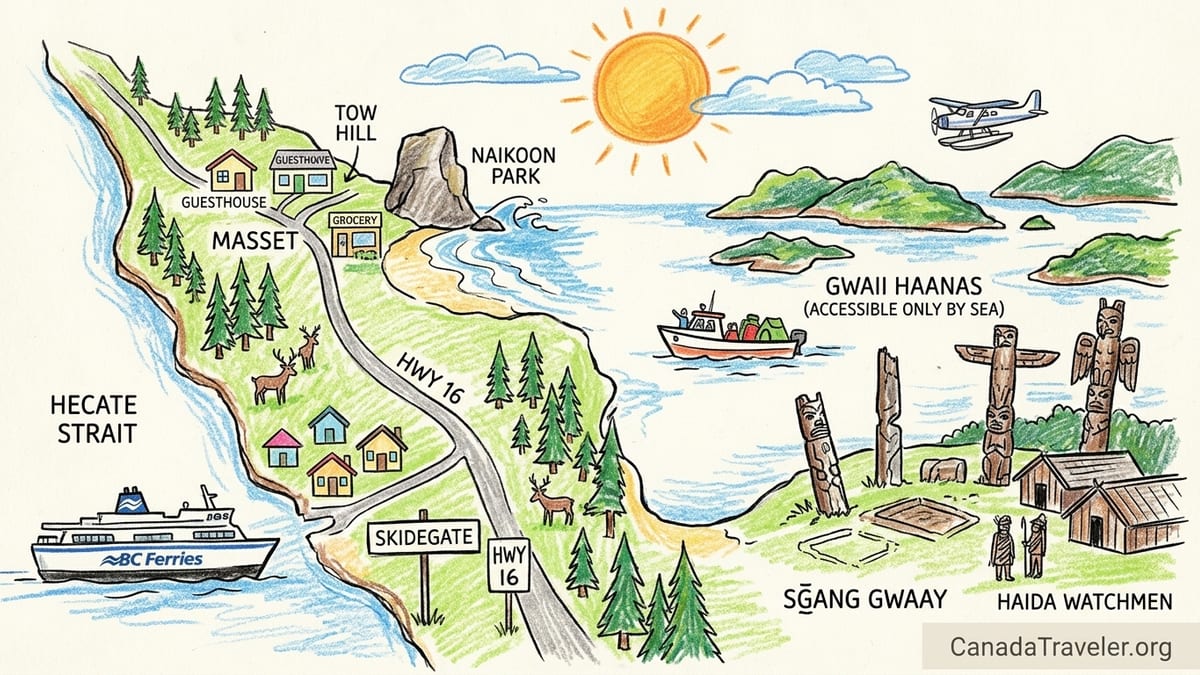
My starting point was not a glossy brochure, but the realization that getting to Haida Gwaii meant stepping outside British Columbia’s main tourism corridor. There are no quick detours from Vancouver or Kelowna. I began on airline and ferry sites, discovering that I had three practical choices: fly from Vancouver to Sandspit on Moresby Island, fly to Masset on northern Graham Island, or sail with BC Ferries from Prince Rupert to Skidegate on Graham Island. The ferries and flights were not daily conveniences to be taken for granted, but lifelines serving small communities, often at strange hours that dictated the rest of my itinerary.
I chose a hybrid route that felt true to the slow, sea-focused character of the place. I would take the Inside Passage ferry up the coast to Prince Rupert, overnight there, then connect on the Prince Rupert–Skidegate route into Haida Gwaii. Only after exploring Graham Island by road would I cross to Moresby Island and join a guided boat trip into Gwaii Haanas. Every step required advance bookings and backup plans. Researching fall 2026 schedules, I saw that the Prince Rupert–Skidegate ferry typically makes several sailings a week, many through the night, with crossing times around 7 to 8 hours. That meant arriving in Skidegate near dawn, jet-lagged not from time zones but from the rhythm of northern transport.
The costs were another reality check. Running sample bookings for October, a one-way adult fare on the Prince Rupert–Skidegate ferry, including a small vehicle up to 20 feet, came out in the range of a few hundred dollars, depending on the sailing and vehicle size. Add to that fuel, an overnight hotel in Prince Rupert, and meals, and simply reaching Haida Gwaii rivalled or exceeded the cost of flying to more familiar resort towns in southern BC. Yet the very difficulty of the journey hinted at what made these islands different: they are not an impulse weekend away, but a deliberate commitment of time and attention.
Crossing Hecate Strait to Skidegate
Hecate Strait has a reputation among mariners that nicely packaged tourism rarely mentions. Booking my ferry, I noticed the warnings about delays and cancellations in heavy weather. Locals I spoke to in Prince Rupert shrugged in that Northern way that combines acceptance and respect. “It can be dead calm in July and nasty in September,” one café owner told me. “You build a buffer day in. You do not cut it close.” So I did exactly that, arriving a full day before my sailing and treating Prince Rupert as part of the journey, not an inconvenience.
The overnight ferry boarded under sodium lights, a line of pickups, camper vans, and a few rental cars queuing on the terminal lot. On board, the atmosphere felt more like a long-distance train than a cruise. Families spread blankets on reclining seats. Seasoned passengers claimed quiet corners with sleeping bags. I opted for a simple reserved cabin, which added another couple of hundred dollars to the trip budget but made the 7 to 8 hour crossing more humane. At roughly 10 p.m. we pushed off into the dark, the deck lights reflecting off black water and distant silhouettes of inlets slipping by.
I woke around 5:30 a.m. to the muffled announcement that we were nearing Skidegate. Through the salt-streaked cabin window I could just make out the low green shoulders of Graham Island and a pale band of cloud lifting off the trees. This was not a dramatic, snow-capped entrance, but something subtler: a sense of arriving somewhere that reserves the right to reveal itself slowly. The ferry ramp clanged down, and in the grey first light I rolled onto Haida Gwaii’s main road, Highway 16, which in these parts felt more like a village street stretched across an island than a highway in the southern BC sense.
First Impressions of Daajing Giids and Island Pace
My first base was Daajing Giids, the community formerly known as Queen Charlotte, about 10 minutes’ drive from the Skidegate ferry terminal. I had booked a modest waterfront lodge several weeks ahead, paying in the range of 180 to 230 Canadian dollars per night in shoulder season. That price would get you a fairly standard hotel in Vancouver. Here it bought a clean room with simple furnishings, a shared deck facing the bay, and the luxury of quiet so complete that I could hear the clack of barnacles when the tide dropped.
Everything in Daajing Giids reinforced that I had stepped outside British Columbia’s tourist mainstream. The village has a grocery store, a gas station, a handful of cafés, and a few eateries that keep their own hours. One popular spot closed by 3 p.m. several days a week. Another posted a sign explaining that staff shortages meant unpredictable days off. I learned quickly to shop and eat on island time. Stock up when the grocery store is open, be patient when a sandwich takes twenty minutes, and never assume that a business listing online guarantees doors will be open when you arrive.
Renting a car required similar adaptation. Visitor information resources make it clear that you really do need your own wheels on Haida Gwaii. I reserved a compact car from a local agency based in Daajing Giids at a daily rate in the ballpark of 100 to 140 Canadian dollars, plus insurance. The vehicle had more kilometers than a typical city rental and bore the gentle scars of life on rougher roads. It was, in other words, perfectly suited to where I was. The staff walked me through fuel options, reminding me that stations in smaller communities do not operate 24 hours and that running the tank low on the way to Masset was a rookie mistake.
Haida Heritage Centre at Ḵay Llnagaay: Meeting the Living Culture
The first place that began to reset my understanding of Haida Gwaii was the Haida Heritage Centre at Ḵay Llnagaay in Skidegate. The complex sits low along the shoreline, a series of longhouses and carving sheds facing the water, with monumental poles standing in the gravel like elders greeting arrivals. I had read descriptions before coming, but the scale and the attention to detail felt different in person. This was not a museum in the detached sense. It was a place where history, language, and contemporary Haida life intertwined.
I joined a guided tour led by a Haida interpreter, which cost roughly the same as a modest dinner in town and was easily the best investment of the trip. Inside the main hall, among bentwood boxes and argillite carvings, she spoke matter-of-factly about smallpox, forest industry conflict, and the modern assertion of Haida rights. When we stopped before one pole depicting watchmen figures on the roofline, she explained how real Haida Gwaii Watchmen still stand sentinel today in Gwaii Haanas, protecting village sites and welcoming visitors under Haida law and a cooperative agreement with Parks Canada.
Photography was allowed in some parts of the Centre, but not all. Signs and staff made it clear when cameras should stay down. In one gallery with ceremonial regalia, I lowered my lens and simply listened. That early lesson in consent and respect proved essential later in Gwaii Haanas, where some of the most powerful moments could not, and should not, be reduced to images on a memory card.
North to Masset, Tow Hill and Agate Beach
From Daajing Giids I drove north on Highway 16, a ribbon of asphalt curving past muskeg, river mouths, and glimpses of the inlet. The distances on Graham Island are not huge by mainland standards. Daajing Giids to Masset is about 110 kilometres, roughly a 1.5 hour drive at island speeds. Yet the road feels longer because you are always slowing for deer, for logging trucks, or simply to let another weather front drape itself over the hills. I filled the tank in Skidegate, mentally noting the advice about limited fuel hours farther north.
Masset itself felt different again, with its mix of fishing heritage, Haida presence in Old Massett, and hints of surf culture. I stayed in a family-run guesthouse just outside the village, paying in the range of 150 to 200 Canadian dollars per night for a basic but comfortable room with a shared kitchen. At the small grocery, prices reflected the cost of shipping goods across Hecate Strait. A bag of apples that might cost a few dollars in Vancouver was several dollars more here. Fresh produce trucks are subject to ferry schedules and weather. Islanders have long learned to adapt. Visitors must do the same.
The paved road continues north and then east beyond Masset, turning to gravel as it approaches Naikoon Provincial Park. Here Haida Gwaii tilts toward the open Pacific. I parked at the trailhead for Tow Hill, a volcanic plug that rises above the flat shore, and followed the boardwalk through mossy forest to a viewpoint overlooking North Beach. On a clear day, you can see well along the curve of coastline, the sand glinting where waves fold in. I walked later along Agate Beach, pockets filling with stones banded in white and grey, and thought how strange it was that such an accessible, beautiful shore remains almost empty even in peak season compared with beaches near Tofino or Vancouver Island.
Yet the difference is not only numbers. It is also how the place is held. Interpretive signs reference Haida history and stewardship, and conversations with local operators often circle back to responsibility. One told me bluntly, “People come for wild. But wild is not empty. It is someone’s home.” Northern Graham Island offered spectacular landscapes, but as a visitor I was always aware that I was moving through a living territory, not a distant wilderness park divorced from the people whose ancestors named every creek and headland.
From Roads to Water: Entering Gwaii Haanas
Gwaii Haanas exists almost like a separate country within Haida Gwaii. There are no roads into the protected area. The southern half of Moresby Island and the surrounding smaller islands can only be reached by boat or seaplane. That distinction matters, because it changes everything about how you plan and what you experience. After returning to Daajing Giids, I crossed on the short local ferry to Moresby Island and spent a night in Sandspit, a small community that serves as the main launch point for Gwaii Haanas trips.
Sandspit’s airport connects to Vancouver by direct Air Canada flights that take around two hours, and it has a couple of modest lodges and cabin-style accommodations in the 160 to 220 Canadian dollar per night range. There is a single main grocery store, a café, and a gas station. This is where I met the operator for my guided Gwaii Haanas trip, a Haida-owned company running small boat excursions south into the protected area. I had booked months in advance, with a three-day trip including boat transport, meals, camping gear, and guiding costing in the low four-figure range per person.
Before we ever saw the Gwaii Haanas boundary, the logistics became tangible. Our departure time hinged on tide, wind, and the operator’s communication with the Gwaii Haanas office about conditions at key anchorages. I had to pack light but also carry enough layers for conditions that could swing from flat calm to gale in hours. The guide triple-checked that everyone had signed the necessary waivers and carried proof of the required park reservation and orientation. On the morning we left, heavy rain drummed on the cabin roof. The skipper looked at the forecast and calmly delayed our departure by four hours. In Gwaii Haanas, the schedule serves the weather, not the other way around.
Reservations, Orientation and the Haida Gwaii Watchmen
Traveling with a licensed tour operator meant that much of the paperwork for Gwaii Haanas happened quietly in the background. But I wanted to understand what it would mean to visit independently, especially given new rules for 2026. Gwaii Haanas is jointly managed by the Council of the Haida Nation and Parks Canada, and they control access in a way that prioritizes cultural protection and safety over spontaneity.
For independent visitors, a reservation is mandatory before entering the protected area. The current guidance, updated in 2026, requires that reservations be finalized at least five business days before your planned entry. Submitting an online form is not enough. Staff must confirm that there is capacity and issue your permit. Weekends and statutory holidays do not count toward that five-day window. In practice, someone hoping to paddle in on short notice from Moresby Camp cannot simply show up after a good weather forecast. Spontaneous travel into Gwaii Haanas is effectively impossible under the present rules.
Orientation is the second non-negotiable piece. Every visitor must complete an official Gwaii Haanas orientation that covers safety, cultural expectations, environmental protocols, and emergency communication. Independent paddlers and boaters can join scheduled orientation sessions in person on Haida Gwaii or remotely online, often at no additional cost beyond the daily visitor fee. Those traveling with licensed tour operators receive the orientation via their guides, who are trained to deliver official content in the field. Without proof of having completed an orientation, you are not legally permitted to enter Gwaii Haanas, and operators are required to turn unpermitted visitors away.
Layered onto that framework is the Haida Gwaii Watchmen Program, which embodies Haida authority on the land and sea. At five key former village sites, including SG̱ang Gwaay, Haida Watchmen live seasonally from roughly May to September. They welcome visitors, share the history of each place, and ensure that Haida law and agreed visitor limits are respected. Official information emphasizes that these village sites are resting places for Haida ancestors, not open-air museums. Access is on a first come, first served basis, typically limited to small groups ashore at any one time, and visits are expected to conclude by late afternoon so Watchmen have time off.
Protocol is specific and personal. At each Watchmen site, our skipper radioed ahead on marine VHF before approaching, asking permission to land and confirming how many visitors were aboard. Once ashore, we waited by the landing for a Watchman to greet us. Photography was permitted at some angles but not others, and always after asking. We stayed on established paths, never stepping over house beams or touching leaning poles. When a Watchman shared a story that felt particularly intimate, it stayed in my notebook, not on social media. The program’s origins in community volunteers responding to grave-robbing and vandalism decades ago gave every request a weight I could feel, even when a Watchman delivered it with an easy smile.
SG̱ang Gwaay: Standing Among Ancestors
Of all the places we visited in Gwaii Haanas, SG̱ang Gwaay, on a small island at the far south of the archipelago, changed me the most. It is both a UNESCO World Heritage Site and an active Haida Gwaii Watchmen site, widely regarded as one of the most powerful examples of coastal First Nations monumental art and village remains anywhere in the world. It is also one of the most difficult to reach. From our base in the central part of Gwaii Haanas it took hours of careful navigation, threading through reefs and passes, to reach its sheltered landing in a narrow weather window.
We arrived near midday under a high overcast. The Watchmen had been expecting us. After a brief welcome on the shore, one led us along a faint path through salal and moss into the village clearing. There, in a shallow arc facing the sea, stood mortuary and memorial poles carved more than a century ago, their forms softened and hollowed by time. Some leaned at improbable angles, locked in place by surrounding forest. Others had fallen, their designs turning slowly back into earth. Between them lay the outlines of house pits and corner posts, where families had once lived, feasted, and mourned.
Our guide, a Haida Watchman in his thirties, spoke with a mix of pride and grief. He outlined the histories of specific poles, naming the families they belonged to and explaining how smallpox and forced relocation had emptied the village. He also spoke about current work to maintain the site without freezing it in a museum state. When I lifted my camera, I felt the weight of every earlier conversation about consent. I asked before taking images, keeping to broader landscape frames that did not isolate human remains or intrude on graves. Some moments, such as when our group stood silently while the Watchman sang a short song for his ancestors, went unrecorded. The lack of a photo is part of their value.
Standing there, it became obvious that the logistical barriers to reaching SG̱ang Gwaay serve more than safety. They create the conditions for a deeper kind of visit. You cannot accidentally drop by on your way somewhere else. By the time you step onto that beach, you have invested days of travel, thousands of dollars, and significant emotional energy. That commitment, combined with clear Haida leadership through the Watchmen, frames the encounter less as tourism and more as being a guest in someone’s enduring home.
The Takeaway
On my last evening in Daajing Giids, after returning from Gwaii Haanas, I walked down to the shore. The ferry I had arrived on days earlier was now a shape of lights sliding across the horizon, heading back toward Prince Rupert and the mainland. I thought about the chain of logistics that had brought me here: the overnight ferry, the expensive but necessary rental car, the nights in plain but welcoming island motels, the careful choreography of tides, orientations, and radio calls that allowed our small boat to move through Gwaii Haanas under Haida guidance.
By most contemporary travel metrics, Haida Gwaii and Gwaii Haanas are not convenient. Flights from Vancouver to Sandspit or Masset are often several hundred dollars one way. The Prince Rupert–Skidegate ferry route requires advance booking and can be disrupted by weather. Accommodation choices are limited, and food costs run higher than on the mainland because everything rides the same ferries and planes that you do. Even in good weather, you must be ready for delays and cancellations. In Gwaii Haanas itself, where there are no roads and little in the way of facilities, you accept that the ocean, not your itinerary, has the final word.
Yet those very difficulties are inseparable from what I learned here. Experiencing Haida heritage in Haida territory, interpreted by Haida people themselves, changed how I understood British Columbia. The province’s tourism story often centers on accessible spectacles: gondolas near highways, ski villages above big cities, winery routes mapped in glossy brochures. Haida Gwaii reveals a different story, one where Indigenous law, language, and stewardship are not interpretive panels tacked onto a park, but the framework through which the place is governed and visited.
Listening to Haida guides at the Heritage Centre in Skidegate and Haida Gwaii Watchmen in Gwaii Haanas, I realized how partial my previous understanding had been. They spoke not only about art and legend, but about legal battles, blockades, and contemporary governance. They casually used Haida place names that hold histories far older than the English ones on most maps. They drew clear lines around what was appropriate to photograph and share, inviting me to participate in their story without claiming any part of it as mine.
Were the logistics justified? For me, unquestionably yes. I came away with fewer photographs than on many other trips, but with more conversations that continue to work on me long after I left. The slow ferries, the expensive flights, the weather days spent drinking coffee in small cafés and waiting for a break in the wind, all felt like tuition for the privilege of standing quietly at SG̱ang Gwaay and hearing a Watchman describe his ancestors’ village in the present tense. On the flight back toward Vancouver, the lights of the Lower Mainland sprawling beneath the wing, I understood that the British Columbia I thought I knew was only one version. The other one, out there across Hecate Strait, had already begun to change me.
FAQ
Q1. How do you actually get to Haida Gwaii from mainland British Columbia?
Most visitors either fly from Vancouver to Sandspit or Masset, or travel by road or air to Prince Rupert and then board the BC Ferries route to Skidegate on Graham Island. The ferry crossing takes roughly 7 to 8 hours, often on overnight sailings, and should be booked well in advance, especially in summer.
Q2. Is it better to fly or take the ferry to Haida Gwaii?
Flying is faster and often simpler, with flights from Vancouver to Sandspit or Masset taking about two hours. The ferry from Prince Rupert can be cheaper if you are already driving in northern BC and want your own vehicle, but it adds at least a full travel day each way and is more vulnerable to weather delays.
Q3. How expensive is it to visit Haida Gwaii compared with other parts of BC?
Costs are generally higher than in southern BC. Sample October airfares for a one-way flight from Vancouver to Masset or Sandspit can be several hundred dollars, and the Prince Rupert–Skidegate ferry with a vehicle also runs in the hundreds of dollars each way. Accommodation on the islands is often between about 150 and 250 Canadian dollars per night for simple motels or lodges, and groceries and restaurant meals cost more due to shipping.
Q4. What is the difference between visiting Graham and Moresby islands and visiting Gwaii Haanas?
Graham and the northern part of Moresby Island have communities, roads, vehicle rentals, and services, so you can explore by car between places like Skidegate, Daajing Giids, Masset, Tow Hill, and Agate Beach. Gwaii Haanas covers the remote southern half of the archipelago and has no roads at all. It can only be reached by boat or seaplane, requires reservations and orientation, and is usually experienced on guided trips or serious self-guided expeditions.
Q5. What are the 2026 reservation rules for visiting Gwaii Haanas independently?
Independent visitors must secure a Gwaii Haanas reservation and complete a mandatory orientation before entering the protected area. As of 2026, reservations must be finalized at least five business days before your planned entry date, not counting weekends or holidays. You cannot legally arrive unannounced and expect to obtain a same-day permit.
Q6. Do I still need to worry about reservations and orientation if I go with a tour operator?
Yes, but in a different way. Licensed tour operators in Haida Gwaii generally handle Gwaii Haanas reservations, daily visitor fees, and orientation requirements on your behalf. You still receive the official orientation content, usually through your guide, but you will not be dealing directly with the permit office as long as you stay within the tour’s plan.
Q7. What is the Haida Gwaii Watchmen Program and how does it affect my visit?
The Haida Gwaii Watchmen Program stations Haida guardians at key cultural sites in Gwaii Haanas, including SG̱ang Gwaay, from roughly May to September. Watchmen welcome visitors, explain the history and cultural significance of each site, and ensure Haida laws and agreed visitor limits are respected. You typically radio ahead before landing, wait to be greeted, stay with the Watchmen while on site, and follow their guidance on photography and behavior.
Q8. Are there special rules about photography at Haida cultural sites?
Yes. At the Haida Heritage Centre and at Watchmen sites in Gwaii Haanas, some areas and objects may not be photographed at all, and in other places photography is welcome only after you ask. It is important not to photograph human remains, graves, or private ceremonial items, and to respect any request from Haida hosts to lower your camera.
Q9. How likely are weather delays, and how should I plan for them?
Weather delays are a real possibility on both ferries and small boats, especially in shoulder seasons when strong winds and swell develop in Hecate Strait. Gwaii Haanas trips can be postponed or altered based on sea conditions. Build at least one buffer day at the start and end of your trip, avoid tight flight or ferry connections, and carry flexible expectations about what specific sites you will be able to reach.
Q10. Is the effort of reaching Haida Gwaii and Gwaii Haanas really worth it?
For many travelers, yes. The combination of powerful landscapes, the depth of living Haida culture, and the chance to experience places like SG̱ang Gwaay in the presence of Haida hosts offers something that mainstream BC destinations cannot. The high cost and logistical complexity tend to filter for visitors who are ready to travel slowly, listen carefully, and accept that they are guests in someone else’s homeland.