

Travel in coastal British Columbia often begins not with a highway, but with a ferry schedule. For visitors planning to explore Vancouver, Vancouver Island, the Sunshine Coast and the Southern Gulf Islands, understanding how BC Ferries works is just as important as picking hotels. Routes, terminals, reservations and peak-season bottlenecks can shape your entire itinerary. This guide explains the main options and shows, with real-world examples, how to plan ferry logistics before you lock in the rest of your trip.
BC Ferries at a Glance: Why Planning Comes First
BC Ferries is one of the largest ferry systems in the world, connecting Metro Vancouver with Vancouver Island, the Sunshine Coast, the Gulf Islands and northern coastal communities. For most visitors, it is the essential link between Vancouver and destinations like Victoria, Nanaimo, Tofino, the Sunshine Coast and the Inside Passage. Because ferries run on fixed schedules and have limited vehicle capacity, your sailing times can easily dictate when you pick up a rental car or check into a hotel.
On core routes such as Tsawwassen to Swartz Bay and Tsawwassen to Duke Point or Horseshoe Bay to Departure Bay, ferries run frequently, especially in summer. Yet sailings can still sell out for vehicles at busy times, and long weekend waits without a reservation can stretch to several sailings. It is increasingly common for summer vehicle space to be mostly booked days or weeks in advance. Foot passengers are more flexible, but even they may face busy terminals on holiday weekends.
A practical way to think about BC Ferries is to treat it like one more flight in your trip. You would not usually book a hotel in another city without first checking if there is a flight that arrives when you hope. In the same way, confirm ferry times for your dates, then build your Vancouver, Vancouver Island and Sunshine Coast itinerary around what actually operates on those days and times.
For example, a traveler flying into Vancouver in late July and heading for Tofino might land at noon, pick up a rental car at Vancouver International Airport, and aim for a late afternoon sailing from Tsawwassen to Duke Point. If that sailing is already full for vehicles, the traveler either adjusts the flight arrival, stays overnight near Vancouver and sails next morning, or travels via Horseshoe Bay and Departure Bay instead. Those choices have a direct impact on hotel bookings on both sides of the Strait of Georgia.
Main Vancouver to Vancouver Island Routes and Terminals
There are three primary ferry corridors linking Metro Vancouver with Vancouver Island that matter to most visitors: Tsawwassen to Swartz Bay, Tsawwassen to Duke Point and Horseshoe Bay to Departure Bay. All three carry vehicles and foot passengers and run year-round, with extra sailings added in peak season on the busiest days.
Tsawwassen to Swartz Bay is the main route between Vancouver and Victoria. Tsawwassen terminal is south of Vancouver near the U.S. border, roughly a 35 to 45 minute drive from downtown Vancouver in light traffic. Swartz Bay is about 30 to 40 minutes by car from downtown Victoria. This route is ideal for travelers whose priority is Victoria and the southern part of Vancouver Island. It is also the key hub for connecting to many Southern Gulf Islands, so schedules here can influence island-hopping itineraries.
Tsawwassen to Duke Point and Horseshoe Bay to Departure Bay both serve the Nanaimo area. Duke Point lies south of Nanaimo, convenient for people continuing by car toward Victoria or the Cowichan Valley. Departure Bay is closer to central Nanaimo and offers a more scenic drive from Horseshoe Bay along the Sea to Sky Highway from Vancouver. For example, someone driving from Whistler to Tofino might naturally head to Horseshoe Bay and sail to Departure Bay, while a traveler driving from the U.S. border to Parksville might prefer Tsawwassen to Duke Point.
There are also smaller Island routes that are important for trips beyond the main centers, such as the ferry from Nanaimo to Gabriola Island or services from Crofton to Salt Spring Island. If you plan to mix major routes with smaller ones on the same day, pay careful attention to connection windows. It is usually wise to allow at least one full sailing gap between arrival from the mainland and a smaller inter-island connection in case of delays.
Sunshine Coast and Southern Gulf Islands: Short Hops That Shape Itineraries
The Sunshine Coast lies on the BC mainland north of Vancouver but is only accessible by boat or plane. The primary ferry link is Horseshoe Bay to Langdale near Gibsons. This short crossing is vital if you are planning a loop that combines Vancouver, the Sunshine Coast and Vancouver Island. In summer, vehicle demand is heavy and waits without reservations can be significant, especially at the start or end of long weekends. BC Ferries often increases sailings in peak season, but many locals still plan travel around less busy midweek days.
If you intend to connect the Sunshine Coast with Vancouver Island, a common pattern is to sail Horseshoe Bay to Langdale, drive up the coast to Earl’s Cove, then take the small ferry to Saltery Bay, continue to Powell River and finally cross to Comox on Vancouver Island. This creates a scenic loop, but it involves three separate ferry legs. You might, for example, sail to Langdale on a Thursday, spend two nights in Sechelt, then travel onward through Saltery Bay and Powell River on Saturday, catching an afternoon Comox sailing. Each leg has its own schedule and capacity limits, so hotel bookings in Sechelt, Powell River and Comox should match confirmed sailing times, not the other way around.
The Southern Gulf Islands, including Salt Spring, Galiano, Pender, Mayne and Saturna, are reached mainly from Swartz Bay or Tsawwassen. Many routes are indirect and involve inter-island stops. For instance, a visitor leaving Vancouver for Salt Spring Island might sail Tsawwassen to Long Harbour with stops at other islands, or travel Tsawwassen to Swartz Bay and then connect via a short hop from Swartz Bay to Fulford Harbour. Sailing times vary widely, so a same-day arrival on an island with plenty of time to check in and have dinner depends on picking a sailing that suits your exact plan.
Island-hopping adds a layer of complexity. A traveler wanting to visit both Galiano and Pender over four days might time their trip to arrive on Galiano on a mid-morning sailing, stay two nights, then take a midday inter-island sailing to Pender and finally return to Swartz Bay. Because many Gulf Island routes run only a few times per day, securing those crossings on your exact dates should come before prepaying inns or vacation rentals, which may have strict cancellation policies.
Reservations, Check-in and Peak-Season Capacity
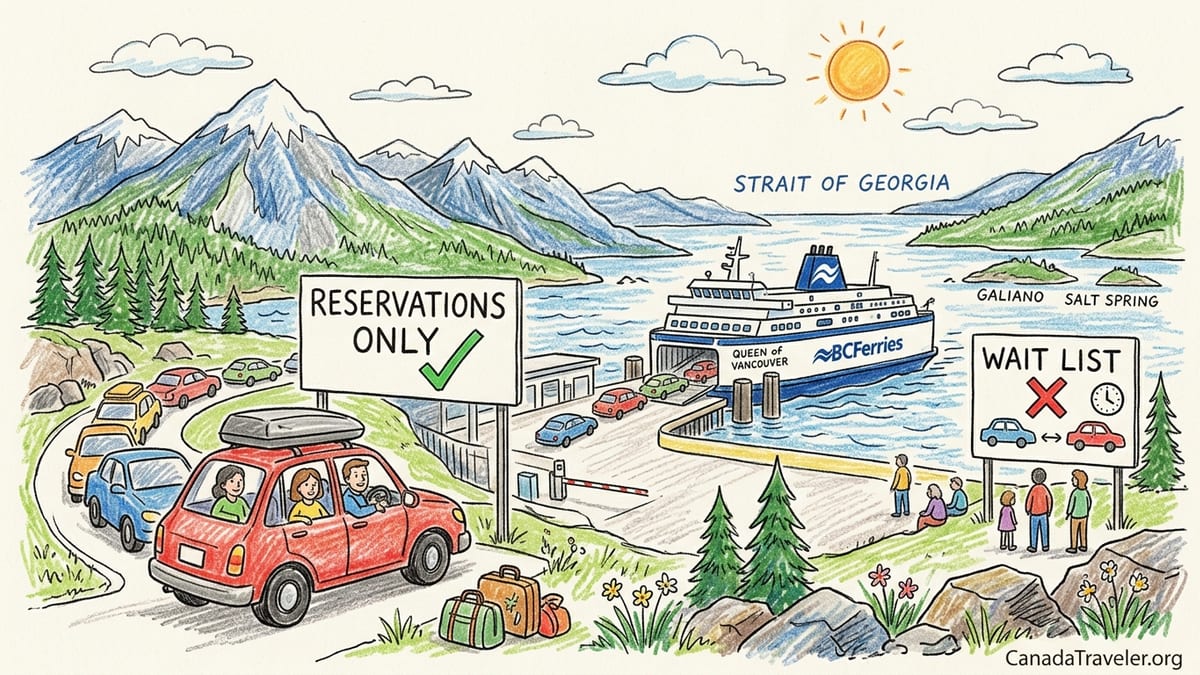
On the busiest routes between Metro Vancouver and Vancouver Island, BC Ferries now treats vehicle reservations as the norm rather than an optional extra. Travelers bringing a car are strongly encouraged to book ahead on Tsawwassen to Swartz Bay, Tsawwassen to Duke Point and Horseshoe Bay to Departure Bay, particularly from late June through early September and on holiday weekends. In summer 2024 and 2025, there were repeated reports of multiple-sailing waits for drivers without reservations on peak days, and the company has responded by increasing the proportion of reservable deck space.
Reservations for vehicles guarantee space on a specific sailing if you arrive within the check-in window, which typically opens 60 minutes before departure and closes 30 minutes before. For example, if you book a 3:00 pm sailing from Tsawwassen, you should aim to be at the ticket booth between about 2:00 pm and 2:30 pm. Arrive too late and your reservation can be forfeited; arrive significantly earlier and you may be asked to wait outside the pre-ticket area until check-in for your sailing officially opens. Building buffer time for highway traffic, border delays if you are coming from Washington State, and rental car pick up is essential.
Fares are structured with several options. Standard fares are available at the terminal on the day of travel, but on busy routes these may not help if vehicle space is already sold out for multiple sailings. Saver-style discounted fares are sometimes offered for less popular sailings or when booking weeks in advance, often with more restrictive change and cancellation rules. As of late 2025, on some Horseshoe Bay to Departure Bay sailings, saver fares for a vehicle and driver can start significantly cheaper than peak-time sailings. Because pricing and promotions change periodically, visitors should check current fare examples while planning, and consider adjusting their driving day to chase a lower-priced, less crowded sailing.
Peak-season capacity is especially tight around late June through Labour Day and during long weekends such as Canada Day, BC Day and Labour Day. On those dates, the practical advice from locals is clear: never assume you can simply drive up with a car in the afternoon and board the next ferry. Instead, book your vehicle spot as soon as you have approximate travel dates. If the time you want is sold out, consider leaving a day earlier or later, sailing at a shoulder time such as early morning or late evening, or shifting between Tsawwassen and Horseshoe Bay or between Swartz Bay and Nanaimo-area terminals.
Foot Passengers, Bicycles and Rental Cars
Traveling as a foot passenger is generally more flexible than bringing a vehicle. Foot passengers usually do not take up deck space, so BC Ferries focuses its capacity management on vehicles. On most days and most routes, you can arrive at the terminal with a valid ticket and board without a reservation, although on the busiest holiday sailings there have been occasional reports of terminals reaching passenger limits. Large terminals such as Tsawwassen and Swartz Bay offer check-in counters and sometimes baggage services for foot passengers on longer routes.
Bicycles are a popular way to explore coastal BC, and BC Ferries explicitly welcomes cyclists. Bikes typically travel free or for a modest fee, and riders check in either with foot passengers or at a designated vehicle lane, depending on the terminal. On shorter routes like Horseshoe Bay to Langdale or Tsawwassen to the Southern Gulf Islands, being on a bike can simplify the experience. For instance, a cyclist based in Vancouver might ride to Horseshoe Bay early on a summer morning, check in as a cyclist, sail to Langdale and spend the day on the Sunshine Coast without worrying about vehicle reservations or parking.
For international visitors, one of the most common questions is whether to bring a rental car onto the ferry. The answer usually depends on your itinerary. If your plans include remote beaches, the Pacific Rim region around Tofino and Ucluelet, or rural Gulf Island stays, having a car offers major convenience. A couple flying into Vancouver could pick up a compact SUV at the airport, drive to Tsawwassen and board a mid-afternoon sailing to Swartz Bay. Their total cost for that leg would include a standard vehicle fare plus fares for each passenger. If the couple instead travels as foot passengers, they avoid the vehicle fare but must rely on buses, taxis or local shuttles once they arrive.
A hybrid approach also works well. Some travelers pair an urban stay without a car with a later rental timed to their island travel. For example, you might spend three days in downtown Vancouver using public transit and rideshare, then take the SkyTrain and bus to Tsawwassen as a foot passenger, sail to Swartz Bay and collect a rental car in Victoria for the Vancouver Island portion only. This can avoid driving in city traffic, reduce parking costs and limit peak-season stress at the Metro Vancouver terminals, while still giving you full flexibility once you reach the island.
Choosing Between Terminals: Tsawwassen, Horseshoe Bay and Island Ports
For visitors starting in Vancouver or arriving at Vancouver International Airport, the first major choice is often between Tsawwassen and Horseshoe Bay. Tsawwassen is closer to the airport and south-of-city suburbs, and serves both Victoria via Swartz Bay and Nanaimo via Duke Point. Horseshoe Bay is northwest of downtown Vancouver and is linked to the Sea to Sky Highway toward Squamish and Whistler. It serves Nanaimo via Departure Bay and the Sunshine Coast via Langdale.
The right terminal depends on your route. If you are heading for Victoria or the Southern Gulf Islands, Tsawwassen is the only practical option. If you are planning a Whistler and Tofino road trip, it is more intuitive to drive from Vancouver or Whistler to Horseshoe Bay, sail to Departure Bay, then continue across Vancouver Island to the Pacific Rim. A family coming from Seattle by car might cross the border near Peace Arch, stay overnight in South Surrey, then drive 20 to 30 minutes to Tsawwassen for the morning sailing to Swartz Bay. In contrast, a couple staying in downtown Vancouver and then heading first to Tofino might grab a rental car in the city and drive 30 to 40 minutes to Horseshoe Bay.
On Vancouver Island, the main decision points are Swartz Bay versus Nanaimo-area terminals. Choose Swartz Bay if Victoria, Sidney and the Saanich Peninsula are your focus, or if you are connecting to Gulf Island ferries. Choose Departure Bay if you want easy access to Nanaimo’s downtown, Parksville, Qualicum Beach and the central island region. Duke Point works well if you are continuing south toward the Cowichan Valley or Victoria by road and want to avoid driving through central Nanaimo. For northern island adventures, such as Port Hardy, Telegraph Cove or the North Coast Trail, you will likely drive up the island and not use another ferry after reaching Nanaimo or Victoria.
Real-world planning often looks like this: A visitor with ten days might fly into Vancouver, spend two nights in the city, pick up a rental car on day three, drive to Horseshoe Bay for a mid-morning Departure Bay sailing, overnight in Parksville, drive to Tofino for three nights, then return across the island and sail from Duke Point to Tsawwassen before flying home the next day. That sequence works smoothly only if you check that your desired Horseshoe Bay to Departure Bay and Duke Point to Tsawwassen sailings exist on your dates and still have reservation space before you confirm accommodations.
Northern Routes and Long-Haul Sailings
Beyond the busy south coast, BC Ferries also operates northern routes that function as both transportation and scenic cruises. The Inside Passage service between Port Hardy on northern Vancouver Island and Prince Rupert on the north coast is a long sailing that typically takes well over half a day. It passes through sheltered channels and remote coastal scenery, and many travelers treat it as a highlight of a BC trip rather than just a transfer. Another important northern link connects Prince Rupert with Haida Gwaii.
These northern sailings operate on limited schedules compared with the major south coast routes, sometimes with only a few departures per week in shoulder seasons. They require much stricter advance planning. Vehicle space and cabins can sell out months ahead for peak summer dates. For example, someone wanting to drive from Vancouver to Port Hardy, sail the Inside Passage to Prince Rupert, then continue into northern British Columbia or connect to Haida Gwaii would normally secure the ferry portion first, then plan the multi-day drive up Vancouver Island and their accommodation in Port Hardy or Prince Rupert around that confirmed date.
Weather and mechanical issues can also affect these long northern sailings, leading to revised schedules or multi-day cancellations. BC Ferries publishes travel advisories and contingency plans, and some seasons have seen temporary schedule changes while specific vessels undergo repairs. Travelers booking the Inside Passage or Haida Gwaii legs should build flexibility into their itinerary, avoid hard connections to flights on the same day as their arrival, and make sure hotels have cancellation policies that match the risk of a schedule change.
This type of trip lends itself to slow travel. A couple might plan to drive from Victoria all the way to Port Hardy over several days, stopping in Campbell River and Port McNeill, then take an early morning departure to Prince Rupert, stay two nights to explore the city, and continue by road into northern British Columbia or by ferry to Haida Gwaii. Every stage hinges on the availability of that long Inside Passage sailing, which is why confirming those dates and times is the first step in planning.
Putting It Together: Sample Multi-Region Itineraries
Because ferries act as moving choke points along the coast, the most reliable way to plan a multi-region trip is to start with sailing times, then fill in the rest. Consider a two-week summer trip combining Vancouver, Vancouver Island, the Pacific Rim and the Sunshine Coast. A visitor might first look up availability for a Horseshoe Bay to Departure Bay sailing on day three, a return from Duke Point to Tsawwassen on day nine, and a Horseshoe Bay to Langdale sailing on day ten, plus a return from Langdale to Horseshoe Bay on day twelve. Once those are reserved, the traveler can safely book hotels in Nanaimo, Tofino and Sechelt around them.
Another example is a Gulf Islands focused vacation. Suppose you want to spend three nights on Salt Spring Island and three on Galiano Island in late August. You would start by checking Tsawwassen to Long Harbour sailings that match your arrival in Vancouver, then the inter-island ferry from Salt Spring to Galiano on your transfer day, and finally your return Galiano to Tsawwassen or Galiano to Swartz Bay sailing. Certain days may have only one or two workable options, so securing those first ensures that you do not end up with a reserved cottage but no convenient way to reach or leave it.
Even shorter trips benefit from this approach. A long weekend from Vancouver to Victoria might appear straightforward, but if you have theatre tickets in Victoria on Friday night and a dinner reservation at 7:30 pm, it matters a lot whether you catch a mid-afternoon Tsawwassen to Swartz Bay sailing that lands you on Vancouver Island by 4:30 pm, or whether every afternoon sailing is full and you have to cross in the evening instead. Reserving the sailing first lets you schedule your dinner and show with confidence and choose a hotel close enough to the Inner Harbour to walk from the bus stop if you leave your car at home.
The common thread in all these examples is that ferry logistics come before hotel confirmations. Once your sailings are reserved, it is easier to pick check-in times, decide whether you need parking, and estimate driving distances. Reversing that order often leads to stressful dashes to the terminal, unexpected waits and, occasionally, the need to pay extra to change either ferry reservations or accommodation bookings at the last minute.
The Takeaway
BC Ferries is a central part of travel in coastal British Columbia, from quick hops between Vancouver and Victoria to epic journeys along the Inside Passage. Its routes, schedules and capacity limits should shape your itinerary rather than being squeezed in at the end. For visitors planning a mix of Vancouver, Vancouver Island, the Sunshine Coast, the Gulf Islands and northern communities, the most reliable strategy is to treat ferry sailings as immovable anchors around which hotels, car rentals, activities and even flights are arranged.
Start by identifying which terminals match your destinations, then look up current sailing times and vehicle reservation availability for your intended dates. Decide early whether you will travel with a rental car, as a foot passenger, or with a bicycle, and understand how that affects your need to reserve. Pay close attention to check-in windows, allow generous driving time to reach terminals, and be especially cautious on long weekends and peak summer days, when drive-up waits can be long. With that groundwork in place, BC Ferries becomes not a source of anxiety, but a scenic and memorable part of your journey along the shores of coastal British Columbia.
FAQ
Q1. Do I really need a vehicle reservation for BC Ferries in summer?
In peak season between late June and early September, a vehicle reservation is strongly recommended on major routes such as Tsawwassen to Swartz Bay, Tsawwassen to Duke Point and Horseshoe Bay to Departure Bay, especially around holiday weekends. Without one, you may face multi-sailing waits or have to travel at off-peak times.
Q2. How early should I arrive at the terminal before my reserved sailing?
For most major routes, vehicle reservations require you to check in within a window that opens about 60 minutes before departure and closes around 30 minutes before. Aim to reach the terminal well inside that window, allowing extra time for traffic, border crossings if coming from the United States and rental car paperwork.
Q3. Can foot passengers travel without reservations?
Foot passengers can usually travel without reservations on most days, but at very busy times some sailings can approach passenger capacity and may introduce booking options on key routes. It is wise to arrive early for popular departures and to consider prebooking when that option is offered on your route and date.
Q4. Is it better to sail from Tsawwassen or Horseshoe Bay?
Tsawwassen suits travelers heading to Victoria, the Southern Gulf Islands or Nanaimo via Duke Point, and is closer to the airport and the U.S. border. Horseshoe Bay is better for trips to Nanaimo via Departure Bay, the Sunshine Coast and the Sea to Sky corridor. The best choice depends on where you are staying and where you are headed next.
Q5. Should I bring a rental car onto the ferry or travel as a foot passenger?
Bring a rental car if your plans include rural areas, Gulf Island cottages or destinations like Tofino where public transit is limited. Travel as a foot passenger if you are focusing on Victoria or downtown Nanaimo and prefer to use local buses, shuttles and taxis. Some travelers rent a car only after reaching Vancouver Island to avoid city driving and peak-time terminal congestion.
Q6. How do I connect the Sunshine Coast with Vancouver Island?
A common loop is to sail from Horseshoe Bay to Langdale, drive north to Earl’s Cove, take the short ferry to Saltery Bay, continue to Powell River and then sail to Comox on Vancouver Island. Each leg has its own schedule, so plan connections carefully and book vehicle reservations where available in peak season.
Q7. How far in advance should I book northern routes like the Inside Passage?
For long northern sailings between Port Hardy and Prince Rupert or to Haida Gwaii, it is best to book several months ahead for summer dates, especially if you need a vehicle space and a cabin. These routes run less frequently than the south coast routes and can sell out for popular dates.
Q8. Can I change or cancel a BC Ferries reservation easily?
Change and cancellation rules depend on the fare type you choose. Flexible fares usually allow modifications up to a certain time before departure with modest fees, while discounted saver-style fares can be more restrictive. Always review the specific conditions shown during booking and factor that into how firmly your dates are set.
Q9. What happens if my ferry is delayed or cancelled?
Delays can occur due to weather, mechanical issues or heavy traffic. If a sailing is cancelled, BC Ferries normally aims to move affected vehicles and passengers to the next available sailing. On complex itineraries, it is wise to leave buffer time before critical events such as flights and to book hotels with reasonable cancellation policies.
Q10. How should I sequence ferries, flights and hotels when planning a trip?
Start by deciding which regions you want to visit, then check ferry routes and sailing times for your dates. Reserve key ferry legs first, especially for vehicles in summer and for northern routes, then book flights that connect comfortably to those sailings, and finally choose hotels that fit around your confirmed transport. This order minimizes schedule conflicts and last-minute changes.