


The Canadian Prairies are often imagined as flat wheat fields, yet hikers quickly discover a more complex landscape: rolling fescue grasslands, badland canyons, forested escarpments and quiet northern lakes. Grasslands, Riding Mountain and Prince Albert national parks form a natural north–south corridor of protected terrain across Saskatchewan and Manitoba, with well marked trails, front‑country campgrounds and rustic backcountry campsites. This guide focuses on the most rewarding routes in each park, explains how to choose the right hike for your group, and highlights the particular realities of prairie hiking, from summer heat and water planning to bison jams and prairie rattlesnakes.
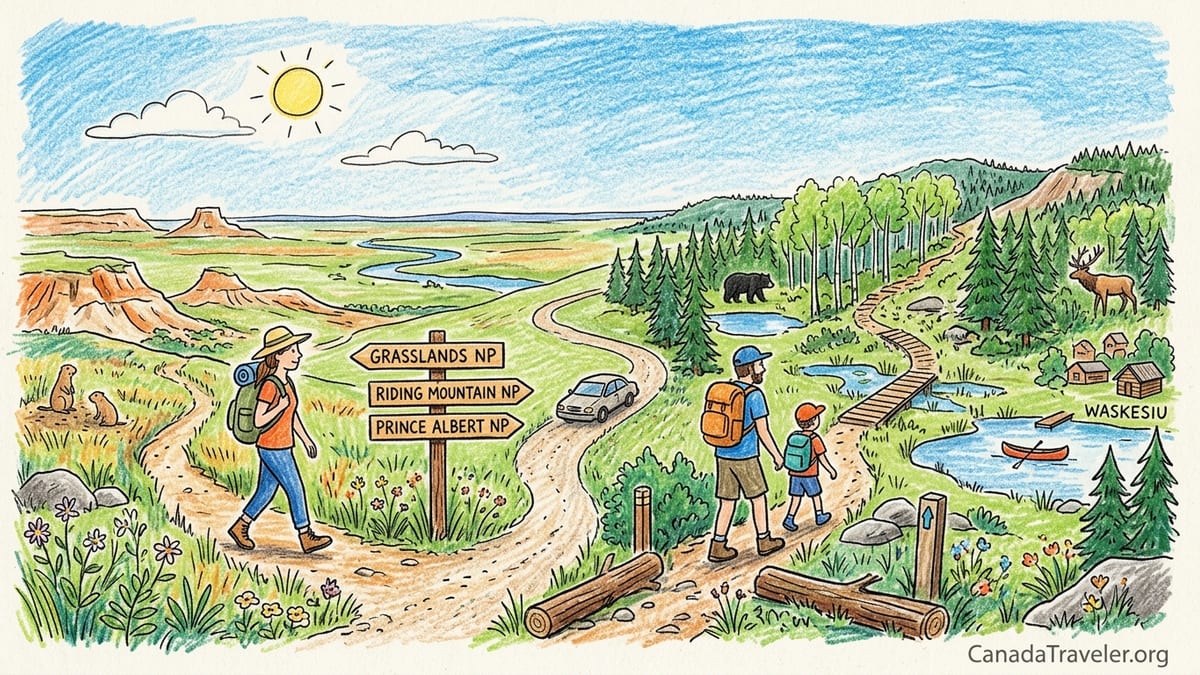
How to Choose Prairie Trails Across Two Provinces
On a road trip from Regina to Winnipeg or from Saskatoon toward northern Saskatchewan, it is entirely realistic to link day hikes in Grasslands National Park, Riding Mountain National Park and Prince Albert National Park into a single itinerary. Driving times between parks are measured in hours rather than days, but the hiking experiences feel dramatically different. Grasslands offers open horizons, eroded buttes and true mixed‑grass prairie. Riding Mountain rises abruptly from Manitoba farmland into an aspen and spruce plateau, its trail network dropping down dramatic escarpments. Prince Albert, further north, is dominated by boreal forest and lakes, with pockets of parkland prairie in its southern reaches.
For a first visit, start by deciding whether you want shorter interpretive walks, family friendly half‑day rambles, or more demanding, full‑day routes with significant elevation gain. An easy walk in Grasslands might be a 2 km loop to a viewpoint with less than 100 m of climbing. By contrast, a demanding Bald Hill circuit in Riding Mountain can approach 20 km if you combine escarpment approaches and connectors, with steep sections that feel more like foothills hiking than prairie strolling. Always cross‑check distance and elevation on the current Parks Canada prairie trail guide and local trailhead signage before committing.
Season and weather are key filters. In Grasslands, July afternoons frequently exceed 30°C, with almost no shade along the 70 Mile Butte or Valley of 1000 Devils routes, so early morning and evening hikes are safer and more enjoyable. In Prince Albert, peak mosquito and blackfly season typically runs through June into early July, which can make deep‑forest trails far less pleasant for young families. Shoulder seasons in May, September and early October often deliver clearer skies, moderate temperatures and fewer biting insects, but nights can be near freezing, especially in higher elevations around Riding Mountain.
Finally, consider logistics. In all three parks, a handful of popular trailheads sit close to serviced campgrounds and village centres such as Val Marie, Wasagaming and Waskesiu, where you can buy groceries, water and stove fuel. Others require a drive on gravel access roads, sometimes with soft shoulders or washboard surfaces. Plan to fuel up in nearby towns before entering each park, and treat tap water in campgrounds and visitor centres as your main refilling points, since natural water sources on the prairies can be seasonal, alkaline or used by livestock and wildlife.
Easy Prairie Walks and Historic Strolls
Travelers easing into prairie hiking will find plenty of short routes that still deliver a real sense of place. Near the West Block of Grasslands National Park, several self‑guided loops branch off the scenic Ecotour Road and can be explored in under an hour. These strolls usually follow firm single‑track or old vehicle tracks across rolling short‑grass prairie, with interpretive panels explaining bison reintroduction, prairie dog colonies and traditional land use. Distances fall in the 1 to 3 km range with minimal elevation change, making them suitable for almost any fitness level as long as you bring a sun hat, sunscreen and at least 500 ml of water per person, even on cooler days.
In Riding Mountain, a good first taste of the park’s terrain is found on short trails near the Wasagaming townsite and highway corridors. Loops such as Beach Ridges or Kippan’s Mill are typically under 4 km, classified by Parks Canada as easy, and weave through mixed aspen and spruce forest with gentle undulations rather than steep climbs. Firm dirt and occasional boardwalk sections make these accessible to novice hikers and older travelers, though roots and wet patches are still possible after heavy rain. Wildlife sightings here often include white‑tailed deer and songbirds rather than large carnivores, but it remains wise to carry bear spray and make periodic noise.
Prince Albert National Park layers cultural history on top of its natural appeal. Around the Waskesiu townsite, short lakeshore paths and paved or hard‑packed gravel walking routes connect the visitor centre, marina and beaches. These 1 to 5 km routes are ideal for evening strolls with an ice cream from local shops, and double as bike paths for families. A short drive away, trailheads for easy forest walks begin from highway pullouts and picnic areas, offering 2 to 4 km out‑and‑back routes with modest hills and firm tread. In shoulder seasons, these paths can be damp or icy in shaded sections, so light hiking shoes with good traction are preferable to casual sandals.
Historic or prairie walks also extend beyond the national parks into surrounding communities. Small prairie towns near Grasslands and Riding Mountain interpret their farming and ranching history with signed walking tours of grain elevators, churches and railway corridors. For visitors already in hiking mode, these 1 to 2 hour self‑guided walks are an easy way to stretch your legs on driving days while learning how the broader prairie landscape has been shaped by agriculture, bison extirpation and conservation efforts.
Family Friendly Half‑Day Hikes
Families with school‑age children often thrive on half‑day outings of 4 to 8 km, where there is a clear objective, varied terrain and enough time for snack breaks without having to rush. In Grasslands National Park, the 70 Mile Butte Trail in the West Block is a standout. Parks Canada lists the formal loop at roughly 2 km, but many hikers extend their outing by exploring side ridges and viewpoints branching from the main path. The route climbs steadily onto a butte with panoramic views of the Frenchman River Valley, then descends through coulees before looping back. While the elevation gain is moderate, there is effectively no shade and summer temperatures can be extreme, so families should carry at least 1 to 1.5 litres of water per person, wear wide‑brimmed hats and consider hiking early or late in the day.
Also in Grasslands, shorter prairie dog colony walks off the Ecotour Road appeal to children who are fascinated by wildlife. Distances are modest, but parents should coach kids to observe from a distance and stay on designated paths to avoid collapsing burrows. Rattlesnakes are present in the region, so children must understand not to reach into rock crevices, under ledges or into tall grass. Keeping dogs leashed protects both pets and wildlife.
In Riding Mountain National Park, several intermediate loops offer a family‑friendly taste of the park’s relief without committing to a full escarpment descent. Trails such as Moon Lake or Bead Lakes fall into the 8 to 10 km category, with rolling hills, forest cover and lakeshore sections that help break up the day. Trail guides describe these as moderate, with total hiking times of 2.5 to 4 hours for typical family groups. Black bears and elk are common, so parents should carry bear spray, teach older children how to react to wildlife encounters, and store snacks in sealed containers to avoid attracting animals at rest stops.
Prince Albert National Park’s family routes often combine lake views with forest paths and sandy beaches where kids can play before or after the hike. Many signed trails near Waskesiu fall in the 3 to 7 km range and are rated easy to moderate. Surfaces alternate between pine‑needle duff, compacted dirt and sections of boardwalk over wetlands. Insects are the main challenge in early summer; families visiting in June or early July should consider lightweight long sleeves, head nets for younger children and kid‑safe repellent. Carrying at least 1 litre of water per person is recommended even on cooler days, since humidity and insects can make these hikes feel more strenuous than their distance suggests.
Demanding Routes: Escarpments, Badlands and Big Days Out
Experienced hikers seeking all‑day challenges will find serious routes in both Grasslands and Riding Mountain, with slightly shorter but still committing options in Prince Albert. One of the most dramatic outings in Grasslands is the Valley of 1000 Devils in the East Block. This route, typically listed around 10 to 11 km return depending on side exploration, leaves from a ridge‑top trailhead and descends into a labyrinth of badland formations and hoodoos. The tread alternates between firm dirt, loose rubble and clay that can become extremely slick after rain. There is no shade and summer temperatures can be intense, so most hikers carry 2 to 3 litres of water, sun protection and a detailed understanding of the route description from the current park trail guide. Navigation is assisted by route markers, but the open terrain and repeating landforms demand attention to landmarks.
Open‑prairie hiking in Grasslands also allows more exploratory days beyond the signed trails, provided visitors are comfortable with off‑trail navigation and have discussed plans with park staff. In practice, this might mean using topographic maps and GPS waypoints to link coulees, bison wallows and ridge lines into a 15 to 20 km loop, always respecting closures, bison herds and nesting areas. These outings are best reserved for travelers already familiar with prairie weather, who understand that sudden thunderstorms and strong winds can transform dry gullies into muddy drainages within an hour.
Riding Mountain’s Bald Hill and Gorge Creek systems are widely regarded as among the most demanding established routes in the Manitoba prairie region. The Bald Hill viewpoint can be reached via several combinations of escarpment trails and connectors. A direct approach from the escarpment edge is sometimes described as an 11 km difficult return hike, with steep climbs on rooty, sometimes muddy single‑track. Longer loop variations that incorporate Reeves Ravine, Jet or other segments can stretch into the high‑teens for total kilometres, turning the outing into a 6 to 8 hour day for fit parties. Elevation change is significant by prairie standards, and sections of trail can be slippery after rain or in spring thaw.
Gorge Creek, which links escarpment viewpoints with the valley floor, is similarly rated difficult in local trail guides. Around 5.5 km one way between the Oak Ridge area and lower trailheads, it drops and regains hundreds of metres through thick forest. Narrow paths, exposed roots and occasional eroded slopes demand sure footing, especially after heavy rainfall. Serious hikers often carry trekking poles, 2 to 3 litres of water, high‑energy snacks and full rain gear, since weather can shift rapidly along the escarpment. Wildlife encounters may include black bears and moose; hikers should know how to react calmly and give animals space.
In Prince Albert National Park, the challenge is less about steep escarpments and more about distance, remoteness and navigation in boreal forest. Longer routes reaching backcountry lakes or following historic portage corridors can easily reach 15 to 20 km return, with muddy sections and water crossings. Trailheads are sometimes located along gravel roads that can be rutted after rain, so a high‑clearance vehicle can be useful. On these big days out, hikers should prepare for a full range of conditions: warm midday temperatures, cool evenings, dense mosquitoes in low wet areas and the possibility of encountering wolves or black bears. Group travel, proper bear‑safe food storage and carrying a satellite communicator or personal locator beacon are prudent choices.
Seasonality, Heat, Water and Wildlife
Hiking in the Canadian Prairies requires a different mental checklist than alpine or coastal hiking. Heat, wind and lack of shade are defining elements of Grasslands National Park in late spring and summer. It is common for day hikers on 70 Mile Butte or Valley of 1000 Devils to carry 2 litres of water per person in early summer, and up to 3 litres in July and August, especially if they are not acclimatized to dry heat. Lightweight long sleeves, sun gloves and a breathable hat with a brim often provide better protection and comfort than sleeveless shirts. Afternoon thunderstorms can appear quickly, so hikers should watch cloud build‑up and avoid ridge tops in active lightning.
Riding Mountain and Prince Albert add humidity and insects to the equation. In June, trails near wetlands can be swarmed with mosquitoes and blackflies, making even a short 4 km family loop feel longer. Many local hikers treat late May and September as prime seasons, when temperatures are cooler, insects are fewer and fall colours begin to appear. In late September and early October, however, overnight temperatures can dip below freezing and higher sections of trail can see early snow or frost, particularly on shady north‑facing slopes along Riding Mountain’s escarpment.
Wildlife awareness is central to safe hiking across all three parks. Bison herds roam parts of Grasslands; hikers should stay at least several dozen metres away, more if animals show signs of agitation. Prairie rattlesnakes are present, especially in rocky areas and badlands; watching the ground, stepping on rather than over logs and rocks, and avoiding tall grass where possible reduces risk. In Riding Mountain and Prince Albert, black bears and elk are common, and wolves and moose are occasionally encountered. Standard practices include hiking in groups where possible, making regular noise, carrying bear spray within quick reach, and storing food or scented items well away from tents and rest stops.
Water sources on the prairies can be misleading. A creek shown on an older brochure may run dry by late summer, or may be too silty or alkaline to drink comfortably even after treatment. Travelers should treat campground taps, visitor centre fill stations and small town grocery stores as their primary resupply points. For demanding routes like Valley of 1000 Devils or Bald Hill loops, starting with a full 2 to 3 litres per person is a practical minimum, and many experienced hikers carry extra capacity such as collapsible bottles or hydration bladders for hotter days.
Trailhead Access and Practical Logistics
Reaching prairie trailheads often involves longer stretches of secondary highways and gravel roads than city‑based hikers are used to. Grasslands National Park is accessed from small Saskatchewan communities, with the West Block near Val Marie and the East Block reached by narrower regional roads. The final kilometres to popular trailheads such as 70 Mile Butte or Valley of 1000 Devils can follow gravel routes that become rutted after heavy rain. Checking current road advisories and arriving with adequate fuel is important, as services between towns are infrequent. Most visitors pick up groceries, ice and extra water in larger centres such as Swift Current or Moose Jaw before the final approach.
Riding Mountain National Park is more centrally located relative to Manitoba’s highway network, but its internal roads still demand planning. The townsite of Wasagaming on Clear Lake serves as a hub, with fuel stations, small supermarkets and outdoor stores that stock basic camping gear and bear spray. From here, signed park roads lead to escarpment trailheads such as Bald Hill and Gorge Creek. Some parking areas are compact gravel lots with limited shade, so storing a cooler out of direct sun and using reflective windshield covers can help preserve food and water on hot days.
Prince Albert National Park’s main access is via Highway 263 to the Waskesiu townsite. Once in the park, paved and gravel roads branch north and south to trailheads and campgrounds. Cellular coverage is reasonably good near Waskesiu but can drop off quickly on more remote stretches, so hikers should not assume they can rely on navigation apps or weather updates mid‑hike. Carrying paper maps or downloaded offline maps is a safer approach, especially on longer routes that cross multiple junctions. In shoulder seasons, some secondary roads and campground loops may close or transition to self‑registration; checking seasonal updates before arrival avoids surprises.
Across all three parks, the Parks Canada prairie hiking guide and individual park trail pages provide the most current information about closures, wildlife advisories and trail conditions. Conditions can shift quickly after major storms or wildfire events, so it is worth confirming details at visitor centres on the morning of your hike rather than relying on a brochure picked up in a previous year. In practice, many experienced prairie travelers begin each day’s planning by checking trail condition pages on a smartphone while still within reliable reception, then verifying updates in person with staff once in the park.
The Takeaway
Hiking the Canadian Prairies is not about ticking off peaks but about traversing living landscapes where grasslands, escarpments and boreal forest still function as connected ecosystems. Grasslands National Park offers unfiltered exposure to big sky, badlands and bison country, with signature hikes like 70 Mile Butte and Valley of 1000 Devils challenging visitors to respect heat and distance. Riding Mountain layers prairie history onto a forested highland, where routes such as Bald Hill and Gorge Creek deliver real elevation gain and a sense of remoteness only a few hours from Winnipeg. Prince Albert completes the three‑park circuit with calmer forest and lake paths that suit both relaxed family holidays and more ambitious backcountry forays.
By selecting trails that match your group’s fitness, preparing for heat, insects and wildlife, and using the latest Parks Canada trail information, you can safely explore this two‑province corridor on foot. Whether you are road‑tripping across the Prairies or planning a dedicated hiking holiday, these parks reward slow travel: early starts, long horizons and evenings spent watching light fade over grasslands or boreal lakes. Done well, a week spent on these trails can reframe what “the Prairies” mean, revealing a layered, resilient landscape far richer than its flat stereotype suggests.
FAQ
Q1. When is the best season to hike in Grasslands, Riding Mountain and Prince Albert?
The most reliable conditions usually fall from late May to early October. June brings lush wildflowers but also mosquitoes, especially in Riding Mountain and Prince Albert. July and August are hotter and drier, ideal for evening hikes but demanding in Grasslands where shade is scarce. September often offers cooler temperatures, fewer insects and fall colours on the escarpments and in the boreal forest.
Q2. How much water should I carry for typical prairie day hikes?
For easy 2 to 4 km walks close to campgrounds, 1 litre per person is generally adequate in mild weather. On exposed routes like 70 Mile Butte or Valley of 1000 Devils, and on demanding escarpment hikes such as Bald Hill or Gorge Creek, many hikers carry 2 to 3 litres per person, especially in mid‑summer. Natural water sources are unreliable or poor quality, so plan to be self‑sufficient.
Q3. Are prairie hikes suitable for children and less experienced hikers?
Yes, provided you choose distances carefully and prepare for sun and insects. Short interpretive loops in Grasslands, forested trails near Wasagaming in Riding Mountain, and lakeside paths around Waskesiu in Prince Albert work well for families. Keep outings in the 3 to 6 km range, start early to avoid afternoon heat, and teach children basic wildlife awareness such as not approaching bison, snakes or bears.
Q4. What wildlife risks should I be aware of on these trails?
In Grasslands, bison and prairie rattlesnakes are the main considerations; give bison plenty of space and watch where you place hands and feet in rocky or grassy areas. Riding Mountain and Prince Albert host black bears, elk and occasionally wolves or moose. Hike in groups when possible, carry bear spray within reach, make regular noise, and store food securely to avoid attracting animals to rest stops or campsites.
Q5. Do I need special navigation skills for the featured hikes?
Most established routes such as 70 Mile Butte, Valley of 1000 Devils, Bald Hill, Gorge Creek and signed trails near Waskesiu are marked and described in park trail guides, so basic map‑reading is usually enough in clear weather. However, open‑prairie off‑trail routes in Grasslands and longer backcountry excursions in Prince Albert require stronger navigation skills, including the ability to use topographic maps, a compass and GPS waypoints, especially in poor visibility.
Q6. What kind of footwear and clothing work best on prairie trails?
Lightweight hiking shoes or boots with good grip are recommended on all but the shortest paved or gravel paths. Escarpment and badland routes involve loose rock, clay and roots that can be slippery after rain, making proper traction important. Clothing should prioritize sun and insect protection: breathable long sleeves, wide‑brimmed hats and, in early summer, light pants and potentially head nets in forested or wet areas.
Q7. How accessible are trailheads and facilities for road‑trippers?
All three parks are reachable by paved highways, but final approaches to some trailheads follow gravel roads that can be rough after storms. Fuel, groceries and basic supplies are available in nearby towns and in the village hubs of Val Marie, Wasagaming and Waskesiu. It is wise to top up fuel before entering each park, carry extra drinking water in the vehicle, and check for any seasonal road or campground closures in advance.
Q8. Are permits or fees required for day hiking?
National park entry fees apply for all three parks, usually charged per vehicle or per person, with daily and annual options. Day hiking itself does not require special permits on the standard trails highlighted here, but backcountry camping and certain overnight routes may need reservations or additional fees. Always confirm current fee structures and reservation requirements with Parks Canada before your trip.
Q9. Can I hike with my dog in these prairie parks?
Leashed dogs are allowed on many front‑country trails, but regulations vary by park and by specific area, especially where sensitive wildlife or grazing bison are present. In Grasslands, keeping dogs firmly leashed protects them from potential encounters with bison or rattlesnakes. In Riding Mountain and Prince Albert, leashes help prevent negative interactions with bears, elk and other wildlife. Always check posted signs at trailheads for local restrictions.
Q10. How can I get up‑to‑date trail conditions before hiking?
Trail conditions can change rapidly with weather, erosion and wildlife activity. The most reliable sources are the Parks Canada prairie hiking guide and individual park trail condition pages, which are updated regularly. Before setting out, check online while you still have reception, then confirm details at park visitor centres where staff can advise on recent washouts, closures, wildlife advisories and which routes are currently best suited to your experience level.